
Summary
Editor's rating
Value for money: good deal if you actually need marine features
Design: simple, low profile, and boat-friendly
Power draw and battery impact: fine if you’re not reckless
Durability and marine use: built for spray, not for pampering
Performance and Bluetooth: how it actually behaves on the water
What the Fusion RA70 actually offers in real life
Pros
- Reliable Bluetooth connection that pairs quickly and stays connected
- Marine-ready build that handles moisture and spray better than car stereos
- Simple controls and clear display that are easy to use on the water
Cons
- Interface and screen feel dated compared to newer touchscreen units
- Extra parts needed for NMEA network and wired remotes add to total cost

Specifications
View full product page →| Brand | FUSION |
A basic boat stereo that actually does what it says
I put the Fusion RA70 on my small fishing boat because the old car stereo I had in there was dying from moisture and random cutouts. I wasn’t looking for anything fancy, just a unit that would survive on the water, pair with my phone, and let me control music without digging around in menus. After a few weekends of use, I’d say this thing is pretty much what it looks like on paper: a simple, marine-focused stereo that gets the job done without a lot of drama.
The first thing I noticed is that it feels like it’s built for a boat, not for a car that happens to be on a boat. The buttons are big enough to hit when the water is choppy, the screen is readable in daylight, and once I wired it in, I basically stopped thinking about it, which is exactly what I want from a head unit. No random reboots, no weird Bluetooth dropouts every 10 minutes.
I mainly use it with Bluetooth and a pair of 4-ohm marine speakers, plus an amp on another zone. I’ve also tested the AUX input just to see if it buzzes or picks up noise from the engine, and it stayed quiet. Sound-wise, it’s not some high-end hi-fi setup, but for a boat where you’ve got engine noise, wind, and people talking, it’s more than enough. Compared to the old Sony car head unit I had, the Fusion is cleaner and a bit punchier at the same volume.
It’s not perfect: the interface is a bit old-school, and once you start playing with extra stuff like wired remotes or NMEA networks, you quickly realize you might need more cables and T-connectors than you thought. But for a straightforward Bluetooth marine stereo, it’s pretty solid. If you just want something reliable that handles water, sun, and basic control from your phone, this is a decent option that doesn’t feel like overkill.
Value for money: good deal if you actually need marine features
In terms of value, the Fusion RA70 sits in that middle spot: not the cheapest thing on the market, but also nowhere near the price of the high-end multi-zone touchscreen units. For what you pay, you get a purpose-built marine stereo with proper sealing, Bluetooth that works reliably, and enough power and features for most small to medium boats. If you compare that to burning through cheap car stereos every season because of moisture and corrosion, the RA70 starts to look like a pretty sensible investment.
What you’re really paying for here is reliability on the water and the ability to integrate into a marine setup. The NMEA 2000 support on the RA70N version is nice if you already have a network or plan to add one later. Just be aware that if you don’t have a network yet and you want to run a wired remote, you’ll need to buy the extra NMEA power cable and an additional T-connector. That adds a bit to the total cost and can be annoying if you didn’t plan for it.
Sound quality is good enough for the price. It’s not audiophile-level, but in a noisy marine environment, that doesn’t really matter. The important part is that it plays loud enough without distorting like crazy and that Bluetooth doesn’t constantly drop. On those points, it does well. You also get the bonus of the Fusion app for remote control, which works better than I expected for something that’s basically a free add-on.
If you’re on a super tight budget and you mostly run in fresh water with the console well protected, you could save money with a basic car stereo and accept that it might die sooner. But if you’re in salt water, leave the boat outside, or just want something you don’t have to babysit, the RA70 is good value. It’s not the cheapest, not the fanciest, but for the money it offers a decent mix of durability, ease of use, and features that actually matter on a boat.
Design: simple, low profile, and boat-friendly
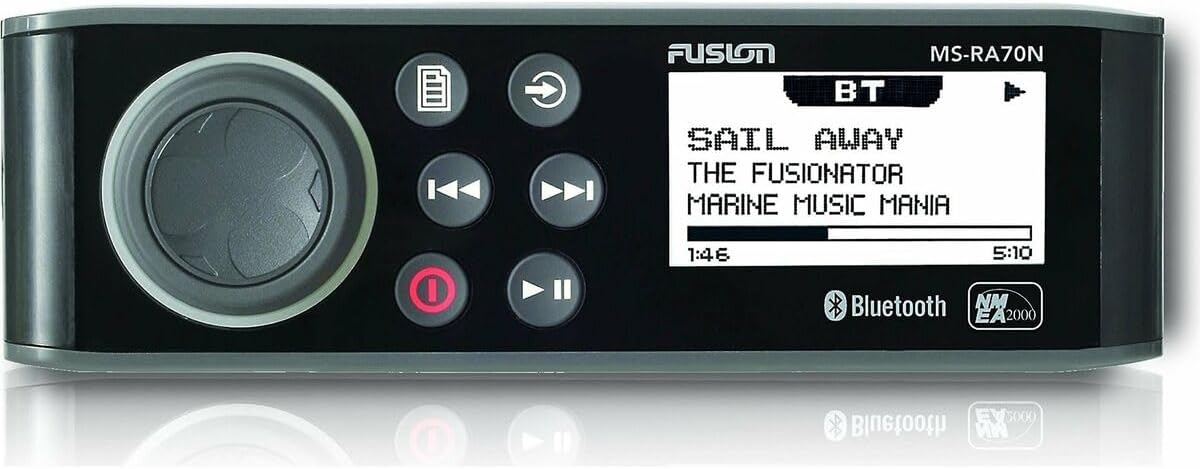
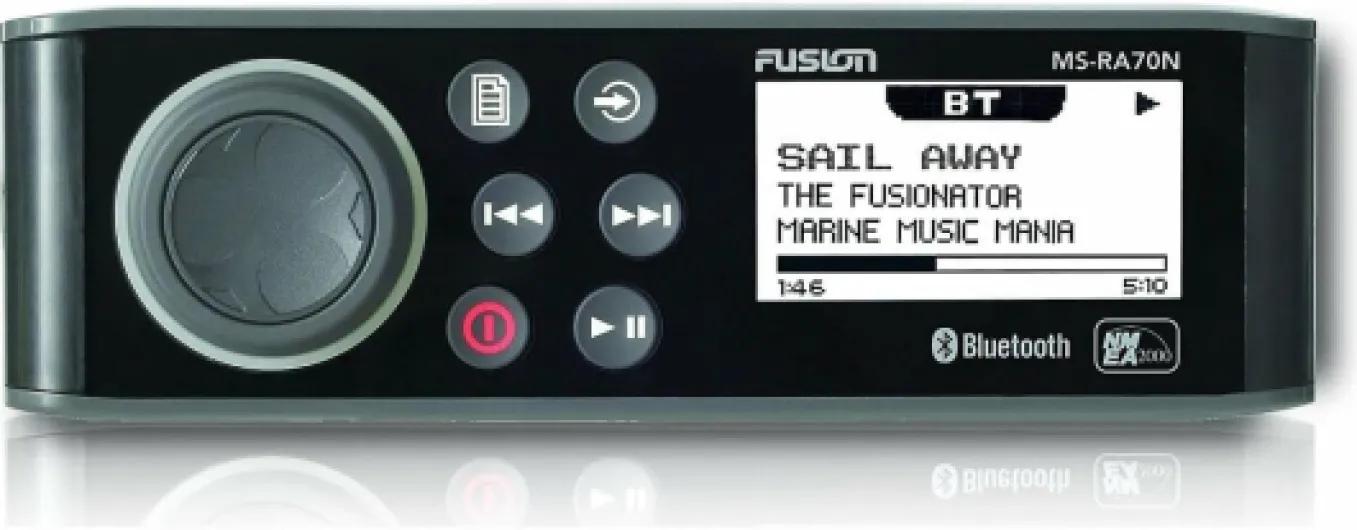
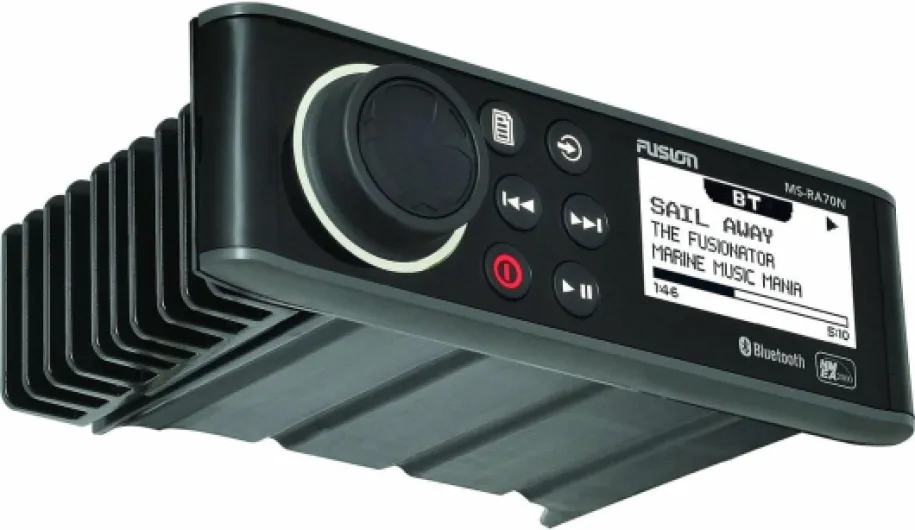
The design is pretty straightforward: black front, low-profile face, a small display, and a main rotary knob in the middle. It’s not flashy or particularly stylish, but on a boat that’s a good thing. It blends in on the dashboard instead of looking like a car stereo glued into a console. The unit can be installed either in a standard DIN cutout or as a flush-mount in a glass helm, which is handy if you’re trying to keep the dash as flat and clean as possible.
What I liked is that the buttons are big enough to hit without looking too closely. When you’re bouncing around in chop or steering with one hand and trying to skip a track with the other, that matters. The labels are clear, and you don’t have to dig through layers of menus for basic stuff like source selection, volume, or muting. The backlighting is decent at night; you can see what you’re doing without the thing lighting up the whole cabin like a Christmas tree.
The screen itself is nothing special. It shows track names and basic info, but the resolution and font feel a bit dated. Still, it’s readable in direct sunlight, which is what counts. I’ve had car stereos on boats where the display washed out completely mid-day; the RA70 doesn’t do that. You can tilt your head or move a bit and still see what’s on it, even with sunglasses.
If I had to nitpick, the overall look is a bit bland. If you’re building out a fancy helm with high-end screens and custom panels, the RA70 will look more “practical” than “premium.” But that’s a trade-off I’m fine with on a working or fishing boat. It feels like it was designed to be used, not admired. No sharp edges, no weird protrusions, and once it’s in, you don’t really think about it, which to me is a sign that the design is doing its job.
Power draw and battery impact: fine if you’re not reckless
The RA70 doesn’t have a built-in battery, obviously, but how it behaves with your boat battery is important. Power-wise, it’s rated at up to 200 W total, but in normal use at reasonable volume, it’s pulling far less than that. I wired it so that the main power goes through a switch on the dash instead of leaving it permanently powered. That way, when I flip the switch off, the unit is fully dead and can’t slowly drain the battery over days or weeks.
The nice part is that even with power completely cut, the RA70 keeps its settings. So each time I turn it back on, the presets, Bluetooth pairing, and basic configuration are still there. It also boots almost instantly, so there’s no waiting around for it to “wake up” like some modern devices. This is especially useful if you’re like me and tend to forget to shut things off; it’s easier to just glance at a bank of lighted switches and kill everything at once.
In terms of actual battery impact, running the RA70 plus a small 4-channel marine amp at moderate volume for a few hours hasn’t caused any starting issues on my single-battery setup. Obviously, if you crank it at full volume for a long time with the engine off, you’ll drain your battery like any other stereo. But for normal background music during a day of fishing or cruising, it’s not a major concern.
If your boat has a weak or small battery, I’d still recommend adding a dedicated house battery or at least keeping an eye on voltage if you plan on sitting at anchor for long sessions with loud music. But overall, the RA70 is pretty reasonable on power draw. It’s not some giant amp pretending to be a head unit; it’s a modest marine stereo that you can safely run for hours as long as you use a bit of common sense.
Durability and marine use: built for spray, not for pampering
I put this unit on a boat that lives outside, not in a climate-controlled garage. It sees salt air, big temperature swings, and the usual hose-down after a day on the water. The RA70 is not magic, but it clearly holds up better than the cheap car stereos I went through before. The face feels properly sealed when it’s mounted correctly, and I haven’t seen any condensation behind the screen so far, which is usually the first sign that a stereo is going to start failing.
The buttons still feel firm after repeated use, and they don’t get sticky or mushy when wet. I’ve splashed it a few times when hitting wake or rinsing the console, and nothing weird happened: no random reboots, no volume spike, no flickering display. That’s a big change from the old non-marine unit I had, which would sometimes reset just from a bit of spray.
Other owners who’ve used it across multiple boats say the same thing: they buy another RA70 for the next boat because the first one just quietly worked for years. That’s not scientific, but when someone says they’re on their third RA70 because they keep putting them on each new boat, that tells me the product is at least reliable enough that people go back to it instead of trying something else every time.
Of course, you still have to install it properly. If you half-seal the cutout, leave the back of the unit exposed to direct spray, or run sketchy wiring, no stereo is going to survive that for long. But with a correct dash or flush mount and basic care, the RA70 feels like it can handle regular marine abuse. It’s not bulletproof, but for a mid-range marine stereo, the durability is pretty convincing compared to repurposed car units.
Performance and Bluetooth: how it actually behaves on the water
Performance-wise, the RA70 is solid for what it is. The built-in amp is rated 4 x 50 W, but like most head units, that’s more marketing than real continuous power. In real use with 4-ohm speakers, it’s plenty loud for a small to medium boat. I ran it into four Bose 151 outdoor speakers through a small Kenwood marine amp (about 45 W per channel) using the RA70’s preamp outputs, and the sound was noticeably cleaner and more controlled than my old Sony head unit. Same speakers, same amp, just swapped the source, and you can hear the difference in clarity at higher volumes.
Bluetooth performance is where this unit really earns its keep. Pairing with my phone (Android) took a couple of minutes the first time, and after that it reconnects quickly when I power the boat back up. Other users with Samsung S9 and iPhone report the same: once it’s paired, it comes back almost instantly. I didn’t have any random dropouts, even walking around the deck or moving to the bow, and that’s with the head unit mounted in the console.
The Fusion-Link app is basic but useful. From the phone I can control volume, skip tracks, and change source without touching the faceplate. The response time is fine; there’s a tiny delay sometimes, but nothing that makes it annoying. It’s also handy when someone else in the boat wants to be the “DJ” without leaning over the helm. Just hand them the phone and let them manage the playlist.
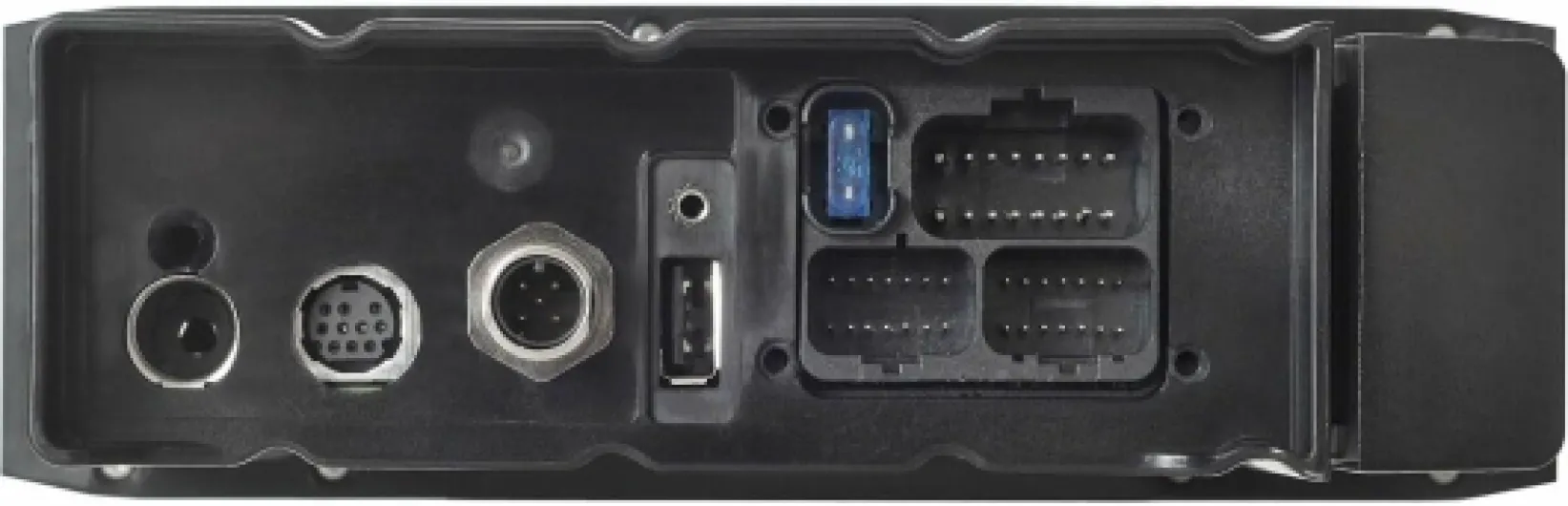
On the downside, if you start adding accessories like a wired remote and don’t already have an NMEA 2000 network, you’re going to need extra parts: a power cable for the NMEA network, T-connectors, and a bit more wiring work. The RA70N version doesn’t magically power the remote by itself. That’s not a performance issue, but it’s something that can catch you off guard. Overall, for straight-up audio and Bluetooth streaming, the unit is reliable, quick to connect, and strong enough for normal use. Just don’t expect it to run a big party system without an external amp.
What the Fusion RA70 actually offers in real life
The Fusion RA70 is basically a compact marine head unit with built-in Bluetooth, 4 channels of amplification, and a couple of standard inputs (RCA, 3.5 mm). On paper it’s rated at 4 x 50 W, but in real life you should think of it more as a decent built-in amp for a couple of speakers and maybe a small second pair, not some monster that will shake the dock. The model I used is the RA70N version, which adds NMEA 2000 support for integration with other marine electronics. If you don’t care about network stuff, the base RA70 is enough.
In practice, the main sources you’ll use are Bluetooth streaming from your phone and maybe the AUX/RCA input for a backup device. It supports WMA and standard stereo audio, but this isn’t some fancy media center; it’s a simple stereo. There’s no built-in Wi‑Fi or streaming services, so don’t expect Spotify directly on the unit. You stream from your phone, control volume and tracks either from the faceplate or the Fusion app, and that’s about it.
The user interface is very straightforward: a small screen, a main knob, and a few clearly labeled buttons. It’s not flashy, it’s not super high-resolution, but it’s readable in daylight and the menu structure is simple enough that after one afternoon you stop thinking about it. You get basic zone control, balance/fader, bass/treble, and a few audio presets. No crazy EQ with 10 bands, but enough to tune it a bit for your speakers.
Overall, the RA70 is more about reliability and simple operation than features. If you’re expecting a super modern touchscreen unit with maps, CarPlay, or full-on smart functions, this is not it. But if you just want a weather-resistant stereo that mounts cleanly in a standard DIN spot or flush on the dash, connects quickly to your phone, and drives some speakers without complaining, it fits that role nicely.
Pros
- Reliable Bluetooth connection that pairs quickly and stays connected
- Marine-ready build that handles moisture and spray better than car stereos
- Simple controls and clear display that are easy to use on the water
Cons
- Interface and screen feel dated compared to newer touchscreen units
- Extra parts needed for NMEA network and wired remotes add to total cost
Conclusion
Editor's rating
The Fusion RA70 is a straightforward marine stereo that focuses on the basics: reliable Bluetooth, decent sound, and a design that can actually handle life on a boat. After using it across several trips, I’d sum it up as “nothing flashy, but it works and doesn’t give you headaches.” The built-in amp is fine for standard speakers, and if you add a small external amp, you can easily cover a deck or cockpit with clean, usable volume. The controls are simple, the screen is readable in daylight, and the Fusion app adds a handy layer of remote control from your phone or watch.
It’s not perfect. The interface feels a bit dated, and once you get into wired remotes or NMEA networking, you quickly realize you’ll need extra cables and connectors that aren’t in the box. If you’re expecting a modern touchscreen with built-in streaming services and tons of audio tweaking options, this is going to feel pretty basic. But that’s kind of the point: it’s built for people who want a reliable, marine-proof stereo, not a dashboard gadget to brag about.
If you have a small to mid-size boat and you just want a solid, weather-resistant head unit with Bluetooth that pairs quickly and keeps its settings, the RA70 is a good fit. If you’re on a tight budget and don’t care about marine-grade hardware, a cheap car stereo will cost less but probably won’t last as long. And if you’re building a big, high-end system with multiple zones and fancy displays, you may want to step up to Fusion’s higher models. For most casual boat owners, though, this unit hits a practical sweet spot between price, durability, and everyday usability.