Summary
Analysis score
Average of the criteria rated below
Is the Deeper CHIRP+ 3 worth the asking price?
Compact sphere design made for casting from shore or boat
Battery life and practical autonomy on the water
Build, warranty, and long-term reliability outlook
Sonar performance and mapping capabilities
What the Deeper CHIRP+ 3 actually offers
Pros
- CHIRP sonar with GPS and 3D bathymetry mapping for detailed analysis of spots
- Long advertised battery life (up to 15 hours) and 5-year limited warranty
- Compact 90 g design with up to 100 m depth and 120 m casting/connection range
Cons
- Price described as high by at least one verified buyer
- Fully dependent on a smartphone or tablet and the Fish Deeper app for all functions

Specifications
View full product page →| Brand | deeper |
A pocket-sized sonar aiming to replace bulky fish finders
The Deeper CHIRP+ 3 is positioned as a compact alternative to fixed fish finders on boats. It’s a castable GPS sonar that pairs with your phone via the Fish Deeper app, promising detailed depth readings, fish detection and even 3D bathymetry maps. On paper, it targets boat anglers, shore anglers and ice fishers who want serious data without drilling holes in a hull or wiring up a big screen.
With a 4.3/5 average from 49 Amazon reviews, buyers seem mostly satisfied. Comments are short but quite clear: people mention an upgrade over older Deeper models, good clarity on depth and contours, and a generally positive experience once they’ve read the instructions. One verified buyer describes it as a “great bit of tech for fishing” and highlights the ability to distinguish different sizes of fish, which is exactly what CHIRP sonar is supposed to help with.
From the spec sheet, the CHIRP+ 3 offers a 120 m casting/connection range, 100 m max depth, built-in GPS for mapping, up to 15 hours of battery life and a strong 5-year limited warranty. At only 90 g and roughly 5 cm in each dimension, it’s clearly made to be thrown with a regular rod. The package includes attachment bolts, a carrying pouch, charging cable and a night cover, which should cover most basic use cases without extra purchases.
In my opinion, this product is aimed at anglers who like to analyze their spots seriously, log data and build their own maps over time, rather than those who just want a simple “fish or no fish” indicator. It’s not cheap, and some reviewers hint that price is on the high side, but the long warranty, 3D mapping and CHIRP technology suggest it’s trying to justify a premium position. The rest comes down to how well the app and hardware combination holds up in real fishing conditions, according to the published feedback.
Is the Deeper CHIRP+ 3 worth the asking price?
The Deeper CHIRP+ 3 sits in the higher end of the castable sonar category. The exact price isn’t listed here, but one verified buyer clearly calls it “pricey but ok” while still rating it 5/5 and describing it as a good upgrade from an older Deeper+. That sums up the positioning quite well: this isn’t a budget gadget, it’s a more advanced tool for anglers willing to pay for features like CHIRP sonar, GPS mapping and long-term support.
On the feature side, you get CHIRP sonar, GPS for 3D bathymetric mapping, a 100 m depth rating, 120 m range, advertised 15-hour battery life, and a 5-year limited warranty. The Fish Deeper app is free and offers unlimited cloud storage for your scans and maps, which is a strong argument compared to products that require paid subscriptions for historical data. The box also includes practical extras (pouch, night cover, attachment bolts), so you’re not forced into immediate accessory purchases.
If you compare this conceptually to a traditional fixed fish finder plus a display, battery, and mounting hardware, the CHIRP+ 3 can actually look cost-effective, especially for kayak or shore anglers who don’t want or can’t install permanent electronics. For someone who fishes only a few times a year and just wants a rough idea of depth, it’s probably overkill. But for anglers who like to build and analyze maps, track spots over time, and distinguish fish sizes and bottom structure, the extra cost can make sense.
In my opinion, the value for money is good but targeted. You’re paying for data and flexibility, not for a flashy screen or brand prestige. The reviews’ 4.3/5 average and the repeated praise (“Great bit of tech for fishing”, “Awesome”, “Spot on”) suggest that most buyers feel they got what they expected, or better, once they learned how to use it properly. If your idea of fishing fun includes looking at sonar charts on your phone and planning sessions based on detailed maps, the CHIRP+ 3 offers a lot in a small package. If you just want a simple beeper that lights up when fish swim by, there are cheaper and simpler options.
Compact sphere design made for casting from shore or boat
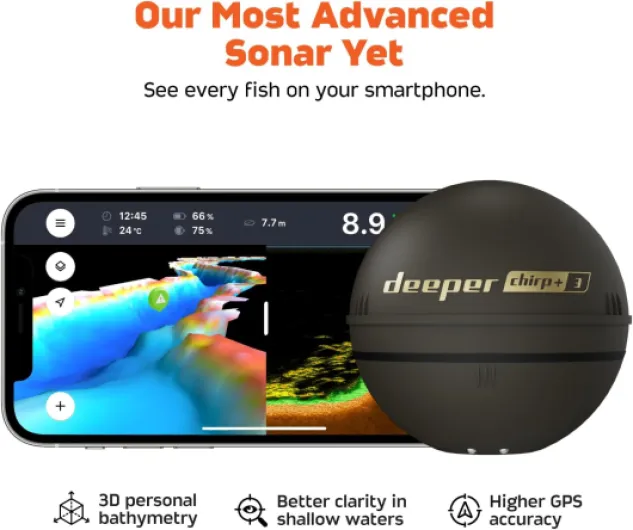
From the dimensions and weight given, the Deeper CHIRP+ 3 follows the brand’s usual “small ball” format. It measures roughly 5 x 5 x 5 cm and weighs 90 g. That’s light enough to cast with many medium spinning setups without feeling like you’re throwing a brick, while still heavy enough to travel a decent distance. The form factor is fully portable: no mount, no big screen, just a sphere that you attach to your line using the supplied attachment bolts.
The mounting type is listed as “portable”, and the box includes attachment bolts, a carrying pouch, a charging cable and a night cover. That night cover is a practical touch for early-morning or late-evening sessions, when tracking a dark ball on the water would be a pain. According to the reviews, setup is straightforward as long as you actually read the instructions; one buyer literally sums it up as “Just read the instructions”, which suggests the product is not complicated but does have a few key steps people tend to skip.
The design choice to offload all display duties to your phone keeps the hardware minimal. There’s no visible screen, just the sonar housing itself. The spec sheet still mentions “TFT display type”, which likely refers to the way data is visualized in the app rather than a physical screen on the device. That can be slightly confusing, but in practice you’re relying 100% on the Fish Deeper interface for visuals. Buyers highlight that the app shows clear depth and lake curvature, with one review specifically praising how clearly the bottom contours are displayed.
In my opinion, the design is functional rather than flashy: small, light, easy to carry in a pocket or small tackle box. The main trade-off is that you’re tied to your phone for everything. If you’re fine having your phone out near water and you like analyzing sonar screens, the approach makes sense. If you want a self-contained unit with built-in display and physical buttons, this spherical, app-only design may feel a bit too dependent on your mobile device.
Battery life and practical autonomy on the water
The Deeper CHIRP+ 3 advertises a 15-hour battery life. For a 90 g castable unit, that’s quite a bold figure. On paper, this would easily cover a full day on the water and likely several shorter sessions between charges. Because the battery is built-in and the power source is listed simply as “Battery Powered”, you’re relying on USB charging via the included cable; there’s no mention of user-replaceable batteries or swappable packs.
None of the short Amazon reviews go into detailed autonomy numbers, so there’s no direct feedback like “I fished X hours and had Y% left.” That means you have to take the 15-hour claim as a best-case scenario, possibly in optimal conditions and with moderate use. Real usage—frequent casting, cold weather (especially for ice fishing), and constant connection to a phone—usually reduces battery life for any electronic device. Still, even if actual autonomy ends up a bit below the advertised figure, anything near that range would be more than enough for most anglers’ sessions.
The advantage of this kind of product is that charging is straightforward: a simple USB cable, likely usable with power banks, car chargers, or any USB wall adapter. If you’re planning multi-day trips, a small power bank in your tackle bag would be a sensible backup. One indirect positive sign is that no review complains about battery life or charging issues. With only 49 reviews, that’s not a guarantee, but if battery performance were terrible, you’d usually see at least one angry comment about it.
In my opinion, the advertised 15 hours put the CHIRP+ 3 in a comfortable spot. For casual anglers doing a few hours here and there, you might go several outings between charges. Heavy users mapping large lakes all day will likely plug it in every evening, which is normal. The only real limitation is that if the battery eventually degrades over years, replacement options are not mentioned, so long-term autonomy will depend on how robust the internal cell is and how often you use and charge it.

Build, warranty, and long-term reliability outlook
The Deeper CHIRP+ 3 is built as a sealed, water-exposed electronic device that you repeatedly cast and retrieve, sometimes in cold or rough conditions. While the exact materials are not listed, this type of product typically uses a tough plastic shell to protect the sonar and battery. At only 90 g, it’s light enough that impacts on the water surface are less violent than heavier castable devices, which should help with longevity. However, durability always depends on how carefully it’s used and stored.
The standout point on the spec sheet is the 5-year limited warranty. That’s quite generous for consumer electronics, especially something that can be dropped, cast, and banged around in tackle boxes. For me, this suggests the manufacturer has reasonable confidence in the product’s build quality and water sealing. If a brand expects a lot of early failures, they usually don’t commit to this kind of warranty length. The country of origin is listed as Lithuania, which might matter to buyers who care about European manufacturing standards and support.
Among the published Amazon reviews, none specifically mention breakages, water ingress, or early failures. The comments are mostly focused on performance and price. That absence of negative reports doesn’t guarantee perfect reliability, but with 49 reviews and a 4.3/5 average, there doesn’t seem to be a common defect standing out. One buyer refers to it as a “good item upgrade” from the older Deeper+ version, which indirectly hints that the brand has been iterating the design and presumably fixing weaknesses from previous generations.
In my opinion, between the compact weight, sealed design and long warranty, the CHIRP+ 3 looks reasonably solid for a portable sonar. It’s still an electronic ball you throw into water, so basic care—using the carrying pouch, avoiding impacts on rocks or concrete, rinsing after saltwater use—will matter. But if you’re looking for a device that should last several seasons of regular use, the warranty and the lack of widespread complaints in reviews are encouraging signs. Just don’t expect it to be indestructible; it’s still a piece of electronics, not a sinker.
Sonar performance and mapping capabilities
The core promise of the Deeper CHIRP+ 3 is better sonar accuracy and target separation compared to simpler castable fish finders. CHIRP technology sends a range of frequencies instead of a single one, which in theory should help distinguish individual fish from the bottom and from each other, especially in deeper water or near structure. One reviewer mentions being able to “differ from different sizes of fish” and being “well impressed” with the clarity, which lines up with what CHIRP is supposed to provide.
The maximum depth of 100 m (330 ft) is more than enough for most freshwater scenarios and a good part of coastal fishing. The advertised range of 120 m (394 ft) between the unit and your phone gives a lot of room for shore casting or using it as a tow-behind sonar from a small boat or kayak. On paper, that range is quite solid for Wi-Fi-based castable sonar, though how well it holds up in choppy conditions or with obstacles would depend on real-world use, which the short reviews don’t detail much.
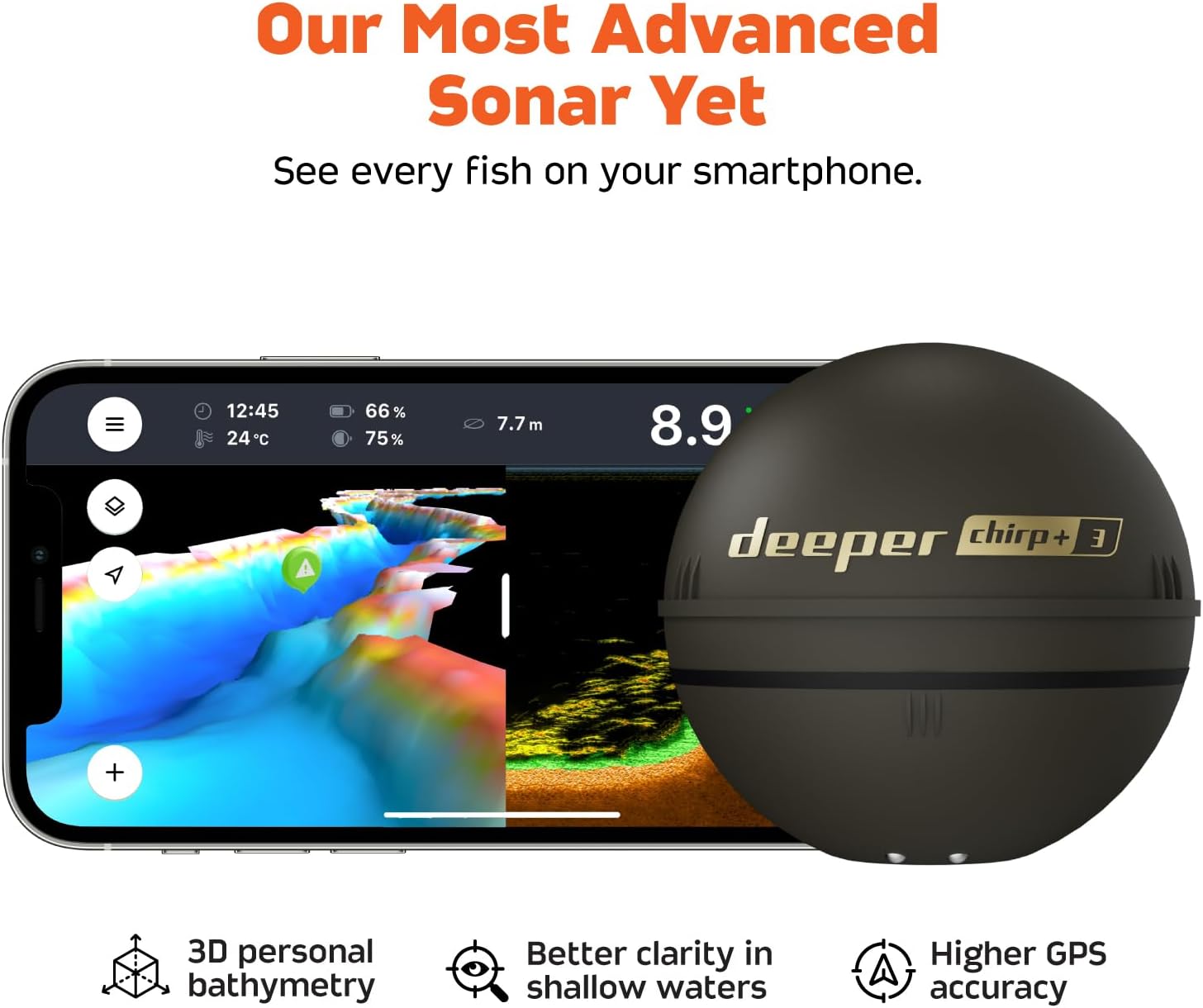
The integrated GPS is a big part of the performance story because it allows custom 3D bathymetry mapping. You can move around a lake, and the app will log depth and position, building a 3D map over time. The brand claims a more accurate GPS than previous versions, which should mean cleaner maps and better repeatability when you come back to a spot. The app also shows bottom contours, vegetation and fish location, and offers unlimited cloud storage for your scans and maps, which is very appealing for anglers who like to analyze their sessions later.
From the user comments, there is a sense that performance is good when used correctly. One buyer calls it a “good item upgrade from deeper +” despite saying it’s pricey, indicating that the CHIRP+ 3 likely improves on sonar detail or stability compared to older models. Another simply says “Awesome” and another “Spot on”, which are brief but clearly positive. In my opinion, the spec sheet and the feedback suggest strong performance for a portable unit, especially for mapping and target separation. It’s not a commercial-grade sonar, but for recreational fishing and detailed spot analysis, it looks like it gets the job done well, provided you accept the learning curve of interpreting sonar data on a phone screen.

What the Deeper CHIRP+ 3 actually offers
On paper, the Deeper CHIRP+ 3 is a compact, castable sonar ball that connects to your smartphone or tablet. It uses CHIRP (Compressed High-Intensity Radiated Pulse) technology, which sends multiple frequencies to give more precise separation of targets and a clearer view of the bottom structure. The manufacturer highlights personal 3D depth maps, which you build by moving or trolling the unit around while the Fish Deeper app records depth and GPS position.
The sonar has a maximum scanning depth of 100 m (330 ft) and a wireless range up to 120 m (394 ft). That’s enough for most freshwater lakes and many inshore saltwater spots. It’s battery powered, with an advertised 15-hour battery life, and weighs only 90 g. The GPS is described as “more accurate” than previous generations, which matters if you want reliable bathymetry maps rather than just a rough idea of depth.
The free Fish Deeper app (Android and iOS) is central to the product. It provides depth, contours, fish arches, vegetation information and offers unlimited cloud storage according to the description. So your scans and maps should be saved and accessible across devices. Buyers in the reviews don’t go into all the advanced functions, but several comments point out that the device is an upgrade over older Deeper units and that it delivers clear information on depth and fish size differentiation.
In my opinion, the feature set is quite complete for a portable sonar: CHIRP technology, GPS mapping, long range, decent depth and a long warranty. There’s no included display because your phone or tablet is the screen, so the value depends a lot on how good the app is and how stable the connection remains at long range. For anglers who already fish with a smartphone nearby, this concept makes sense. For those who hate using phones on the bank or in a boat, a traditional standalone fish finder might still feel more straightforward.
Pros
- CHIRP sonar with GPS and 3D bathymetry mapping for detailed analysis of spots
- Long advertised battery life (up to 15 hours) and 5-year limited warranty
- Compact 90 g design with up to 100 m depth and 120 m casting/connection range
Cons
- Price described as high by at least one verified buyer
- Fully dependent on a smartphone or tablet and the Fish Deeper app for all functions
Conclusion
Analysis score
The Deeper CHIRP+ 3 is a compact, castable sonar aimed at anglers who want serious information without installing a fixed fish finder. On paper it’s well equipped: CHIRP sonar for better target separation, GPS for custom 3D depth maps, 100 m depth capability, 120 m range, and an advertised 15-hour battery life. The 5-year limited warranty is a strong signal for a small, water-exposed electronic device. In the public reviews, buyers highlight clear depth and bottom contours, the ability to distinguish different fish sizes, and generally describe it as a solid upgrade from older Deeper models, even if they find it a bit expensive.
In my opinion, this product suits anglers who enjoy analyzing their fishing: mapping lakes, logging sessions, and studying structure and fish positioning on their phone or tablet. Shore anglers, kayak users and ice fishers who don’t want permanent installations are the main winners here. If you hate using your phone near the water or just want a basic indicator, this will feel too complex and too costly. It’s not perfect and it’s not cheap, but the combination of features, app ecosystem and long warranty make it a strong option in the castable sonar category.