
Summary
Editor's rating
Price vs what you actually get
Compact single-bollard design that’s better for straight pulls than fancy knots
316 stainless that actually behaves like 316 stainless
Built to last, but overkill only goes so far on a tiny footprint
Real-world use: tying up in wind, wakes, and lazy weekend conditions
What you actually get when you order it
Pros
- Solid 316 stainless construction with no noticeable corrosion after weeks in salty conditions
- Compact but heavy design that feels sturdy and doesn’t flex under normal small-boat loads
- Mirror-polished visible surfaces look clean and are easy to rinse back to near-new appearance
Cons
- Small size can be cramped with thicker lines and not ideal for larger boats
- No mounting hardware or backing plate included, so total install cost can creep up

Specifications
View full product page →| Brand | Akozon |
A tiny cleat that feels like it belongs on a bigger boat
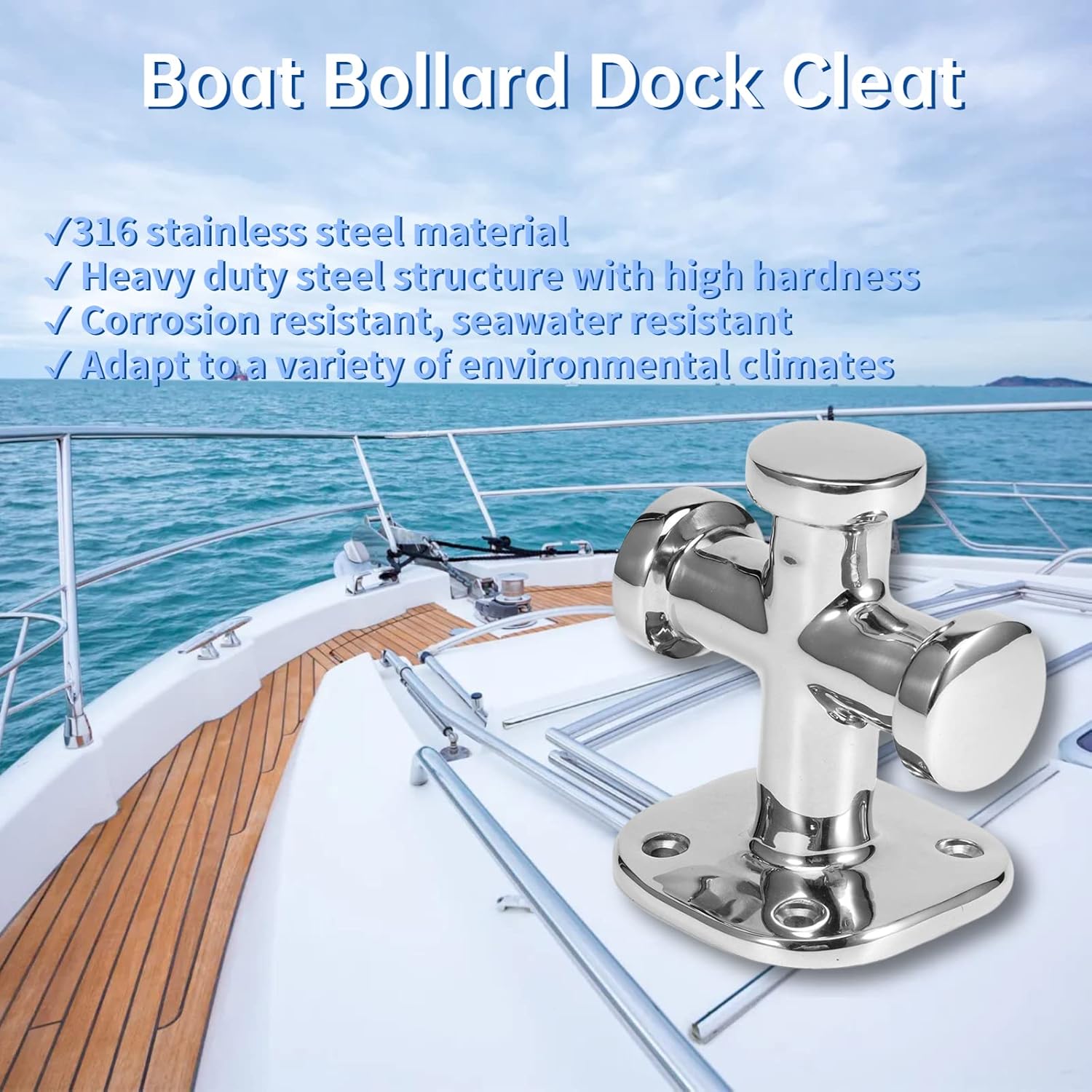
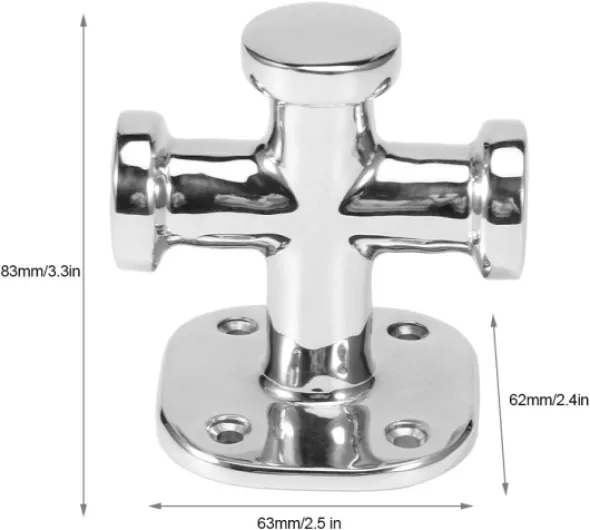
I put this Akozon 316 stainless dock cleat on a small pontoon-style platform I use as a swim dock and occasional mooring spot for a 5.5m boat. So this is not theory: it’s been bolted down, had wet ropes on it, and taken a few decent side pulls from wind and current. The first thing that hit me when I unpacked it was the weight. For such a compact piece (the listed size is 62 x 63 x 83 mm), it feels dense and solid in the hand, not like cheap hollow hardware.
Out of the box, the surface is properly shiny. It’s clearly been polished, not just brushed quickly. You can see reflections in it, not perfectly like a mirror, but close enough that it looks clean and modern on the deck. If you care how your boat hardware looks, it doesn’t scream “budget part”. It’s closer to what you’d expect on a decent production yacht rather than a bargain-bin fitting.
I’ve used aluminium cleats and cheap stainless bits from generic brands before, and they often show tiny rust spots or staining after a couple of weeks in brackish water. With this one, after a few wet weekends and leaving it outside in the rain and sun, I haven’t seen any rust tea stains running from the base, which is usually the first sign the alloy is not great. I just get some dried salt on it that wipes off with a damp cloth.
Overall, my first impression was: compact, heavy, and probably overkill for a small boat, which is not a bad thing. It’s not perfect – the base casting could be a bit cleaner and the edges under the cross bar aren’t the smoothest – but for the price level, it feels like a pretty solid piece of hardware that should hold up to normal mooring use without drama.
Price vs what you actually get
In terms of value, this Akozon cleat sits in that middle zone: not bargain-basement cheap, not premium-brand expensive. For a single small bollard-style cleat, the price is reasonable given that it’s 316 stainless and feels properly solid. If you compare it to basic aluminium or zinc-plated cleats, yes, you’re paying more. But those cheaper ones usually start corroding much faster, especially if you’re anywhere near salt water, and they often look rough after one season.
Compared to more established marine brands, this one is usually a bit cheaper for similar specs. You don’t get the fancy packaging or a known logo, but in actual use, the cleat doesn’t feel far off. Where the value drops a little is the lack of extras: no bolts, no backing plate, no gasket. If you have to buy all that separately at marine-store prices, your total cost per cleat can creep up. If you already have stainless hardware at home, then the value looks better.
Another point: this size is specific. It’s great for small boats, tenders, or as an extra tie point, but if you’re outfitting a bigger boat, you might quickly realize you need larger cleats and more of them. In that case, buying several of these might not be the best price-to-function ratio. On my small platform project, one or two of these are enough, so the cost feels justified by the quality and the peace of mind in terms of corrosion resistance.
Overall, I’d call the value “good but not spectacular”. You’re paying mainly for the 316 material and the solid feel. If you just need something cheap for a freshwater lake and you don’t care how it looks in a couple of years, you could save money with simpler hardware. If you want something that looks decent and should hold up in harsher conditions without rusting quickly, this hits a decent price-quality balance.
Compact single-bollard design that’s better for straight pulls than fancy knots
The design is a single cross bollard on a square-ish base, which is different from the usual long horn cleats you see on small boats. In practice, that means it’s good for wrapping a line around several times, or doing a quick figure-eight, but it’s not as intuitive for a textbook cleat hitch if you’re used to the classic shape. After a couple of uses, I got used to it, but the first time I tied up I had to think for a second about how I wanted to run the line.
The footprint is small, which I actually like on a crowded deck. I mounted it on a narrow section near the edge of my platform where a traditional 150 mm horn cleat would have looked oversized and been easier to trip on. This one sits more compact, with less to snag a toe or a line. The trade-off is that when you have cold or wet hands and you’re trying to wrap a thicker rope, it can feel a bit cramped. There’s not a ton of clearance between the cross bar and the base, so if you’re using bulky double-braid or anything over 12 mm, you’ll notice the space limits.
A nice point: the top bar has enough thickness that it doesn’t dig into the rope too aggressively. Some cheap cast cleats have sharp transitions that can flatten or pinch the outer braid when you’re under heavy load. Here, the curves are reasonably smooth. They’re not luxury-level smooth, you can still feel some slight casting marks underneath, but nothing that’s going to shred a line in normal use. I’ve tensioned the line pretty hard to keep the bow pulled in against the dock, and I haven’t seen any weird flattening or fiber damage so far.
Visually, if you care, the design looks more modern than the classic long cleats. On a white or grey deck it blends in nicely and gives a bit of that “yacht hardware” vibe rather than cheap galvanized stuff. But be realistic: it’s a small cleat. It’s not going to handle mooring a big heavy boat on its own. For small boats, tenders, jetskis, or as an extra tie point on a pontoon or swim platform, the design works. For a 10m cruiser in a rough marina, I’d want larger cleats and more of them.
316 stainless that actually behaves like 316 stainless
The main selling point here is the material: 316 marine-grade stainless steel. On paper, that’s what you want for salt or brackish water, because it handles corrosion better than 304. Plenty of cheap “marine” parts online claim to be 316 and then start rusting almost immediately. With this Akozon cleat, after a few weeks outside in changing weather and some time with salt water splashing on it, I haven’t seen any real corrosion yet. No orange spots, no brown streaks running off the base onto the deck.
The body feels like solid stainless, not hollow or thin-walled. At about 600 g for such a compact piece, that weight lines up with a solid casting. When you tap it with a wrench, you get that dense metallic sound, not a hollow ring. The surface is mirror polished, which is nice for looks but also helps a bit with corrosion resistance because there are fewer microscopic pits for salt to sit in. It’s not a lab test, but after leaving it dirty and salty for a week, a quick rinse and wipe made it look almost like new again.
One thing to be aware of: the underside of the base is less polished. You can see more of the raw casting there. That’s standard, but if you’re picky about finish everywhere, you’ll notice it. Functionally, it doesn’t matter. That side is against the deck and not exposed to the elements as directly. I did run my hand around the edges before mounting and didn’t find any sharp burrs or casting flashes that needed filing down, which is more than I can say for some no-name stainless fittings I’ve bought in the past.
Overall, the material quality feels decent for the price bracket. It’s not yacht-show jewelry, but it’s proper 316 that behaves like it should. If you combine it with good stainless bolts and a backing plate, you end up with a mooring point that feels trustworthy for a small craft. Just don’t mix it with cheap mild-steel hardware, or you’ll get galvanic issues and rust from the bolts even if the cleat itself stays clean.
Built to last, but overkill only goes so far on a tiny footprint
Durability-wise, the first good sign is that the cleat hasn’t shown any corrosion or staining after several weeks outside near salt water. I’ve left it un-rinsed on purpose a couple of times after use, just to see if any surface rust would appear. So far, nothing. It still looks bright after a quick rinse. That’s what you expect from 316, but as I’ve learned with other parts, you don’t always get what the listing claims, so it’s nice that this one behaves correctly.
The casting itself feels overbuilt for its size. The cross bar has enough meat that I’d be surprised if anyone manages to bend it in normal small-boat use before something else fails first (like the deck core or the bolts). The base is thick enough that I’m not worried about it cracking. When I tightened the mounting bolts down firmly onto a backing plate, there was no sign of distortion or flex in the base. Some thinner cast bases will dish slightly when you reef on the nuts; this one stayed flat.
That said, there’s a practical limit to how much load you should put through a cleat of this footprint. The material might be strong, but the force still goes into whatever it’s bolted to. On my platform, I used a decent-sized stainless backing plate underneath, which spreads the load, and I’d recommend doing the same on a fiberglass deck. Relying on just washers on thin fiberglass with no backing is asking for trouble, no matter how strong the cleat itself is.
Based on the first weeks, I’d expect this thing to last several seasons easily with basic care (occasional rinse, don’t let dissimilar metals rust all over it). There are probably heavier-duty commercial bollards for bigger vessels, but for small craft, this is already more robust than a lot of the generic deck hardware you see in discount bins. It’s not immortal, but it feels like a part you install and then basically forget about.
Real-world use: tying up in wind, wakes, and lazy weekend conditions
In actual use, this cleat does what it’s supposed to: it holds the boat where you leave it. I installed it on a floating platform that sees some side load from wind and occasional wake from passing boats. The main job of this cleat is to take the bow line when I bring the boat in and keep it snug to the platform. With 10 mm braided line, the rope grips well when wrapped a couple of times around the cross bar, and I haven’t had any slipping or sudden loosening, even when the boat pulls hard for a second.
The compact size means you need to be a bit more deliberate about how you wrap the line. With a longer horn cleat, you can be sloppier and still get a secure hitch. Here, if you just toss a half-hearted wrap, the line can look messy or try to climb off the bollard. Once you get into the habit of doing 2–3 neat turns and a proper hitch, it’s fine. I tested it by pushing the boat off hard and letting it snap back on the line a few times; the cleat didn’t move, and the line stayed where it should.
One thing I noticed is that the low profile is nice when you’re walking around the platform. I’ve caught my foot on tall cleats before; this one sticks up, of course, but not as badly as a long horn. When you’re actually tying up, the lower profile means you have slightly less leverage when cranking the line tight by hand, but it’s not a huge deal. You just pull the line itself tight and then wrap, rather than trying to torque on the metal.
Overall performance for a small-boat application is solid: it holds, it doesn’t chew the line, and it hasn’t loosened or shown any flex. I wouldn’t rely on a single one of these as the only mooring point for a heavy cruiser in a storm, but for day-to-day docking of a lighter boat, tender, or jetski, it gets the job done without any drama.
What you actually get when you order it
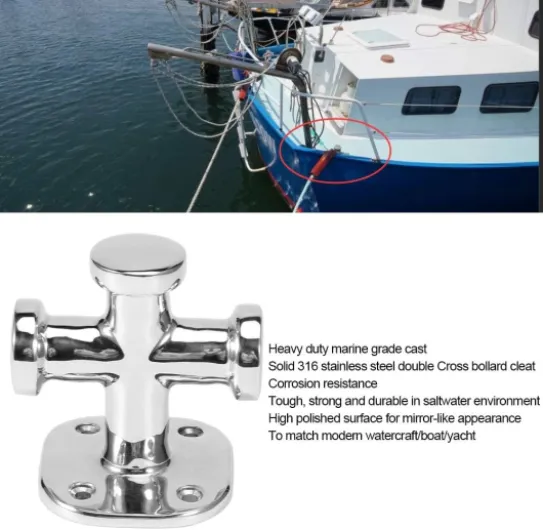
In the box, it’s as basic as it gets: you get the cleat/bollard itself and that’s it. No screws, no backing plate, no gasket, no paper template. Just the 316 stainless single cross bollard on its base. For some people that’s fine, but if you’re expecting a ready-to-mount kit, you’ll be a bit annoyed. I had to dig through my own stainless bolt stash to find the right size and length, which is normal for marine hardware, but worth knowing if you’re not set up for that.
The dimensions listed are a bit confusing in the product description (1 x 1 x 1 cm is clearly a nonsense placeholder), but in hand the cleat matches the advertised 62 x 63 x 83 mm range. It’s small but chunky: think more like a mini bollard than a long classic horn cleat. It works well for lines in the 8–12 mm range; anything much thicker starts to feel cramped around the base when you do several turns or a proper cleat hitch.
The base has pre-drilled holes, which is nice because you don’t have to mess around with marking and drilling stainless yourself. The holes on my unit were clean and correctly spaced, not oval or misaligned. However, there’s no marking of exact hole diameter or recommended screw size anywhere on the product or packaging, so you either measure it yourself with calipers or just offer up a few bolts until one fits. I ended up using M8 stainless bolts with washers and a backing plate under the deck, which felt about right for the loads it will see.
As for how it’s presented overall: it’s functional, nothing fancy. Basic cardboard, basic plastic bag. No instructions, which might bother beginners, but any boater who’s installed hardware before will figure it out instantly. I’d say the presentation matches the price bracket: not premium, not junk, just simple. The important part – the cleat itself – comes out of the box looking clean and ready to mount, with no oil residue or manufacturing dust on mine.
Pros
- Solid 316 stainless construction with no noticeable corrosion after weeks in salty conditions
- Compact but heavy design that feels sturdy and doesn’t flex under normal small-boat loads
- Mirror-polished visible surfaces look clean and are easy to rinse back to near-new appearance
Cons
- Small size can be cramped with thicker lines and not ideal for larger boats
- No mounting hardware or backing plate included, so total install cost can creep up
Conclusion
Editor's rating
If you need a compact, solid cleat for a small boat, jetski, tender, or a floating platform, this Akozon 316 stainless dock cleat is a pretty solid option. It feels dense in the hand, the mirror-polished finish looks clean, and in real use it holds lines without slipping or chewing them up. After a few weeks around salt water, I haven’t seen corrosion, which is the main thing I was watching for. The pre-drilled base makes installation straightforward as long as you’re comfortable sourcing your own stainless bolts and, ideally, a backing plate.
It’s not flawless. The size is on the small side, so if you’re using thick mooring lines or tying up a heavier boat, you’ll probably want something larger. There are no included fixings or instructions, and the finish on the hidden surfaces is more functional than pretty. But none of that affects how it works day to day. For the price, you get a genuinely solid chunk of 316 that should last several seasons without turning into a rusty eyesore.
I’d say it’s a good fit for: small-boat owners, people upgrading from cheap zinc or aluminium cleats, and anyone adding a discrete tie point to a pontoon or swim platform. If you’re outfitting a big cruiser, working boat, or you need heavy-duty mooring gear for rough marinas, I’d skip this size and look for larger, more industrial bollards instead. For light to moderate mooring tasks, though, this cleat gets the job done with minimal fuss.