
Summary
Editor's rating
Is it worth the money compared to cheaper gadgets and full-size fish finders?
Chunky little sphere that feels tough enough to abuse
Battery life vs real fishing sessions
Can it handle repeated casts, rocks, and cold water?
How well it actually finds fish and structure on the water
What you actually get in the box (and what you don’t)
Pros
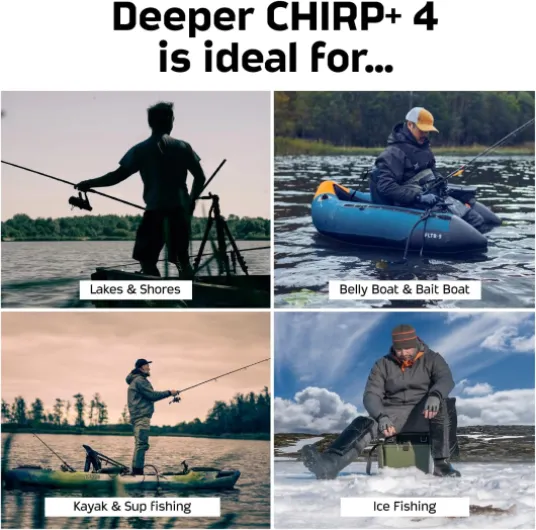
- Versatile use for shore, boat/kayak, and ice fishing with the same unit
- Good sonar detail with CHIRP and useful structure/depth mapping in 2D and 3D
- Strong battery life and tough build that handles repeated casting and bumps
Cons
- Relies heavily on your phone for screen and power, so you almost need a power bank
- Wi‑Fi connection can drop at longer ranges or in rougher conditions
- Price is on the high side for casual anglers who won’t use all the mapping features

Specifications
View full product page →| Brand | deeper |
A fish finder you can throw like a bobber
I’ve been playing with castable sonars for a few years now, mostly the older Deeper units and one from a cheaper brand that died after one season. I picked up the Deeper CHIRP+ 4 because I wanted something I could use from shore, in a kayak, and for ice fishing without having to buy three separate setups. I used it for a couple of weekends on a small lake and one half day on a bigger reservoir, both from the bank and from a kayak.
First thing: this is not a magic fish magnet. It doesn’t suddenly fill your net. It’s a tool that gives you a pretty clear idea of what’s under the surface: depth, bottom shape, weeds, and blobs that are probably fish. If you already know how to read basic sonar, you’ll get into it fast. If you’re new to sonar, there’s a bit of a learning curve, even with the AI that’s supposed to detect fish for you.
The part that surprised me most is how far you can comfortably cast it. It’s not tiny, but it’s dense and flies well with a medium-heavy spinning setup. I had no problem hitting 50–60 meters from shore with braid. Connectivity stayed mostly stable at those distances, but you do need to keep your phone out and the app open, which is less fun when it’s cold or raining.
Overall, after these first sessions, my feeling is: it’s a pretty solid tool if you like tinkering and mapping your spots. It’s not cheap, it’s not perfect, and the app has some quirks, but it does give you info you simply don’t get by guessing with a lead and line. Whether that’s worth the price depends on how serious you are about exploring new water and how much you like messing with tech while you fish.
Is it worth the money compared to cheaper gadgets and full-size fish finders?
Price-wise, the Deeper CHIRP+ 4 sits in that annoying middle zone: not cheap enough to buy on a whim, not as expensive as a full boat-mounted sonar. For what it costs, you’re paying for versatility more than raw power. You can use the same unit from shore, in a kayak, on a small boat, and on the ice. If you fish a bit of everything and don’t want to install a permanent transducer and screen, that flexibility is the main argument in its favor.
Compared to the older Deeper models and some budget castable sonars, the extra detail from the CHIRP and the AI detection is noticeable. Target separation is better, maps look cleaner, and the app is more mature. On the other hand, if you mostly just want to know “how deep is it here” and “is there roughly any fish around,” a cheaper model might already do enough for you. The CHIRP+ 4 feels aimed at people who care about mapping, creating personal charts, and revisiting marked spots over time, not just casual one-off sessions.
If you already own a proper boat with a mounted sonar and GPS, this is more of a backup or a shore/ice tool. In that case, the value depends on how often you actually leave the boat at home. For me, fishing from shore and from a small kayak, it makes more sense. I can throw it in a backpack, use my phone as a screen, and still get decent mapping and fish-finding without installing anything permanent. I do think the price is a bit high once you consider that you also need a decent phone and probably a power bank to make the most of it.
Overall, I’d say the value is good if you’re the type who fishes often, likes exploring new lakes, and will actually use the mapping features. If you only fish a couple of times a year on the same small pond, it’s probably overkill. There are cheaper ways to figure out where the drop-off is. But if you’re regularly hitting different waters and you want one portable sonar that covers boat, shore, and ice without extra screens and wiring, the CHIRP+ 4 is a pretty solid package for the money.
Chunky little sphere that feels tough enough to abuse
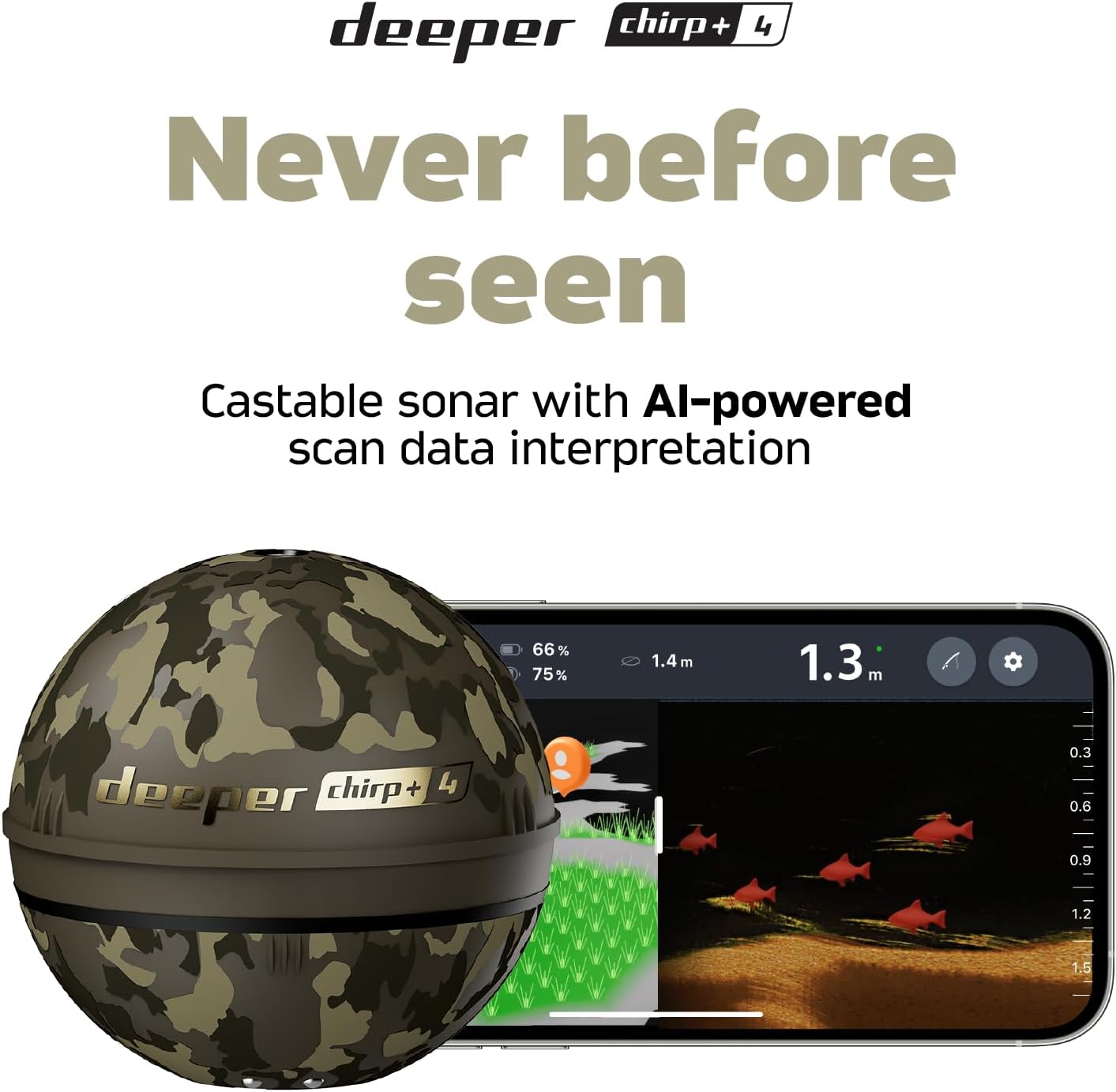
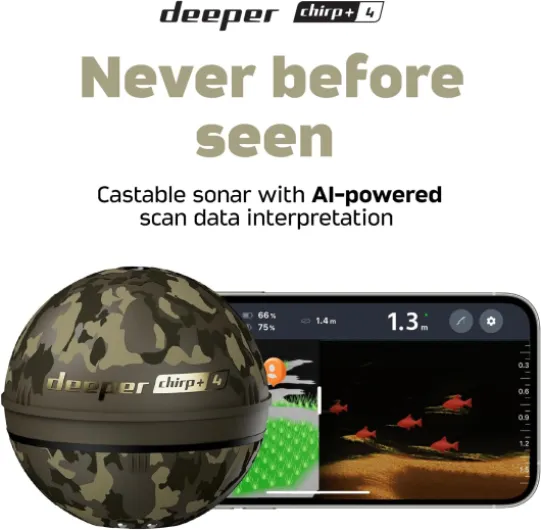
The design is very straightforward: a solid, matte-finish sphere with a threaded section for the attachment bolts. It’s compact at 7 x 7 x 7 cm, but it’s dense. On the rod it feels like casting a heavy lure or a small sinker. If you’re used to light finesse setups, this thing will feel like a rock on the end of your line. Personally, I ran it on a medium-heavy spinning rod with 20 lb braid and a short mono leader, and that felt about right. I wouldn’t throw this on ultralight gear unless you enjoy breaking rods.
The attachment points are simple but functional. You get multiple eyelets you can screw into different positions depending on whether you’re casting from shore, trolling from a boat, or using it vertically for ice fishing. Once tightened, they don’t wobble or feel cheap. I yanked on them pretty hard and didn’t see any give. The USB‑C charging port is under a rubberized seal. It closes firmly enough that I wasn’t worried about water getting in, but like any rubber flap, I wonder how it will hold up after a couple of seasons of opening and closing.
On the water, the unit floats high enough that the signal isn’t constantly dipping under, but low enough that it’s not getting blown around like a cork in the wind. The night cover is a bright, translucent orange cap you swap on so a light can shine through, making it easier to spot in low light. I liked that touch; it’s not fancy, just practical. In choppy water, I could still see it clearly at distance, which helps when you’re watching both your line and your phone screen.
One detail I noticed: because it’s perfectly round, it rolls around on any slightly tilted surface. Sounds obvious, but on a boat or kayak, if you put it down without the case, it will wander off. I ended up either clipping it or dropping it straight into the case when not in use. Overall, the design is pretty no-nonsense: tough shell, simple attachment system, and a form factor that’s easy to toss but requires proper gear. Nothing fancy-looking, but it feels like it can take some abuse and keep going.
Battery life vs real fishing sessions
The specs say up to 15 hours of battery life, which sounds generous. In real use, I didn’t hit that, but it still lasted long enough for a full day of mixed fishing. On my first long session, I ran it for about 7 hours total, with maybe 5 hours of active scanning and the rest just sitting in the case while I actually fished the spots I’d mapped. At the end of the day, the app showed around 45–50% battery left. That’s not bad at all, especially considering I was checking maps and switching modes a lot.
One thing to keep in mind: the sonar only really works when it’s in the water, but the Wi‑Fi and app side of things still chew some power on your phone. Over a long day, my phone battery dropped way faster than the Deeper’s battery. I ended up plugging my phone into a power bank by midday. So yes, the CHIRP+ 4 itself can easily handle a long outing, but if your phone dies, the sonar becomes a floating ball with no screen. For serious trips, I’d say a power bank is basically mandatory, especially if you’re also using your phone for pictures or music.
Charging is straightforward with USB‑C. From nearly empty to full took a bit under 2 hours on a regular wall charger. There’s no fancy charging dock; just plug the cable into the port under the rubber flap. I liked that it uses USB‑C instead of some weird proprietary connector. It means I can charge it with the same cable I use for my phone or power bank if needed. There’s a small indicator in the app to show remaining battery, and so far it seemed reasonably accurate. It didn’t suddenly die without warning or anything like that.
Overall, I’d call the battery life more than enough for weekend anglers. If you’re doing multi-day trips without power and scanning constantly, you might need to be a bit more careful or bring a way to recharge between days. But for a normal day on the water, I never felt limited by the sonar’s battery, only by my phone’s. That’s a good problem to have, relatively speaking.
Can it handle repeated casts, rocks, and cold water?
Durability was one of my main concerns. I’ve killed a cheaper castable sonar before by accidentally slamming it into a rock on a bad cast. With the CHIRP+ 4, I wasn’t gentle. I cast it hard from shore, clipped a few branches, and even bounced it lightly off a concrete edge once. So far, the shell shows only minor scuff marks and no cracks. The plastic feels thick and solid, not hollow or flimsy. The seams are tight, and I never saw any moisture inside or any sign of fogging under the plastic.
I also tested it in cold conditions, just above freezing, and dunked it repeatedly while checking ice fishing holes near the bank. It powered on and connected normally. No weird lag, no shutdowns. The rubber flap over the USB‑C port stayed flexible enough to open and close, though I can see that becoming stiffer over a couple of winters. That’s one of those parts I’d keep an eye on, because if that seal fails, the unit is basically done. Right now it still feels snug and secure.
The attachment bolts and threads are metal and haven’t shown any rust yet, but I also rinsed the unit with fresh water after using it in slightly dirty or silty conditions. That’s a habit I’d recommend. The hard case they include is actually useful too. It’s rigid enough that I’m comfortable tossing it in a backpack with other gear without babying it. The zipper feels decent, not junky. This is the kind of product that will probably last several seasons if you treat it like a piece of electronics, not a rock, but it also doesn’t feel fragile.
I obviously haven’t had it for years yet, so I can’t speak to long-term failure rates, but the 5‑year limited warranty at least suggests the brand expects it to survive more than one season. Based on the abuse I’ve already put it through, I’m reasonably confident it’ll hold up to regular weekend use, including some accidental knocks and drops. It’s not indestructible, but it doesn’t feel like a toy either.
How well it actually finds fish and structure on the water
This is where the CHIRP+ 4 earns its keep. In practice, the sonar performance is pretty solid for a castable unit. I tested it in depths from about 1.5 m near shore out to around 18–20 m on a deeper section. The stated max depth is 100 m; I didn’t have anything that deep to try, but up to 20 m it had no problem giving a stable bottom reading. The CHIRP technology with three frequencies does help separate targets better than the older single-frequency units I’ve used. Fish arches, or at least fish blobs, are easier to distinguish from random noise and debris.
The AI fish detection is helpful but not magic. It will mark likely fish targets and filter out some of the clutter, but it does still show fish icons in places where I’m 90% sure it’s weeds or branchy structure. I confirmed that a few times by casting lures through the same zone and snagging up. On the flip side, when I saw multiple consistent marks at mid-depth over clean bottom, I usually did get bites if I adjusted lure depth properly. So I’d say the AI is useful as a hint, but you still need to use your head and not blindly trust every fish icon it shows.
Where it really shines is mapping structure. The depth mapping and 2D/3D views let you see drop-offs, humps, and channels quite clearly once you’ve made a few passes. I did several long casts in a fan pattern from shore, reeling slowly, and within half an hour I had a pretty clear picture of the slope and a small ridge about 40 m out that I had never noticed before. That spot ended up producing two decent fish later that evening. So in that sense, the sonar helped me stop wasting time in dead, flat areas and focus on more interesting structure.
Connectivity is mostly okay but not flawless. The advertised range is 120 m; I stayed under 70 m most of the time. At around 60–70 m, I had a few brief dropouts where the app froze for a couple of seconds or lost the feed until I reeled in a bit. It wasn’t constant, but it happened enough that I didn’t feel comfortable casting to the absolute limit all the time. In calm conditions close to the bank or boat, it’s stable. In wind and chop at longer range, expect the occasional hiccup. Overall, for actually finding depth changes and likely holding spots, it gets the job done very well. For fish detection, it’s helpful, but you still need to think like an angler, not like a slot machine player staring at icons.
What you actually get in the box (and what you don’t)
Out of the box, the Deeper CHIRP+ 4 is basically a hard plastic ball with some extras. You get the unit itself, a hard case, a night cover, a USB‑C cable, and a few attachment bolts for different line setups. No charger brick, no rod, no line, nothing fancy. Just the core stuff to get the sonar in the water and keep it protected in your bag. The ball is about 7 cm across, so roughly tennis-ball size but heavier. It feels solid enough that I wasn’t worried about hurling it into the lake repeatedly.
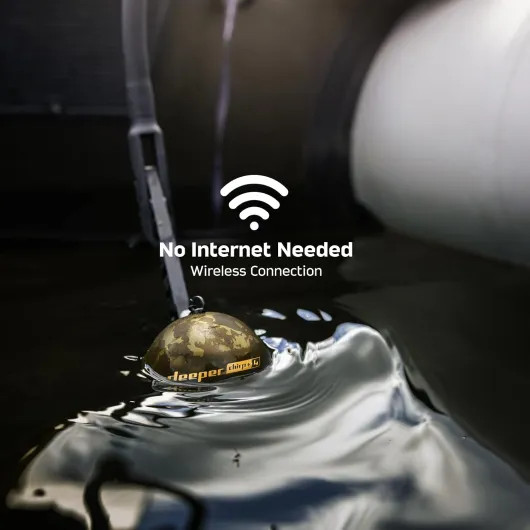
Setup is pretty straightforward: charge it via USB‑C, download the Fish Deeper app, create an account, and pair it over Wi‑Fi. It connects directly to your phone, so you don’t need mobile signal on the lake, but you do need to enable Wi‑Fi and sometimes location services. On my Android phone, the first pairing took maybe 2–3 minutes of fiddling. After that, reconnection was usually under 20 seconds once the unit hit the water, but I did have a couple of cases where I had to toggle Wi‑Fi off and on to get it to hook up again.
The app is where most of the value sits. It shows you live sonar, GPS mapping, weather data, and lets you save different spots and sessions. It’s fairly packed with options: 2D and 3D map views, hardness layers, weed layers, depth shading, etc. For someone who just wants to see fish icons and depth, it might feel a bit overloaded at first. I had to dig through menus to find simple things like unit changes and display modes. Once dialed in, it’s fine, but it’s not plug-and-play simple if you’re not used to fishing electronics.
What’s missing? There’s no printed manual worth talking about, just a quick start guide. If you want detailed instructions, you’re basically reading online help or watching videos. Also, there’s no float or bobber-style attachment like some cheaper units bundle; the CHIRP+ 4 itself is the float. In practice that’s okay, but it does mean all the weight is on your line, so you need a rod and line that can handle casting something that heavy repeatedly. In short: you get a robust little sonar ball and a decent protective case, but don’t expect a full kit. You still need to bring your own fishing gear and a bit of patience to get through the app setup.
Pros
- Versatile use for shore, boat/kayak, and ice fishing with the same unit
- Good sonar detail with CHIRP and useful structure/depth mapping in 2D and 3D
- Strong battery life and tough build that handles repeated casting and bumps
Cons
- Relies heavily on your phone for screen and power, so you almost need a power bank
- Wi‑Fi connection can drop at longer ranges or in rougher conditions
- Price is on the high side for casual anglers who won’t use all the mapping features
Conclusion
Editor's rating
After a few solid outings with the Deeper CHIRP+ 4, my take is that it’s a strong all-round tool for anglers who like to mix shore, small boat, and ice fishing, and who don’t mind dealing with an app while they fish. The sonar itself does its job well: stable depth readings, clear bottom structure, and reasonably helpful AI fish detection as long as you remember it’s not perfect. The mapping features, especially the 2D/3D views with hardness and weeds, are genuinely useful for figuring out where to focus your time instead of randomly casting into featureless water.
It’s not without downsides. You’re tied to your phone, both for the screen and for battery life. The Wi‑Fi connection can hiccup at long range or in choppy conditions, and the app has a learning curve with a lot of menus and options. The price isn’t low either, so if you only fish occasionally or on very simple waters, it’s probably more tech than you need. But if you’re out regularly, hit different lakes, and want one portable sonar you can cast, troll, or drop through a hole in the ice, it’s a pretty solid choice. Tech‑minded anglers who like mapping and data will get the most out of it; people who just want to relax and toss a bobber might find it more hassle than help.