
Summary
Editor's rating
Value for money: worth it, but only if you’ll actually use it
Design: compact dome, clean look, but a few install quirks
Power draw and real-world impact on your electrical system
Durability and reliability so far
Performance: fast sweep, clear targets, and Doppler that actually helps
What the Halo 20+ actually is (and what you need with it)
Effectiveness in real use: fog, night entries, and tight harbors
Pros
- Fast 60 RPM sweep at close range makes moving targets easier to track
- Doppler VelocityTrack coloring clearly highlights approaching vs receding targets
- Compact, lightweight dome that integrates cleanly with Lowrance MFDs and supports dual-range operation
Cons
- Total cost climbs once you add a proper heading sensor and mounting hardware
- Power draw is noticeable and can stress weak 12 V systems on smaller boats

Specifications
View full product page →| Brand | Lowrance |
A radar dome that actually changes how you drive the boat
I’ve had the Lowrance Halo 20+ on my boat for a bit now, paired with a Lowrance HDS display, and I’ll be blunt: once you get used to having this thing on, going back to just eyes and chartplotter feels like driving half-blind. Not because this radar is magic, but because it gives you a constant picture of what’s around you, especially in the dark or in fog. It’s not cheap, and it’s not plug-and-play for everyone, but it does the job it says it does.
Before this, I relied on an older open-array radar on a friend’s boat and a basic dome on a charter. Both worked, but target refresh was slow and close‑range detail was kind of blurry. With the Halo 20+, the first thing that stood out for me was how fast it refreshes at short range. When you’re threading your way through moorings or watching ferries move around you, that faster sweep makes a real difference in how confident you feel at the helm.
I mainly use it for coastal cruising, night entries in busy harbors, and the occasional foggy morning run. I’m not a commercial skipper, just a recreational boater who got tired of stressing every time visibility dropped. I wired the unit myself over a weekend, and while it was mostly straightforward, there are a couple of gotchas you should know about, especially around power and the heading sensor if you want proper chart overlay.
So this review is from that angle: normal boat owner, not an electronics tech. I’ll go through what I liked, what irritated me, and where I think Lowrance cut corners a bit. If you’re hoping this radar will “see everything and do everything”, it won’t. But if you want a compact dome that actually helps you avoid stuff and read traffic better, it’s pretty solid. Just be ready for the total bill once you add the extra pieces you really need.
Value for money: worth it, but only if you’ll actually use it
Let’s talk money, because this isn’t a cheap add-on. By the time you buy the Halo 20+, the right cables, and a Point-1 or similar heading sensor if you don’t already have one, you’re into a decent chunk of change. For a casual boater who only goes out on sunny afternoons and rarely at night or in poor visibility, I’d say this is probably overkill. You’ll be paying for features you barely use, and the radar will just sit there spinning for show.
For regular coastal cruisers, people who do night runs, fish early or late, or anyone who often deals with fog, the value starts to make more sense. Compared to cheaper, older radars, the quick startup, faster sweep, and Doppler targeting actually improve how you operate the boat. It’s not just nicer graphics; it’s being able to spot moving targets faster and separate real threats from background clutter. That, to me, justifies the price more than the marketing buzzwords.
Compared to other radars in the same general class (Garmin Fantom domes, Raymarine Quantum, etc.), the Halo 20+ sits in the same ballpark in terms of cost. If you’re already in the Lowrance ecosystem, it’s a logical choice. Switching brands just for the radar would be dumb. The main “hidden” cost is that heading sensor and any mounting hardware you need, so don’t be surprised when the actual invoice is higher than the base radar price you saw online.
Overall, I’d rate the value as good but not mind-blowing. You get solid performance, modern features, and a compact form factor that works well on smaller boats. It’s not cheap, there are definitely less expensive ways to put a radar on your boat, but you’d be giving up the fast sweep and Doppler that make this one stand out. If those things matter to you and you actually sail in conditions where radar matters, it’s money reasonably well spent. If you’re mostly a fair‑weather day boater, I’d save the cash for something else.
Design: compact dome, clean look, but a few install quirks
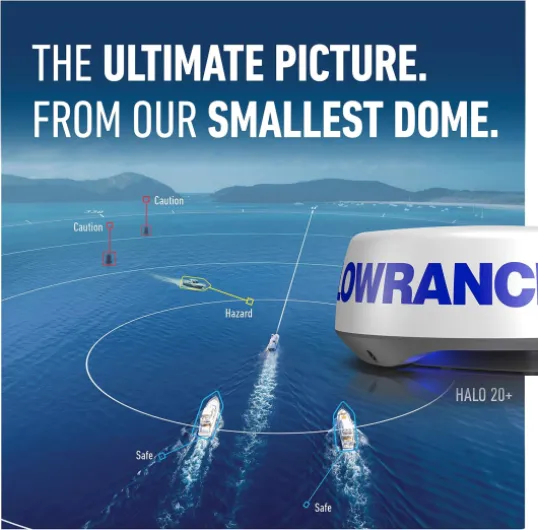
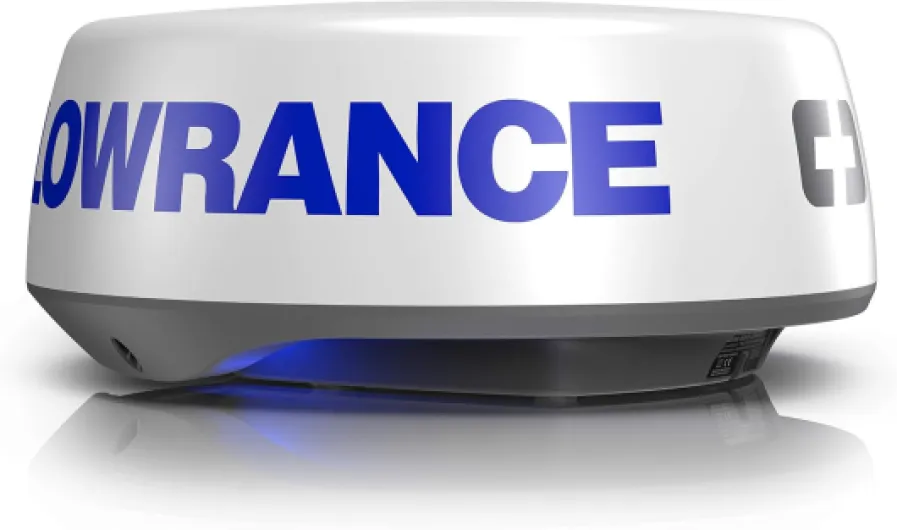
From a design standpoint, the Halo 20+ is pretty simple: white low‑profile dome, about 20 inches wide, not too tall, and it blends in well on a hardtop or arch. On my boat, it doesn’t dominate the roof like some big open arrays do, which I appreciated. You can still see forward from the flybridge without feeling like there’s a big bar blocking your view. The lines are clean, and it looks like every other modern radar dome out there, which is fine by me. I’m not decorating a living room; I just need it to sit there and work.
The weight is around 22 pounds, so you definitely feel it when lifting it into place, but it’s manageable for one person on a ladder if you’re careful. I did the install with a buddy: one up top holding the dome, one below passing cables and tools. The mounting pattern is standard enough that most radar pads or generic mounts will line up, but I still had to drill new holes because my old mount was set up for a different pattern. Not a huge deal, just something to expect.
What I liked in the design is how the cabling is handled. The connections are tucked under the dome, so once it’s installed you don’t have a mess of exposed connectors. That helps for weather protection and just keeping the install clean. Still, plan your cable run carefully: the Ethernet and power cables are not tiny, and if you’re threading them through tight conduits or bends, it can get annoying. I ended up widening one existing cable pass-through because the radar connector just wouldn’t fit as‑is.
On the downside, Lowrance doesn’t exactly drown you in mounting accessories. You get the basics, but if your roof is curved or you want a specific angle on the dome, you’re buying a separate mounting bracket or wedge. Also, the manual is clear enough, but the diagrams are a bit small and vague in places. Overall, the design is practical and low‑drama: it looks fine, doesn’t take too much space, and once it’s bolted down you can forget about it visually, which is pretty much what I wanted.
Power draw and real-world impact on your electrical system
The spec sheet lists it as running on 10.5 V DC and up, and in practice it’s just another 12 V load on the boat, but not a tiny one. I don’t have lab gear to measure exact watts, but based on my setup and what similar units draw, you’re looking at a noticeable but manageable power consumption when the radar is transmitting. On my boat with a mid-size house bank, I could run the radar, plotter, instruments, and lights for a full night without panicking, but I wouldn’t call it light on power either. You do need to think about it if you’re mostly on batteries.
In standby, the draw is much lower, and that’s actually how I used it a lot. I’d keep the unit on standby while cruising in good visibility, then pop it into transmit when entering busier waters or when fog started to appear. The wake-up is quick, so you’re not sitting there waiting like with older magnetron radars that need several minutes to warm up. That behavior alone saves a bit of power over a long day because you’re not forced to leave it blasting all the time just in case.
One thing to watch is cable sizing and voltage drop. The dome is often mounted high and far from the batteries, so the run can be long. I followed the manual’s gauge recommendations, and I’m glad I did. Undersized cables on a high-draw device like this can give you weird dropouts or random reboots when the radar transmits. I haven’t had any of that, which tells me the install is solid, but it’s something people sometimes cheap out on. If you’re DIY-ing, don’t.
Overall, I’d say the power side is fine for most small to mid-size cruisers with a decent battery bank and at least some charging while underway (alternator, solar, whatever). If you’re on a tiny boat with a single battery that already struggles with a fridge and lights, this radar might push things over the edge. It’s not a power hog compared to older big radars, but it’s not trivial either. Plan for it, wire it correctly, and it behaves. Ignore it, and you’ll probably blame the radar for what is really a weak electrical system.
Durability and reliability so far
Durability is always a bit of a guess unless you’ve run the gear for years, but I can at least share how the Halo 20+ has held up in the time I’ve had it. So far, it’s been through a mix of salt spray, a couple of serious rainstorms, and plenty of sun. The housing still looks like new: no yellowing, no weird hairline cracks, and the seals around the base seem to be doing their job. I’ve checked under the dome a few times and haven’t seen any signs of moisture creeping in.
Operationally, it’s been boring in the good way. No random reboots, no loss of connection to the MFD, and no weird artifacts on the screen that would make me think something is failing. Startup is consistent every time, and the heading alignment hasn’t drifted noticeably. I did a basic alignment when I installed it and haven’t had to touch it since. That’s kind of what you want with this kind of gear: install it once, then forget about it except for the occasional software update on the MFD.
The mount and hardware haven’t given me grief either, though I did use my own stainless bolts and sealant rather than relying only on what came in the box. The dome has taken a couple of accidental knocks from gear being moved around the arch, and there are no dents or cracks. I wouldn’t go around hitting it with heavy stuff, but it feels sturdy enough for normal boating abuse. The weight and construction give you a sense that it’s not flimsy plastic.
Of course, I can’t speak to five- or ten-year longevity yet. Solid-state radars in general tend to be more reliable than older magnetron units, and so far this one seems to follow that pattern. If you’re in a very harsh environment (tropics, constant exposure), I’d still keep an eye on UV damage and make sure the mounting surface doesn’t flex. But for regular coastal use, I’m comfortable saying it feels like a solid, durable bit of kit, not something that will fall apart after a season.
Performance: fast sweep, clear targets, and Doppler that actually helps
This is where the Halo 20+ justifies its price. The main thing I noticed is how fast it updates at short range. At up to 2 nm, it spins at 60 RPM, which basically means you’re getting a full refresh every second. When you’re in a tight harbor or crossing traffic lanes, that speed lets you actually see boats moving in real time instead of watching a slowly rotating sweep. I used it a lot between 0.25 and 3 nm, and targets like small fishing boats, buoys, and shorelines were clear enough to make decisions without guessing.
The dual-range feature is also genuinely useful. I usually ran one window on 0.5–1 nm and the other on 6–12 nm. That way I could keep an eye on nearby stuff while still seeing bigger ships or weather further out. The radar doesn’t feel like it’s compromising too much when doing both at once. You do see a bit more noise on the long‑range view in choppy conditions, but dialing back the gain and using the sea clutter controls cleans it up. It’s not perfect, but after a couple of outings I found settings that worked for my area and basically left them there.
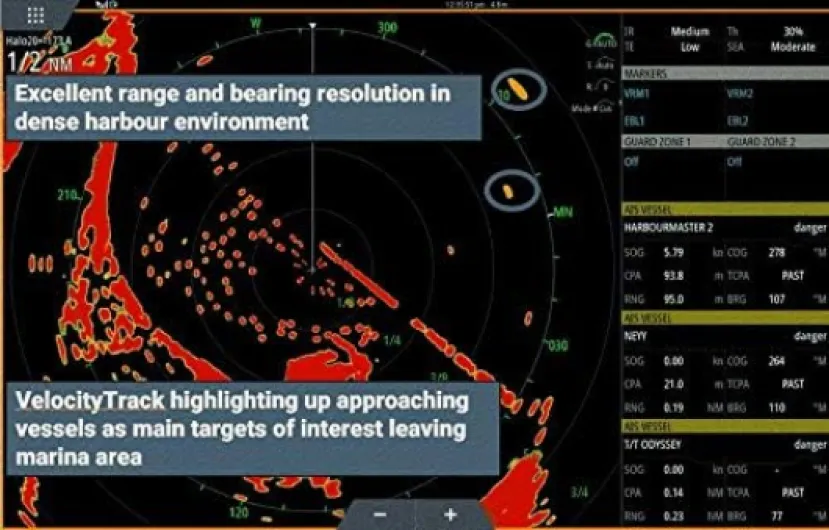
The Doppler VelocityTrack is one of those features that sounds like marketing until you use it. Targets moving towards you show up in a different color than those moving away. On a busy night with lots of AIS and non-AIS boats around, that color coding makes it easier to spot which blobs you really need to care about. I had one situation in light fog where a small fast boat without AIS was headed on a collision course; the Doppler color made it stand out from all the background clutter, and that alone justified having this tech onboard for me.
Long-range performance up to the 24–36 nm area is fine for general awareness, but don’t expect perfect detail that far out; it’s more about seeing landmasses and larger ships. Where the Halo 20+ really shines is from 0 to about 12 nm. Compared to older magnetron radars I’ve used, warm-up time is basically zero, the picture stabilizes quickly, and you’re not sitting around waiting for the unit to “wake up.” It’s not flawless—rain and heavy sea states still create clutter you have to manage—but as a modern solid-state dome, it does the job very well.
What the Halo 20+ actually is (and what you need with it)
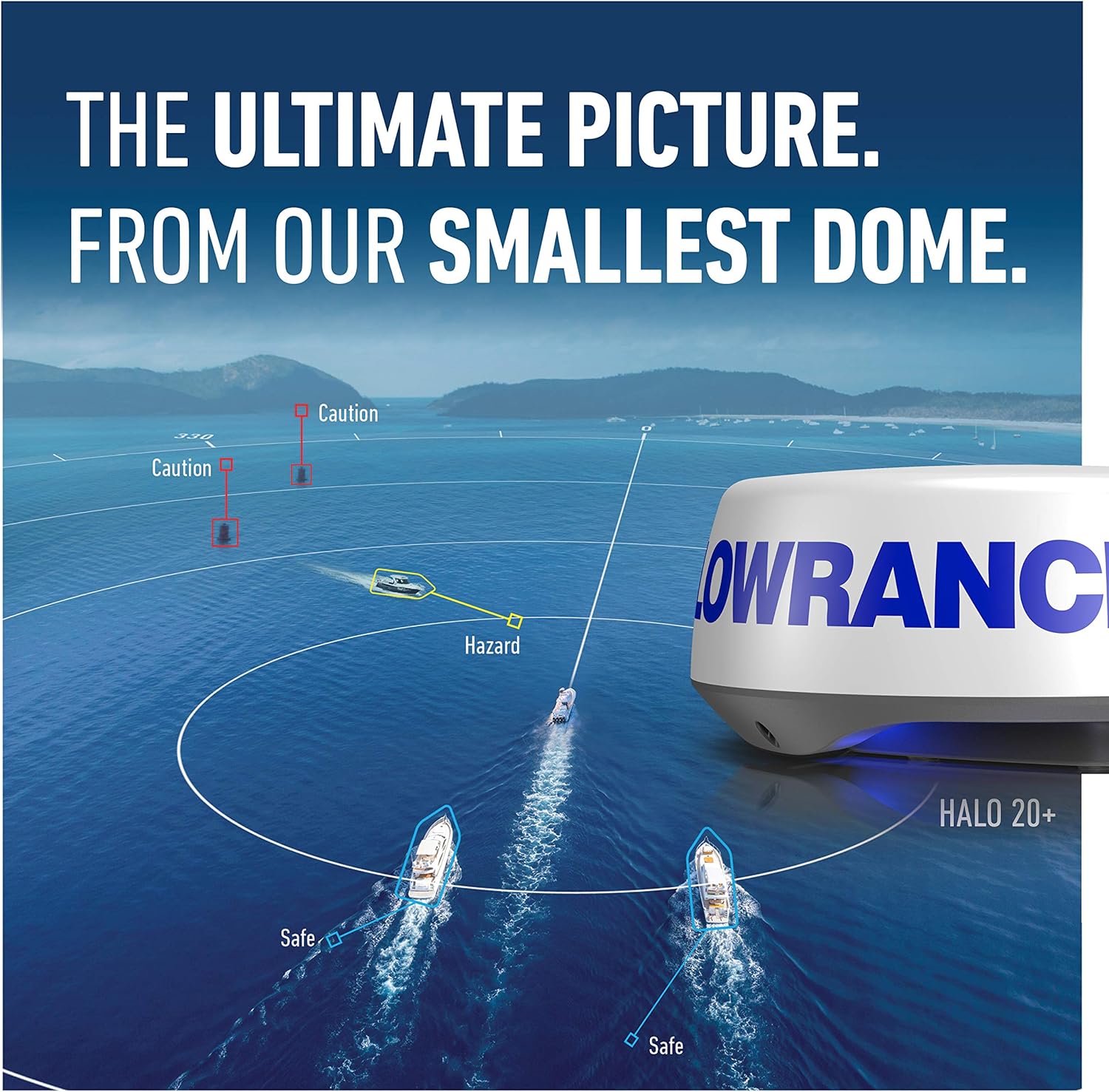
The Halo 20+ is basically a 20-inch closed dome radar that talks to Lowrance MFDs (HDS, Elite, etc.). On paper, the big points are: up to 36 nm range, dual-range mode (near and far at the same time), 60 RPM sweep up close, and built‑in Doppler (VelocityTrack) to color‑code moving targets. In normal words: you can see buoys, boats, and shorelines around you, and it refreshes fast enough that you can actually follow moving targets without waiting ages for the screen to catch up.
In practice, the setup is: the dome on the mast or arch, an Ethernet cable down to your Lowrance display, power to the dome, and ideally a Point-1 or other heading sensor/GPS so you get proper radar overlay on your chart. The product page doesn’t scream that last part loudly enough. Yes, the radar works without it, but without a solid heading source, the overlay is sloppy and less useful. So factor in that extra box if you don’t already have it installed.
Out of the box, you basically get the dome, mounting hardware, and the usual paperwork. No cables thrown in for free beyond the basics, no compass receiver. So the “price of the radar” is not the final price. Compared to some older radars I’ve seen, the physical footprint is pretty compact, and that helped on my boat because space on the arch is limited. I had about 60 cm width to play with and the 20-inch dome fit fine without looking ridiculous.
Overall, the presentation is straightforward: this is a modern solid-state radar meant to plug straight into the Lowrance ecosystem. If you already run Lowrance gear, it drops in nicely. If you’re on Garmin or Raymarine, just skip it because it’s not meant for you. It’s clearly designed for small to mid-size boats that want better situational awareness without going to a big open-array system, and in that slot it makes sense.
Effectiveness in real use: fog, night entries, and tight harbors
On paper, performance numbers are one thing. What matters is whether this radar actually helps when things get sketchy. For me, the short answer is yes, it genuinely reduces stress in bad visibility. I had two main test cases: early-morning fog banks on a coastal run, and a couple of night entries into a busy harbor with ferries, fishing boats, and random small craft doing their own thing. In both situations, the Halo 20+ made it much easier to understand what was around me and which targets were moving in ways I needed to worry about.
In fog, running at about 8–10 knots, I kept one radar range at 0.5 nm and another at 4–6 nm. Buoys and fixed markers popped enough to line them up with what I saw on the chart. Small boats with poor lights still showed as solid returns, and I could track their movement over a couple of sweeps instead of guessing from faint lights. The Doppler coloring was handy here too: anything that showed up as approaching caught my eye right away. It doesn’t make you invincible, but it gave me a buffer of information I just didn’t have before.
For night harbor entries, the effectiveness is more about clutter handling and target separation. With lots of background reflections from docks, piers, and moored boats, some older radars I’ve used just turn into a noisy mess. The Halo 20+ still shows clutter, but the target separation is good enough that moving boats stand out. I tested this by following a ferry track on the screen while visually watching it; the radar track was stable and the heading line made it clear which way it was turning before the maneuver was obvious to the naked eye.
Where it’s less impressive is in very heavy rain or when you’re close to steep rocky shorelines. You do get more false echoes and some messy blobs that you have to mentally filter. The built-in filters help, but you still need to know what you’re looking at. So, it’s not magic, and you still need to keep your brain engaged and your eyes out. But as a tool to reduce guesswork and catch dangerous targets earlier, it’s very effective. For collision avoidance and navigation around traffic, it gets the job done in a reliable, repeatable way.
Pros
- Fast 60 RPM sweep at close range makes moving targets easier to track
- Doppler VelocityTrack coloring clearly highlights approaching vs receding targets
- Compact, lightweight dome that integrates cleanly with Lowrance MFDs and supports dual-range operation
Cons
- Total cost climbs once you add a proper heading sensor and mounting hardware
- Power draw is noticeable and can stress weak 12 V systems on smaller boats
Conclusion
Editor's rating
The Lowrance Halo 20+ is a solid fit if you already run Lowrance gear and actually use your boat in conditions where visibility isn’t always perfect. The fast short‑range sweep, clear target separation, and Doppler coloring aren’t just nice extras; they genuinely help you read traffic and avoid trouble, especially in fog and at night. It’s compact, looks clean on the boat, and once installed it has been reliable and low‑maintenance for me. Dual-range is handy, warm‑up is basically instant, and integration with the MFD is straightforward.
It’s not perfect. You need to budget for a proper heading sensor and decent mounting hardware, and power draw isn’t trivial if your electrical system is weak. Heavy rain and complex coastlines still create clutter, and you do need to spend some time learning how to read the picture properly. Also, if you only go out in clear daylight and stay close to home, this is probably more radar than you actually need.
If you’re a coastal cruiser, night fisherman, or anyone who regularly deals with fog and busy waterways, the Halo 20+ is a pretty solid upgrade in situational awareness. If you’re a casual fair‑weather boater or on a tight budget, I’d either look at something cheaper or skip radar altogether. It’s good gear, but it makes the most sense for people who will actually lean on it, not just turn it on once a season to see what it does.