
Summary
Editor's rating
Value for money: cheaper than piecing it all together, with a few trade-offs
Design: practical, but you’ll need space and planning
Battery and charging: the real backbone of the kit
Durability: feels solid, but I’d still treat it with respect
Performance: what it actually powers in real life
What you actually get in the box
Pros
- Strong core combo: 300Ah LiFePO4 battery, 600W panels, 2000W pure sine inverter, and DC-DC with MPPT in one bundle
- Bluetooth battery monitor makes it easy to see real state of charge and manage usage
- Good real-world performance for RV/small cabin use: fridge, electronics, and short high-load bursts are handled well
Cons
- Not a fully complete kit: you must buy cables, fuses, and mounting hardware separately
- Requires decent DIY skills and planning for a safe, tidy install

Specifications
View full product page →| Brand | Renogy |
A full off-grid kit without having to mix and match
I’ve been slowly upgrading my camper setup over the last few years, and I’m honestly tired of piecing systems together from different brands. Different cables, different apps, random incompatibilities… it gets old. That’s why this Renogy 600W 12V Solar Panel Kit caught my eye. Panels, big LiFePO4 battery, DC-DC charger with MPPT, and a 2000W inverter, all in one box. On paper it covers pretty much everything you need to run an RV or small off-grid cabin.
I’ve been using it for a few weeks on a long-weekend style setup: parked in a driveway and then a couple of nights off-grid in a field and a basic campsite. I wired it into a mid-size camper van that used to run on a basic AGM battery and a cheap inverter. So I had a good before/after comparison in terms of how much I could actually run without babysitting the battery every hour.
Right away, the main thing I noticed is that this kit is more about practicality than fancy features. The parts feel solid enough, the manual is okay (not great, not terrible), and the system just quietly does its thing once installed. But it’s not perfect. There are some corners cut in the accessories, and you’ll probably end up buying a few extra bits to make the install clean and safe. So don’t expect a plug-and-play magic box.
If you’re thinking about this kit, I’d say it’s aimed at people who are reasonably handy, want a one-brand solution, and care more about reliable power than having the fanciest app or the neatest wiring layout. If you’re not comfortable with 12V and AC wiring, you’ll either need help from someone who is, or you might want to look for a more pre-assembled power station type solution instead.
Value for money: cheaper than piecing it all together, with a few trade-offs
In terms of value, this Renogy kit sits in that middle ground: not bargain-basement cheap, but also not as expensive as buying each component from higher-end brands separately. If you price out three 200W panels, a 300Ah LiFePO4, a 50A DC-DC with MPPT, a 2000W pure sine inverter, and a smart shunt individually, you’ll usually end up above the bundle price, especially if you stick to known brands. So as a package, it does make financial sense, assuming you were going to buy this kind of setup anyway.
However, it’s important to remember that this is not a fully complete kit. You will spend extra on cables, fuses, mounting hardware, and little accessories. That can easily add another chunk to the total bill, especially if you go for thicker cable and proper breakers instead of the absolute cheapest stuff. For me, the hidden extra cost was a bit annoying, but not shocking – I’m used to 12V projects. For someone expecting a complete solution straight from the box, it might feel like the price suddenly crept up.
Compared to a big all-in-one power station (like the popular portable batteries with built-in inverters and solar inputs), this Renogy kit is more effort to set up but better value per kWh and per watt of solar. You also get more flexibility in how you mount and wire everything. On the flip side, you don’t get the same plug-and-play convenience, and there’s no slick single app controlling every aspect of the system. You trade convenience for capacity and price.
Overall, I’d call the value good but not mind-blowing. If you’re the kind of person who would otherwise buy random bits from Amazon and hope they play nice together, this is a safer, more coherent route. If you already own some of the components (like an inverter or panels), then this specific bundle might not be the best way to spend your money. It shines most for people starting from scratch who want a solid, mid-range off-grid setup without going fully custom or dropping premium-brand money.
Design: practical, but you’ll need space and planning
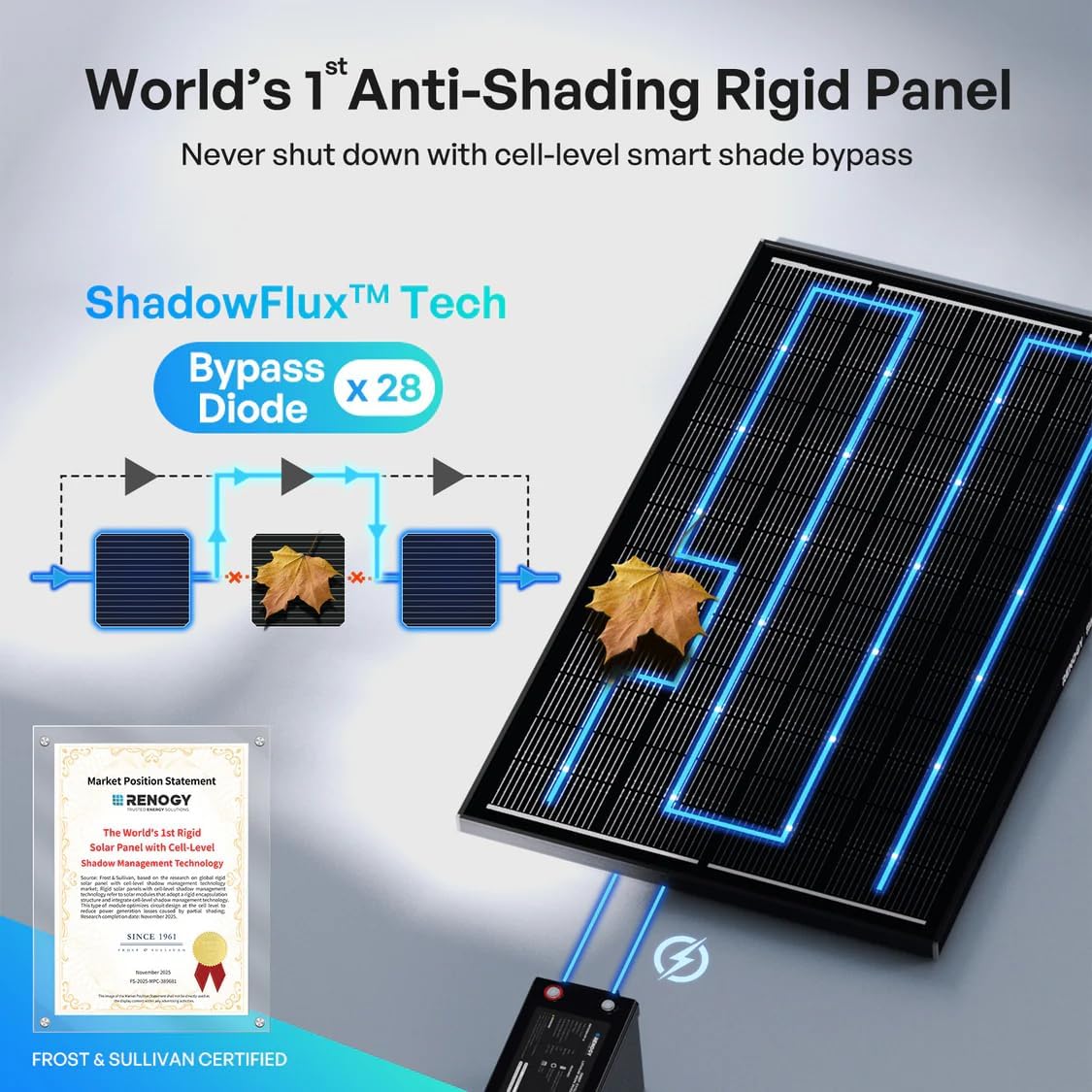
Design-wise, everything here is very much “RV gear” – no flashy looks, just black boxes and rectangular panels. The ShadowFlux N-Type panels are fairly slim and not too heavy for 200W units. They have a clean black look that doesn’t scream “DIY science project” on the roof, which I appreciated. The junction boxes and MC4 connectors feel standard, nothing fancy but they clicked in securely and didn’t feel cheap. I mounted them flat on a van roof using generic brackets, and they sat nicely without any weird flexing.
The 300Ah LiFePO4 battery is compact for its capacity, but it’s still a big lump. You need a decent chunk of floor or cabinet space, and you want to make sure it’s strapped down because of the weight and movement when driving. The anti-vibration claim is nice, but I still wouldn’t just let it sit loose. The casing feels sturdy, and the IP65 rating is reassuring if you’re putting it in a slightly dusty or damp area, though I wouldn’t deliberately expose it to direct spray or anything like that.
The DC-DC charger with MPPT and the 2000W inverter are both rectangular boxes that need some wall or board space for mounting, plus airflow. That’s something the product page doesn’t really highlight: you need to plan a layout that allows for cable runs, fusing, and still leaves room for air circulation. If you cram everything into a tiny compartment, the inverter fan will run a lot and you might get heat buildup. I spaced mine out on a plywood board in a side cupboard, and that worked fine.
The only design gripe I have is cable routing and terminals. The units are made for proper ring terminals and thick cable, which is good, but the orientation of some terminals makes neat wiring a bit of a puzzle in tight spaces. Also, no right-angle options or strain reliefs are included, so you’re doing all of that yourself. Overall, the design is functional and RV-friendly, but it’s not a plug-and-play Lego set. If you like clean installs, expect to spend time thinking through where each box goes and how the cables will run.
Battery and charging: the real backbone of the kit
The 300Ah LiFePO4 battery is what makes this kit feel like a proper upgrade over basic setups. LiFePO4 chemistry means you can safely use a much bigger chunk of the capacity compared to lead-acid. In practice, I was comfortable using 70–80% of the battery without stressing about it, whereas with my old AGM I tried to stay above 50% all the time. That alone changes how you use your van – you stop obsessing over every light you switch on.
The battery has low-temperature charging protection, which is important if you camp in colder places. I didn’t hit freezing temps during my test, but it’s nice to know it won’t happily try to charge below safe temperatures and damage itself. The IP65 rating is also a plus: it handled a slightly dusty compartment and the usual van condensation without any drama. I wouldn’t put it in a soak-prone area, but for normal RV use it feels robust enough.
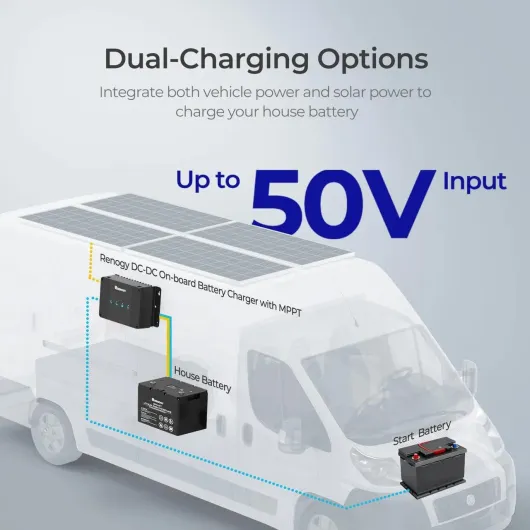
The 50A DC-DC charger with MPPT is the other half of the story. It lets you charge the battery from both your alternator and the solar panels. On driving days, I was seeing a steady 30–40A going into the battery from the alternator, which is a big help when the weather is grey. The built-in MPPT for the solar side did its job – it tracked the panels reasonably well and I didn’t see any weird behaviour. It’s not as tweakable as some standalone MPPT controllers, but for a van setup it’s fine. Set it up once, and forget it.
The 500A Bluetooth battery monitor is simple but genuinely useful. It shows state of charge, amps in/out, and a few other basics in an app. Is it the most polished app in the world? No. But it connected reliably, and I could sit in bed and check how much juice I had left before deciding whether to run the inverter again. Once the shunt is wired correctly and you calibrate it, it gives you a much clearer picture than just watching voltage numbers. Overall, the battery part of this kit is the strongest element – big capacity, sensible protections, and decent visibility into what’s going on.
Durability: feels solid, but I’d still treat it with respect
I haven’t had this kit for years, so I can’t pretend to know how it will age long term, but I can talk about how it feels and behaves out of the box and after a few weeks of use. The panels feel solid, with no flexing or creaking when handled properly. The frames are rigid and the glass didn’t show any weird marks or scratches from a normal install. After being on the roof through a couple of decent rainstorms and some motorway driving, nothing rattled loose and the MC4 connections stayed dry and tight.
The battery casing is tough and doesn’t feel flimsy. The IP65 rating suggests it can handle dust and the odd splash, which lines up with how it handled my slightly damp storage area. The anti-vibration design is nice in theory – I drove on some rough country roads and speed bumps, and there were no odd noises or performance issues. That said, I still mounted it on a rubber mat and strapped it down tight. I wouldn’t rely on any battery’s internal design to compensate for a bad mounting job.
The inverter and DC-DC charger both have metal housings that feel sturdy. The mounting tabs are decent, and once screwed into a board they didn’t move. The fans on the inverter kicked in and out as expected under load, and I didn’t notice any hot spots on the casing beyond what you’d normally expect. Cable terminals also held up fine to being tightened down firmly; nothing stripped or felt weak. I’ve seen cheaper gear where the screw terminals feel like they’ll give up if you look at them funny – this is better than that.
My one concern is more about the usual RV reality: vibration, moisture, and user error. The kit itself seems built for mobile use, but its long-term durability will depend a lot on how well you install it – proper strain relief on cables, good ventilation, and no shortcuts on fuses and mounts. If you treat it like permanent infrastructure and not like a temporary gadget, I don’t see any obvious red flags. But if you just toss the boxes in a cupboard and hope for the best, you’ll probably run into issues sooner or later, like with any 12V system.
Performance: what it actually powers in real life
On paper, 600W of panels and a 300Ah LiFePO4 battery sounds like a lot, but what matters is what you can actually run day to day. In my use, with mixed UK autumn weather (so not peak summer sun), I was seeing between 250–450W from the panels in decent sun and more like 80–150W in light cloud. On a good clear day, the system easily put back enough power to cover a 12V fridge, lights, phone/laptop charging, a bit of water pump use, and some TV time, with room for a short run of a coffee machine through the inverter.
The 2000W pure sine inverter handled everything I threw at it within reason: induction hob (low setting), Nespresso machine, small microwave for quick reheats. The fan does spin up under heavier load and it’s not exactly quiet, but that’s pretty normal for this kind of gear. I didn’t notice any weird flickering or buzzing on sensitive electronics. My laptop charger and a camera battery charger both behaved normally, which is what you want from a pure sine inverter.
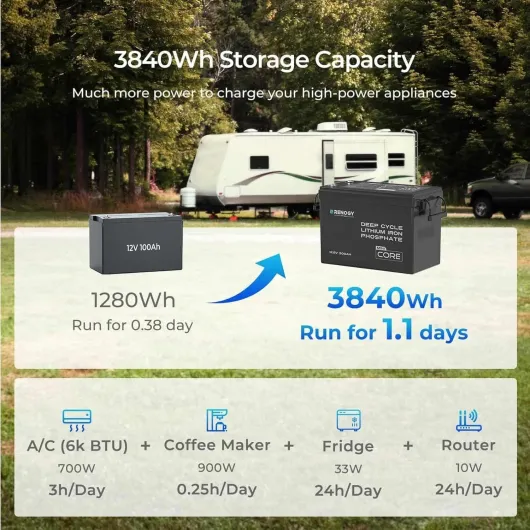
On the storage side, that 300Ah battery is the star. Compared to my old 100Ah AGM, it’s night and day. I could comfortably go through an evening running lights, fridge, fans, and some AC loads without watching the voltage like a hawk. The Bluetooth monitor showed that even after a heavy evening, I usually had 40–60% left by morning. With some sun the next day, it climbed back up steadily. I didn’t fully drain it to zero – no need – but I did push it under 20% once and it still held voltage well.
Overall, performance is pretty solid for a compact off-grid setup. If you’re expecting to run an electric heater or full-size air conditioning off this, you’ll be disappointed – that’s just not realistic for 12V systems of this size. But for a normal camper or small off-grid shed setup (fridge, gadgets, occasional high-draw appliance), it gets the job done. You just need to be aware of your usage and weather. In winter or very cloudy stretches, you’ll lean more on alternator charging through the DC-DC unit, which this kit is clearly built to support.
What you actually get in the box
On the spec sheet, the Renogy kit looks straightforward: 3 x 200W ShadowFlux N-Type panels (600W total), 300Ah LiFePO4 battery, 50A DC-DC charger with MPPT, 2000W pure sine wave inverter, plus a 500A battery monitor with Bluetooth. That’s enough capacity on paper to store around 3.84kWh and run most typical van or small cabin needs: lights, fridge, laptop, phone chargers, and short bursts of heavier stuff like a coffee maker or small microwave.
In reality, what you get is the core hardware but not a fully complete installation pack. In my box I had the three panels, the DC-DC charger, the 300Ah battery, the inverter, and the monitor. What you don’t get: all the cabling, fuses, breakers, mounting hardware, and proper lugs to tie it together in a safe way. So if you’re thinking you’ll just open the box and be done by the afternoon without extra shopping, that’s optimistic. I ended up spending extra on: 25mm² battery cables, ANL fuses and holders, MC4 extension leads, panel brackets, and a few glands and grommets.
Functionally, the idea of this kit is good: you can charge from the sun and from your vehicle alternator (via the DC-DC charger), store a decent chunk of power in a LiFePO4 battery, and then run AC stuff off the 2000W inverter. The Bluetooth battery monitor is what ties it together in daily use, because you can actually see how much charge you have left instead of guessing by voltage. Once installed, the system is simple to live with. You look at the app, see the percentage, and decide if you can run the kettle or not.
Overall, the presentation is “here are the big building blocks, you figure out the rest.” It’s not as friendly as an all-in-one power box, but it’s also more flexible. If you’re okay with buying the missing pieces and doing a proper install, the bundle makes sense. If you expected a full turnkey kit with every nut and bolt included, you’ll probably be a bit annoyed when you realise how many extra items you still need.
Pros
- Strong core combo: 300Ah LiFePO4 battery, 600W panels, 2000W pure sine inverter, and DC-DC with MPPT in one bundle
- Bluetooth battery monitor makes it easy to see real state of charge and manage usage
- Good real-world performance for RV/small cabin use: fridge, electronics, and short high-load bursts are handled well
Cons
- Not a fully complete kit: you must buy cables, fuses, and mounting hardware separately
- Requires decent DIY skills and planning for a safe, tidy install
Conclusion
Editor's rating
After using the Renogy 600W 12V Solar Panel Kit in a camper setup for a few weeks, my overall feeling is that it’s a practical, fairly priced, mid-range off-grid solution. It doesn’t feel cheap, but it also doesn’t feel like luxury gear. The big win is the combination of a sizeable 300Ah LiFePO4 battery, 600W of panels, a proper DC-DC charger with MPPT, and a 2000W pure sine inverter all from one brand. Once installed, it quietly does its job: keeps a fridge running, charges devices, and handles short bursts from things like a coffee machine or microwave without drama.
It’s not perfect, though. You still need to budget time and money for cables, fuses, mounts, and a clean installation. The manuals are decent but not hand-holding, and this is not something I’d recommend to someone who has never touched 12V wiring before. If you want plug-and-play, a big portable power station might suit you better, even if it costs more per watt. But if you’re reasonably handy and want a coherent, all-Renogy system that offers good capacity and flexibility for RVs, boats, or small off-grid cabins, this kit is a solid option.
So who is it for? People building or upgrading a camper or small off-grid setup who want enough power to live comfortably – fridge, laptops, lighting, some AC appliances – without going into crazy high-end territory. Who should skip it? Anyone allergic to DIY wiring, or people expecting to run heavy loads like heaters or full-time AC. For typical vanlife or weekend off-grid use, it hits a sensible balance between cost, capacity, and reliability.