
Summary
Editor's rating
Value for money: who this radio makes sense for
Design: practical, a bit chunky, but easy to live with
Battery life and charging in real use
Waterproofing, floating, and general toughness
Performance and range on the water
What you actually get with the BlueBound 350
Pros
- Floats and flashes when overboard, making it easy to recover
- Solid battery life around a full day of typical use and easy USB-C dock charging
- Clear, readable day/night display and simple, logical controls
Cons
- Belt clip feels a bit flimsy for heavy or professional use
- No GPS or DSC features, so less suited as a primary radio for serious offshore trips

Specifications
View full product page →| Brand | Cobra |
A floating VHF that doesn’t feel like a toy
I’ve been using the Cobra BlueBound 350 as my main handheld VHF for a few weeks now on a small sailboat and a RIB. I didn’t baby it: it got splashed, dropped, tossed in a damp bag, and used in bright sun and at dusk. I already own an older Standard Horizon handheld, so I wasn’t coming from nothing. I wanted a backup that floats and charges over USB-C, without being some overcomplicated gadget.
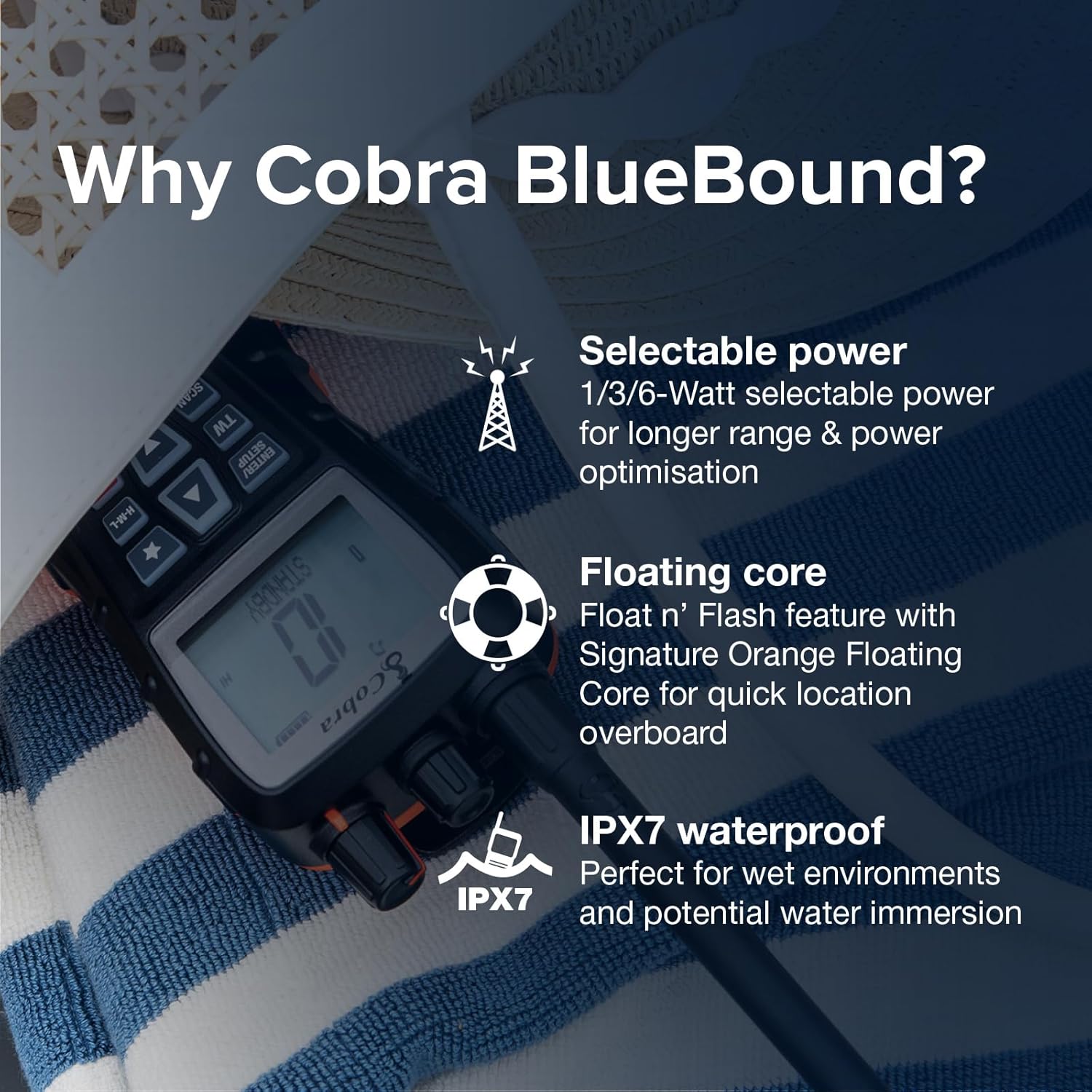
First impression: it feels like proper gear, not a cheap plastic walkie-talkie. The 6-watt power, IPX7 waterproof rating, and floating body with the flashing light are the main selling points, and they’re basically why I bought it. I’m not interested in Bluetooth or fancy pairing with phones; I just want clear comms with decent range and a radio that survives going overboard.
In actual use, the radio is simple to understand, even without reading the manual line by line. Buttons are clearly labeled, the screen is large enough, and the tri-watch and memory scan functions are easy enough once you’ve played with them for ten minutes. Nothing here feels revolutionary, but it covers the basics well. If you’ve used any VHF in the last 10 years, you’ll find your way around this one quickly.
It’s not perfect though. Some details annoyed me: the belt clip feels a bit flimsy, the menu logic is slightly clunky in places, and the speaker could be a bit louder in heavy wind. But for the price and what it’s meant to do—be a reliable floating backup or main radio on a small boat—it’s pretty solid overall.
Value for money: who this radio makes sense for
Price-wise, the BlueBound 350 sits in that middle zone: not the cheapest handheld VHF, but not in the high-end range with GPS and AIS either. For what you pay, you get 6 watts power, IPX7 waterproofing, floating with flashing light, USB-C charging, and about 12 hours of battery. For most casual boaters, that’s basically the checklist. You’re paying for reliability and practical features, not gadgets.
Compared to cheaper no-name radios I’ve tried, this one feels more solid and better thought out. The screen is easier to read, the button layout is more logical, and the float-and-flash feature alone is worth a bit extra in my opinion. When a radio goes overboard in real conditions, you don’t want to be staring at flat water wondering where it sank. Here, you actually see it. On the other hand, compared to big brands’ higher-end models with GPS or DSC, you obviously get fewer features, but you also save money and keep things simpler.
If your use is occasional—weekend coastal cruising, fishing trips, dinghy runs to shore—this hits a good balance between price and reliability. If you’re offshore a lot or doing longer passages, I’d still see this more as a backup to a fixed radio than your only line of communication. In that scenario, the value is still decent, but you might want to spend more on a model with GPS/DSC as your primary.
So in plain terms: good value for a solid, no-nonsense handheld. There are cheaper options if you just want something basic for rare use, and there are pricier ones if you want advanced features. This sits in the middle and makes sense for people who actually go out regularly but don’t need every bell and whistle.
Design: practical, a bit chunky, but easy to live with
Design-wise, the BlueBound 350 is pretty straightforward. Black body with an orange floating core in the middle so it’s easier to spot in the water. It’s not a small radio; it’s a bit tall (25.5 cm with the antenna), and if you’re used to very compact handhelds, this one will feel a bit bulkier. For me, it actually helped: the bigger size makes it easier to grip with cold or wet hands, and the buttons are spaced out enough to use with light gloves.
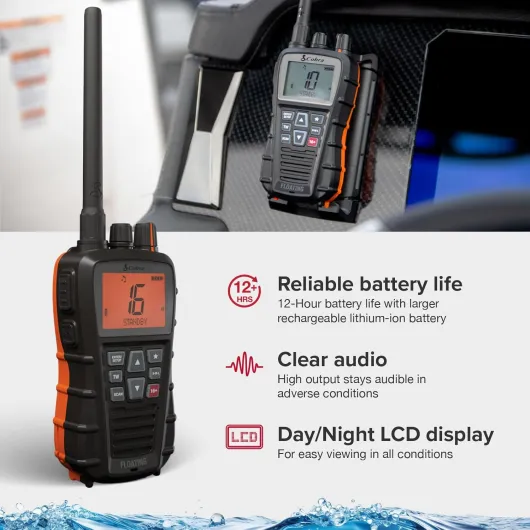
The Day/Night LCD display is one of the better points. In bright daylight on deck, I could read the channel number and icons without squinting too much. At night, with the backlight on, it’s clear but not blinding. The backlit buttons are also handy; you can actually see what you’re pressing instead of guessing in the dark. The layout is logical: PTT on the side, volume/squelch on top, and the main function buttons under the screen.
One thing I found slightly annoying: the belt clip. It works, but it doesn’t inspire a lot of confidence if you’re moving around a lot or crawling under a sprayhood. I tended to keep the radio in a pocket or clipped to a lifejacket D-ring instead. Also, the body is a bit square; it doesn’t sit super comfortably in a jeans pocket, but in foul-weather gear pockets it’s fine.
Overall, the design is focused on practicality, not looks. It’s not pretty, but it’s functional. You can operate it with one hand, the screen is readable in most conditions, and the orange core plus flashing light make sense for real use. If you care more about ergonomics than style, you’ll probably be okay with how this is put together.
Battery life and charging in real use
The battery is one of the reasons I picked this model. Cobra claims around 12 hours of use, and I’d say that’s roughly accurate in normal conditions. On a full day out (about 8–9 hours on the water), with the radio on almost the whole time, volume at about 50–60%, and occasional transmissions, I ended the day with one or two bars left. If you constantly chat or monitor loud channels at full volume, it will obviously drain faster, but for normal weekend boating, it’s fine.
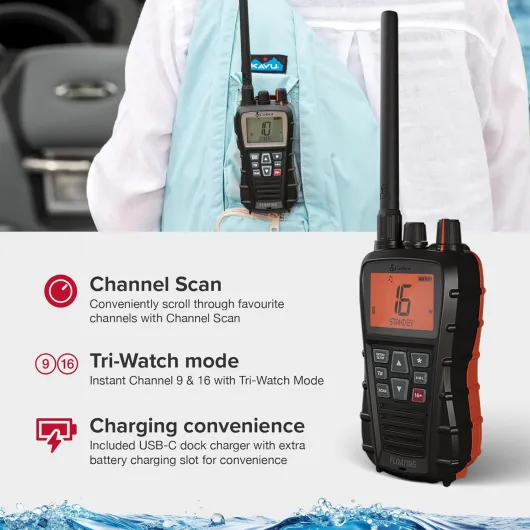
The radio comes with a USB-C dock, which is honestly very handy. I hate proprietary chargers. Being able to plug the dock into a regular USB port on the boat or a power bank made things simple. The dock also has a slot to charge a second battery, which I didn’t have, but if you’re doing multi-day trips with no shore power, it’s a nice option. Charging from low to full took a few hours; I usually left it overnight and it was ready by morning.
There’s also a battery saver mode, which turns off the receiver between channel checks to save power. I left it on by default and didn’t notice any downside in responsiveness. The radio also gives a clear low-battery indicator, so you’re not caught off guard. It doesn’t suddenly die on you without warning, which I’ve had happen with cheaper units before.
My only small complaint is the proprietary battery pack itself. It’s included, so that’s fine, but if it dies in a few years, you’re stuck buying Cobra’s replacement instead of just throwing in AA batteries. For now though, the combination of realistic runtime, clear battery status, and easy USB-C charging makes the power side of this radio pretty practical for most casual boaters.
Waterproofing, floating, and general toughness
I didn’t do lab tests, but I did treat this thing like normal boat gear: not gently. It got splashed with saltwater, sat in a wet cockpit pocket, and took a couple of low-height drops onto a fiberglass deck. So far, no issues. The IPX7 rating means it should survive being submerged to 1 meter for 30 minutes. I did a quick bucket test and also tossed it into the marina once on purpose: it floated as promised, screen up, and the Float n’ Flash kicked in with the strobe, which actually makes it easier to spot when you’re grabbing for it.
The casing feels solid enough. The plastic isn’t soft or rubbery, but it doesn’t feel like brittle toy plastic either. The seals around the battery compartment and ports look decent. After exposure to salt spray, I rinsed it with fresh water and didn’t see any fogging inside the screen or corrosion on contacts. Obviously, long-term durability will show after a season or two, but first impressions are positive.
One weak point could be the belt clip and maybe the antenna if you’re rough with it. The clip doesn’t feel bombproof; I wouldn’t trust it as the only attachment point when you’re leaning over the side. I’d recommend clipping it to your lifejacket or a lanyard. The antenna is flexible enough, but if you tend to throw gear into lockers, just be aware you can still bend or stress it.
Overall, from a durability point of view, I’d say it feels reliable for normal recreational use: weekend sailing, fishing, RIB runs, that kind of stuff. If you’re a commercial user beating on gear every day, you might want something more rugged and proven over years, but for the average boater, this holds up well so far and the waterproof/float features seem properly implemented, not just marketing lines.
Performance and range on the water
On paper, the BlueBound 350 offers up to 11 km of talking range. In real life, like any VHF, range depends on antenna height, sea state, and obstacles. On my small sailboat, using it from the cockpit, I was consistently clear with the marina and nearby boats at a few miles out. Compared to my older Standard Horizon handheld, I didn’t notice any big difference in range. Both were more limited by line of sight than anything else.
Audio clarity is good enough for real use. Received audio is clear at normal volume, and the automatic squelch does its job. When I cranked the volume up to fight engine noise and wind, the speaker started to sound a bit harsh, but still understandable. In strong wind right in your face, you’ll still need to bring it closer to your ear. Transmit audio: people on the other side heard me fine, no complaints. I did a few back-to-back tests with the fixed VHF on board, and the handheld was obviously weaker, but that’s expected.
The tri-watch and memory scan functions work as advertised. I set it to monitor 16, 9, and our working channel, and it cycled through them without any weird lag. It’s not lightning fast, but good enough for a handheld. Channel changing is quick, and the buttons respond well even when wet. I didn’t experience any random shutdowns or lockups, which is already a win compared to some cheaper handhelds I’ve tried.
So in terms of pure performance, it’s solid: range is what you expect from a 6-watt handheld, audio is clear enough, and the basic monitoring features are there. If you’re expecting miracles at 10+ miles from a handheld at deck level, that’s not realistic for any brand. As a backup to a fixed radio or a main radio on a dinghy, it does the job without weird surprises.
What you actually get with the BlueBound 350
Out of the box, you get the radio, antenna, battery, belt clip, a USB-C charging dock, and cable. No weird proprietary power brick, which I liked a lot. The dock has an extra slot to charge a spare battery, which is a nice touch if you plan longer trips. The radio itself weighs about 268 grams, so it’s light enough to carry all day but it doesn’t feel hollow or cheap in the hand.
Specs-wise, you’re looking at 6 watts max output, 41 channels, IPX7 waterproof rating (so submersible up to 1 meter for 30 minutes), and Cobra’s Float n’ Flash system: if it falls in the water, it floats with an orange core visible and a strobe starts blinking. Battery life is advertised at about 12 hours, and in my use that’s roughly what I got at medium volume with occasional transmissions—not a lab test, but realistic day-boating use.
The radio covers the standard marine VHF frequencies (156–174 MHz) and lets you select the country/region channel set. By default, it’s on the international channels, which is fine for most people. It also has tri-watch (so you can monitor channel 16 plus two more), memory scan, automatic squelch, and a battery saver mode. Nothing fancy like GPS or AIS, but you’re not paying for that either.
Overall, the feature set is basic but complete for a handheld backup or primary radio on smaller craft. If you’re used to big fixed VHFs with tons of extras, this will feel stripped down, but in a good way: fewer things to set up, less chance to press the wrong button when you’re wet, cold, and annoyed. For this price range, I’d say the package is fair and focused on the essentials.
Pros
- Floats and flashes when overboard, making it easy to recover
- Solid battery life around a full day of typical use and easy USB-C dock charging
- Clear, readable day/night display and simple, logical controls
Cons
- Belt clip feels a bit flimsy for heavy or professional use
- No GPS or DSC features, so less suited as a primary radio for serious offshore trips
Conclusion
Editor's rating
The Cobra BlueBound 350 is a practical, straightforward handheld VHF that does what most boaters actually need: it floats, it flashes if it goes overboard, it’s properly waterproof, and the battery lasts a full day on the water. The screen is readable in sun and at night, the buttons are simple, and the 6-watt output with tri-watch and memory scan covers normal recreational use without getting complicated. It’s not the smallest or prettiest radio, but in real use it feels like a tool, not a toy.
It’s not perfect. The belt clip could be sturdier, the speaker could be louder in heavy wind, and the menu system isn’t the most modern. You also don’t get GPS or DSC, so if you’re doing serious offshore work or want distress calling built into the handheld, this isn’t the right model. But for day sailing, fishing, RIBs, or as a backup to a fixed set, it’s reliable, easy to charge with USB-C, and generally hassle-free. If you want a simple, floating VHF you can trust more than the bargain-bin brands, this is a solid pick. If you’re a power user who wants advanced features and super rugged build, you’ll probably want to look higher up the range or at more professional models.