
Summary
Editor's rating
Value: cheap entry ticket, but I’d rather pay a bit more
Design: small screen and awkward mounts
Battery and power: very picky about voltage
Durability: plastic parts you have to baby
Performance on the water: works, but very sensitive to settings
What this fish finder actually offers on paper
Pros
- Shows depth, temperature, bottom contour and fish icons when kept near default settings
- Portable and relatively compact, easy to store and move between boats
- Lower price than big-name fish finders with similar basic features
Cons
- Very picky about power, display cuts out when voltage drops below around 12.5 V
- Small screen and basic bracket that only tilts up/down, hard to position and read
- Flimsy transducer mount that feels easy to break and may need DIY replacement

Specifications
View full product page →| Brand | SHUAIGUO |
A budget fish finder that looks better on paper than on the water
I took this F918-C180S fish finder out because I wanted something cheap for a small boat and a kayak, without dropping brand-name money. On the box it sounds pretty decent: 300 m wireless range, 180 m depth, 45° beam, LCD screen, alarms, all the usual sonar stuff. In reality, it’s a bit more rough around the edges than the specs suggest. It works, but you can feel it’s a low-cost unit from a no-name brand as soon as you start using it.
I’ve used Garmin and Lowrance entry-level units before, so I had a point of comparison. With this one, you quickly see where they cut corners: screen size, mounting hardware, and how picky it is about power. At the same time, it does show depth, bottom contour and fish icons, and when it’s dialed in, it’s not useless at all. For casual weekend fishing, it can help you find drop-offs and roughly see if there’s life under the boat.
Over a few outings, I mainly used it on a small aluminum boat on a lake and once from a pontoon. I played with sensitivity, alarms, and chart speed to see how far I could push it. The more you move away from the factory settings, the more the screen gets messy, especially in murky water. You end up spending more time fiddling than actually fishing, which kind of defeats the point of the fancy menus.
If you’re expecting a polished, idiot-proof fish finder, you’ll probably be disappointed. If you’re okay with something a bit clunky that gives basic sonar info and you’re handy enough to fix a weak bracket or two, it can get the job done. Personally, after using it, I’d say it’s usable but not something I’d rush to buy again now that I know its limits.
Value: cheap entry ticket, but I’d rather pay a bit more
From a value perspective, the F918-C180S sits in that awkward spot where it’s cheaper than big brands but not so cheap that you forgive everything. You do get a functioning fish finder with decent depth range, temperature, fish icons, and a portable setup. For someone who just wants to know “how deep is it here” and get a rough idea if there’s fish under the boat, it can be enough, especially if the price is significantly lower than a Garmin or Lowrance basic unit in your market.
The problem is, once you factor in the small screen, flimsy brackets, picky power behavior, and fussy settings, the gap with entry-level known brands doesn’t feel huge anymore. If you can afford to add a bit more money, you’ll likely get a clearer screen, better mounting hardware, and a sonar image that stays readable even when you tweak sensitivity. For me, that matters more over time than saving a few bucks at the start.
On the flip side, if you’re on a tight budget, fish occasionally, and are comfortable tinkering a bit (like making your own bracket or dedicating a battery to it), then the value isn’t terrible. It does what it says most of the time, and when it’s set up right, it helps you find drop-offs and see some fish activity. Just don’t expect miracles or pro-level reliability. I’d call it “decent but nothing more” in terms of value.
Personally, after using it, I agree with the Amazon reviewer who said they probably wouldn’t buy it again and would spend a bit more for a larger screen. That’s exactly where I landed. It’s not a total waste of money, but if I had to do it over, I’d put the cost of this unit towards a lower-end model from a known brand and get better usability and longevity out of it.
Design: small screen and awkward mounts
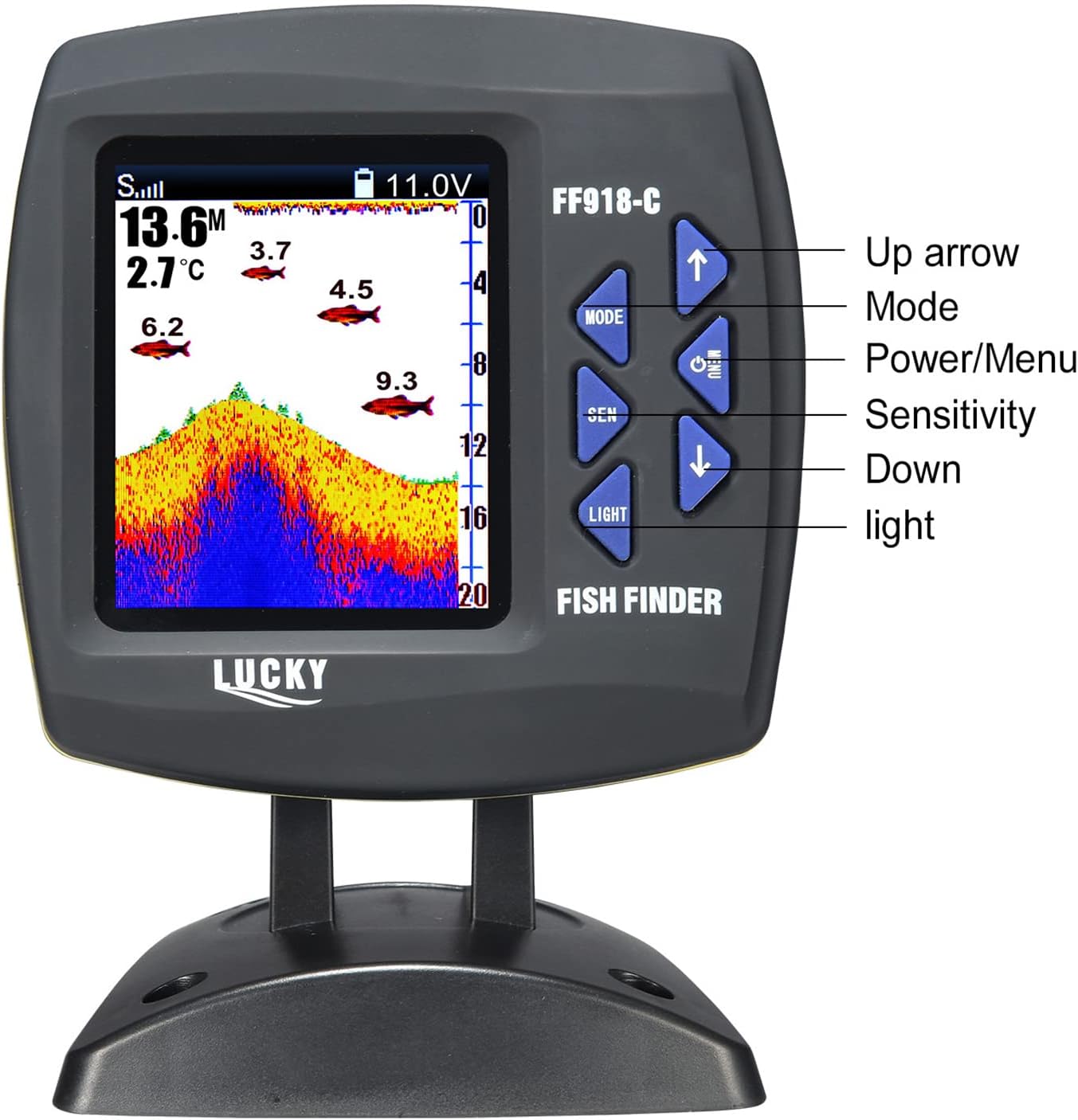
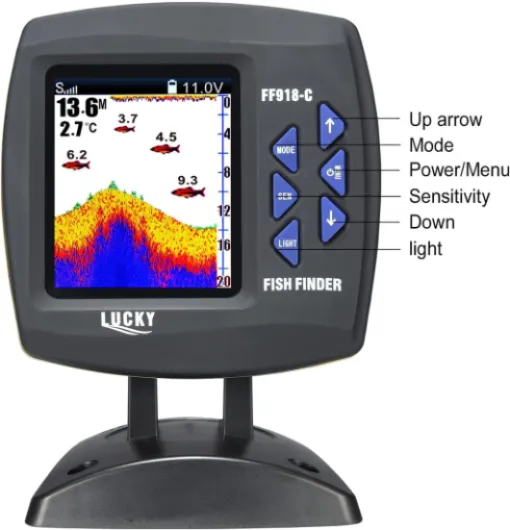
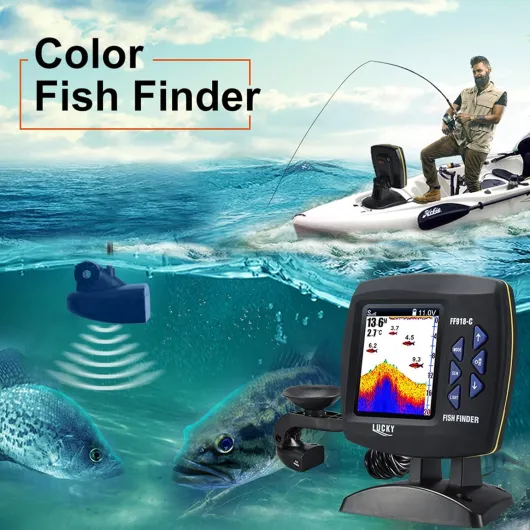
The first thing that stood out to me with the F918-C180S is the screen size. At 8.6 cm (a bit over 3 inches), it’s on the small side. On the bank or in the garage it looks okay, but once you’re on the water, with light reflections and some distance from your eyes, you quickly realize you’ll probably need reading glasses if your eyesight isn’t perfect. Trying to read individual depth values on fish icons is not very pleasant, especially when the boat is moving and you’re also trying to manage rods and lines.
The bracket for the display is also pretty basic. Like that Amazon review says, it only allows up and down tilt, not left and right rotation. In practice, that means if you don’t mount it exactly where you need it, you can’t just swivel the screen towards you. On my small boat, I ended up in a weird position trying to see the display properly because I couldn’t angle it sideways. For a portable unit, that’s a bit annoying. A simple swivel joint would have solved it.
The transducer mount is even more of a weak point. The plastic bracket feels light and a bit flimsy. Mine didn’t snap on the first outing, but I can easily see how it could, especially if you bump it on the dock or if you mount it on a board and forget it while trailering. Another buyer said theirs broke right away and they had to make a custom stainless steel bracket. Honestly, I’m not surprised. I ended up tightening it very carefully and checking it every time I launched the boat because I didn’t trust it.
In terms of overall design, the unit is compact and easy to store, and the LCD is readable in the shade but struggles in direct sun like most cheap screens. The menus are laid out in a phone-like style, which is decent once you get used to it, but the buttons don’t feel very premium. It’s not unusable, but you can tell design and ergonomics were not top priorities. It’s functional enough, but a bit clunky and clearly built to a tight cost.
Battery and power: very picky about voltage
The power side of this unit is where I had one of my biggest frustrations. It’s advertised as battery powered, which is fine, but in practice it behaves like a diva when the voltage drops a bit. Using a small 12 V battery that I also use for lights and a bilge pump, I noticed that once the charge dropped and the voltage dipped under roughly 12.5 V, the display started acting up. It would flicker, then sometimes just go blank until I reset it or the battery recovered a bit.
This lines up exactly with the Amazon review that mentions the display disappearing below 12.5 V. That’s a very narrow window if you’re using a normal small lead-acid or AGM battery for a fishing session. Most decent electronics tolerate voltage drops better than that. Here, you basically need a fresh, well-charged battery and not much else running off it if you want the fish finder to stay stable for several hours.
On days when I started with a fully charged battery and only used the fish finder, it ran for a normal fishing session without cutting out. So it’s not that it consumes a crazy amount of power; the problem is more the low tolerance to voltage sag. Once you add other small loads or the battery is a bit tired, you start seeing issues. You don’t get a smooth warning either, it just kind of drops the display and becomes unreliable.
If you plan to use this on a kayak or a small boat, my advice is simple: dedicate a good, separate 12 V battery just for the unit, or at least make sure your main battery is in very good shape. Don’t expect it to behave nicely at the end of a long day when the battery is half-discharged. For me, that’s a clear weak point, because portable gear should be more forgiving, not less.
Durability: plastic parts you have to baby
Durability-wise, this feels like a typical low-cost Chinese electronic: the main unit itself seems okay if you don’t drop it, but the accessories are clearly where they saved money. The casing of the display is decent plastic, not super thick but not paper-thin either. I got splashes on it and light rain, and it kept working, so from a basic waterproofing standpoint it held up. I wouldn’t fully submerge it or leave it banging around in the bottom of the boat, though.
The weak link is definitely the transducer bracket. The plastic there feels brittle. I was careful tightening it to the mounting surface and still had the feeling I could crack it if I went a little too far. Another user actually broke theirs on the first outing and had to fabricate a stainless-steel bracket. That doesn’t surprise me at all. If you buy this, I’d seriously consider reinforcing the mount or planning to replace it with something sturdier, especially if you fish in places where you might bump rocks or logs.
The display bracket is mechanically simple, which is good for not breaking, but because it only moves up and down, you end up adjusting it in awkward ways. The hinge itself feels okay, but again, it’s not the kind of hardware you want to torque hard or lean on. Treat it gently and it’ll probably last, but it doesn’t inspire a lot of confidence. The cables are thin but flexible, and so far I haven’t had any issues with them, though I keep them coiled and stored properly between trips.
Overall, I’d rate durability as “acceptable if you’re careful”. This is not a rugged, throw-it-anywhere fish finder. It’s fine for occasional use if you baby it, rinse off salt, and don’t over-tighten anything. If you’re rough on gear or fish a lot in tight, rocky spots, I’d be worried about the transducer mount and long-term wear. For the money, it’s not shocking, but it’s definitely an area where they cut corners.
Performance on the water: works, but very sensitive to settings
In terms of raw performance, the F918-C180S does what it says: it shows depth, bottom contour, water temperature, and some fish targets. I tried it on a lake with depths between 3 and 25 meters. The depth readings were generally consistent with what I know from other sonars and maps, maybe off by a small margin now and then but nothing dramatic. Bottom contour is also fairly clear: you can see when you go from soft mud to harder bottom because the return thickens up on screen.
Where it gets tricky is with the fish detection and sensitivity. On the default settings, the screen is fairly clean and you get some fish icons popping up. As soon as you start tweaking sensitivity to pick up more detail, especially in murky water, the display quickly gets cluttered with noise. At that point, it becomes hard to tell what’s actually a fish and what’s just debris or interference. The Amazon reviewer wasn’t lying: if you move too far from the recommended settings, the image can become almost unreadable, especially for someone new to fish finders.
The fish alarm and shallow alarm work, but they’re a bit crude. The fish alarm tends to beep for anything that looks like a target, which means you get a lot of false positives in busy water. I turned it off after a while because it was just too chatty. Chart speed is adjustable, which is nice, but at higher boat speeds the screen doesn’t really give you a stable picture anyway. This is more of a slow-trolling or anchored-up kind of unit, not something for scanning big areas at speed.
Overall, when you leave it close to factory settings and you’re in reasonable conditions, the performance is okay for casual use. You can see drop-offs, you can roughly see if there’s fish around, and you get reliable depth and temperature. But it’s not forgiving. Push it out of its comfort zone and the screen becomes a noisy mess. Compared to entry-level Garmin or Lowrance units I’ve used, it’s clearly a step below in terms of clean, stable sonar image.
What this fish finder actually offers on paper
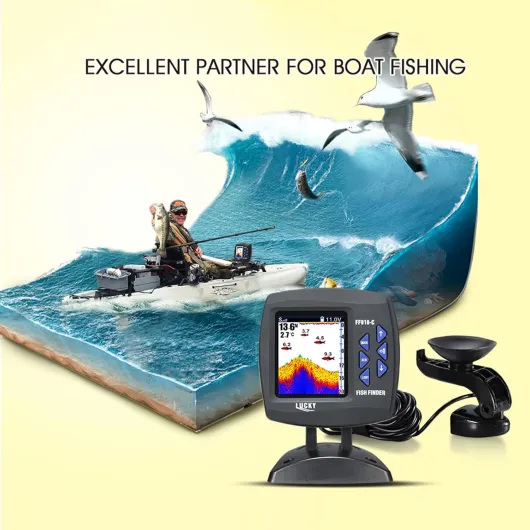
On paper, the F918-C180S looks like a pretty solid little sonar for the price. You get a wired transducer with a 45° beam at 200 kHz, a portable LCD unit, and a bunch of functions: depth range, shallow alarm, fish alarm, chart speed settings, and adjustable sensitivity. It’s rated for up to about 590 ft (180 m) of depth, which is way more than most lakes and rivers I fish. The brand is SHUAIGUO, which I had never heard of before, but that’s pretty common with budget electronics from China.
The screen size is listed at 8.6 cm (a bit over 3 inches), so don’t expect a big bright display like you see on mid-range units. The menus are set up a bit like a phone, with icons and nested options. It’s battery powered, so you don’t need to hard-wire it to a boat’s electrical system, but you do need a decent 12 V source. One thing I noticed quickly: when the voltage drops under about 12.5 V, the display tends to cut out or disappear, which matches the user review you see on Amazon. So it’s picky about power quality.
Function-wise, it promises to show: water depth, water temperature, fish location, and bottom contour. It does show all of that, but accuracy and readability depend a lot on how calm the water is and how well you set the sensitivity. In clear water with moderate depth, you can clearly see the bottom and some structure. In very murky or choppy water, it becomes a guessing game because the screen clutters up fast if you raise the sensitivity too much.
Overall, the presentation is that of a “does everything” budget fish finder, but once you use it you realize it’s more a basic depth/fish indicator with lots of menu options that you’ll mostly leave alone. If you go in thinking “cheap sonar with some extras” instead of “mini high-end sounder”, you’ll be closer to reality.
Pros
- Shows depth, temperature, bottom contour and fish icons when kept near default settings
- Portable and relatively compact, easy to store and move between boats
- Lower price than big-name fish finders with similar basic features
Cons
- Very picky about power, display cuts out when voltage drops below around 12.5 V
- Small screen and basic bracket that only tilts up/down, hard to position and read
- Flimsy transducer mount that feels easy to break and may need DIY replacement
Conclusion
Editor's rating
After a few sessions with the F918-C180S, my overall feeling is that it’s a functional but compromised fish finder. It does give you depth, temperature, bottom contour and fish icons, and when you leave it close to the default settings, the screen is reasonably clear in normal conditions. For casual anglers who just want basic sonar info on a small boat or kayak and don’t want to spend big, it can get the job done as long as you’re patient with it.
On the downside, the small screen, limited bracket movement, and flimsy transducer mount make the physical side a bit frustrating. The unit is also very sensitive to power: once your 12 V source drops under roughly 12.5 V, the display can disappear or act unreliable, which is annoying on longer outings. And if you like to tweak sensitivity and settings, be ready for a cluttered, noisy display that’s hard to interpret. Compared to entry-level units from bigger brands, it clearly feels a step behind in polish and ease of use.
I’d say this is for someone on a tight budget who fishes occasionally, is okay with tinkering (maybe reinforcing the mount and dedicating a battery), and mainly wants a simple depth and basic fish indicator. If you fish often, care about a clean, readable screen and long-term durability, or hate dealing with power quirks, I’d skip this and spend a bit more on a known brand with a bigger display. Personally, I wouldn’t buy it again now that I’ve tried it.