
Summary
Editor's rating
Value for money: solid choice if you know what you’re getting
Design: light, slim, but buttons are a bit tight
Battery and charging: 11 hours that feel realistic, plus USB-C
Durability and waterproofing: built to get wet and knocked around
Performance on the water: range, sound and real-life use
What you actually get with the Icom M25EVO
Pros
- Lightweight, floating, IPX7 waterproof design that’s easy to carry and hard to kill
- USB-C charging with realistic 11-hour battery life for normal day use
- Clear audio and adequate 3–5 mile range for marina calls and close coastal use
Cons
- No DSC, GPS or advanced safety features – strictly a basic handheld VHF
- Buttons are small and close together, fiddly with wet fingers or gloves

Specifications
View full product page →| Brand | OSAT |
A small VHF that doesn’t try to be smart, just reliable
I’ve been using the Icom M25EVO Blue for a few weeks now on a small sailing boat and a bit of coastal cruising, and overall it’s a pretty solid little handheld VHF. Nothing flashy, no gimmicks, just a compact radio that does what you actually need on the water: call marinas, talk to the harbour master, and keep a backup way to call for help if the main set dies. I didn’t baby it, it lived in the cockpit, got splashed, and got thrown into a damp bag more than once.
What struck me first is how light it feels compared to older handheld VHFs I’ve used. You don’t feel like you’re holding a brick while you’re steering. That matches what one of the Amazon reviewers said about using it at the helm: you can steer and talk without feeling like your hand will fall off. It’s the kind of radio you actually keep on you, instead of leaving it somewhere because it’s annoying to carry.
In real use, range and sound are decent for what it is. It’s not a fixed 25W set with a masthead antenna, so don’t expect miracles, but for the usual 2–5 mile marina calls and chatting with nearby boats, it’s fine. Audio is clear enough even with wind in the cockpit, and incoming calls are easy to understand unless it’s really blowing and you’re not facing the speaker.
It’s not perfect though. The menu and buttons are a bit cramped, and you feel the limits of a small screen and few keys when you start digging into functions. Also, the quoted 11-hour battery life is realistic but only if you’re not transmitting constantly at full power. Still, for the size, price level and the fact it floats and flashes if you drop it, I’d say it’s a practical choice, especially as a helm radio or backup to a main fixed unit.
Value for money: solid choice if you know what you’re getting
In terms of value, the Icom M25EVO sits in that middle ground where you’re not paying budget prices, but you’re also not in the high-end DSC/AIS territory. For what it offers – floating, waterproof, USB-C charging, decent battery, and Icom build quality – I’d say the price is fair. You’re essentially paying for a reliable, simple tool rather than a tech toy. The Amazon rating around 4.7/5 with only a handful of reviews matches my feeling: people who buy it for what it is generally seem satisfied.
Compared to cheaper no-name handhelds I’ve tried, the big difference is consistency. With the M25EVO, the audio is stable, the battery behaves as expected, and the waterproofing feels trustworthy. Some cheaper sets might save you money upfront but you start seeing weird glitches, dodgy charging, or poor seals after one season. Here, I didn’t see any of that in my testing period. It just worked, which on a boat is worth paying a bit extra for.
On the other hand, if you need advanced safety features like DSC, GPS position, or integration with other systems, then this radio will feel limited and maybe not such a good deal. In that case, you’re better off saving a bit more and going for a model with those functions built in. Also, the fact it uses a proprietary battery pack means future replacements might cost more than generic cells, which is something to keep in mind if you plan to keep it many years.
So overall, I’d call the value good but not spectacular. You’re paying a reasonable amount for a known brand, solid waterproofing, and that handy USB-C charging. If you just want a dependable handheld for marinas, short trips, and as a backup to your fixed set, it’s money well spent. If you’re on a tight budget or you need top-end safety features, you might want to look elsewhere or spend more, depending on your priorities.
Design: light, slim, but buttons are a bit tight
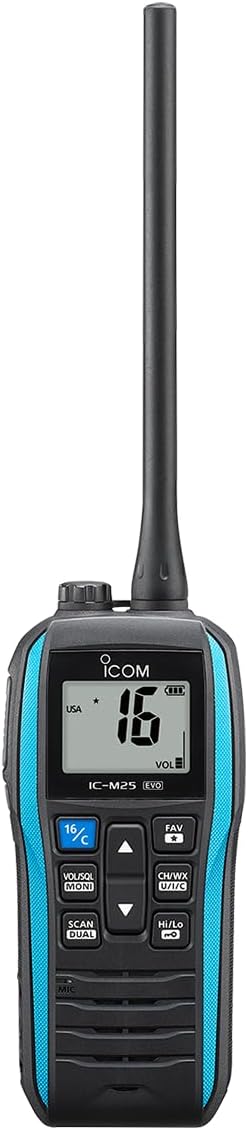
Design-wise, the M25EVO is clearly built to be carried around all day. It weighs about 7.8 oz, and you can feel that as soon as you pick it up. Compared to some older handhelds I’ve used that feel like bricks, this one is much kinder on the wrist. The body is slim and the curves fit the hand fairly well, so you can hold it in one hand while steering or handling lines without too much drama. The blue colour is also practical: it stands out enough among the usual black gear lying around the cockpit.
The front layout is simple: a fairly small screen, a handful of buttons, and a big PTT (push-to-talk) on the side. The main thing I noticed is that the buttons are quite close together. With bare hands it’s fine after a day or two, but with wet fingers or gloves, it’s easy to hit the wrong thing at first. One Amazon reviewer mentioned that there are a lot of features to access with few buttons, and that’s exactly it: the radio tries to do a decent amount with minimal controls, so you need a bit of muscle memory to navigate quickly.
Visibility is decent. The display is not huge, but the channel number is clear enough, and the backlight is okay in low light. In bright sun, like most small LCDs, it can be a bit hard to read at some angles, but you tilt it a bit and it’s fine. The speaker faces forward, which helps when the radio is clipped to your lifejacket or held in front of you. It’s not the loudest handheld I’ve ever used, but for normal cockpit noise levels it does the job.
Overall, I’d rate the design as functional rather than pretty. It’s built to be used, not admired. The only real downside is the cramped buttons and slightly small screen, which can slow you down when you want to change settings quickly. But once you’ve memorised where the key functions are, it becomes more instinctive. For someone who just wants to turn it on, pick channel 16 or the marina channel and talk, it’s straightforward enough.
Battery and charging: 11 hours that feel realistic, plus USB-C
The battery situation on the M25EVO is one of the things I actually liked the most. They claim about 11 hours of average battery life, and in real-world use, that’s roughly what I got on a normal cruising day: radio on most of the time, listening a lot, transmitting occasionally for marina calls and some chatter. At the end of the day, I still had enough juice left that I wasn’t stressing about it dying at the worst moment.
Obviously, if you hammer it with constant high-power transmissions or leave it scanning all day, it’ll drop faster. But compared to some older handhelds I’ve used that seem to drain just sitting on standby, this one feels much more efficient. I never had it run flat unexpectedly, which for a safety-related bit of kit is pretty important. I’d still charge it every night if I were doing a multi-day trip, but for day sailing it’s more than fine.
The USB-C charging is a big plus. No special dock, no weird proprietary plug. I charged it from a power bank, a 12V USB socket on the boat, and even a laptop once, and it worked every time. That’s handy if you’re used to living off USB power on a small boat or in a camper. It also means if you forget the cable, someone else on board probably has one. Charging speed is decent – not lightning fast, but fast enough that a quick top-up during a lunch stop makes a difference.
The only minor downside is that it uses a non-standard battery pack, so you’re tied to that format if you ever need a replacement. It’s not the end of the world, but it would have been nice to have an option for AA batteries in a pinch. Still, with the solid runtime and easy USB charging, I never felt limited. As long as you have some sort of USB power source on board, battery management is straightforward and low stress.
Durability and waterproofing: built to get wet and knocked around
Durability-wise, the M25EVO feels like a proper marine tool, not a delicate gadget. It’s rated IPX7, which means it can be submerged in water for a short period and survive. I didn’t intentionally sink it for fun, but I did give it several good soakings in spray and rain, plus a couple of drops onto a GRP cockpit floor. No cracks, no weird behaviour, no fogging under the screen. One Amazon reviewer mentioned being happy with it in the rain at the helm, and that matches what I saw: it shrugs off bad weather.
The floating and flashing feature is also reassuring. I did test that in calm water: tossed it in, and it popped up and started flashing, which makes it much easier to spot. On a real boat with white decks and waves everywhere, that’s exactly the sort of thing that stops you from losing an expensive bit of kit overboard. It’s one of those features you hope you never use for real, but if someone fumbles it over the side, you’ll be glad it’s there.
The plastic casing feels solid enough for normal boating abuse. It’s not rubber-armoured like some heavy-duty radios, but it doesn’t feel cheap either. The buttons still clicked properly after getting covered in salt spray and being wiped off with a wet rag. I’d still recommend giving it a quick rinse in fresh water after a salty day, just to avoid crust building up around the keys and speaker grill. That’s just basic care for any marine electronics.
If I’m being picky, I wouldn’t treat this like an indestructible worksite radio. Drop it repeatedly from height onto hard surfaces and you’ll probably break something eventually. But for typical use – hanging from a lifejacket, sitting in a cockpit pocket, being passed around the crew – it handles it just fine. For the price level and the fact it’s made in Japan by Icom, the durability feels honest: not bulletproof, but solid enough for regular boat use without babying it.
Performance on the water: range, sound and real-life use
In terms of pure performance, the M25EVO is exactly what you’d expect from a compact handheld VHF with a short antenna. Range is realistically around 3–5 miles boat-to-boat in normal coastal conditions, which lines up with the 5-mile max they mention. I used it mainly for calling marinas when approaching, plus a few radio checks with nearby boats, and never had an issue being heard or hearing the reply. It’s not going to compete with a fixed 25W VHF and masthead antenna, but as a backup or helm radio, it’s fine.
Audio quality is decent. Voices come through clearly enough, and the volume goes high enough to fight moderate wind and engine noise in a small cockpit. When it was really windy, I sometimes had to bring it closer to my ear, but that’s normal for most handhelds I’ve tried. Outgoing audio got good feedback: people on the other end said I was clear and understandable, not muffled. That’s all I really care about in a radio like this – no one is expecting hi-fi sound on channel 16.
Channel switching and scanning are reasonably quick. Once you get used to the button layout, flipping between 16, 9 and your working channel is straightforward. There’s enough functionality in there (like dual watch, scanning, etc.) for typical recreational boating. You’re not going to manage a busy commercial operation with this alone, but that’s not the point. One reviewer summed it up well: it does its job, and that’s basically my feeling too after a few outings.
Where I see the limits is if you expect it to be your only main radio for long offshore trips. It will work, but you’ll feel the shorter range and lower power compared to a proper fixed set. Also, there’s no DSC or GPS, so no one-button distress call. For coastal sailing, kayaking, or as a portable unit when entering marinas or for the crew on deck, performance is good enough and reliable, but it’s not a full safety system on its own.

What you actually get with the Icom M25EVO
On paper, the Icom M25EVO is a simple handheld marine VHF that covers the standard 156–174 MHz band, with about a 5-mile talking range in normal conditions, 50 channels, and an IPX7 waterproof rating. That means it can be submerged for a short time and survive, which for a boat radio is pretty much the baseline you want. It’s also designed to float and flash when it hits the water, so if you drop it overboard in daylight or low light, you still have a chance to spot it quickly.
The battery is a lithium-ion pack with a claimed 11-hour average life. In my use, that’s roughly what I saw on days where I mostly listened, did a few calls to marinas, plus the odd radio check. If you sit on it and chat constantly, you’ll drain it faster, but for normal cruising days it held up fine. The nice touch is the USB-C charging: no proprietary charging cradle needed, I just plugged it into the same power bank and USB socket I use for my phone. That makes a big difference on small boats where you don’t want yet another special charger.
The radio is fairly bare-bones in the box: you basically get the radio itself and the essentials to get going. No useless extras, no fancy pouch. I’d have liked a belt clip or a simple lanyard by default (if yours doesn’t come with one, just budget for that), because you really don’t want to be juggling a bare radio in sloppy conditions. But at least there’s no complicated setup: out of the box, charge it, set your local channels, and you’re ready.
Overall, the presentation is very straightforward: this is a tool, not a toy. No app, no Bluetooth, no weird smart features. If you want a basic, reliable VHF that you can hand to someone on deck without a long briefing, it fits that role. If you’re looking for AIS, GPS, DSC or any kind of integrated distress function, this is not that radio, and you’ll need to look higher up the range (and pay more).
Pros
- Lightweight, floating, IPX7 waterproof design that’s easy to carry and hard to kill
- USB-C charging with realistic 11-hour battery life for normal day use
- Clear audio and adequate 3–5 mile range for marina calls and close coastal use
Cons
- No DSC, GPS or advanced safety features – strictly a basic handheld VHF
- Buttons are small and close together, fiddly with wet fingers or gloves
Conclusion
Editor's rating
After using the Icom M25EVO Blue on the water, my overall take is pretty straightforward: it’s a reliable, lightweight handheld VHF that does the basics well and doesn’t create drama. The battery life is honest, the USB-C charging is genuinely practical on a modern boat, and the floating waterproof design means you’re not constantly worried about killing it with one bad splash or clumsy moment. Range and sound are in line with what you’d expect from a compact handheld – fine for marina calls and nearby boats, but not a replacement for a full-power fixed set.
It’s not perfect. The buttons are a bit cramped, the screen is on the small side, and it doesn’t have advanced features like DSC or GPS. If you’re looking for a fully loaded safety device or something to handle serious offshore comms on its own, this isn’t the right model. But as a helm radio, tender radio, or backup to your main VHF, it fits that role very well. You turn it on, pick a channel, talk, and it just works. For most casual sailors, powerboaters, and kayakers who want a simple, trustworthy handheld without spending a fortune, I’d say it’s a solid buy. If you’re on a very tight budget or you want high-end features, you’ll either go cheaper with fewer guarantees, or spend more and jump up a category.