
Summary
Editor's rating
Value for money: where it makes sense and where it doesn’t
Design: basic, compact, and clearly built to be tossed around
Battery life: good enough for a full day, with some margin
Durability and build: decent for the price, but not indestructible
Performance on the water: does it actually help you catch fish?
What you actually get with the MT-202
Pros
- Very portable wireless design: castable sensor, no drilling or wiring needed
- Solid battery life that comfortably covers a full day of fishing
- Gives useful depth and basic fish presence info that helps avoid dead water
Cons
- Old-school screen and interface, not very bright in strong sunlight
- Fish icons can be inaccurate at times, especially in weedy areas

Specifications
View full product page →| Brand | LUCKY |
A cheap way to stop fishing blind?
I picked up the LUCKY MT-202 because I was tired of casting blindly from the bank and from my kayak. I didn’t want to drill anything into the hull, and I didn’t feel like spending big money on a fancy Garmin. This one looked like a simple, wireless, throw-it-in-the-bag type of unit, so I gave it a go for a few weekends on a small lake and a slow river near my place.
My main goal was basic: I wanted to know roughly how deep it was, if there were fish around, and avoid wasting time casting over dead water. I wasn’t expecting pro-level accuracy or detailed structure mapping. Just something that tells me: “yes, there’s life here” or “move on.” With that in mind, I used it from the shore, from a sit-on-top kayak, and once through a hole in thin ice at the end of winter.
In practice, the MT-202 does what it says on the box: it shows approximate depth, indicates fish targets with icons, and gives a rolling view of what passed under the sensor. It’s not super precise like a full chartplotter, but for casual fishing it’s actually pretty helpful. I caught more fish on the days I used it, mostly because I stopped insisting in empty spots.
It’s not perfect though. The menus feel a bit old-school, the screen is only OK in bright sun, and the depth range is limited compared to bigger units. But if you just want a simple, wireless sonar you can toss out like a bobber, it’s a pretty solid gadget that makes shore and kayak sessions less random and a bit more fun.
Value for money: where it makes sense and where it doesn’t
For what it costs, the MT-202 sits in that middle ground: not dirt cheap, not high-end. In terms of value, it depends a lot on what you expect. If you’re a casual angler who usually fishes from the bank, a kayak, or a small boat and you currently have zero electronics, this thing gives you a noticeable advantage without blowing your budget. You get depth readings, basic fish detection, and a simple, portable setup that doesn’t require drilling holes or wiring anything to a 12V battery.
Compared to higher-end brands with big color screens and GPS, of course this looks basic. No maps, no waypoints, no fancy structure scan. But those units cost several times more and usually need a fixed install. Here, for a fraction of that price, you get something you can toss in a backpack and use on any water: small ponds, rivers, lakes, even ice fishing. That flexibility is where the value really shows. I’ve already used it on three different lakes and one river without changing anything except where I cast the sensor.
On the downside, the interface feels dated, the screen is only OK in strong sunlight, and the depth range (up to around 147 ft) is fine for most lakes but not for serious offshore fishing. If you mainly fish deep reservoirs or want detailed structure mapping, this will feel limited pretty fast. Also, the fish icons and occasional false readings mean you still need to use your head and not blindly trust every symbol on the screen.
For me personally, the price-to-benefit ratio is pretty solid. It helped me waste less time on dead water, understand my local spots better, and made shore sessions a bit more interesting. If your expectations are realistic – a simple, portable helper, not a pro sonar system – the value is good. If you want high-end features and perfect accuracy, you’re better off saving up for something more advanced and skipping this one.
Design: basic, compact, and clearly built to be tossed around
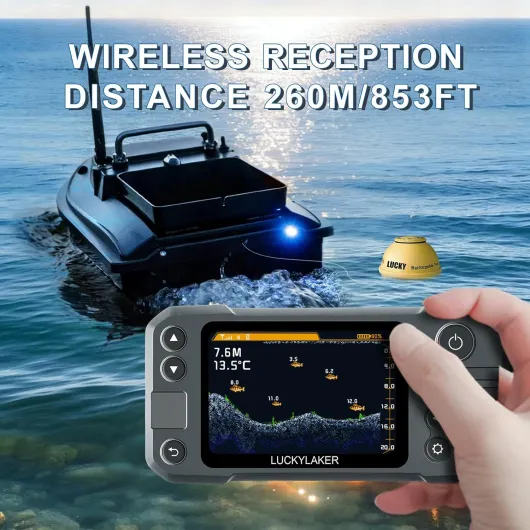
Design-wise, the MT-202 is very no-nonsense. The handheld unit is a small rectangular block of plastic with a 3.5-inch screen, a few rubbery buttons, and a textured back. It’s not pretty, but it feels practical. The size is nice: I can hold it in one hand, operate the buttons with my thumb, and still keep my rod in the other hand. It also slips easily into a jacket pocket or a side pouch on my backpack when I’m walking along the bank.
The floating transducer is basically a yellow plastic puck shaped like a small buoy. There’s a metal ring where you tie your line or the tether. It’s light enough to cast with a medium spinning setup – I used a 10–30 g rod and it felt fine. You do feel the weight compared to a normal float, but it’s not like casting a brick. Once it hits the water, it sits upright and starts sending data pretty quickly. I didn’t have issues with it flipping or sinking.
The buttons on the main unit are functional but not very refined. They click, they work, but the layout is a bit old-fashioned. You’ve got a power button, menu, up/down, and confirm. After a day or two, you know where everything is, but the first time you’ll probably press the wrong one a few times while looking at the water instead of the screen. Also, the screen has a basic backlight, which is handy for early morning or dusk, but in full sun you sometimes have to tilt it a bit to see better.
Overall, the design feels like something made for practical use, not for looks. It’s compact, easy to throw in a bag, and the floating sensor idea is genuinely handy if you don’t want to drill or mount anything. Just don’t expect premium materials or a modern look – this is more “tool” than “gadget you show off.” For the price, I’m fine with that trade-off.
Battery life: good enough for a full day, with some margin
Battery is always a big deal with these portable units, especially if you do longer sessions or a full weekend trip. The MT-202 is rechargeable (both the display and the sensor), which I prefer over burning through AA batteries. I charged both fully before each outing and tracked roughly how long they lasted. On average, with the screen brightness at a medium level and the unit on almost constantly, I got around 6–8 hours of use on the display before the battery indicator started to drop into the last bar.
The sensor seems to sip power quite slowly. Since it only really works when it’s in the water, it doesn’t drain much when you’re moving spots or walking. Across several 3–4 hour sessions, I never had the sensor die on me. I did one longer day, about 7 hours with breaks, and both the display and sensor still had juice left when I packed up. For most people doing normal day trips, that’s more than enough. If you’re going on a multi-day camping trip without power, you’d want a power bank or small solar panel to top it up, but that’s true for almost any electronic gear.
Charging is via a basic cable (no fancy dock). Plug it in at home, and in a couple of hours it’s good to go. There’s no super detailed battery percentage, just bars, so you don’t know exactly how much is left, but you can roughly judge if you’re safe for another session. I’d prefer a bit more precise indicator, but it’s not a dealbreaker. I just got into the habit of charging it the night before if I knew I’d be out more than half a day.
Overall, I’d call the battery life solid. It’s not endless, but it easily covers a normal fishing day, and I never had it quit mid-session. Compared to older portable fish finders that chew through disposables, this rechargeable setup is cheaper and less annoying in the long run. Just remember: this is still a small unit, not a big boat battery system, so don’t expect it to run forever without a top-up.
Durability and build: decent for the price, but not indestructible
After a few weeks of use, including some light rain and a couple of knocks in the kayak, the MT-202 is holding up fine. The plastic housing on the main unit doesn’t feel premium, but it doesn’t feel flimsy either. I’ve tossed it into my tackle bag without any special protection, and so far no cracks, no screen scratches, and the buttons still work like day one. I wouldn’t throw it on concrete, but for normal fishing abuse, it seems to handle it.
The floating transducer feels tougher than the display. It’s a solid plastic puck, and it took some rough landings on rocks when I misjudged a cast from the bank. No leaks, no visible damage. It’s obviously designed to be in the water and bumped around a bit. Just make sure you tie it properly; if you lose it, that’s the end of your sonar. I ended up using a slightly thicker line for it, just to be safe, especially around rocky banks and snags.
In terms of water resistance, I’ve fished with light rain and a bit of spray in the kayak. I didn’t fully dunk the display, but it got some splashes and was fine. I wouldn’t trust it underwater or in a heavy downpour without some kind of cover or dry bag. It feels splash-resistant, not fully waterproof. If you’re in a small kayak and expect waves or a lot of spray, I’d keep it on a lanyard or in a small waterproof pouch between uses.
Long-term, I can’t say yet how it will hold up after a year or two, but based on the first weeks, I’d rate the durability as “good enough for casual use.” It’s not built like military gear, but for weekend anglers who treat their stuff with basic care, it should last. If you’re the type who throws gear around or fishes in rough conditions all the time, you might want something more rugged. For me, at this price, I’m satisfied with how it’s holding up so far.
Performance on the water: does it actually help you catch fish?
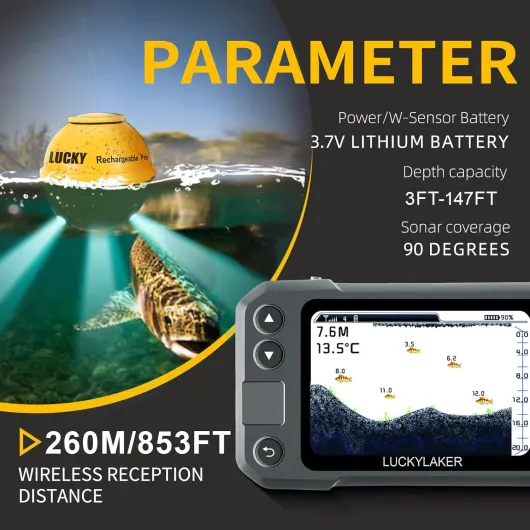
I’ve used this MT-202 on three short kayak trips and four bank sessions so far. In terms of pure performance, it does what I needed: it shows depth, gives a rough idea of fish presence, and helps me avoid wasting time. The sonar covers a 90° beam and claims a depth range from 3 ft to 147 ft. On my local spots (usually 5–30 ft deep), it handled everything without dropping signal or giving nonsense readings.
The fish detection is not surgical. It uses fish icons, not raw arches, so you don’t get the detailed sonar picture that more expensive fish finders show. Sometimes it marks weeds or debris as fish, especially when sensitivity is high. But after a while, you get used to reading the screen: if you see a bunch of icons stacked with a clear bottom line, there’s usually some bait or fish activity. If you see one random icon in the middle of nothing, I tend to ignore it. What I found most useful was simply knowing when a spot looked “empty” versus “there’s clearly something moving here.”
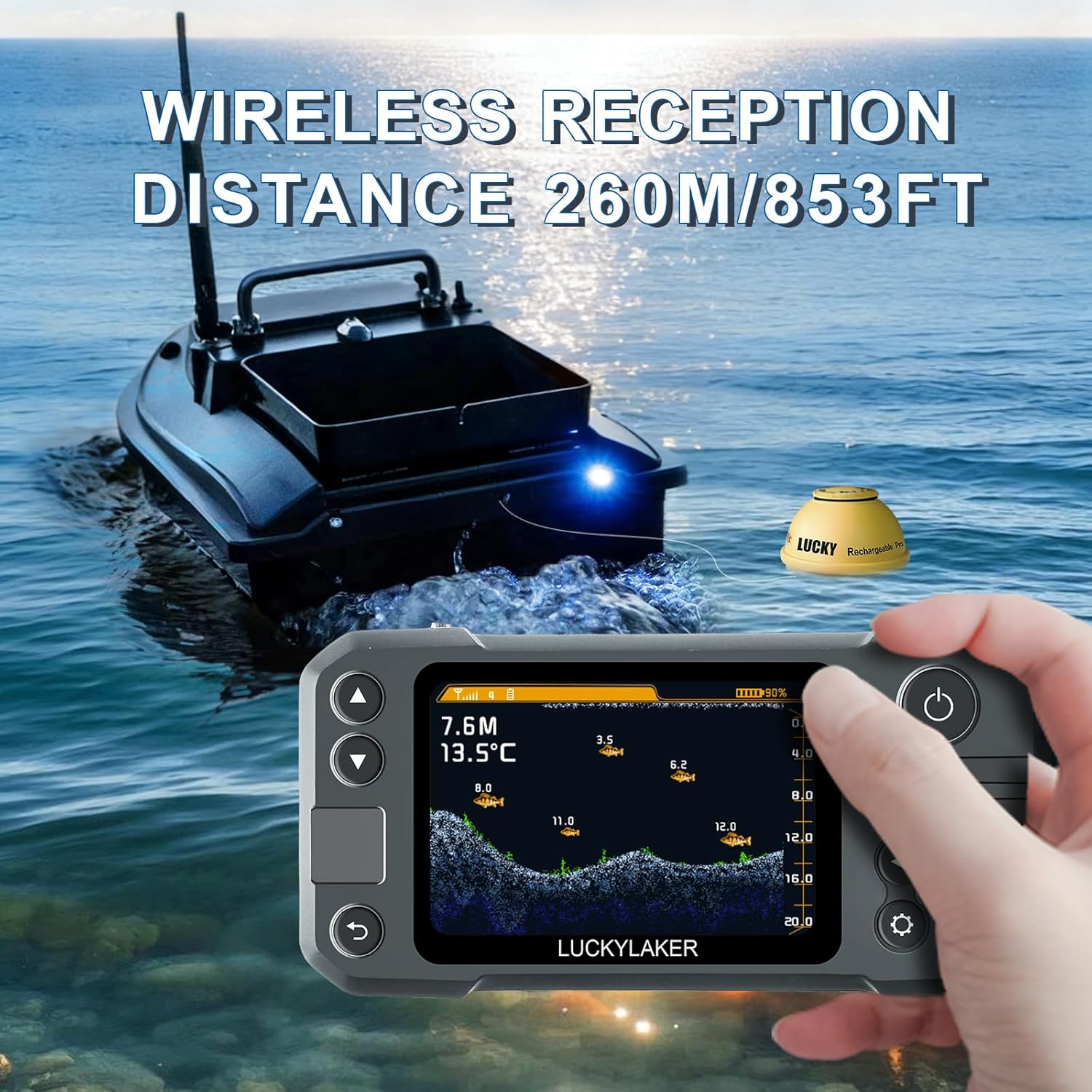
The wireless connection with the sensor was stable in normal conditions. I tested it up to maybe 60–70 meters from shore, and it kept working. I didn’t try anywhere near the 853 ft claim, but realistically, for shore and kayak fishing you rarely need more than 100 meters. Response time is fast enough: you cast, wait a few seconds, and the screen starts updating. The scrolling history is handy: as you slowly reel the sensor back in, you get a sort of cross-section of the area you just covered.
In terms of impact on my fishing, I’d say it helped mainly with two things: choosing the right depth and not staying too long in dead zones. On one kayak outing, I used it to follow a drop-off line and keep my lure near that edge, and I picked up two decent perch where I would usually just drift randomly. It’s not magic, it doesn’t make fish appear, but it gives enough info to fish a bit smarter. For a small, budget-friendly unit, that’s about what I expected, and it delivers reasonably well.
What you actually get with the MT-202
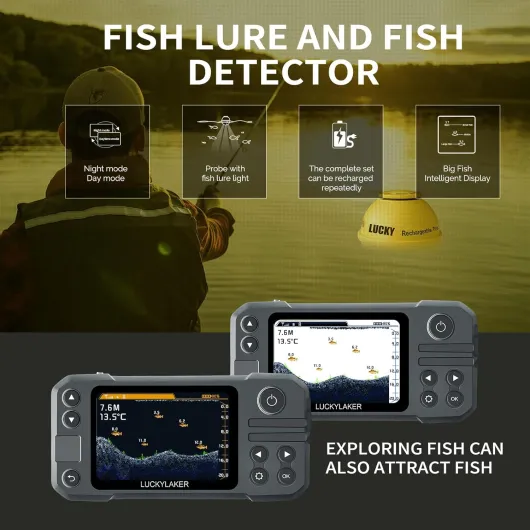
Out of the box, the LUCKY MT-202 is very straightforward. You get the handheld display, the small wireless floating transducer, a charging cable, and a basic manual. That’s it. No fancy mount, no huge bundle of accessories, which honestly matches the price and the simple use case. The whole kit is light – under a kilo – and fits easily in a small tackle bag or even a big jacket pocket.
The display has a 3.5-inch horizontal LCD screen, a few physical buttons on the front, and a basic plastic housing. It runs on an internal rechargeable battery, so no need for AA batteries, which I liked. The transducer is a small, hard plastic ball you tie to your line or to the included tether. You cast it out like a bobber, and the display picks up the sonar signal wirelessly. They claim up to 853 feet of wireless range; I didn’t push it that far, but over 50–60 meters from shore it still connected fine.
The interface is old-school but clear enough: depth at the top, fish icons with depth numbers next to them, some bottom contour, and a scrolling history from right to left. You’re not getting fancy maps or GPS tracks here. It’s just a simple sonar view with icons. You can tweak sensitivity, fish alarm, and a couple of basic settings, but that’s about it. For someone who just wants to turn it on and fish, that’s actually a plus.
If you’re used to more advanced units, this will feel pretty bare-bones. No color, no split screen, no detailed structure view. But if you’re coming from “no electronics at all,” it’s a clear step up. You see something happening under the surface instead of guessing, and that alone already changes how you choose your spots and how long you stay in them.
Pros
- Very portable wireless design: castable sensor, no drilling or wiring needed
- Solid battery life that comfortably covers a full day of fishing
- Gives useful depth and basic fish presence info that helps avoid dead water
Cons
- Old-school screen and interface, not very bright in strong sunlight
- Fish icons can be inaccurate at times, especially in weedy areas
Conclusion
Editor's rating
After a few weeks of real use, I’d sum up the LUCKY MT-202 as a practical, no-frills fish finder that actually helps, as long as you keep your expectations in check. It gives you honest basics: depth, rough fish presence, and a simple view of what’s under that floating sensor. The wireless, castable design is the main selling point. For bank and kayak fishing, being able to throw the sensor wherever you want without drilling or wiring is genuinely useful.
It’s not a high-end sonar. The screen is basic, the interface is a bit dated, and the fish icons can be optimistic at times. But it’s light, easy to carry, and the battery holds up for a full day, which makes it a good fit for casual anglers who just want to stop guessing where the drop-offs and fish are. If you usually fish small to medium lakes, rivers, or do some ice fishing and you don’t want to mess with permanent installs, this unit makes sense.
Who should skip it? Anyone looking for detailed structure scans, GPS mapping, or super precise readings in deep water will hit the limits of this device pretty fast. If you already have a decent fixed fish finder on your boat, this will feel like a downgrade. But if you’re starting from nothing or you want a portable backup you can bring to any water, the MT-202 is a fairly priced, functional option that gets the job done without overcomplicating things.