
Summary
Editor's rating
Value: solid quality, but you pay the marine tax
Design: small, clean, and clearly built for boats
Durability: feels built to survive the usual marine abuse
Performance: bright, efficient, but locked to fixed modes
Installation: easy if you know 12V wiring, annoying if you don’t
What you actually get with this light
Pros
- Bright for its size and power draw, easily replaces a 20W halogen
- IP67 sealed construction handles spray and moisture without issues
- Compact, low-profile design with a clean glass bezel that looks neat in cabins and cockpits
Cons
- This version is non-dimming and control via timed toggle is clunky
- Price is high compared to generic 12V RV or home LED puck lights

Specifications
View full product page →| Brand | Lumitec |
A tiny ceiling light that punches above its weight
I’ve been slowly swapping out old halogen puck lights on a small boat and in a camper, and I picked up this Lumitec Mirage LED flush mount to see if the price was justified. On paper it’s a 2.5-inch, 6W marine-rated LED downlight with multiple fixed colors (white, red, blue, purple), IP67 rating, and a glass bezel. Basically, it’s sold as a compact, sealed, do‑it‑all interior/exterior light that should outshine a 20W halogen while drawing a fraction of the power.
In real use, I wired it into a 12V system on a small cabin boat, right above the helm at first and then moved it to the cabin ceiling. I also briefly tried it on a 12V bench supply at home to compare against a cheap Amazon RV puck light and one older Imtra LED I already had. I wasn’t trying to do lab measurements, just a side‑by‑side eyeball test and a bit of current draw checking with a basic multimeter.
The short version: the light is bright for its size, feels properly built for a marine environment, and the color options are handy on a boat at night. But it’s not perfect. It’s not dimmable in this specific non‑dimming version, the wiring and control approach are more “boat electrician” than “DIY plug and play,” and the price is clearly higher than generic RV or home recessed lights.
If you’re coming from cheap plastic LED pucks, this will feel like a solid upgrade in build and output. If you’re already using other marine brands, it’s more of a sideways move with a few pros and cons. I’ll break down what stood out to me in terms of design, performance, installation, durability, and value for money.
Value: solid quality, but you pay the marine tax
On the price side, the Lumitec Mirage clearly sits in the “marine gear” bracket, not the generic Amazon LED bracket. You can easily find cheaper 12V recessed LEDs for RVs and vans that cost half or even a third of what this does. Those will still light up your space, but in my experience they don’t handle moisture, salt air, or constant vibration nearly as well. If your boat or RV lives in a harsh environment or you hate chasing electrical gremlins, that difference matters.
Where the value makes sense is if you care about a mix of build quality, waterproofing, and decent light output. For a small to medium boat, using a handful of these in key spots (helm, cabin, cockpit) is a reasonable compromise: you get reliable lights where you need them most without going all‑in on a full premium lighting system. For a budget build or a van conversion on a tight budget, though, this is probably overkill and you’d be better off with simpler, cheaper fixtures.
The lack of dimming on this specific model hurts the value a bit for me. At this price point, I’d like either built‑in dimming or at least a clearer path to controlling brightness without jumping through protocol hoops or buying other versions. If you just want a tough white light with an occasional red mode, you might feel you’re paying for color options (blue, purple) that you barely use.
So overall, I’d call the value good but not spectacular if you actually need marine‑grade hardware. For purely indoor home use, the price is hard to justify. For boats and RVs that see rough conditions, it starts to make sense, especially if you’ve already been burned by cheap fixtures corroding or dying early. It’s one of those products where you’re paying as much for not having problems later as you are for the immediate performance.
Design: small, clean, and clearly built for boats
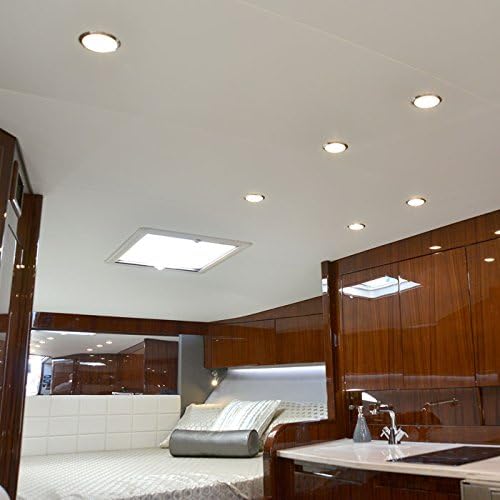
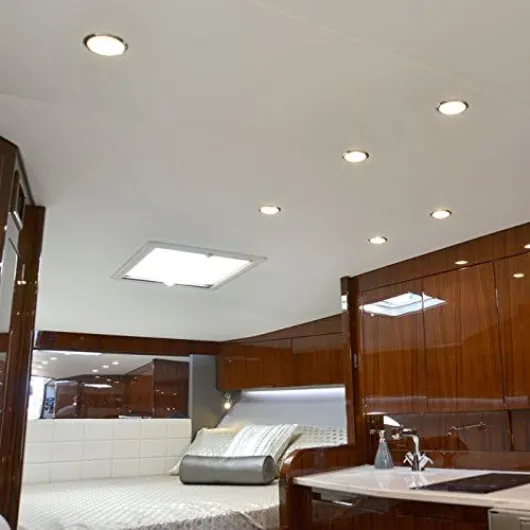
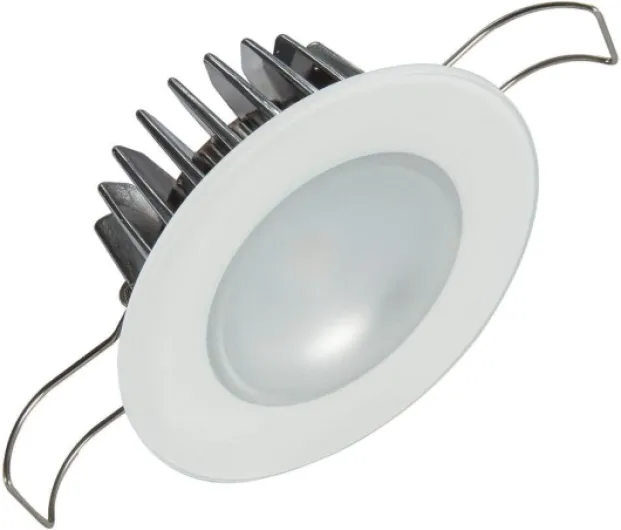
The overall design is simple and functional. The front is basically a polished white bezel with glass, sitting almost flush with the ceiling once installed. It doesn’t scream “marine gadget” when you look at it — it just looks like a neat, modern puck light. On my boat ceiling it blended in better than the chunky old halogen fixtures it replaced. The low profile is a real plus if you’re tight on headroom or mounting it under a T‑top or deck overhang.
From the back, it’s more obvious that it’s a marine product. The housing is sealed, wiring exits from the back, and there are no exposed screws on the front. It’s rated IP67, which means it’s dust‑tight and can handle being splashed or briefly submerged. I didn’t dunk it in a bucket on purpose, but it did get hit with spray and a bit of rain at the helm before I moved it inside, and there were zero issues: no fogging, no water marks, no flickering.
One thing I liked is that the light spread is fairly even. Some cheaper puck lights have a bright hot spot in the middle and then a harsh cutoff. This one throws a more even pool of light, so you don’t get that flashlight effect. The beam isn’t super wide like a floodlight, but for a cabin, stateroom, or cockpit overhead it felt about right. Mounted over the helm, it lit the controls and wheel area without blinding me completely.
On the downside, the design assumes you’re okay with a fixed size and non‑replaceable LED module. The fixture is non‑removable and you’re not swapping bulbs like a GU10 in a house, regardless of what the spec sheet mentions. When it eventually dies, you’re replacing the whole unit, not just a lamp. For a boat where access is a pain, that’s worth thinking about. Still, in terms of looks and layout, the design is pretty solid and feels thought‑through for marine and RV use, not just rebranded home hardware.
Durability: feels built to survive the usual marine abuse
Durability is where this light actually justifies a good chunk of its price. The IP67 rating and sealed construction aren’t just marketing fluff; the unit feels tight and solid in the hand. I had it installed in a spot that got regular spray and the occasional direct hit from a hose when washing down the boat. After a few weeks like that, there was no sign of moisture inside, no corrosion on the contacts, and the glass stayed clear.
The glass bezel is a plus and a minus. On the plus side, it doesn’t scratch as easily as cheap plastic lenses, and it wipes clean with a cloth — salt, fingerprints, bug splatter, whatever. On the downside, if you manage to hit it with something heavy (rod butt, tool, whatever), glass can chip or crack. I didn’t manage to break it, but on a rough day with rods swinging around, I was aware of it. Still, compared to the yellowing plastic lenses I’ve had on other lights, glass is a nice step up.
Internally, the thermal design seems decent. I ran it for long stretches and never saw any flickering, dimming, or weird behavior. Some cheap LEDs start to misbehave when they get hot or after a few cycles. This one just worked. Obviously I haven’t had it for years, so I can’t pretend to know the long‑term lifespan, but based on the build and how it handled heat and moisture so far, I’d expect it to outlast the average bargain light by a good margin.
If you’re using it indoors only (RV or house porch), it’s probably overkill in terms of sealing, which is not a bad thing. For a boat, the “install and forget” vibe is what you want. My only real complaint is that when it eventually fails, you’re swapping the whole unit, not just a bulb. That’s the trade‑off with most sealed LED fixtures, though, so it’s not unique to this model.
Performance: bright, efficient, but locked to fixed modes
In day‑to‑day use, the brightness is the main strength. For something that only pulls around 6W, the white mode is strong enough to replace the old 20W halogen in my cabin without feeling like a downgrade. I mounted it on the ceiling of a small V‑berth and it lit the whole space evenly. In the cockpit, one unit over the helm was enough to comfortably see instruments, controls, and the immediate deck area at night.
The color modes are a mixed bag, but mostly positive. Red is genuinely useful at night: it preserves night vision better and is less harsh if someone is trying to sleep below deck. Blue and purple are more cosmetic than practical. They look cool for a bit, but I rarely found a real use for them beyond mood lighting when sitting at the dock. Since this version is non‑dimming, you can’t soften the white output, which I did miss when I wanted a low‑key evening light instead of full brightness.
Heat management seems fine. After running it for a few hours on the bench and then later on the boat, the housing was warm but not worrying. No flicker, no odd noise, and no color shift. Compared to a cheap RV light I bought off Amazon, the Mirage runs a bit brighter and the white tone is cleaner and less greenish. It’s not high‑end home lighting quality, but for a boat cabin or RV ceiling it’s more than good enough.
The big limitation is control flexibility. This particular non‑dimming model doesn’t give you much beyond fixed modes. Lumitec’s two‑wire “timed toggle” system is clever in theory, but in practice it means you’re doing quick on/off taps on the same circuit to cycle colors. It works, but it’s clunky if all you want is “turn on low white for reading.” If you’re picky about ambiance or want proper dimming, you’ll either need one of their dimmable versions or a different product entirely.
Installation: easy if you know 12V wiring, annoying if you don’t
Installing the Mirage is straightforward for someone used to 12V systems, but it’s not as plug‑and‑play as a typical home LED retrofit kit. You cut a hole to the specified diameter, connect the positive and negative leads to your 12/24V circuit, and secure the fixture in place. On my boat, I reused the existing wiring from the old halogen puck, so it was mostly a matter of widening the cutout slightly and crimping proper connectors.
Where it gets a bit annoying is the control logic. Lumitec uses that two‑wire timed toggle protocol for color changes and, on other models, dimming. There’s no separate control wire, no simple remote included, and no dedicated wall controller in the box. You basically use your existing switch and do short toggles to step through colors. It’s clever in the sense that you don’t need extra hardware, but it’s not very intuitive for guests or family who just want to press a switch and get the same thing every time.
Also, the documentation is fine but not super detailed. It explains the basics of wiring and the switching pattern, but if you’re trying to integrate it with third‑party controllers (Imtra, Cantaloupe, etc.), you’ll probably end up reading forums or calling someone who’s done it before. I kept it simple and just ran it off a standard rocker switch, but if you’re building a fancier system, expect a bit of trial and error.
Overall, I’d say installation is manageable but not beginner‑friendly. If you’ve installed other marine lights, it’s no big deal. If you’re coming from a house background where you expect a standard GU10 or E26 bulb and maybe a dimmer slider, this will feel more fiddly. Once it’s in, though, it stays put and doesn’t rattle or loosen, even with the usual boat vibration and slamming in chop.
What you actually get with this light
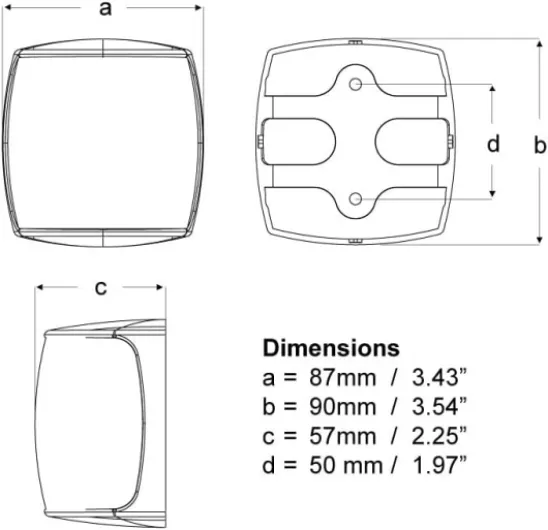
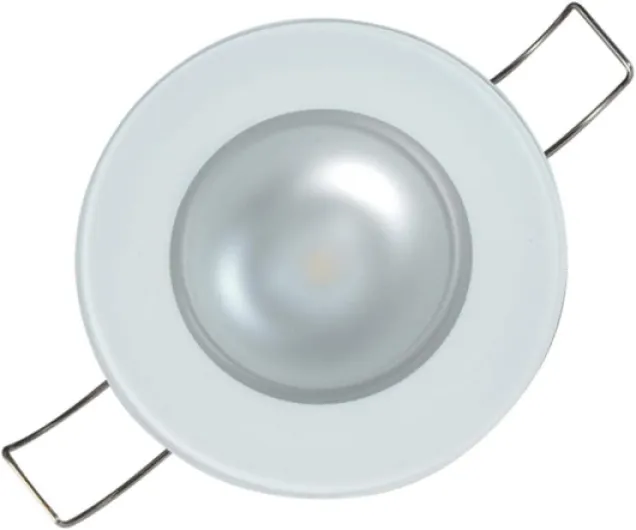
Out of the box, the Lumitec Mirage is pretty barebones. You get the light itself and that’s basically it. No fancy packaging, no wall switch, no wiring harness beyond the pigtail leads coming out of the back. For a marine light, that’s normal, but if you’re used to home lighting kits, it might feel a bit stripped down. The unit is small: about 2.5 inches in diameter, low profile, and meant to sit flush in the ceiling. It’s clearly designed more for boats and RVs than for a house ceiling.
The specs say 6 watts, about 300 lumens for the white mode on this version, running on 10–30V DC. I measured current draw at roughly what you’d expect for a 6W LED at 12V, so the numbers don’t feel inflated. Lumitec claims it replaces a 20W halogen, and from a brightness standpoint that lines up with my old halogen puck lights. It’s not going to light a huge salon by itself, but as a cabin or cockpit downlight it’s plenty for a small zone.
This model is the one with white, red, blue, and purple, all non‑dimming. So you’re not getting smooth dimming or a full RGB app‑controlled thing here. It’s more like: pick a color using their switching logic and that’s it. For my use, red was useful for night vision, white for general use, and I mostly ignored blue and purple except to show them off once. If you expect smart‑home style control, this isn’t that product.
Overall, the presentation tells you exactly what it is: a compact, sealed, marine‑rated light built to be wired into a 12/24V system. No frills in the box, no decorative stuff, just the fixture. It feels like it was designed for someone who already knows how to deal with boat wiring, not a casual DIYer trying to upgrade their kitchen ceiling.
Pros
- Bright for its size and power draw, easily replaces a 20W halogen
- IP67 sealed construction handles spray and moisture without issues
- Compact, low-profile design with a clean glass bezel that looks neat in cabins and cockpits
Cons
- This version is non-dimming and control via timed toggle is clunky
- Price is high compared to generic 12V RV or home LED puck lights
Conclusion
Editor's rating
After using the Lumitec Mirage LED flush mount on a small boat and comparing it to both older halogens and cheap RV LEDs, my take is pretty simple: it’s a tough, bright little light that does its job well, but it’s not a miracle product. The build quality and waterproofing feel solid, the light output is strong for 6W, and the white + red combo is genuinely useful on a boat at night. Blue and purple are more for show than anything else, but they’re there if you like that kind of mood lighting.
The weak points are mostly about flexibility and price. This specific non‑dimming version is locked to fixed brightness, and the color switching via timed toggles is a bit clunky. If you’re picky about atmosphere or want smooth dimming, you’ll need a different version or another brand. And yes, you pay a clear premium compared to generic 12V puck lights, especially if you’re just using it indoors where the IP67 rating is less critical.
I’d recommend this light to someone outfitting a boat or serious RV who wants reliable, sealed fixtures and is okay paying more upfront to avoid corrosion and cheap electronics failing later. If you just need basic ceiling lights in a van build or spare room, it’s overkill and there are far cheaper options that will be “good enough.” Overall, it’s a pretty solid marine light with a few quirks, not a perfect all‑rounder, but definitely competent at what it’s designed for.