
Summary
Editor's rating
Is it good value for money?
Big size, simple layout, and two useful D-rings
PVC quality and hardware: feels tough enough for real use
Early signs on durability and what worries me (or not)
Real-world performance at the dock
What you actually get in the box
Pros
- Large 18"x60" size offers strong protection and can replace several smaller fenders
- Deflates quickly and stores flat, which saves a lot of space on smaller boats
- Sturdy PVC and solid D-rings give a reassuring feeling of durability in normal use
Cons
- No pump included, so you need extra equipment to inflate it
- Bulky when inflated and a bit awkward to store if you don’t deflate it between trips

Specifications
View full product page →| Brand | HXDOGSP |
A huge inflatable fender that actually feels reassuring
I’ve been using this 18"x60" inflatable boat fender for a few outings now on a 22 ft fishing boat, mostly in a pretty tight and sometimes choppy marina. To be honest, I bought it because I was tired of juggling four small traditional fenders every time I dock. I wanted one big, simple bumper I could throw on the side that I worry about the most and just focus on driving the boat.
Right away, the first thing that stands out is the size. It’s big. When it’s inflated, it looks almost oversized for a 22 ft boat, but in practice I’d rather have too much protection than not enough. The brand (HXDOGSP) is not exactly a household name, so I wasn’t sure what to expect. I went in thinking, “If it survives one rough weekend and doesn’t leak, I’ll be happy.”
After a few days tying up at different docks and rafting up once against another boat, I can say it does what it’s supposed to do: it takes the hits instead of the hull. It’s not fancy, it doesn’t have some clever system, but it absorbs contact pretty well. I’ve had it rubbing on rough pilings and floating docks and it’s still intact, just a bit marked up, which is normal.
It’s not perfect, though. Being so big, it’s a bit of a pain if you don’t deflate it between trips, and the included ropes are usable but nothing special. Still, for the price and the level of protection, I’d say it’s a pretty solid piece of gear if you’re mainly worried about keeping your gelcoat out of trouble rather than impressing anyone at the marina.
Is it good value for money?
Price-wise, this inflatable fender sits in the middle of the pack. It’s not the cheapest inflatable tube out there, but it’s also well below some big-name marine brands. For what you pay, you’re getting a large-format fender, two usable lines, a wrench, and repair pads. Considering what a single decent traditional fender can cost, being able to cover a big section of hull with one piece is not a bad deal.
Where it makes sense financially is if you want serious protection but don’t have space to store four or five big foam fenders. Being able to deflate it and tuck it away between trips saves a lot of room, especially on smaller boats or pontoons where locker space is always tight. In my case, I replaced three old worn fenders with this one, and I’m happier with both the protection and the storage situation.
On the other hand, you do need to factor in the cost of a pump if you don’t already have one. Also, this is still a single point of failure: if you puncture it and don’t have time to patch it properly, you’re back to square one. With multiple smaller fenders, losing one is less dramatic. So I wouldn’t rely on this as your only protection forever; I’d see it as the main piece plus maybe one or two backups.
Overall, I’d call the value good but not mind-blowing. It does what it’s supposed to do, feels fairly robust, and the price lines up with the quality. If you’re tight on storage and want a big, simple bumper that you can pack away, it’s a sensible purchase. If you already have a full set of traditional fenders and plenty of space, this is more of a convenience upgrade than a necessity.
Big size, simple layout, and two useful D-rings
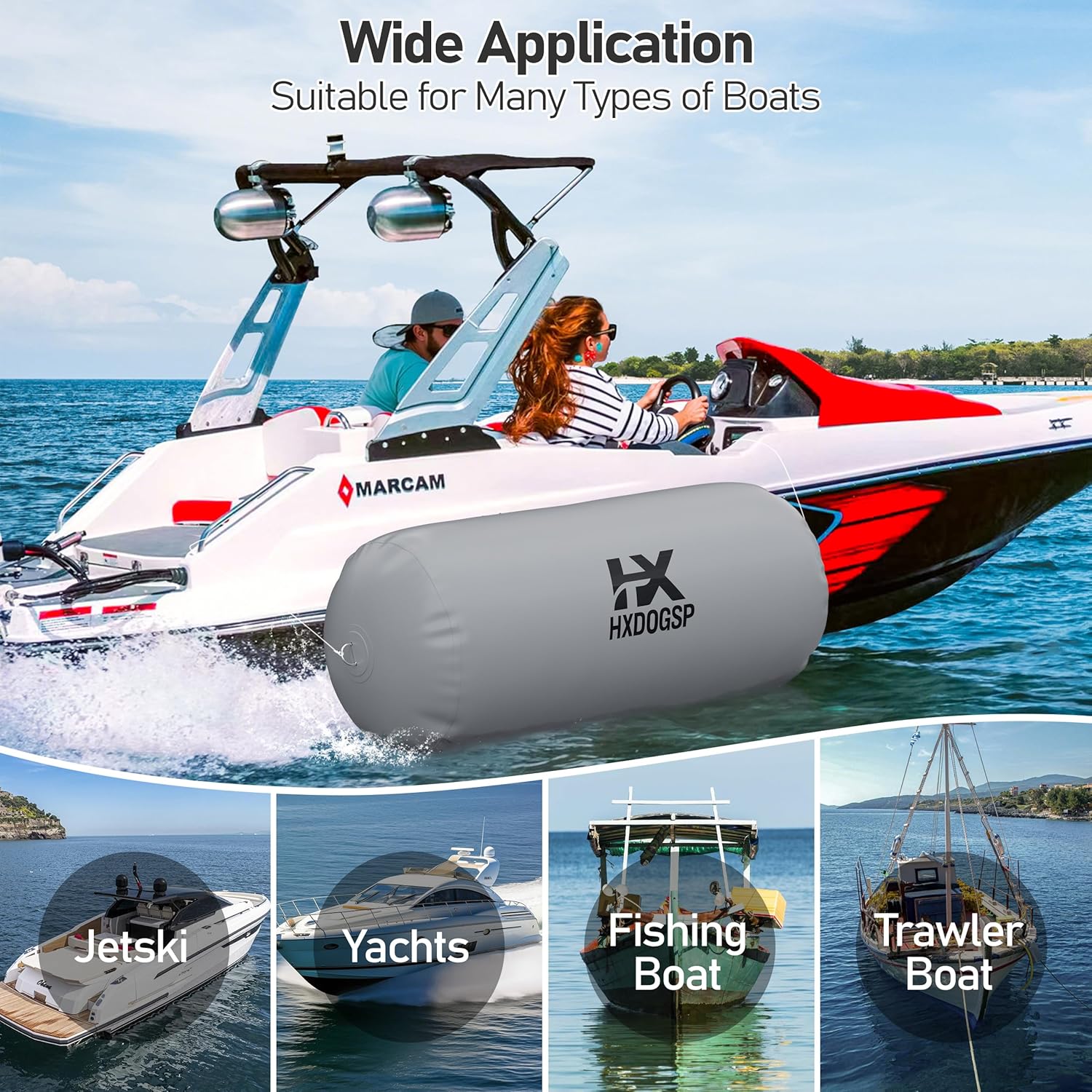
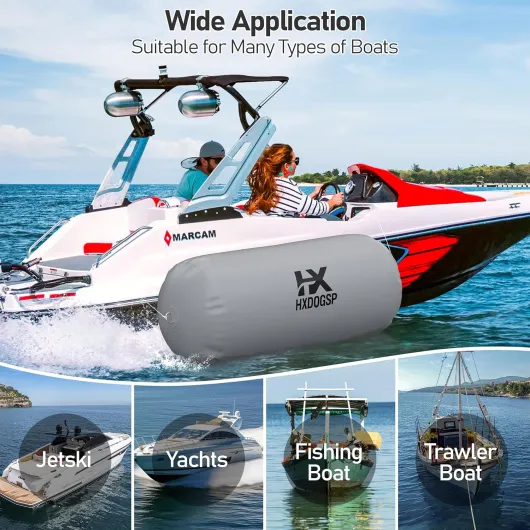
The design is pretty straightforward: a long grey tube-style fender with two heavy-duty D-rings, one at each end. The main point of the design is the size: 18 inches in diameter and 60 inches long. On my 22 ft boat, that gives a big vertical protection zone that covers most of the side where I usually bump the dock. Compared to classic 6"x22" fenders, you’re basically replacing three or four small ones with a single big bumper.
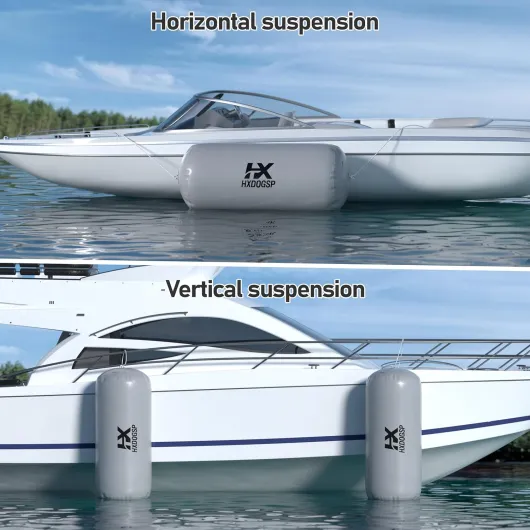
The two D-rings are what make it flexible. You can hang it vertically from one D-ring if you just want a big cushion at one point, or rig it horizontally using both D-rings with the two included lines. In practice, I ended up using it horizontally most of the time when tying up against a floating dock, because it keeps a nice big contact area even when the water level moves a bit. For rafting up alongside another boat, having it horizontal was also more reassuring than juggling a bunch of smaller fenders.
One thing I noticed: because it’s so large in diameter, you need to think a bit about where you place it. On a low dock, it can sit a bit high if your boat rides low, so you might have to adjust rope length more precisely than with smaller fenders. On taller docks or rough pilings, the size works in your favor because it keeps the hull well clear of hard edges.
Visually, it’s pretty boring: plain grey, no big logo, no fancy shapes. Honestly, I like that. It doesn’t scream for attention, and it blends in with most hull colors. The only real design downside I’d flag is that when it’s inflated, it takes up a lot of deck or cabin space if you leave it out. So if you don’t plan to deflate it between uses, you need to accept that you’re storing a big sausage on board somewhere.
PVC quality and hardware: feels tough enough for real use
The fender is made from PVC, and in hand it feels fairly thick and rigid, not like a cheap pool toy. I don’t have the exact thickness in millimeters, but compared to some low-end inflatables I’ve used, this one clearly has a more robust skin. The surface is slightly glossy and a bit grippy, which helps keep it from sliding too much along the dock or another boat when there’s some movement.
The D-rings are the key parts you want to trust, and these look and feel solid. They’re well welded/attached to reinforced pads on the body of the fender. I pulled hard on the lines to test them, and there was no visible flexing or worrying noise. Obviously I’m not hanging the whole boat by them, but for side loads and normal docking pressure, they feel secure. The stitching and bonding around those areas looks clean enough; I didn’t see any loose edges or glue blobs.
The PVC itself seems resistant to abrasion. I’ve had it rubbing on a rough wooden dock and once against a concrete edge when the wind pushed the boat sideways. It came out with some light scuff marks but no cuts or worn spots. The brand claims UV resistance; I haven’t had it in direct sun for an entire season yet, but after several sunny days there’s no fading or softening. I still wouldn’t leave it permanently inflated and exposed all summer if you can avoid it, just to prolong its life.
The repair pads included are just basic PVC patches, no glue provided. So if you do puncture it, you’ll need to have PVC adhesive on hand. That’s not a huge deal if you already mess around with inflatables, but it’s something to know. Overall, for the price bracket, I’d say the materials are pretty solid: not top-of-the-line commercial-grade, but absolutely decent for a leisure boat that sees weekends and holidays rather than daily charter work.
Early signs on durability and what worries me (or not)
I haven’t had this fender for years obviously, but after several outings and a few sessions where it really got squeezed and rubbed, it’s holding up well. No leaks, no slow loss of air overnight, and no visible damage beyond normal scuffs. I left it inflated for a full weekend, tied to the boat in the slip, with sun during the day and cooler temperatures at night. The pressure dropped slightly by the end of the weekend, but nothing dramatic, and that’s pretty normal for any inflatable with temperature changes.
The seams and D-ring attachments are the main stress points I checked. After some harder contacts with the dock, I looked closely at those areas and didn’t see any separation or stretching. If something is going to fail first, I’d expect it to be there, but for now they look solid. The PVC hasn’t gone soft or sticky in the sun either, which is a good sign for UV resistance, at least in the short term.
That said, this is still PVC, not some indestructible material. You need to respect the usual rules: don’t drag it across sharp metal, don’t let it grind for hours on a rusty bolt, and don’t store it folded while it’s dirty and wet. The brand itself warns against sharp edges, and that’s fair. If you use it in a rough, barnacle-covered harbor every day, you’ll probably end up patching it at some point.
Based on the build and early use, I’d say durability looks pretty good for recreational use: weekend boating, occasional storms, rafting up with friends. For heavy commercial use or if you’re really rough on gear, I’d maybe look at more industrial-grade fenders. But for a normal owner who takes basic care of their stuff, this should last several seasons without drama.
Real-world performance at the dock
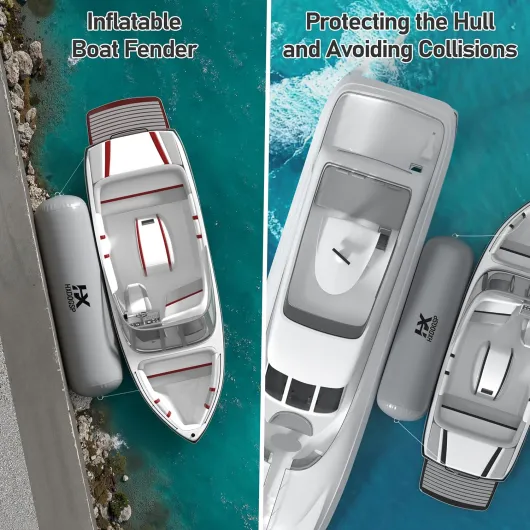
In practice, the main thing I wanted to know was: does this fender actually protect the hull when things get bouncy? So far, the answer is yes. I used it during a windy afternoon where the boat was getting pushed against a floating dock with passing wake from bigger boats. Instead of hearing that unpleasant hull-on-dock noise, all I got was the dull thud of the fender taking the impact. The hull stayed clean, and I didn’t see any new scratches after that session.
The size really helps absorb energy. Because it’s 18" in diameter, you get a decent air cushion that compresses when the boat moves. I followed the advice from the listing and didn’t overinflate it: I left a slight give when pressing with my hand, which seems to be the sweet spot. Overinflating would probably make it too hard and less effective at shock absorption. With the right pressure, it feels firm but still forgiving.
In terms of setup, inflation with an electric pump took under a minute, as advertised. Deflation is also quick: open the valve, press out the air, and it flattens fairly easily. Once deflated, it folds down to something you can stash in a locker without needing a dedicated bag. That’s a big plus compared to foam or traditional cylindrical fenders that always take up the same volume.
The only performance downside I noticed is that because it’s one big unit, if you misplace it, you can still hit the dock with another part of the hull. With multiple small fenders, you can spread them out more. So you still need to be a bit careful with positioning, especially if your boat is longer than about 24–27 ft. For boats up to the 27 ft the brand mentions, it’s a solid extra layer of security, but I’d still keep at least one or two regular fenders as backup for odd dock shapes or very tight spots.
What you actually get in the box
In the package, you get the 18"x60" grey inflatable fender, two dock lines (about 3 meters / 9.85 ft each), a small wrench for the valve, and a couple of repair material pads. No pump is included, which is worth mentioning, because the listing talks about inflating with an electric pump. So you either need a compressor, an electric pump, or a manual pump with the right adapter. If you already have gear for inflating paddleboards or towable tubes, you’re set. If not, add that to the budget.
The fender comes folded and wrapped in plastic inside a fairly basic cardboard box. Nothing fancy in terms of packaging, but it arrived without any obvious creases that looked dangerous for the PVC. When you unfold it the first time, it’s a bit stiff and smells like PVC/plastic, which is pretty standard for this kind of material. The smell faded after a day or two sitting in the open air in the garage.
The ropes are usable but basic: standard nylon dock lines, roughly 3/8" thickness. They’re fine for tying the fender to cleats or rails, but I wouldn’t rely on them for anything more serious than that. The wrench is just there to help with the inflation valve; it’s small, easy to lose, so I’d suggest throwing it into your main boat tool kit right away so it doesn’t disappear.
Overall, the presentation is very no-frills. You get what you need to start using it (aside from a pump), plus the repair pads are a nice backup in case you nick it on something sharp. For a mid-range dock fender, that’s about what I expect: not pretty, but functional and complete enough to get going.
Pros
- Large 18"x60" size offers strong protection and can replace several smaller fenders
- Deflates quickly and stores flat, which saves a lot of space on smaller boats
- Sturdy PVC and solid D-rings give a reassuring feeling of durability in normal use
Cons
- No pump included, so you need extra equipment to inflate it
- Bulky when inflated and a bit awkward to store if you don’t deflate it between trips
Conclusion
Editor's rating
After using this HXDOGSP 18"x60" inflatable boat fender for a bit, my overall feeling is pretty straightforward: it’s a big, no-nonsense bumper that gets the job done. The size gives real peace of mind when you’re coming into a tight slip or dealing with wake at the dock. The PVC feels solid, the D-rings are trustworthy, and being able to hang it both vertically and horizontally makes it adaptable to different docks and situations.
It’s not perfect. You need your own pump, the included ropes are basic, and when it’s inflated it takes up a lot of space on board. It’s also not a magic solution: if you misplace it or rely on it alone on a longer boat, you can still get contact where it doesn’t reach. But used as a main fender with a couple of smaller backups, it’s a very practical setup.
I’d recommend it for people with boats up to around 27 ft who want strong protection without filling their lockers with foam fenders. It makes particular sense for pontoons, small yachts, and fishing boats that see choppy marinas or tight docking. If you’re a casual boater who rarely bumps anything, or if you already have a full set of quality fenders and tons of storage, you can probably skip it. For everyone else, it’s a pretty solid, functional piece of gear that does what you buy it for: keep your hull away from hard stuff.