
Summary
Editor's rating
Value for money: one big fender vs buying a bunch of small ones
Design: long padded wall instead of dangling sausages
Materials and build: foam and vinyl that feel built for abuse
Durability: how it’s holding up after real bumps and scrapes
Performance in real use: docking, rafting, and handling
What you actually get with this rafting fender
Effectiveness: does it actually protect better than a bunch of fenders?
Pros
- Covers a large section of the hull, reducing the need for multiple individual fenders
- Solid foam and vinyl construction that handles real bumps and scrapes without failing
- Simple to deploy and adjust, saving time and hassle during docking and rafting
Cons
- Bulky to store and a bit awkward to handle compared to standard fenders
- Doesn’t fully replace traditional fenders for bow, stern, and piling situations

Specifications
View full product page →| Brand | TaylorMade |
One long fender instead of six: does it actually help?
I’ve been using this TaylorMade Profile Rafting Fender (the big blue one) on a 26-foot cruiser for a few weekends now. Before this, I was the guy hanging three or four regular cylindrical fenders, then still stressing every time we rafted up with friends. With this thing, the idea is simple: one long padded slab instead of a bunch of dangling sausages. I was curious if it was just a gimmick or if it would really cut down on the hassle.
In practice, I’ve mainly used it in two situations: tying up alongside a buddy’s boat and docking along a not-so-gentle concrete wall at our marina. I’ve also thrown it between my boat and a metal floating pontoon that usually eats fenders for breakfast. So it’s had a mix of gentle and rough treatment, plus a couple of windy afternoons where boats were really pushing against each other.
What struck me first is how it changes the routine. Normally, I’m digging out multiple fenders, guessing at spacing, and constantly adjusting. With this, I just drop the one pad in the right spot and adjust the lines. It’s not magic, but it definitely simplifies the whole thing. I spent more time actually docking and less time fiddling with knots and heights.
It’s not perfect though. It’s bulky, the sizing specs are a bit confusing, and if your cleats or rail setup are weird, you might need to improvise. But overall, after a few weekends, I’d say it’s a pretty solid solution if you regularly raft up or dock broadside and you’re tired of managing a small army of fenders.
Value for money: one big fender vs buying a bunch of small ones
Price-wise, this kind of rafting fender usually costs more upfront than a single standard round fender. But that’s not really the right comparison. You need to compare it to buying four to six decent fenders, because that’s what it’s trying to replace in a lot of rafting and side-docking situations. When you look at it that way, the value is actually pretty reasonable, especially if you often tie up alongside other boats.
The main value for me is in time and hassle saved. I don’t have to drag out a pile of fenders, tie and adjust each one, and then deal with them all when we leave. One pad, a couple of lines, done. If you’re out every weekend or you raft up regularly with friends, that convenience starts to matter. Plus, you’re less likely to have that one gap that the hull somehow finds every single time.
On the flip side, it’s not a universal solution. You’ll probably still keep some regular fenders on board for pilings, bow/stern protection, and random dock situations. So you’re not throwing away your old fenders; you’re adding another piece of gear. If you only occasionally raft up or you mostly use finger slips with pilings, you might not get full value out of it. In that case, a few standard fenders might be enough.
Overall, I’d call the value good but not mind-blowing. It’s a solid purchase if you actually use it for what it’s designed for: broadside docking and rafting. If that’s your routine, it can replace a pile of smaller fenders and make your life easier. If you’re more of a quick in-and-out dock user or mostly on moorings, it’s probably overkill and your money might be better spent on a couple of higher-quality regular fenders instead.
Design: long padded wall instead of dangling sausages
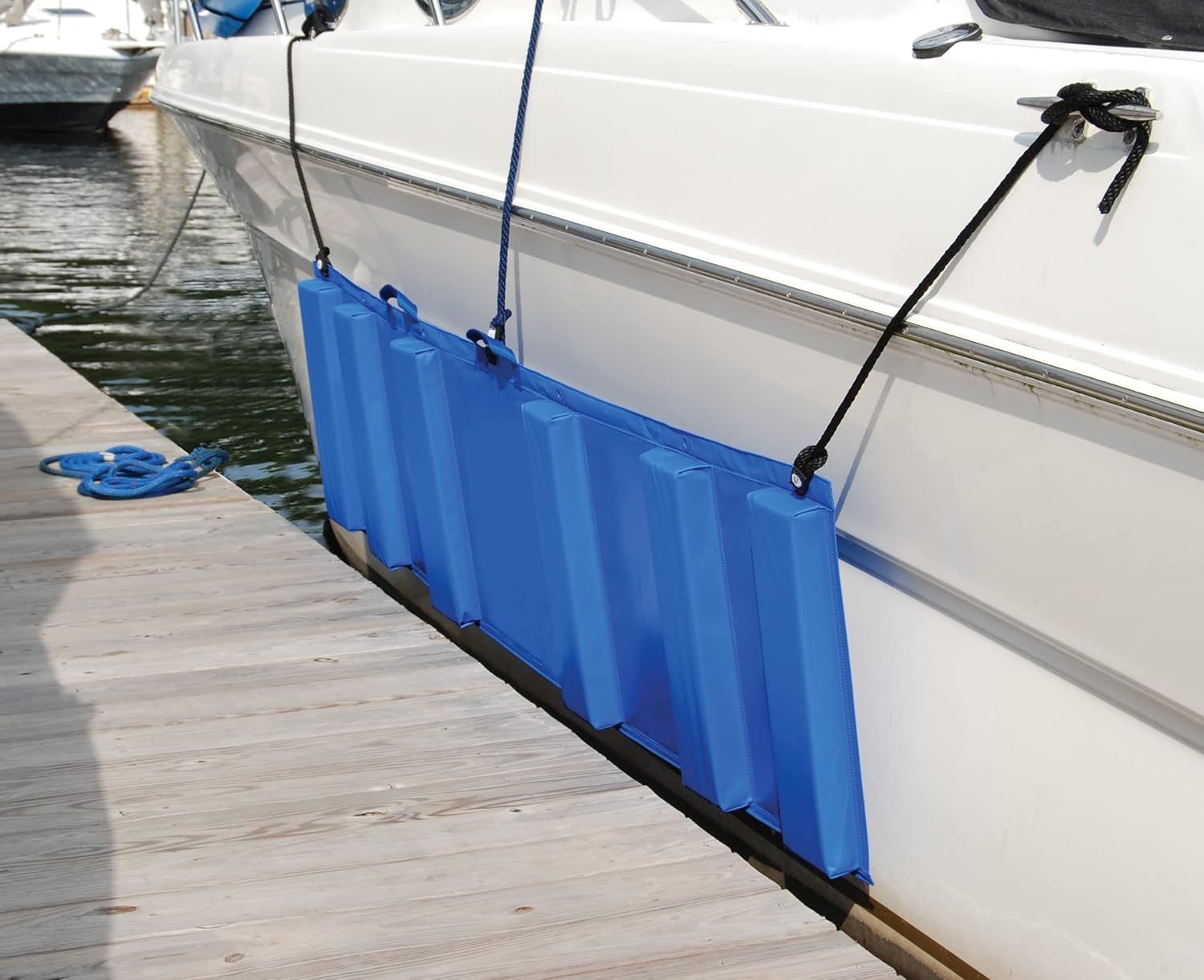
The main design idea here is pretty straightforward: instead of hanging 4–6 individual fenders and hoping you spaced them right, you hang this one long pad and it covers a big chunk of the hull. The manufacturer even says it “attaches easier and protects better than 6 individual fenders,” and honestly, that’s not far off if you raft up a lot. Once it’s in place, you’ve basically got a soft wall between the boats or between your boat and the dock.
There are multiple attachment points, which is really where the design works. I’ve hung it both vertically and horizontally. When rafting up with another boat similar in size to mine, I liked it horizontal, roughly centered at the beam, with two lines to the midship cleat and rail. When I was tying up against a rough concrete wall, I ran it more vertically and used three points so it wouldn’t sag. The big plus is that there are enough tie points to tweak the position without doing some weird knot gymnastics.
One thing I noticed: the thickness is decent but not crazy thick. It’s not some giant mattress; it’s closer to a firm pad. In flat or moderate water, that’s plenty. In more chop, the boats still move a bit and you’ll hear some bumping, but the hulls stay off each other. I did see a couple of minor scuff marks on the vinyl after pressing hard against a rough dock, but nothing that went through to the foam or looked serious. For a few weekends of use, that seems normal.
On the downside, the size is both its strength and its weakness. It’s great when deployed, but it’s a bit awkward to handle solo in tight spaces, especially if you’re used to just grabbing a small cylinder fender. Also, if you have a boat with odd rail or cleat placement, you might have to get creative with how you lash it, because it’s designed around the idea that you have at least two or three decent attachment points along the side of your boat.
Materials and build: foam and vinyl that feel built for abuse
The fender is made from vinyl-covered polyethylene foam, which is pretty standard for gear that’s meant to be banged around all day. The big advantage of this combo is that it’s solid, not inflatable. There are no air chambers to puncture, no valves to fail, and no guessing if it’s properly inflated. You just toss it out, tie it off, and it does its thing. For someone who doesn’t want another maintenance item, that’s a plus.
The vinyl skin feels reasonably thick. I dragged it along a rough concrete dock more than once (not on purpose, just windy days and sloppy line handling), and it came away with surface marks but no cuts or deep gouges. The seams look heat-welded rather than stitched, which is what you want on something that’s going to live in water. No peeling or bubbling so far, even after being left out in the sun for a couple of afternoons while we were hanging out on the boat.
The foam inside is firm. When two boats press together, it compresses a bit but not so much that you feel the hull on hull. Compared to my regular round fenders, this feels slightly stiffer, which I actually like because it doesn’t pancake under pressure. I haven’t noticed any water absorption either – it doesn’t feel heavier after use, and there’s no soggy feel when you pull it out. That’s a good sign that the vinyl wrap is doing its job and that the foam isn’t getting soaked.
Where I’m a bit cautious is long-term UV exposure. Vinyl eventually gets tired in the sun. I haven’t used it long enough to see fading or cracking, but based on other vinyl marine gear I own, I’d store it out of direct sun when not in use. Overall, though, the materials feel built for rough use, not just for looking good on day one. It’s more “workhorse” than “showpiece,” which for something that’s literally made to get smashed between boats is exactly what I want.
Durability: how it’s holding up after real bumps and scrapes
Durability was one of my main questions with this thing because it’s a big chunk of foam wrapped in vinyl that’s meant to get abused. After a few weekends of use, including some pretty rough contact with docks and another boat in light chop, it’s holding up pretty well. No tears, no exposed foam, and no seams coming apart so far.
The most obvious wear is cosmetic. The blue vinyl shows scuff marks from concrete and metal edges, which is exactly what I expected. If you’re picky about everything looking brand new, you’ll notice the marks right away. Personally, I see that as “it’s doing its job.” The foam underneath still feels uniform – no soft spots, no crushing, and it springs back after being squeezed between hull and dock for an hour.
I’ve left it out in the sun and water for full afternoons. So far, I haven’t seen fading, chalking, or surface cracking. That said, vinyl is vinyl, and based on other marine gear I own, if you store it permanently on deck under full sun, it’ll eventually show its age. I now keep it in a locker when we’re not using it, and it folds up easily enough to make that practical. It doesn’t take up that much more space than two or three big traditional fenders stacked together.
Long-term, I can’t pretend I’ve used it for years, but the build gives me some confidence. It feels more like a solid dock bumper than a fragile inflatable fender. If something is going to fail eventually, my guess would be the vinyl skin at the highest wear points, not the foam core or attachment points. As long as you’re not dragging it across sharp metal all day or leaving it to bake in the sun nonstop, I’d expect it to last several seasons of regular weekend use.
Performance in real use: docking, rafting, and handling
Performance-wise, the big win is simplicity. Instead of digging out multiple fenders, guessing spacing, and adjusting each one, I grab this single pad, clip on two or three lines, and it’s ready. When I’m coming alongside another boat, I just tell them, “I’ve got the fender wall, don’t worry about yours,” and we’re set. That alone cuts the setup time in half compared to my old routine with standard fenders.
Handling it on deck is fine. At 2.7 kg, it’s not heavy, just a bit awkward in tight spaces because of the length. I can manage it alone without any drama, but you do need to think about where you’re swinging it so you’re not smacking passengers or railings. Once in the water and tied off, it stays put pretty well. The foam has enough buoyancy that it rides nicely between the hulls instead of sinking or popping out constantly.
In terms of how it behaves in different conditions, here’s what I’ve seen so far:
- Calm to moderate conditions: Works great. You set it once and basically forget it.
- Light chop and wakes: Still solid. You get some movement, but the large surface area keeps things from slipping past it.
- Stronger wind on the beam: You feel the pressure, but the pad spreads it out. I did tighten the lines once when the wind picked up, but that’s normal.
The only performance downside is that it doesn’t replace every single fender scenario. For example, when backing into a slip or dealing with pilings, I still use standard round fenders at the bow and stern. This rafting fender is best as a main side protection for broadside docking or rafting, not a total replacement for all fenders on the boat. Think of it as your main shield, with regular fenders as backup at the corners.
What you actually get with this rafting fender
On paper, this thing is listed as a “Profile Rafting Fender Blue Large Profile” with dimensions of 26"H x 9'L. The Amazon specs say 25 x 25 x 25 mm, which is obviously wrong for a boat fender, so ignore that part. In real life, it’s basically a long, padded panel that runs along a good chunk of your hull instead of a single round fender hanging in one spot. Mine covers most of the midsection of my 26-foot boat when I hang it where the beam is widest.
It’s made from vinyl-covered polyethylene foam. So you’re not dealing with an inflatable tube here; it’s a solid foam core with a vinyl skin. That means no valves, no pumps, and no worrying about slow leaks. The weight is around 2.7 kg, which feels about right in the hand – light enough to move around easily, but with enough heft that it doesn’t flap around like a pool float.
Out of the box, it’s just the fender itself, no fancy storage bag or mounting hardware. You’ll need your own lines to tie it off. There are attachment points (grommets/eyes) along the edges so you can rig it vertically or horizontally depending on your boat and your cleats. I ended up using standard fender lines and a couple of short dock lines I already had, and that worked fine. Just don’t expect a full kit; this is basically the pad and nothing else.
Visually, it’s plain: solid blue, TaylorMade branding, nothing flashy. If you’re into matching every little detail on your boat, the color is pretty standard fender blue, so it blends in fine with typical marine gear. Nothing about it screams premium or cheap – it just looks like a practical, slightly oversized bumper made for people who are tired of messing with multiple fenders.
Effectiveness: does it actually protect better than a bunch of fenders?
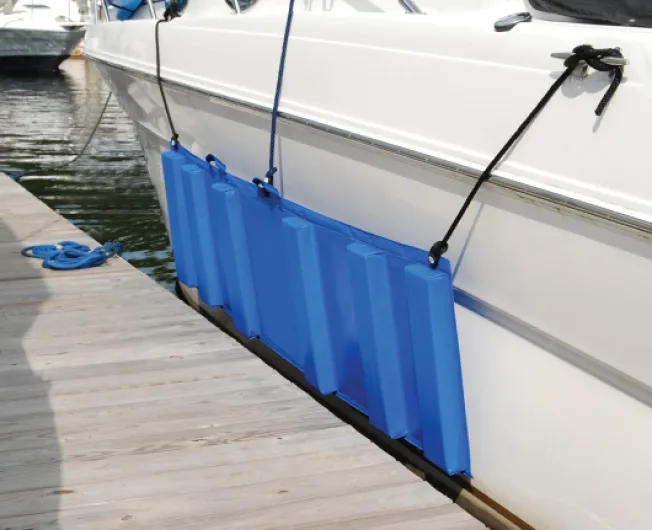
In terms of pure protection, this thing does the job. I’ve used it mainly for rafting up with a similar-sized boat and for docking alongside a rough concrete wall. In both cases, it covered more area than my usual setup of three or four standard fenders. Instead of worrying about whether there’s a gap between fenders, you just get one big contact surface. For lazy docking days, that alone is worth a lot to me.
When rafting up, I noticed a big difference in how little we had to adjust things. Usually, with individual fenders, you’re constantly tweaking heights and positions as the boats settle. With this, once we had it in the right general spot, we didn’t touch it again for the next few hours, even as people moved around and wakes came through. The hulls never touched, and there was a lot less “thunk” noise compared to when a single round fender pops out of position.
Against the concrete dock, it also worked well. The pad spreads the pressure out, so you don’t get that one fender that gets squished to death while the others just hang there. I intentionally let the boat ride against it in some light chop to see what would happen. The vinyl got a bit scuffed, but the hull was totally fine. For me, that’s the whole point: I’d rather the fender gets ugly than my gelcoat.
Is it perfect? No. If you’re in very choppy conditions or big wakes, the boats will still move up and down, and you can get some edge contact if the fender isn’t long enough or if it’s not tied tight enough. It’s not magic protection; it’s still just foam and vinyl. But compared to juggling a bunch of small fenders, I’d say its overall effectiveness is better and more consistent, especially for casual rafting and side docking. For heavy-duty commercial use or really rough marinas, you’d probably still want extra backup fenders at the bow and stern.
Pros
- Covers a large section of the hull, reducing the need for multiple individual fenders
- Solid foam and vinyl construction that handles real bumps and scrapes without failing
- Simple to deploy and adjust, saving time and hassle during docking and rafting
Cons
- Bulky to store and a bit awkward to handle compared to standard fenders
- Doesn’t fully replace traditional fenders for bow, stern, and piling situations
Conclusion
Editor's rating
After a few weekends of real use, I’d sum up this TaylorMade Profile Rafting Fender as a practical, no-nonsense side bumper that genuinely simplifies rafting and broadside docking. It doesn’t try to be fancy. It’s just a long chunk of foam wrapped in vinyl that covers a lot more hull than a few round fenders, and in practice that makes life easier and docking a bit less stressful. It handles normal bumps, light chop, and rough docks without drama, and it’s clearly built to be used, not babied.
This is a good fit if you often raft up with friends, tie up along seawalls or concrete docks, or just hate juggling a pile of smaller fenders every time you come in. You’ll still want a couple of regular fenders for the bow, stern, and odd dock setups, but for the main side protection, this pad does the heavy lifting. On the downside, it’s bulky to store, the specs online are a bit confusing, and it’s not some magic shield for extreme conditions. If you’re an occasional boater who rarely rafts up, you might not use it enough to justify the cost.
Overall, I’d give it a solid rating. It’s not perfect, but it gets the job done and actually solves a real annoyance: managing too many fenders. For regular weekend boaters who spend time tied to other boats or along rough docks, it’s a pretty sensible piece of gear to add to the boat.