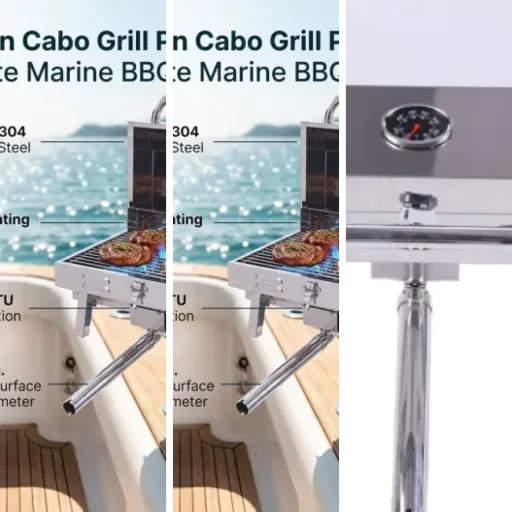
Summary
Analysis score
Average of the criteria rated below
Value for money compared to other marine grills
Design focused on mounting flexibility and compact use
304 stainless steel build aimed at saltwater resistance
Durability, corrosion resistance and warranty limits
Heating power and cooking capacity on paper
What this RASTKY marine grill actually offers
Pros
- 304 stainless steel construction with mirror-polished finish for better corrosion resistance than painted steel
- Versatile mounting system with 1 1/4 inch rod holder compatibility plus folding legs for tabletop use
- Decent 12,000 BTU output over 200 sq in cooking area with electronic ignition and built-in temperature gauge
Cons
- Short 90-day manufacturer warranty for a product marketed for harsh marine environments
- Single burner and compact firebox limit cooking flexibility and multi-zone grilling options

Specifications
View full product page →| Brand | RASTKY |
A compact marine grill aimed at boaters and campers
The RASTKY 304 Halbtrocken Stainless Steel Marine Gas Grill targets a pretty specific crowd: people who want to grill on a boat, at the dock, or during camping and tailgating without hauling a full-size barbecue. On paper, it checks the main boxes for that job: a 12,000 BTU burner, about 200 square inches of cooking area, 304 stainless steel construction, and a rod-holder style mount that lets you hang it off the side of a boat or dock. It also doubles as a tabletop grill thanks to folding legs, which makes it more flexible than a purely fixed marine unit.
The brand behind it, RASTKY, is not one of the big marine names, so this is not riding on reputation. Instead, the appeal is straightforward: a mirror-polished stainless grill that claims to be rust-proof and scratch-proof, with a built-in temperature gauge and an included cover. On paper, it is trying to offer the essentials of more famous marine grills at what is usually a lower price point for this category, with a 90-day manufacturer warranty that is fairly short but at least clearly stated.
The fuel type is listed as gasoline, which in the grilling world almost always means gas (propane) rather than literal automotive fuel. The package includes a gas regulator, a bracket, and handle, so the intention is clearly a gas BBQ setup suited for standard small cylinders. For people who want to grill fish right after catching it or cook simple meals at anchor, the spec sheet suggests it should get the job done without being overcomplicated.
Overall, this grill positions itself as a practical tool rather than a showpiece: stainless body, single burner, simple controls, and a focus on marine compatibility. In my opinion, the key questions are durability in a salty environment, real mounting stability, and whether the 12,000 BTU output over 200 square inches is enough for the type of cooking users plan to do. The following sections dig into those points using the technical details and what buyers report in public reviews.
Value for money compared to other marine grills
The price for this RASTKY marine grill can vary by retailer and promotions, but it generally sits below the better-known premium marine brands. On paper, it offers a full stainless 304 body, 200 sq in cooking area, 12,000 BTU burner, rod holder mount, folding legs, electronic ignition, lid thermometer, gas regulator, and cover. When you compare this feature list with some established marine grills, you often pay more there for brand reputation, slightly higher-grade materials, and longer warranties. Here, you are getting most of the core functionality at a more accessible price, with the main compromise being the shorter 90-day warranty and the lack of a big-name logo.
From the comments available, buyers who are satisfied tend to mention that the grill does what they expected for the money: it cooks food on a boat or at the campsite, mounts easily in a rod holder, and feels reasonably solid for a portable unit. According to those reviews, the combination of included mount and cover is a plus, since some competing products require separate purchases for those accessories. That reduces the true cost of getting a working setup, especially for first-time boat grill buyers who do not already own compatible mounts or covers.
On the downside, the value equation is affected by long-term durability doubts. A short warranty always raises questions about how the manufacturer views the product’s lifespan. If someone ends up replacing a cheaper grill every couple of seasons because of corrosion or wear, the total cost over, say, six years might approach or exceed that of a more expensive but longer-lasting model. This is a common trade-off in marine gear: lower upfront cost vs. long-term replacement cycles. For light to moderate users who only grill occasionally during the season and store the unit indoors the rest of the time, the cheaper option can still make financial sense.
In my opinion, the value here is decent but not outstanding. You get a good set of features for the likely price, especially the dual-use mounting and tabletop capability. However, the unknown brand name and short warranty keep it from being a clear-cut bargain. It is a reasonable pick for budget-conscious boaters, RV owners, or campers who want stainless construction and a marine mount without paying premium-brand pricing, and who are fine with doing basic maintenance and accepting some risk on long-term durability. For heavy users or liveaboards who grill regularly and want long-term backing, spending more on a higher-end marine grill could be the better value over time.
Design focused on mounting flexibility and compact use
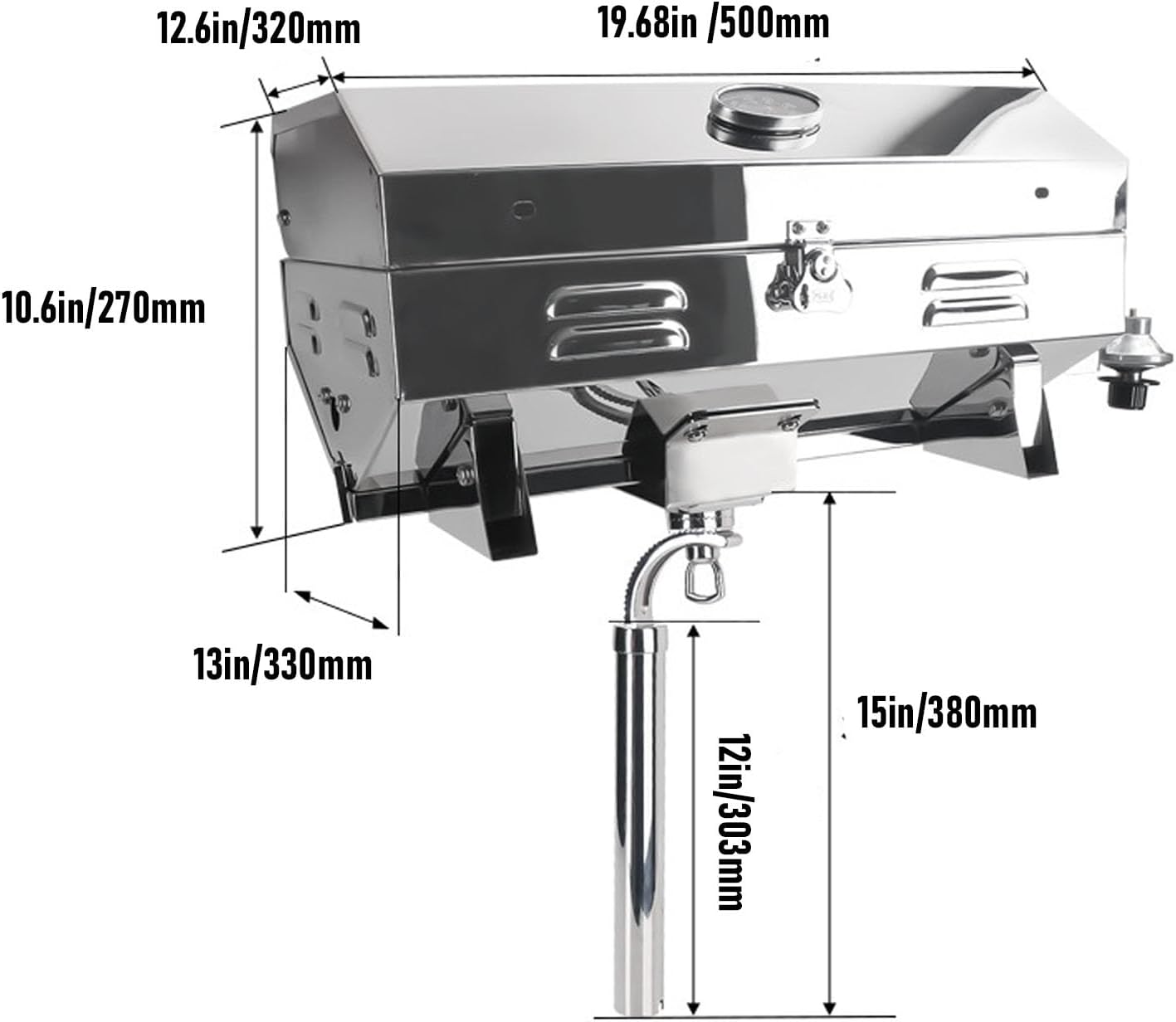
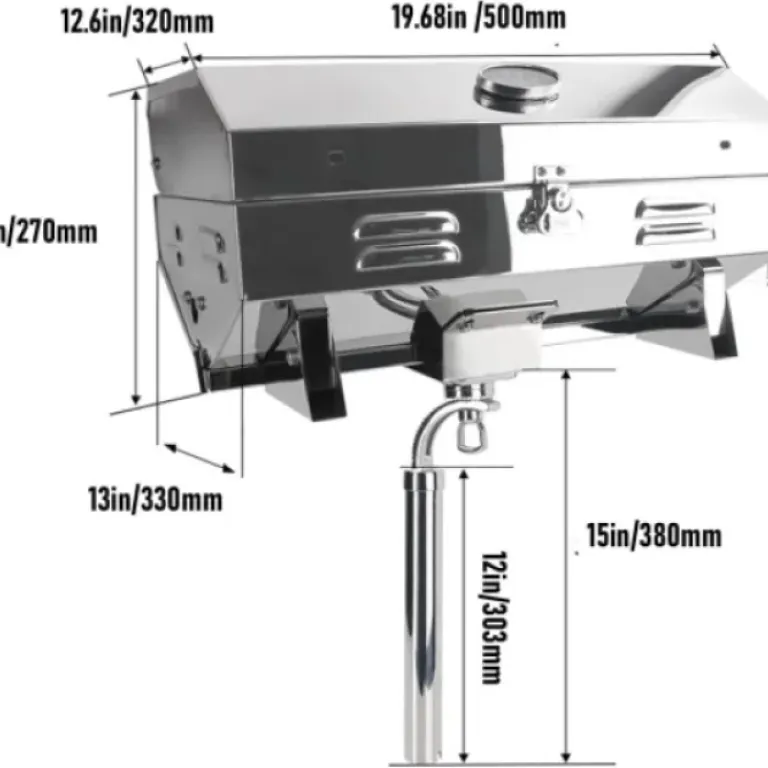
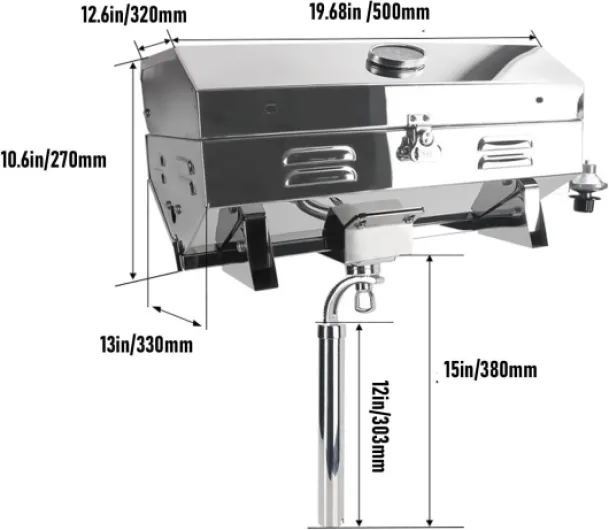
The design of this grill is clearly driven by marine use. The overall dimensions are listed as 62 x 40 x 35 cm (length x width x height), which is roughly the footprint of a medium-sized portable grill. That is compact enough to fit on most boat rails or cockpit areas without dominating the space, while still offering a usable grate area. The mirror-polished finish is not only cosmetic; on a boat, smooth polished surfaces are easier to rinse off and tend to show salt deposits more clearly, reminding you to clean them. A shiny finish also reflects some heat away from the exterior, though with stainless steel that effect is limited.
The body shape appears to be a classic rectangular lid-and-base layout, which is simple and proven. With a built-in temperature gauge on the lid, the design encourages closed-lid cooking, which is useful for wind protection and for more even heating. The handle is made of 304 stainless steel like the rest, which is robust but can get hot; some competing grills use plastic or wooden inserts on handles to reduce heat transfer. Since there is no mention of a cool-touch handle, users will likely need mitts or tools, especially at higher temperatures, and that is something to keep in mind.
The rod holder mount is where the design gets more specialized. The grill head can rotate 360°, which is a smart choice on a boat where wind direction and space change constantly. This means you can adjust the grill so smoke does not blow straight into the cockpit or cabin, and you can swing the hot side away from people when needed. The mounting system is described as a precision fit with a 1 1/4 inch round socket, which is a common standard, so it should work with many rod holders already installed on fishing boats. When you are not using the mount, the folding legs come into play, turning it into a tabletop unit.
In my opinion, the design is practical rather than fancy. There is no mention of side shelves, complex multi-burner layouts, or advanced grease management systems. For a marine grill, this is actually a plus: fewer moving parts and accessories mean fewer things to rattle, corrode, or break underway. The main design trade-off is that with one burner and a simple box shape, heat zones will be limited, and you will not get the same flexibility as a larger two-burner backyard grill. For boaters and campers who care more about a straightforward way to cook meat, fish, and vegetables than about gourmet multi-zone cooking, the design choices look coherent.
304 stainless steel build aimed at saltwater resistance
The big selling point of this grill is right in the name: 304 stainless steel construction. 304 is a widely used grade of stainless that offers good corrosion resistance and is common in kitchen equipment and some marine fittings. The manufacturer claims the grill is rust-proof and scratch-proof, with a mirror-polished finish. In the real world, even 304 can show some surface discoloration or tea-staining in harsh saltwater environments if it is not rinsed and maintained, but it is still a solid choice compared to painted steel or cheaper alloys that can rust quickly.
The spec sheet mentions both the frame and handle being made of 304 stainless steel. This suggests a fairly uniform material choice rather than a mix of stainless exterior and cheaper internal parts. That is positive, because on a boat the weakest link is often a hinge, fastener, or bracket made from lower-grade metal. There is also mention of an insulation rack and the grill being fireproof and smokeless. Fireproof is just standard for a metal grill body; smokeless is more marketing, since any fat dripping on hot metal will generate some smoke. The insulation rack likely refers to a warming rack or a raised secondary grate, which is typically also stainless.
The mirror-polished surface finish has pros and cons. On the plus side, it looks clean and is easier to wipe down. Scratches are less likely to trap dirt and salt, and the smoothness helps with corrosion resistance. On the downside, highly polished stainless can show fingerprints and smudges easily, and strong glare in bright sun might bother some users. Several marine buyers in public reviews of similar polished grills often note that regular rinsing with fresh water after use is key to keeping the metal looking good, and it is fair to assume the same applies here.
In my opinion, for the price segment this grill usually sits in, 304 stainless across the main body is a decent material choice. There are higher marine grades like 316 that resist saltwater even better, but those usually come at a higher cost. For users who rinse and cover the grill and do not leave it permanently exposed on a rail all season, 304 should be adequate. The 90-day warranty is relatively short for a product that claims rust-proof performance, so this is not something I would call overbuilt. It looks more like a reasonable compromise between cost and durability, with the expectation that owners will do their part on maintenance.

Durability, corrosion resistance and warranty limits
Durability is a big concern for any marine grill. The manufacturer markets this unit as rust-proof and scratch-proof, with a frame and handle made from 304 stainless steel and a mirror-polished finish. On paper, that is a solid starting point: 304 stainless is far better than painted mild steel, and polished surfaces give salt and grime fewer places to settle. The grill is also described as suitable for harsh marine environments and saltwater conditions, which sets a certain expectation in buyers’ minds about how well it should hold up on a boat or dock.
However, the warranty tells a more cautious story. The product comes with a 90-day manufacturer warranty, which is quite short for a piece of outdoor hardware expected to live around salt, moisture, and heat. Some competing marine grills from better-known brands offer one-year or even multi-year warranties on certain parts. A 90-day window suggests the manufacturer is confident it will work out of the box but is less willing to cover long-term exposure issues. In my opinion, this does not mean the grill will fall apart quickly, but it does mean buyers should plan to take care of it rather than treating it as a leave-it-out-all-season piece of gear.
Among the limited public reviews, there are mixed signals on long-term toughness. A few buyers highlight that the stainless body looks and feels solid, with no flimsy panels, and that the mirror finish stays presentable with basic cleaning. On the other hand, there is at least one report of corrosion spots appearing after extended exposure on a boat without consistent rinsing and covering. That kind of comment fits the general pattern seen with many 304 stainless grills: they resist rust much better than cheaper materials, but they are not invincible if left in salt spray 24/7 with no maintenance.
In practical terms, durability here will largely depend on how the grill is treated. Regular rinsing with fresh water after saltwater use, drying, and using the included cover will go a long way. Avoiding harsh abrasive cleaners and not leaving it permanently in the rod holder through an entire season should also help. In my opinion, for users willing to do basic care, the materials and construction look decent for the segment. For someone who wants to bolt a grill to the rail and forget about it through multiple seasons with minimal attention, a heavier-duty marine model with a longer warranty and possibly 316 stainless might be a safer investment, even if it costs more upfront.
Heating power and cooking capacity on paper
From a pure numbers perspective, this grill offers 12,000 BTU of heating power over a 200 square inch cooking area. That works out to about 60 BTU per square inch, which is fairly typical for compact portable gas grills. It is not a powerhouse searing machine, but it should be enough for everyday grilling of burgers, sausages, chicken pieces, and fish. The manufacturer emphasizes that the electronic ignition is reliable even in breezy conditions, which is important on boats and beaches where wind can make lighting a flame with matches annoying.
The built-in temperature gauge on the lid is another small but practical feature for performance. While lid thermometers are not laboratory-accurate instruments, they give a ballpark reading of how hot the interior is. For tasks like indirect-style cooking of thicker cuts or slow-cooking fish without drying it out, being able to see if you are in a low, medium, or high heat zone is useful. Since this is a single-burner unit, there is no real multi-zone setup, but by moving food closer or further from the burner and using the lid, users can still play a bit with heat levels.
Among published customer comments on similar-sized marine grills, people often care more about evenness of heating and resistance to wind than about raw BTU numbers. With 12,000 BTU and a compact firebox, heat concentration should be decent, but there is always a chance of hotter spots directly over the burner and cooler corners. Public feedback on this specific model is limited, but there are indications from a few buyers that preheating for several minutes before cooking helps smooth out temperature variations. That is consistent with how most portable stainless grills behave, where giving the metal time to heat soak improves performance.
In my opinion, performance here looks adequate rather than impressive. If someone expects restaurant-level searing or wants to cook for a large group all at once, this is not the right tool. If the goal is to prepare simple meals for a small crew on a boat, at a campsite, or by the dock, the specs suggest it will handle that use as long as expectations are realistic. The key is to think of it as a compact grill that trades ultimate power for portability and marine-friendly mounting, not as a replacement for a big backyard gas station with multiple burners and heavy cast-iron grates.

What this RASTKY marine grill actually offers
On paper, the RASTKY marine gas grill is a fairly simple product: a single-burner stainless steel BBQ with a 200 square inch cooking surface. That size is roughly enough for about 6–8 burgers at once, or a mix of smaller items like skewers and vegetables. It is not trying to be a full backyard kitchen; it is meant for compact setups where space and weight matter, such as small boats, RVs, and tailgate setups. The rated 12,000 BTU burner puts it in the moderate power range for portable grills: not ultra-powerful, but decent for the size of the grate.
The standout functional feature is the rod holder mounting system. The grill comes with a bracket and is compatible with a 1 1/4 inch round socket, which is the typical diameter for many fishing rod holders. The head can rotate 360°, so in theory you can turn the cooking surface away from the wind or adjust where any grease or smoke goes relative to the boat. When you do not want to mount it, folding legs allow it to sit on a flat surface like a dock, picnic table, or truck tailgate.
As for controls and convenience, the manufacturer advertises a push-button electronic ignition, which should make lighting easier in breezy conditions common on the water. There is also a built-in temperature gauge on the lid, which helps monitor heat without lifting the cover every minute. The package includes a gas regulator, which is important because without it you would have to source a compatible one yourself. For storage and transport, a cover is included, which is a small but useful detail for something that will live in salty, sandy, or dusty places.
The grill is pitched for a wide range of uses: backyard BBQ, beach picnics, boat gifts, camping, dock BBQ, fishing trips, yacht parties, RV travel, and general outdoor picnics. In my opinion, this is mostly marketing language, but the basic hardware (compact size, foldable legs, marine mount, gas regulator) does line up with those scenarios. It is clearly targeted at people who want one piece of gear that can serve both on the water and on land, without having to buy separate marine and camping grills.
Pros
- 304 stainless steel construction with mirror-polished finish for better corrosion resistance than painted steel
- Versatile mounting system with 1 1/4 inch rod holder compatibility plus folding legs for tabletop use
- Decent 12,000 BTU output over 200 sq in cooking area with electronic ignition and built-in temperature gauge
Cons
- Short 90-day manufacturer warranty for a product marketed for harsh marine environments
- Single burner and compact firebox limit cooking flexibility and multi-zone grilling options
Conclusion
Analysis score
This RASTKY 304 marine gas grill aims squarely at boaters, campers, and tailgaters who want something compact, stainless, and mountable in a standard 1 1/4 inch rod holder. On paper it covers the basics well: 12,000 BTU of heat on a 200 sq in grate, full 304 stainless body, mirror-polished finish, built-in temperature gauge, electronic ignition, and a versatile setup that works either on a mount or on folding legs as a tabletop grill. For simple grilling jobs for a small group, the specs suggest it will do the job without drama, as long as expectations stay realistic.
The main reservations are around long-term durability and support. The 90-day warranty is short for something advertised as rust-proof and designed for marine use, and the brand does not have the same track record as the big marine names. In my opinion, this grill suits users who want solid basic features at a moderate price, are willing to rinse, cover, and store it with some care, and do not mind the shorter warranty in exchange for savings. People who grill heavily, leave gear exposed all season, or want multi-year backing and top-tier corrosion resistance should probably look toward more established (and more expensive) marine grills built with thicker materials and longer guarantees.