
Summary
Editor's rating
Value: good price on paper, but think about what you’re risking
Bulky, functional design with some clunky controls
Materials feel tough enough, but sealing is the real question
Feels tough, but long-term trust is another story
Underwater performance: usable images, limited camera control
What you actually get with this Sea frogs X‑T3 housing
Pros
- Much cheaper than high-end housings for the X‑T3 while still rated to 40 m / 130 ft
- Solid-feeling ABS shell and thick glass port with decent image quality
- Includes leak detector, vacuum port, and zoom gear for the XF 16–55mm
Cons
- No access to front/rear command dials or proper aperture control with the 16–55mm
- Control precision and overall engineering feel basic; button feedback is mushy
- Mixed confidence on sealing, with at least one user reporting moisture alarm at shallow depth

Specifications
View full product page →| Brand | Sea frogs |
A cheap way to take your X‑T3 underwater… with some nerves
I picked up this Sea frogs housing for the Fujifilm X‑T3 because I wanted to take my main camera underwater without spending the kind of money you drop on Nauticam or Ikelite. On paper it looks tempting: 40 m / 130 ft depth rating, leak detector, vacuum port, and support for the 16–55mm. The price is way lower than the big brands, so I went in knowing it probably wouldn’t be perfect, but I still expected something I’d trust with a £2,000+ kit.
First contact out of the box, it looks solid and quite bulky, with that typical white Sea frogs shell. It feels more like a tool than a toy. You get the housing, flat port, zoom gear, spare O-ring, and some straps. So the basics are there. But once you actually try to put the X‑T3 inside and start checking controls, you see where they clearly cut corners in terms of precision and ergonomics.
I tested it first in a bathtub and then in a pool session with tissue paper inside instead of the camera, plus one shallow shore dive. I didn’t dare throw my X‑T3 in it at 30 m on the first day, especially after reading that Amazon review about the moisture alarm going off at 10 m. After my own tests, I’d say this: it can work, but you need to be picky about prep and you need to accept that you’re not getting pro-level reliability.
So this review is from that angle: if you’re a hobby diver or snorkeler looking for a cheaper way to use your Fuji underwater, I’ll walk through what’s good, what’s annoying, and where I personally would or wouldn’t trust this housing. It’s not a disaster, but it’s not the kind of thing you forget about once you’re in the water either. You keep it in the back of your mind.
Value: good price on paper, but think about what you’re risking
This housing’s main argument is clear: price. Compared to big brands, it’s much cheaper, and that’s exactly why I and many others look at Sea frogs. If you compare it to the cost of a Nauticam or similar for the X‑T3, you’re easily saving several hundred. On top of that, Sea frogs throws in a leak detector, vacuum port, and zoom gear, which is more than some entry-level housings offer. So on specs-versus-price, it looks like a good deal.
But you really have to factor in what you’re putting inside it. In my case, that’s an X‑T3 plus the 16–55mm f/2.8 – roughly £2,000+ worth of kit. Saving a few hundred on the housing is only a good deal if you’re reasonably confident it won’t flood. My own tests went fine, but the Amazon 1-star review describing a moisture alarm at 10 m on the first dive is exactly the kind of story that makes you think twice. Even if it’s just one unit, it shows the quality control is not perfect.
So in terms of value, I’d say: if you’re a hobbyist, you dive a few times a year, and you’re very careful with prep (O-ring cleaning, vacuum check, shallow test first), this housing is good value for money. It gets the job done without spending a fortune, as long as you accept its ergonomic limits and the fact you’re taking a bit more risk than with a premium housing.
If you’re a working photographer or someone who dives a lot and depends on their gear, the savings here don’t look so attractive. Losing a camera to a leak wipes out any money you saved on the housing. In that case, I’d see this more as a backup or a starter option rather than a long-term professional solution. So yeah, the value is decent for casual use, but it’s not a no-brainer when you factor in the potential cost of failure.
Bulky, functional design with some clunky controls
Design-wise, it’s the typical Sea frogs look: white body, clear back, big chunky buttons. It’s not pretty, but it looks like a piece of dive gear, which is fine. Once the X‑T3 and 16–55mm are inside, the setup is definitely on the heavy and bulky side. On land it feels like a brick, but underwater that weight is less of an issue. Still, if you’re used to compact camera housings, this feels like a step up in size and drag, especially if there’s any current.
The main weak point in the design, in my opinion, is the control layout and precision. Sea frogs says up front that the front and rear command dials aren’t accessible, and you really feel that. You basically lose that classic Fuji handling. Some of the buttons on the back are a bit mushy; they work, but you don’t always get a clear "click" feedback through gloves. The shutter lever is usable, but not as crisp as on higher-end housings I’ve tried. It’s fine for casual shooting, but if you want to react quickly to moving fish or fast scenes, it’s not the most responsive setup.
Another thing: aligning the camera inside with the internal controls isn’t as clean as I’d like. When I first mounted the X‑T3, I had to fiddle a bit with the tray position to make sure all the buttons lined up properly with the camera’s buttons. It’s not terrible, but it shows the machining and tolerances aren’t super tight. One Amazon reviewer mentioned quality of engineering issues, and I get where that’s coming from. This isn’t the kind of housing where everything just slots perfectly into place on the first try.
The presence of the vacuum port and fiber optic ports is a plus in terms of design flexibility. You can build a decent little rig around it with strobes and a tray. But overall, the design feels more focused on cramming in features than on making the handling smooth. It’s usable, but you have to accept that it’ll feel a bit agricultural compared to more expensive housings. For the price, that’s not shocking, but you need to know what you’re getting into.
Materials feel tough enough, but sealing is the real question
The housing is made mostly from polycarbonate and ABS plastic, with stainless steel bits for the mounting plate and some screws, plus EPDM rubber for the main O-ring and button seals. In the hand, the shell feels pretty solid – not flimsy, no creaking when you squeeze it, and it gives the impression it can handle some knocks on the boat or a drop on the deck without falling apart. I’m not worried about impact resistance or scratches on the body itself; this is not delicate gear.
The front port is made from thick optical glass, and that’s one of the better points. I didn’t notice any obvious loss of sharpness or weird color casts in my test shots. For a flat port, it does its job: the image is clear, and reflections are manageable as long as you watch your angles. The glass also feels robust; I’m less worried about it cracking than I would be with a thinner plastic port. You still want to baby it a bit when rinsing and transporting, but it doesn’t feel fragile.
Where I’m more cautious is the whole sealing system. Sea frogs talks about "triple waterproof": double rings on the panel and buttons, moisture alarm, and vacuum port. On paper, that sounds reassuring. In practice, there are two sides to it. On my own shallow tests (pool and short dive under 10 m) with tissue inside instead of the camera, I didn’t get any leaks or alarms. So clearly, when the O-ring is clean, greased, and properly seated, it can hold.
But then you look at the Amazon review from someone who took it to 30 m empty and had the moisture warning light start flashing at around 10 m, and that lines up with the feeling that the tolerances might not be super consistent from one unit to another. With these materials and this price point, I’d say the shell and glass are decent, but the real risk is in the quality of the seals and how well everything is assembled. If you treat it carefully, clean the O-ring, check for dust and hair obsessively, and ideally use the vacuum system, it can be fine. If you’re rough with it or expect bulletproof sealing out of the box, that’s where you may be disappointed.
Feels tough, but long-term trust is another story
In terms of physical durability, the housing feels like it will hold up reasonably well over time. The ABS shell is thick, the hinges feel sturdy enough, and the latch mechanism didn’t give me any impression of weakness. I tossed it in a gear bag with fins and a mask, bumped it around on a boat bench, and it came out without any new marks besides a few minor scuffs. So for normal dive-trip abuse, I don’t think it’s going to fall apart quickly.
Where durability becomes more of a question is the sealing system over months or years. O-rings wear, button springs can get sticky with salt and sand, and cheaper housings are usually more sensitive to that. The buttons here are all O-ring sealed and spring-loaded, which is standard, but they don’t have that very tight, clean feel you get on premium housings. I can see them becoming a bit stiffer if you don’t rinse thoroughly and regularly work the buttons in fresh water after each dive.
The included spare main O-ring is a good point, but that also tells you Sea frogs expects you to eventually swap it. That’s normal, but combined with the mixed user feedback (like the moisture alarm at shallow depth), it doesn’t give me the same long-term confidence as more expensive options. Personally, I’d be okay using this for occasional trips, maybe a few times a year, with careful maintenance. I’d be a lot more hesitant to use it as a daily work tool for paid underwater jobs.
So durability for me splits in two: the physical shell is likely to last and handle knocks without drama; the long-term reliability of the water seal is more uncertain. If you’re disciplined with care – rinsing, inspecting, storing it away from heat and sun, checking O-rings before every dive – you can probably get good mileage out of it. But if you’re the kind of person who throws gear into a bag and forgets about it until the next trip, I wouldn’t trust this as my only protection for an expensive X‑T3 setup.
Underwater performance: usable images, limited camera control
In the water, the housing does what it says: it lets you take the X‑T3 and 16–55mm down and shoot. Image quality through the flat glass port is decent. The photos I got in the pool and on a shallow shore dive looked sharp enough, and autofocus worked as expected. The housing doesn’t block AF, but remember: you don’t have manual focus on the lens here, and you don’t have direct aperture control. You basically have to set your exposure strategy before closing the case and rely on the camera’s automation and compensation once you’re underwater.
That’s the main performance limitation I felt: you lose that Fujifilm tactile control that makes the X‑T3 fun to shoot. No front or rear dials, no easy aperture ring access on the 16–55mm in this setup. So if the light changes or you go from surface to deeper water, you’re more dependent on auto ISO and shutter speed choices from the camera. For casual diving or snorkeling, it’s manageable. For more serious underwater photography where you want full manual control and quick tweaks, it’s frustrating.
Button responsiveness is okay but not great. Menu navigation works, but with gloves it’s a bit of a pain, and the feedback is not always clear. The shutter trigger is fine for single shots; for fast sequences or action, it feels slightly spongy. Still, I managed to get the shots I wanted in slower situations, like shooting coral, divers, or relatively still subjects. Just don’t expect the same reactivity you’d get from a higher-end housing.
As for the leak detection sensor, it’s a double-edged thing. It’s nice to have the warning light there, but it also means you’re constantly aware that something might go wrong. In my case, no false alarms. In that Amazon review, the light went off at just 10 m, which would have ruined my peace of mind. So performance-wise, I’d say: optical side is fine for a flat-port budget case, AF works, but control and confidence level are clearly below pro housings. For the price, that’s not shocking, but if you’re serious about underwater work, you will hit those limits quickly.
What you actually get with this Sea frogs X‑T3 housing
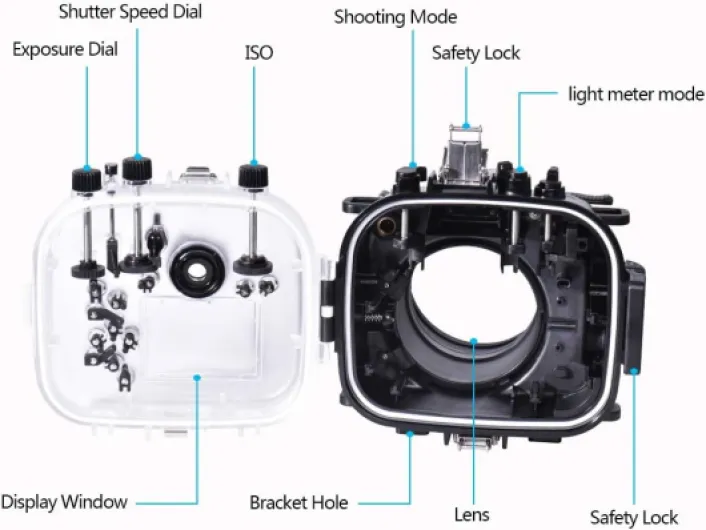
The housing is advertised as a 40 m / 130 ft underwater case specifically for the Fujifilm X‑T3 paired with the XF 16–55mm f/2.8. It’s a polycarbonate/ABS shell with a flat port and includes a manual zoom gear for that lens. Important detail: you only get autofocus for the lens, no direct aperture ring control and no access to the front or rear command dials. So if you’re used to tweaking aperture and shutter speed on the fly, you’ll feel a bit locked in and will have to rely more on auto or pre-set settings before the dive.
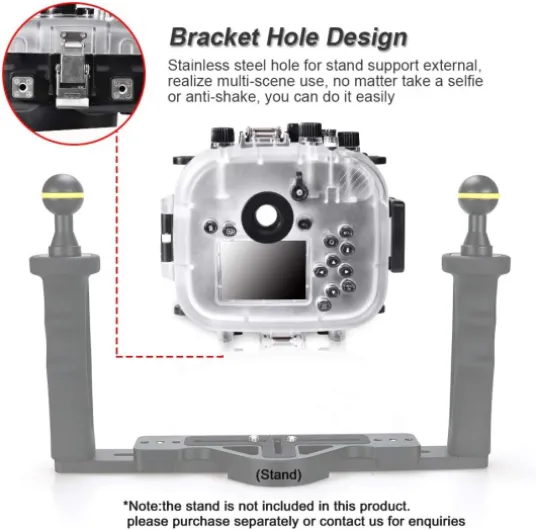
In the box I got: the main housing in white, the flat port pre-mounted, the zoom gear for the 16–55, a spare main O-ring, user manual, and shoulder/wrist straps. There’s a stainless steel mounting plate inside for the camera, and underneath you’ve got a standard 1/4" thread so you can mount it on a tray, tripod, or whatever rig you use. On the top/front, there are fiber optic ports if you want to trigger external strobes, which is nice for a budget housing.
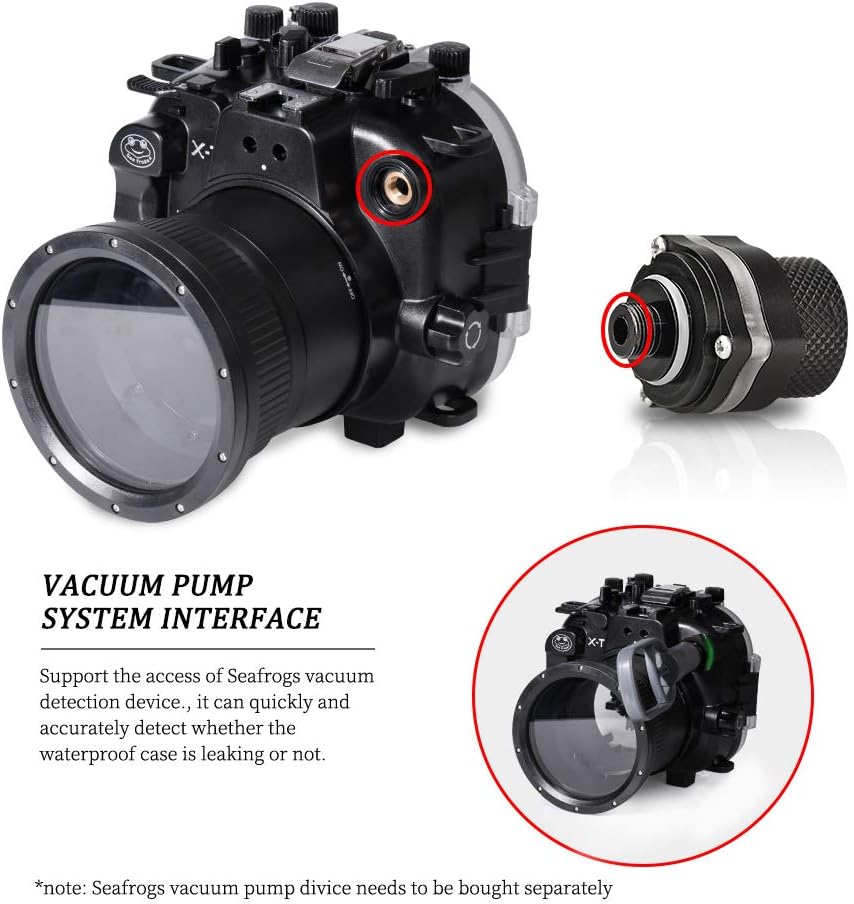
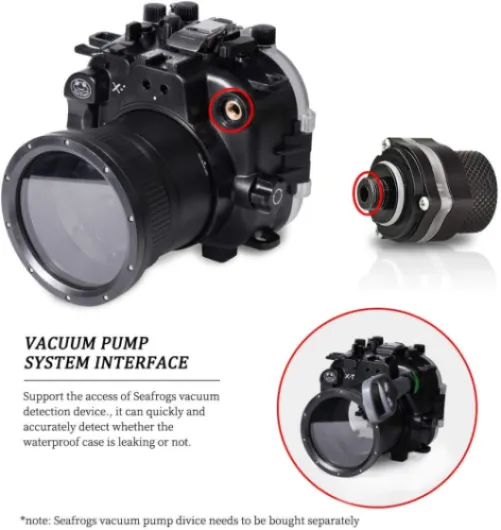
Sea frogs also highlights a few safety features: an in-built leak detection sensor (basically a moisture alarm), an interchangeable port system (in theory you can swap to other ports for different lenses), and a vacuum system port that works with their VPS-100 pump. Important: the vacuum pump is not included. For a housing at this price, I think they should at least offer a bundle, because that pump is basically what turns this from "maybe it’s sealed" into "I kind of trust it" before a dive.
On paper, the spec sheet is attractive: 40 m rating, ABS shell, O-ring sealed buttons, no audio recording, and a weight around 2.3 kg. In practice, what stands out is that this is clearly aimed at divers who want something affordable and are ready to work around its limits. The product page doesn’t hide that some functions aren’t accessible, but it doesn’t really stress how that affects real-world shooting. That’s what hit me most once I started using it: you technically can take the X‑T3 underwater, but not with the same control you’re used to on land.
Pros
- Much cheaper than high-end housings for the X‑T3 while still rated to 40 m / 130 ft
- Solid-feeling ABS shell and thick glass port with decent image quality
- Includes leak detector, vacuum port, and zoom gear for the XF 16–55mm
Cons
- No access to front/rear command dials or proper aperture control with the 16–55mm
- Control precision and overall engineering feel basic; button feedback is mushy
- Mixed confidence on sealing, with at least one user reporting moisture alarm at shallow depth
Conclusion
Editor's rating
After using this Sea frogs housing for the Fujifilm X‑T3, my feeling is pretty clear: it’s a budget-friendly way to get your X‑T3 underwater, but it comes with real compromises in both control and confidence. The shell and glass feel tough enough, the leak detector and vacuum port are nice touches, and optically it does a decent job for a flat-port case. For casual dives, snorkeling, or someone who just wants to experiment with underwater photography without dropping a fortune, it can make sense.
On the other hand, you lose key camera controls (no front/rear dials, no direct aperture handling for the 16–55mm), the buttons aren’t the most precise, and the general engineering feels a bit rough compared to higher-end housings. Add to that at least one user reporting a moisture alarm at just 10 m, and you get a product that works, but that you don’t fully relax with. Personally, I’d use it with a vacuum pump, do a shallow test dive every time, and still think carefully before trusting it at full depth with expensive gear.
If you’re a hobby diver who accepts some limitations and is disciplined with prep and maintenance, this housing offers reasonable value and will let you bring your X‑T3 along for underwater fun. If you’re shooting professionally, diving deep, or you simply can’t afford to lose your camera, I’d skip this and look at a more robust, better-engineered housing, even if it costs more upfront.