
Summary
Editor's rating
Is it worth the money compared to buying things separately?
Compact, bright, and mostly thought-through design
Battery life and real-world practicality
Materials feel decent and ready for real-world use
Holding up to sun, salt, and general abuse
How it actually performs on the water
What you actually get in the bag
Pros
- All-in-one kit that covers key USCG visual and audible signal requirements for small craft
- Electronic distress light replaces traditional flares, with no expiration and safer handling
- Compact, durable dry bag setup that’s easy to mount or stash on kayaks and small boats
Cons
- First aid kit and compass are very basic and may need upgrading
- Uses CR123 batteries, which are less common than AA/AAA and add a bit of ongoing cost

Specifications
View full product page →| Brand | SIRIUS SIGNAL FOR LIFE |
A realistic safety upgrade for small boats and kayaks
I picked up the Sirius Signal Boating Safety and Emergency SOS Kit because I was tired of dealing with expired flares and random loose safety gear rolling around in my kayak crate and under the console of my small skiff. I wanted one bag I could grab and know that, at the very least, I’m covered for the basics if something goes wrong. This kit kept popping up because it’s USCG compliant and uses an electronic distress light instead of pyrotechnic flares, which I liked from a safety and hassle standpoint.
I’ve used it on a 13' open boat and a sit-on-top fishing kayak over a few weekends. Nothing dramatic happened, thankfully, but I did force myself to test the different pieces: the light, the whistle, the mirror, the flag, the flashlight, and the dry bag itself. My goal wasn’t to admire it on a shelf but to see if it actually feels like a practical kit you’d trust when you’re a couple of miles off the beach or on a big lake.
Overall, it feels like a kit designed by people who actually boat, not someone just throwing random gear into a bag. It’s not perfect, and there are a couple of corners that feel a bit basic, but the main thing is this: it genuinely covers the key legal and safety bases in a tidy package. If you’re starting from zero safety gear, it’s a simple way to go from "probably not compliant" to "pretty solid" in one purchase.
If you already have some high-end gear or a bigger boat with built-in storage and power, this might feel a bit barebones or beginner-oriented. But for kayaks, small center consoles, jon boats, or a tender, it hits a good balance between price, completeness, and simplicity. That’s the angle I’m reviewing it from: not as a hardcore offshore survival kit, but as a realistic day-boat and paddle-craft safety bundle.
Is it worth the money compared to buying things separately?
Looking at value, I tried to price out what it would cost to build a similar kit piece by piece: a USCG-approved electronic distress light, a floating waterproof flashlight, a small dry bag, whistle, flag, mirror, basic first aid kit, phone pouch, compass, and paracord. Even if you go budget on some of those, you’d get close to or over the price of this kit, especially for the approved e-flare. So from a raw cost perspective, it’s not a rip-off. You’re paying for the convenience of a ready-made, compliant bundle.
Where it earns its keep is for new or casual boaters who don’t already have a pile of gear. If you just bought a small boat, kayak, or paddleboard and realized you’re technically supposed to have visual and audible signals, this kit gets you there in one shot. No confusion about which flare kit to buy, no wondering if your random Amazon flashlight is actually waterproof. That peace of mind has real value, especially if you’re taking kids or less experienced friends out.
On the flip side, if you already own a good waterproof flashlight, a whistle, and a solid first aid kit, then a big chunk of this bundle will be redundant. In that case, you might be better off just buying an electronic distress light on its own and calling it a day. Also, the included first aid kit and compass are pretty barebones. If you were hoping this would cover all safety categories in a deep way, you’ll likely end up spending extra to beef up the medical side at least.
For the average small-boat or kayak owner, I’d call the value proposition pretty solid: you spend once and check a lot of boxes in terms of both legality and basic safety. It’s not the cheapest thing on the market, but considering the Amazon rating (around 4.7/5) and my own use, the price feels fair for what you get. You’re not paying for fancy branding, just a straightforward, functional kit that does its job.
Compact, bright, and mostly thought-through design
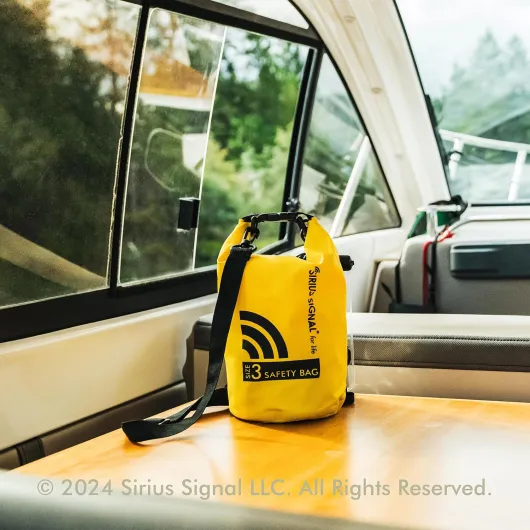
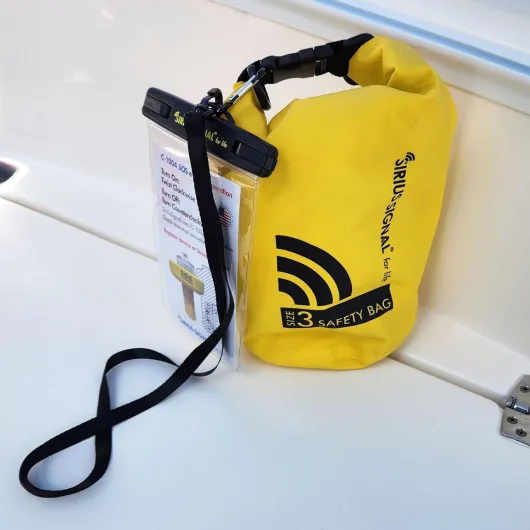
The design is clearly aimed at people with limited space: kayaks, paddleboards, small open boats. The dry bag is a small cylinder (roughly 15 x 15 x 18 cm) with a roll-top closure and a buckle. It’s bright and easy to spot in the boat, which is what you want in an emergency. There’s enough strap and attachment points to clip it to a T-top bar, rail, or kayak bungee. I did exactly what one Amazon reviewer mentioned: looped it around the T-top bar and just left it there. It doesn’t flap around much, and it hasn’t come loose.
Inside, there’s no fancy organization like pockets or dividers, which is both good and bad. Good because you’re not fighting with tight sleeves and stitched compartments; bad because everything ends up in a pile. I solved it by putting the first aid kit and small pieces in a zip bag inside, just so I’m not digging for the whistle at the bottom. Still, for this price and target use, I don’t really expect a fully organized interior. The main point is that the bag opens and closes quickly, and it does.
The electronic distress light has a simple, no-nonsense layout: one button, clear lens, and a mounting hole. You don’t need a manual to operate it. Same for the flashlight: it’s chunky enough to hold with wet hands, with a basic on/off function. No complicated modes or strobe party tricks, which I actually like for a safety kit. In rough conditions, you don’t want to be cycling through 7 modes just to get a steady beam.
If I had to nitpick, I’d say a small printed checklist or quick-reference card inside the bag would be helpful, especially for newer boaters. Something that says: "Night distress: use this. Day distress: use this. Sound signal: use this." It’s not hard to figure out, but in a stressful situation, clear labels and simple instructions go a long way. As it stands, the design is straightforward and practical, but there’s room for small usability tweaks.
Battery life and real-world practicality
The kit comes with batteries included, which is already a plus because a lot of cheaper safety kits make you chase down the right cells before you can even test them. The electronic distress light uses a CR123 lithium battery, and the flashlight also runs on a lithium cell. These aren’t the cheapest batteries, but they’re stable, handle temperature changes well, and have a long shelf life, which is what you want in emergency gear you hopefully never use.
I ran the distress light for about an hour straight to see if the brightness dropped off quickly. It stayed consistent, no obvious dimming. I didn’t drain it completely, but based on similar lights and the fact that it’s USCG-approved, it’s clearly designed to run for several hours, not just a quick burst. The idea is that you can keep signaling through a long wait, not just flash it for a minute and be done. For most recreational trips, one fresh battery in there, checked once a season, is realistic maintenance.
The flashlight battery life is also decent. I used it on and off over a few evenings, probably totaling around 1.5–2 hours, and it still felt full-strength. For a safety flashlight, that’s fine: it’s not meant to be your nightly camp lantern, it’s meant to work when you actually need to see something or signal. The use of lithium instead of cheap alkalines also means less risk of corrosion ruining the contacts if you forget about it for a year.
On the downside, CR123 batteries aren’t as easy to find as AA or AAA at a random gas station. If you want to be thorough, I’d buy a spare or two and keep them in a small zip bag inside the kit. That’s a small extra cost but worth it. There’s no built-in rechargeability here, which some people might miss, but for emergency gear I actually prefer replaceable lithiums: they sit for a long time without self-draining. Overall, the battery situation is practical as long as you remember to test the lights once in a while and swap the cells every couple of seasons.
Materials feel decent and ready for real-world use
Most of the kit is plastic, as the specs say, but it doesn’t feel like the flimsy dollar-store type. The dry bag material is a typical PVC-style coated fabric. It’s not ultra-thick like some heavy-duty river bags, but it’s perfectly fine for keeping this gear dry on a boat or kayak. I splashed it, left it in the bottom of the skiff with wet feet, and it kept everything dry. I wouldn’t drag it across rocks for fun, but for normal boating, it’s solid enough.
The electronic distress light and the flashlight both feel sturdy. The casings are rigid plastic with decent sealing. The IP68 rating on the flashlight is reassuring, and I did toss it in the water next to the boat to see what happens. It floated and kept working, which is the main claim they make. The lens and seals seem well done, and the buttons didn’t feel mushy or loose. The whistle is a standard hard plastic pealess design, loud enough and not fancy, which is fine by me.
The first aid kit comes in a soft plastic pouch, and the contents are very basic: small bandages, wipes, that kind of thing. Nothing high-end, but also nothing obviously junky. The hand compass is lightweight plastic and feels cheap compared to a dedicated hiking compass, but it does find north and the liquid filling keeps it from sticking. I’d call it an emergency backup, not a main navigation tool. The paracord is decent; not military-grade, but strong enough to lash the bag, rig a flag, or secure gear.
Overall, materials match the price and purpose: not premium, but clearly chosen to survive sun, splashes, and occasional dunking. If you’re expecting stainless steel hardware and super thick fabric, you’ll be disappointed. If you just want gear that doesn’t feel like it’s going to crumble after one season, this hits that mark. I’d still rinse things with fresh water after saltwater trips, but that’s true for any marine gear.
Holding up to sun, salt, and general abuse
I haven’t owned this kit for years, but I did my best to treat it like typical boat gear: tossed it in the bottom of the skiff, left it in a hot car for a day, splashed it, and banged it around on a kayak launch. After a few weekends of that, nothing looks fragile or on the verge of failing. The dry bag’s seams are still tight, no peeling or cracking in the material. The roll-top and buckle still feel snug and haven’t warped or loosened up.
The electronic distress light and flashlight both handled getting wet and then drying in the sun without any condensation inside the lenses. The plastic housings didn’t show any chalking or discoloration yet, though that kind of UV wear usually takes longer to show up. Buttons still click cleanly. I also dropped the e-flare from about chest height onto the deck a couple of times on purpose, and it didn’t crack or flicker. That’s about the level of rough handling I expect on a small boat.
The smaller pieces are fine too. The whistle is basically indestructible plastic. The compass is the only thing that feels like it might not age as well; the clear plastic could scratch easily if you just toss it loose with metal gear. The first aid kit pouch will probably get beat up over time, but that’s easy to replace or upgrade. The paracord’s sheathing hasn’t frayed with light use, and the waterproof phone pouch’s seals still look good after a few open/close cycles.
Given the price point and the very portable size, I’d say durability is better than I expected. It’s not built like professional offshore gear, but for weekend boaters and kayakers, it feels like it can handle a few seasons of normal use if you do basic care: rinse off salt, don’t leave it baking in the sun 24/7, and check things once in a while. If you’re extremely hard on gear or running charters daily, you might eventually outgrow this and move to heavier-duty stuff, but for typical recreational use, it holds its own.
How it actually performs on the water
Performance is where this kit matters, and the C-1004 electronic distress light is the key piece. When I tested it at night from a small bay, the SOS flash pattern was very clear and easy to see from a distance. It’s not like a camera flash that blinds you, but it’s bright enough to be obvious against the dark. Knowing it meets USCG specs is reassuring, because you’re not just guessing if it’s visible enough. The infrared mode is more of a nice-to-have unless you know someone is looking with night-vision equipment, but it doesn’t hurt to have it.
The separate waterproof flashlight did fine in real use. I used it to check lines, look into the water near the transom, and dig around in the kayak crate after sunset. The beam is focused enough to be useful without being a spotlight. The fact that it floats is a big deal; I dropped it on purpose, and it bobbed up within arm’s reach. That’s the kind of simple detail that actually matters when you’re tired and clumsy at the end of the day.
During the day, I tried the orange distress flag and signal mirror from a distance. The flag is visible, but like all flags, it depends on wind and how high you can get it. Using the included paracord to hoist it up on a paddle or a rod tip helps a lot. The mirror takes a bit of practice; it works, but you need to know how to angle it to catch attention. The whistle is loud, sharp, and cuts through background noise better than yelling. I could hear it clearly across the marina.
All together, the kit gives you a realistic set of tools for both day and night distress situations. It’s not going to replace a full-on EPIRB or VHF radio, and it’s not meant to. But as a compact safety layer for inshore boating and lakes, it performs as advertised. My only complaint is that the first aid kit’s performance is limited by how minimal it is; it will handle small cuts and scrapes, but for anything serious, you’ll want to supplement it with a better medical kit.
What you actually get in the bag
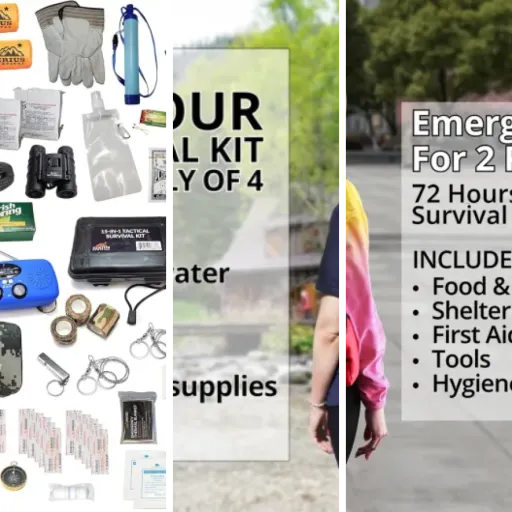
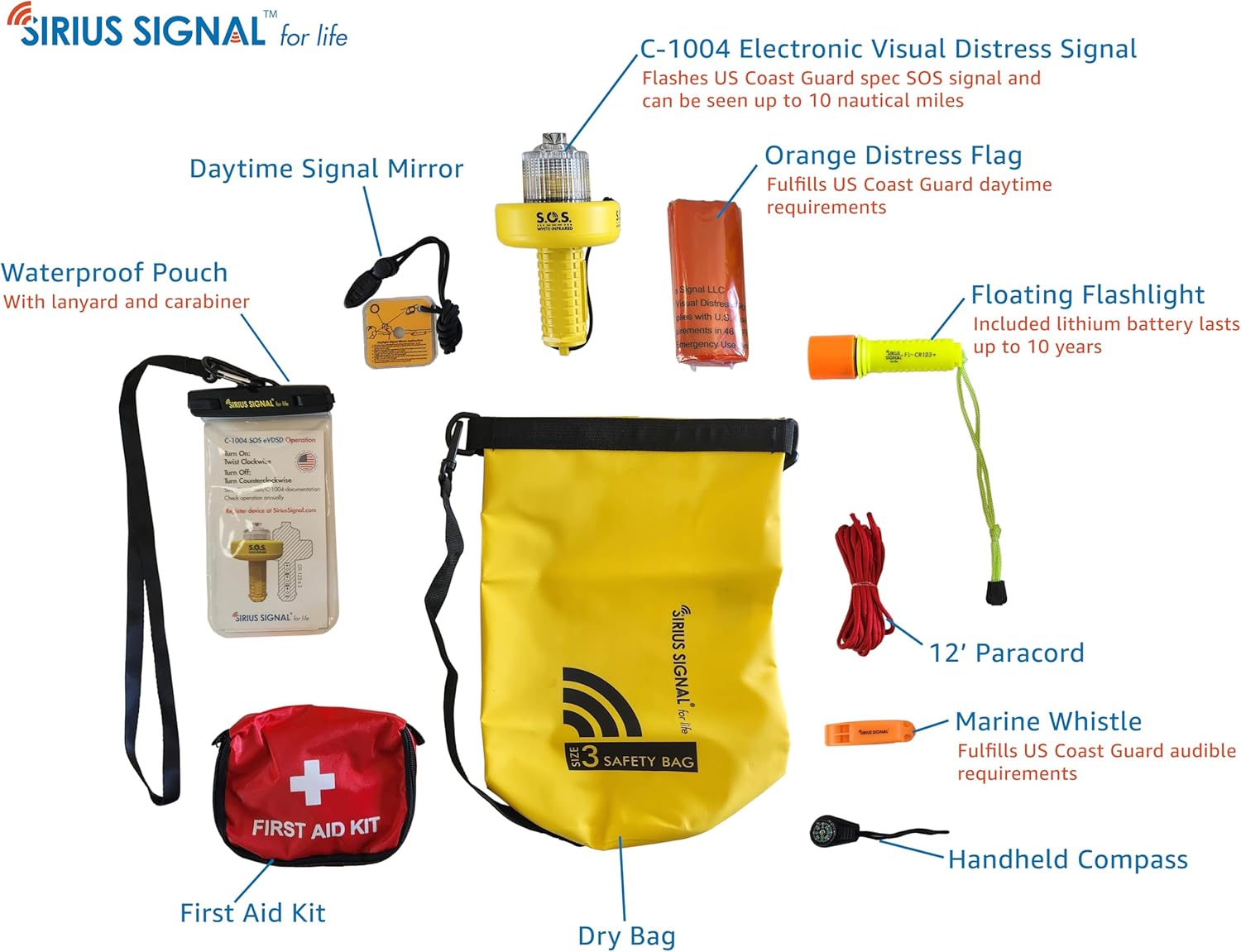
Out of the box, the Sirius Signal Boating Safety and Emergency SOS Kit is basically a bright dry bag stuffed with ten pieces of gear. The main star is the C-1004 electronic visual distress signal (the e-flare) that flashes SOS to US Coast Guard specs, plus an infrared mode. Then you’ve got a separate IP68-rated waterproof flashlight, a whistle, a signal mirror, an orange distress flag, a small first aid kit, a simple hand compass, a waterproof phone pouch with strap and carabiner, and a length of paracord. Batteries for the e-flare are included, which is one less thing to think about.
In practice, everything fits pretty neatly inside the dry bag with room to spare for a few extras like seasickness tablets or a small multitool. It’s not one of those kits where you can’t close the bag once you open it; you can actually repack it without playing Tetris for 20 minutes. The bag itself is around 3L in size, so it’s compact enough to tuck under a seat or lash to a rail without being in the way. Weight-wise, at under 2 pounds for the whole set, it’s light enough for kayakers to bring without thinking twice.
What I liked is that it covers both legal compliance and practical signaling: daytime (mirror + flag + whistle) and nighttime (electronic SOS + flashlight). You’re not buying random duplicates. If you’re in the U.S., this set basically checks the main USCG boxes for visual and audible distress signals for small craft, which is why several reviewers mention using it to stay compliant. If you’re used to the old-school flare kits, this feels less messy and less annoying to maintain.
On the downside, the first aid kit is very basic, and the compass is more of a "better than nothing" backup than a serious navigation tool. If you expect a full trauma kit or a professional-grade compass, you’ll be underwhelmed. But as a starter safety bundle for recreational boating, the contents are logical and reasonably thought out. You might still add a few personal items, but you don’t feel like the bag is full of useless filler.
Pros
- All-in-one kit that covers key USCG visual and audible signal requirements for small craft
- Electronic distress light replaces traditional flares, with no expiration and safer handling
- Compact, durable dry bag setup that’s easy to mount or stash on kayaks and small boats
Cons
- First aid kit and compass are very basic and may need upgrading
- Uses CR123 batteries, which are less common than AA/AAA and add a bit of ongoing cost
Conclusion
Editor's rating
After using the Sirius Signal Boating Safety and Emergency SOS Kit on both a small boat and a fishing kayak, my takeaway is simple: it’s a practical, compact way to get your safety basics in order, especially if you’re starting from scratch. The standout is the USCG-approved electronic distress light that lets you ditch traditional flares, which are annoying to store, expire quickly, and aren’t exactly family-friendly. Paired with the floating waterproof flashlight, whistle, flag, and mirror, you’re covered for both day and night signaling in a realistic way.
It’s not perfect. The first aid kit is minimal, the compass is more backup than primary gear, and people who already own a bunch of marine equipment might find parts of the bundle redundant. Also, the use of CR123 batteries means you should plan ahead and keep a spare or two. But overall, the build quality is decent, the bag is easy to stash and has held up well, and the whole thing feels geared toward real-world use, not just ticking boxes on a spec sheet.
If you’ve got a kayak, jon boat, or small center console and want a straightforward, no-fuss safety setup that keeps you legal and prepared, this kit makes sense. If you’re running offshore, already have a full medical kit, VHF, and other advanced gear, you might be better off just adding an electronic flare on its own. For the typical weekend boater, though, this is a good-value, confidence-boosting bundle that gets the job done without drama.