
Summary
Editor's rating
Value: pricey, but you do feel where the money goes
Design: feels like workshop gear, not a toy
Durability and build: feels like it’ll last years, not months
Performance: 30A is not a joke, and it stays cool doing it
What this charger actually is (and what it isn’t)
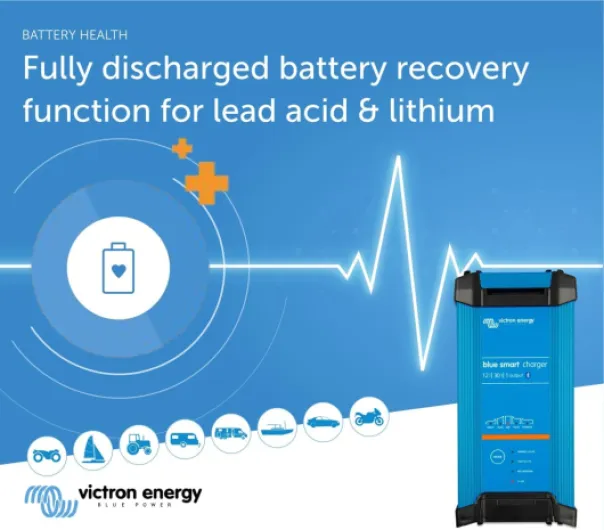
Effectiveness: actually revives and maintains big batteries
Pros
- Strong 30A output charges large batteries much faster than typical small chargers
- Bluetooth app gives clear info and easy control over charge profiles and power supply mode
- Solid build and stable operation, runs relatively cool and feels suitable for permanent camper/boat installs
Cons
- High price compared to basic car battery chargers
- Single output only, no built-in way to charge multiple banks at once
- Clearly geared toward hard-wiring and more technical users, not the most beginner-friendly or plug-and-play

Specifications
View full product page →| Brand | Victron Energy |
A charger for when trickle toys aren’t enough anymore
I picked up the Victron Blue Smart IP22 12V 30A because my small 5A trickle charger was taking forever on my camper leisure battery and kept giving up on tired batteries. Between a campervan, a motorbike and a car that sits a lot, I needed something that could both charge fast and act as a stable 12V power supply. On paper, this Victron looked like the step up: 30A, proper charging profiles, and Bluetooth to keep an eye on it from the phone.
After a few weeks of use, I’ve mainly used it on a 120Ah AGM leisure battery, a 110Ah lead-acid starter battery and briefly on a LiFePO4 pack. The short version: it’s clearly built for people who actually tinker with electrics, not for someone who just wants to clip on and forget with no thinking at all. It does get the job done, but you have to accept the price and the slightly nerdy setup.
What stood out to me quite fast is the charging speed and the stability. My old no‑name charger would get hot and sometimes drop out. This one barely gets warm and just sits there quietly doing its thing. The downside is that, for the price, Victron could have thrown in more leads and clearer quick-start info. Out of the box, it feels more like a piece of kit for a van conversion or boat install than a casual garage gadget.
If you’re expecting a tiny plastic box with crocodile clips and a big green "OK" light, this isn’t that. It’s more like a compact workshop charger/power supply you’ll probably mount permanently in a camper, RV or boat. That’s the mindset you need to have: it’s not overkill, but it’s clearly aimed at people who care about battery health and want more control than the average cheap charger offers.
Value: pricey, but you do feel where the money goes
Let’s be clear: compared to the usual £30–£60 smart chargers, the Victron Blue Smart IP22 30A sits in a different price bracket. You’re paying for 30A output, proper adaptive charging, Bluetooth monitoring, and a build aimed at camper/boat/workshop installs. If you just want to top up a single small car battery once in a while, this is overkill and not good value. A basic 5–10A charger will do that job and cost a fraction of the price.
Where the value starts to make sense is if you have larger batteries (100Ah+) or lithium, and you actually care about charge time and battery health. On my 120Ah AGM, cutting charge time from "most of a day" to "a few hours" is not just a small improvement; it changes how I use the van. I can plug in on a campsite or driveway for an afternoon and know the battery is properly full. Also, being able to recondition and sensibly maintain batteries has already saved me from replacing at least one borderline battery. If that saves you one decent battery, a chunk of the charger’s price is basically recovered.
Another factor is that it doubles as a 12V power supply. If you’re building a camper or refitting a boat and were thinking about a separate 12V PSU for when you’re on hookup, this can cover that role and still be your charger. So instead of buying two separate devices, you buy one slightly more expensive but more capable unit. That’s where the value is for me: one solid piece of kit instead of multiple cheap boxes.
Still, it’s not perfect value-wise. For the price, Victron could include a better set of leads (ring terminals, clamps, maybe a quick-connect harness) and a clearer, more beginner-friendly quick start guide. As it is, it feels aimed at people who already live in the Victron ecosystem or are comfortable wiring things properly. If you fit that profile and you use it regularly, the cost feels justified. If you’re only going to dust it off twice a year, it’s hard to call it good value; you’d be paying for features you won’t really use.
Design: feels like workshop gear, not a toy
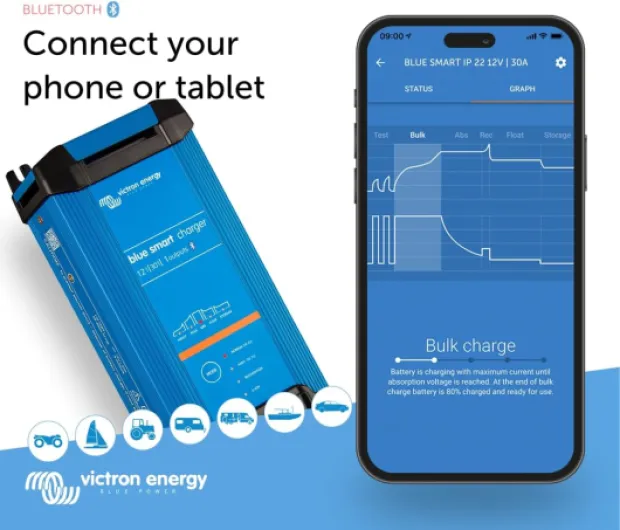
The design is pretty straightforward: a blue metal-ish housing, vents, screw holes for mounting, and a simple front panel with LEDs. It’s not small, but for a 30A charger it’s actually pretty compact. Dimensions are about 23.5 x 10.8 x 6.5 cm and it weighs around 1.4 kg. So you can carry it around easily, but it clearly looks more like something that belongs screwed to a wall in a van or boat locker than on a kitchen counter.
The front has status LEDs for bulk, absorption, float, and a few mode indicators. Once you understand what they mean, it’s easy enough, but it’s not super "consumer-friendly" like some chargers that just say "charging" and "ready". The good thing is that you don’t need a big screen on the unit because the Bluetooth app gives you all the detail. I actually prefer that: less plastic screen to break, and you get more info on the phone anyway.
One detail I liked: the unit doesn’t feel cheaply put together. The casing feels solid, the mounting holes are sensible, and the cable strain relief seems thought through. There’s a clear sense that this is meant to live in a slightly rough environment, like a camper garage or small engine room. On the downside, it’s very obviously designed to be hard-wired. The output posts are set up in a way that makes permanent ring-terminal connections feel more natural than constantly clipping and unclipping alligator clips.
If you want a charger you constantly move between cars on the driveway, this design is a bit awkward. You can do it, but you’ll probably end up making a few dedicated leads or permanently wiring it into the vehicle you care about most. For me, that’s the campervan, so the design suits me fine. But if you expected a tiny, super-portable box like the typical 4–10A chargers, this will feel a bit overbuilt and a bit more “installer” oriented.
Durability and build: feels like it’ll last years, not months
I obviously haven’t had it for years, but you can usually tell within a few weeks if something is flimsy. This doesn’t give that feeling at all. The housing is solid, the connectors don’t wobble, and there’s no cheap creaking plastic. It’s rated IP22, so it’s not waterproof, but it’s fine for a camper cupboard or a reasonably dry boat locker. I’ve had it mounted vertically on a plywood panel in the van, and it’s been bounced around a bit on bad roads without any weird noises or issues.
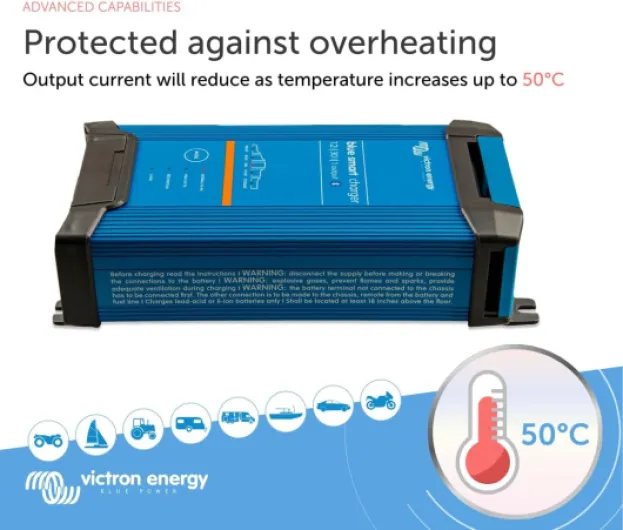
The cooling seems well thought out. There are vents, but no obvious dust-trap fan that’s going to clog up immediately. Because it runs fairly cool even at higher current, I’m not too worried about it cooking itself over time. With some cheaper chargers I’ve had, you can literally smell them getting too hot after a long session on a flat battery. With this, after a half day of charging, it just feels warm to the touch and that’s it.
Victron also has a decent reputation in the camper and marine world, and you can feel why. The screw terminals are proper, the casing can be mounted cleanly, and the whole thing feels like it’s designed to be part of a permanent electrical system, not a throwaway gadget. I also like that firmware updates come via the app. That’s not really "durability" in the physical sense, but it means the product can be kept up to date instead of being obsolete when new battery types or tweaks come along.
If I had to nitpick, I’d say the IP22 rating is the limit: you still need to protect it from proper moisture. So in a damp boat bilge or outside garage wall that gets condensation, I’d be a bit cautious and maybe build a small protective box or mount it somewhere more sheltered. But in normal indoor, van, or workshop use, I don’t see any obvious weak point that screams "this will fail soon". It feels like a unit you install and then forget about for a long time.
Performance: 30A is not a joke, and it stays cool doing it
The headline spec is 30A at 12V, and in practice it gets close to that when the battery is low enough. On my camper’s 120Ah battery sitting around 12.1V, the app showed 26–29A during the early bulk phase. That’s plenty. You can actually hear the fridge click on and lights stay bright while the charger is still pushing current. With my older 10A unit, if the fridge was running, the battery voltage would sag and charging basically stalled.
Victron claims up to 94% efficiency and less heat than typical chargers. I obviously didn’t measure efficiency, but I did the basic hand test: after a couple of hours at high current, the casing was warm, not roasting. No fan noise either, which is nice if it’s in a van where you’re sleeping. There is a night mode that reduces power and noise; I tried it once and it does lower the current, so if you want absolute silence at night, that’s a useful feature.
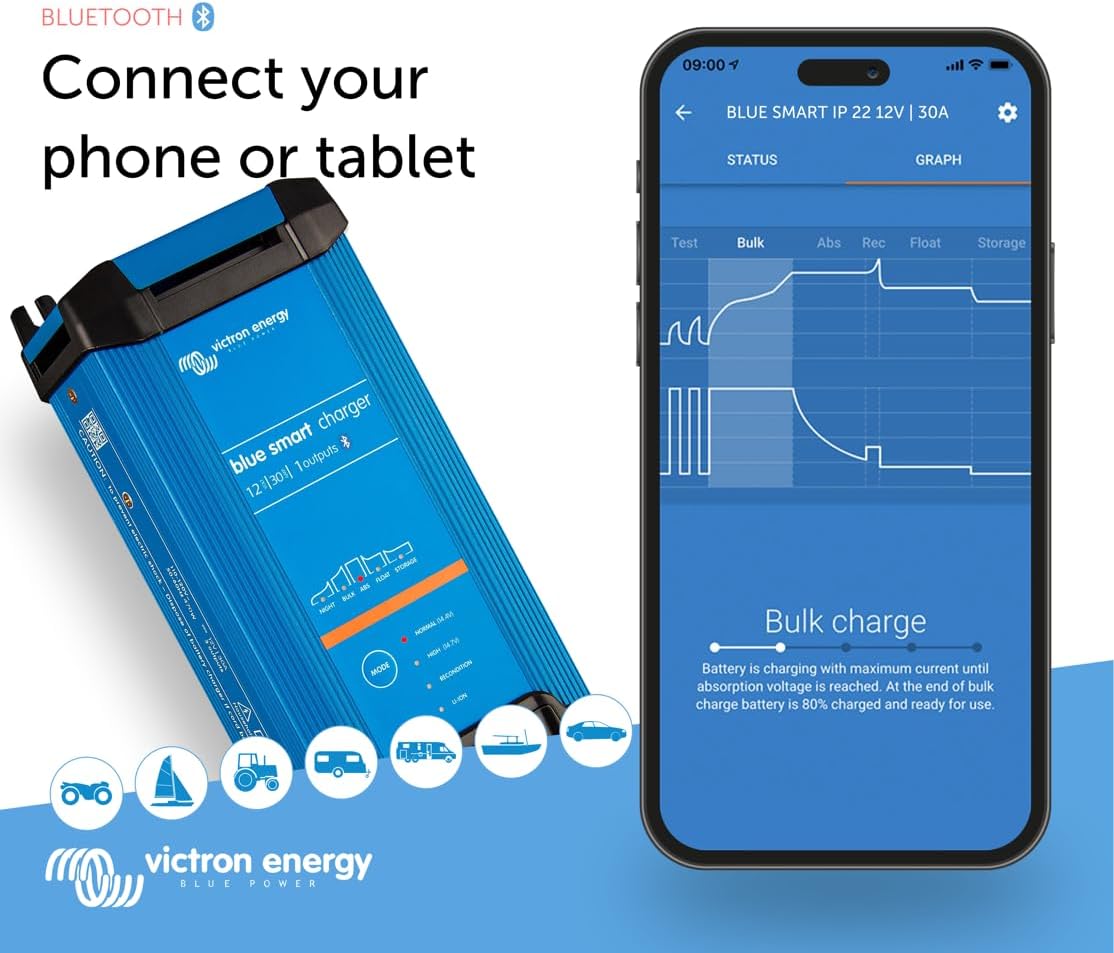
As a power supply, it’s also pretty handy. Via the app, you can switch it to supply mode and set a fixed voltage. I used it to run 12V lights and a small water pump in the camper while the battery was temporarily disconnected. Voltage stayed stable and nothing flickered. It’s not a lab-grade power supply, but for camper or workshop use it’s stable enough. The Bluetooth control is not just a gimmick; being able to see actual amps and volts, and tweak things, is genuinely useful when you’re chasing down power issues.
Only real performance downside: it’s one output only. So if you’ve got starter and leisure batteries and you want them both charged at the same time, you either need multiple units or some sort of battery combiner setup. For my use, dedicating it to the leisure battery and using smaller chargers for the others made sense. But if you hoped this one box would handle a whole multi-battery setup on its own, that’s not how it’s built.
What this charger actually is (and what it isn’t)
The Victron Blue Smart IP22 12V 30A is basically a single-output 12V charger that can push up to 30A into one battery bank. So think: one big leisure battery, a chunky starter battery, or a small LiFePO4 bank. It’s not a multi-bank charger and it’s not a jump starter. If you’re hoping to charge three batteries at once, wrong product. It’s more like a solid bench charger that you can also wire permanently into a camper or boat.
Out of the box, you get the charger itself, basic AC cable and a set of output leads with alligator clips / cigarette lighter adapter depending on the kit. No fancy storage bag, no pile of adapters. The manual is a bit dry and assumes you at least know what AGM, GEL, and LiFePO4 are. The Bluetooth app is really where the product makes sense. You turn it on, connect via the VictronConnect app, and suddenly you see voltage, current, history, and can switch between battery profiles or even make it act like a power supply.
In practice, I’ve used it in three ways: as a fast charger on the workbench, as a fixed charger in the camper, and as a 12V power supply while messing with the 12V system without flattening the battery. It handled all three decently. The 30A rating means it’s actually able to run things like a small 12V fridge and lights while still charging the battery, which my old 10A charger simply couldn’t keep up with. That’s where you really see the difference.
Where it falls a bit short is in pure plug‑and‑play simplicity. A cheaper smart charger usually has a big mode button and that’s it. With this, you really want to pair your phone and check that you’re on the right preset, especially if you’re switching between lead-acid and LiFePO4. It’s not complicated, but it’s a step more involved. So I’d say it’s aimed at people who don’t mind opening an app and checking numbers, not someone who just wants a big green light and no thinking.
Effectiveness: actually revives and maintains big batteries
This is where the Victron IP22 30A starts to justify its price. On my 120Ah AGM leisure battery, my old 5A charger would need basically a full day to get from around 50% to fully charged, and sometimes it would never hit proper float and just hang around in absorption. With the Victron, I’m seeing bulk charge currents in the 25–28A range initially, and the battery gets back up to a healthy state in a few hours rather than an entire day. That’s a big difference when you’re preparing for a trip or working on a van build.
I also tried it on a 110Ah lead-acid starter battery that had been sitting and was reading about 11.9V. The Victron started gently, then went into bulk mode and, over the course of the afternoon, brought it back up and then held it in float at around 13.5V. The desulfation/reconditioning part isn’t magic, but I did notice that one battery which a cheap charger declared as "fault" was at least usable again after a full cycle with the Victron. It’s not like getting a brand new battery, but it did crank the engine afterwards, which is all I needed.
On LiFePO4, it’s more about having the right profile and a stable current. I used it on a 100Ah LiFePO4 pack and the charger followed a simple bulk–absorption–float pattern as advertised. No drama, no odd voltage spikes. The app showed a clean curve, and the pack’s own BMS didn’t complain. The adaptive charging is more noticeable with lead-acid, though: if the battery is lightly used, it doesn’t sit in absorption too long, and if it’s heavily discharged, it gives it a longer, proper cycle.
In day-to-day use, the main thing is that it just charges properly and reliably. I haven’t had it randomly cut out or overheat. It’s not a miracle worker on batteries that are truly dead, so don’t expect it to bring a 10-year-old completely sulphated lump back to life. But for tired, partially neglected batteries, it gives them a decent second wind and then maintains them sensibly. Compared to cheap chargers I’ve used, it’s simply more consistent and less fussy.
Pros
- Strong 30A output charges large batteries much faster than typical small chargers
- Bluetooth app gives clear info and easy control over charge profiles and power supply mode
- Solid build and stable operation, runs relatively cool and feels suitable for permanent camper/boat installs
Cons
- High price compared to basic car battery chargers
- Single output only, no built-in way to charge multiple banks at once
- Clearly geared toward hard-wiring and more technical users, not the most beginner-friendly or plug-and-play
Conclusion
Editor's rating
Overall, the Victron Blue Smart IP22 12V 30A is a solid choice if you’re dealing with big batteries, camper or boat setups, or LiFePO4, and you actually care about how they’re charged. It’s powerful, runs cool, and the Bluetooth monitoring is genuinely useful rather than a gimmick. Charging is fast and controlled, and it has enough brains to maintain and gently revive tired lead-acid batteries without you babysitting it. It feels more like a permanent bit of electrical kit than a casual gadget.
On the flip side, it’s not cheap and it’s not the most plug‑and‑play option for a casual car owner. Single output only, IP22 (so not fully sealed), and the lack of extra leads mean you get a focused, professional‑leaning charger rather than a friendly all‑round household tool. If you just want to keep one small car battery topped up over winter, you’ll be spending more than you need to and not really using half of what it offers.
I’d say it’s ideal for: campervan owners, narrowboat and yacht users, people with off‑grid setups, and anyone who wants a reliable 12V power supply plus charger in one. It’s also good if you have multiple large batteries and are tired of slow, cheap chargers giving up or overheating. If you’re on a tight budget, only have one small battery, or hate messing with apps and settings, you’re better off with a simpler, cheaper unit. For regular, heavier use though, this Victron is a pretty solid long‑term investment.