
Summary
Editor's rating
Is it worth the money compared to a basic handheld?
Design and handling: chunky but reassuring
Battery life: fine for a day, but AIS and screen do cost you
Water, drops and real-world abuse
Range, audio and AIS: does it actually pull its weight at sea?
What you actually get and what this thing really does
Pros
- Built-in AIS, DSC and GPS in a single floating handheld adds real safety and awareness
- Loud 1500mW audio and effective noise cancelling make it easy to hear in noisy conditions
- Robust waterproof build with Float’n Flash and AquaQuake that actually work in practice
Cons
- Higher price than basic handhelds, only worth it if you use the AIS/DSC features
- Interface is a bit busy and takes time to learn, with a small screen for AIS info

Specifications
View full product page →| Brand | Icom |
A handheld VHF that does more than just shout on channel 16
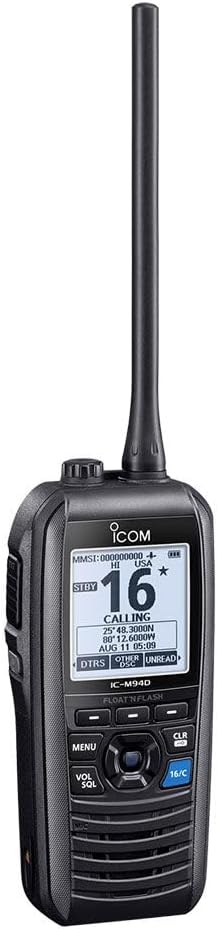
I’ve been using the Icom IC-M94D Euro on a 7m motorboat and occasionally on a 9m sailing boat for a few weeks now. I wanted a handheld VHF that wasn’t just a backup walkie-talkie, but something that actually helped with safety and navigation. The built-in AIS and GPS were what caught my eye, because on a small boat you don’t always have a fancy plotter with all the bells and whistles.
In practice, I’ve used it as a backup to the fixed VHF, and also as the main radio in the dinghy and when I’m moving around the deck. I’ve had it in light rain, proper spray, and one full dunk when it slipped off a bench into the water. So this isn’t just a “unboxed it and it looks nice” opinion – it has seen some real use, even if not in Arctic storms or anything like that.
The first thing that stood out is that it’s not just a talk/listen brick. The AIS display and GPS info actually change how you use it. Instead of just hearing calls, you can see who’s around you and where ships are going. For coastal trips in busy areas, that’s genuinely useful, especially when you don’t have a big-screen chartplotter in front of you all the time.
It’s not perfect though. The interface is a bit busy, the AIS screen is small, and the battery life is good but not endless, especially if you leave the screen and AIS on all the time. But overall, it feels like a serious tool rather than a toy. In this review I’ll go through what worked well for me and where it annoyed me, so you can decide if it’s worth the extra money over a basic handheld VHF.
Is it worth the money compared to a basic handheld?
Price-wise, the IC-M94D sits clearly above the no-name or entry-level handheld VHFs. You’re paying for the Icom badge, AIS, DSC, GPS and generally better build. If you only want a spare radio to call the marina once in a while, this is probably overkill. There are cheaper handhelds that will handle basic voice comms just fine. So the value really depends on whether you’ll actually use the extra functions or not.
In my case, I think the extra cost is justified, mainly because of the AIS and the proper DSC with GPS. On a small boat without a full integrated system, having a handheld that can send a distress call with your exact position and also show nearby ships on its own screen is a solid safety upgrade. Compared to buying a cheap handheld plus a separate AIS receiver or upgrading a plotter, this feels like a relatively straightforward way to add those capabilities.
That said, it’s not perfect value. The interface is a bit dated, there’s no USB charging, and the screen is small for AIS use. So you’re paying for functionality that isn’t always super comfortable to use. It absolutely works, but it’s not as slick as a modern chartplotter. If you already have a good fixed VHF with DSC and an AIS-enabled plotter, this handheld is more of a nice backup than a necessity, and the price might feel a bit steep for something that lives in the grab bag.
Overall, I’d call the value pretty solid for people who actually want AIS and DSC in a handheld and don’t have them elsewhere on the boat. For casual users who just want something cheap to tick the “we have a radio” box, this is probably money better spent on fuel or other gear. It’s a serious bit of kit, and the price reflects that.
Design and handling: chunky but reassuring
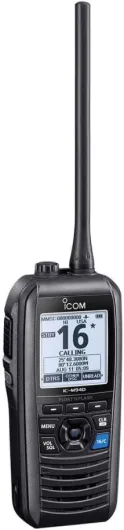
Physically, the IC-M94D is fairly typical Icom: black, a bit bulky, and very much in the “tool” category rather than something stylish. It’s not tiny. In the hand it feels a bit taller and more packed than basic handheld VHFs, mostly because of the larger screen and all the extra buttons for AIS and DSC. I have average-sized hands and I can use it one-handed without much trouble, but it’s not something you slip in a small pocket and forget about.
The layout is mostly logical. You get a decent-sized screen at the top, then a row of dedicated keys (AIS, DSC, etc.), then the usual keypad. The PTT button is big and easy to find even with wet fingers. The volume and squelch are handled by buttons and menus, not a physical knob, which some people might hate. Personally, I prefer a knob, but after a few days I got used to the button system and it wasn’t a big deal. The backlight is strong enough to see clearly in daylight and at night, though in full sun you do need to angle it a bit.
In terms of grip, the case has some texture and doesn’t feel slippery when wet, which is important on a moving deck. I usually clip it to my lifejacket or keep the wrist strap on, because like any handheld, it will bounce if you drop it. When it did fall in the cockpit and once overboard, the casing shrugged off the knocks without marks beyond small scuffs. The buttons have a firm click, not mushy, and I never had accidental presses in a pocket or clipped to a harness.
The only downside design-wise for me is that the interface is a little crowded. There are quite a few icons and options on the screen, and if you’re not used to Icom menus, the first days feel a bit like learning a new phone. It’s not unusable, just not super intuitive right out of the box. If you want something ultra simple with two buttons and a knob, this is not that. But if you’re okay spending a bit of time learning it, the design is practical and feels like it’s made for real-world abuse rather than pretty pictures.
Battery life: fine for a day, but AIS and screen do cost you
The spec says around 10 hours of battery life, and that lines up roughly with what I saw, with some caveats. On a typical day out, with the radio on for 6–8 hours, occasional transmissions, AIS running and the screen lighting up regularly, I usually ended the day somewhere around 30–40% battery left. So for one day trips, it’s perfectly usable without babying it. For multi-day trips without easy charging, you either need to be more careful with settings or bring a spare battery or charging option.
What really eats into the battery is leaving AIS and high brightness on all the time. When I experimented with having the backlight high, AIS constantly on, and lots of scanning and dual-watch, I got closer to the 8-hour mark rather than 10. On the flip side, if you lower brightness a bit and don’t play with the menus constantly, it holds up better. It’s not terrible, but you do feel that this is more power-hungry than a basic voice-only handheld.
Charging is fairly straightforward: you drop it in the cradle. From pretty low battery to full took around 3–4 hours in my experience. Not lightning fast, but if you plug it in at the end of the day, it’s full again by the time you head out the next morning. I would have liked a USB-C option for more flexible charging on smaller boats, but that’s not how it’s built. You’re tied to the supplied charger unless you get extra accessories.
So, in short, the battery is decent but not magical. It gets the job done for normal day boating, but if you plan to use it heavily as an AIS monitor and main radio for long stretches, treat it like you would a smartphone with GPS on: keep an eye on the level, carry a backup plan, and don’t expect it to run forever at full brightness and full feature set.
Water, drops and real-world abuse
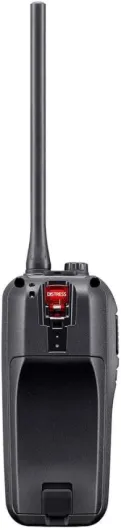
Durability-wise, this is where the IC-M94D feels reassuring. It’s IPX7, so rated for being submerged in 1 meter of water for up to 30 minutes. I didn’t time it with a stopwatch, but I did manage to drop it overboard once at the pontoon. It floated, as promised, and the Float’n Flash kicked in, so I had a flashing lump on the surface that was easy to spot and grab. After a quick rinse in fresh water and a shake, it carried on working like nothing happened.
The AquaQuake feature (which basically vibrates the speaker to clear water) actually helps. After getting it wet, I ran that and the audio cleared up faster than on my older radio, which usually sounds muffled for a while after a dunk. It’s not magic; if the thing is soaked, it still needs a bit of time, but overall I could understand calls again pretty quickly. For a handheld that’s meant to live near spray and waves, that’s a handy thing to have.
As for physical toughness, I’ve had it bouncing around in a bag with other gear, sliding on the cockpit floor, and taking a couple of small drops on deck. The casing has minor scuffs, but nothing cracked or loosened. The antenna connection still feels firm, the battery pack locks solidly, and the buttons haven’t gone soft. It feels like the kind of radio that will last several seasons if you don’t actively abuse it.
One thing I’d say: because it’s not tiny and has a big screen, I wouldn’t treat it as disposable. I keep the wrist strap on and I usually clip it to something when I’m moving around. It’s built tough enough for marine use, but it’s still electronics. If you throw it around like a fender, you’ll kill it eventually. Used with a bit of common sense, though, I’m confident it will handle regular saltwater outings without drama.
Range, audio and AIS: does it actually pull its weight at sea?
On the performance side, the radio does what it says on the tin. The 6W output is standard for a higher-end handheld, and in real use I was talking clearly with a marina about 5–6 nautical miles away from a small boat with the antenna around head height. That’s about what I’d expect from a handheld. Compared to an older 5W handheld I have, the range felt slightly better, but the biggest difference was actually the clarity and the noise cancelling, not raw distance.
The audio is genuinely loud. At 1500mW, I could hear calls at cruising speed with the windscreen open and some wind in the face. On my older, cheaper handheld I often had to hold the speaker right up to my ear and still missed half of what was said. With the IC-M94D, I still bring it closer in heavy noise, but it’s much easier to catch every word. The noise cancelling seems to filter some background engine noise when I transmit; people on the other end said my voice was clear, even when I was near the engine bay, as long as I spoke firmly into the mic.
The AIS performance is the big extra. In busy coastal areas, I could see ships well before I visually spotted them, and the CPA-style info (closest approach) helps judge if something is actually a problem or just passing by. However, the small screen and text-heavy interface mean it’s more a “situational awareness booster” than a full plotting tool. You won’t be doing fancy collision-avoidance planning just on this tiny display, but you will know that a tanker is coming up your stern at 18 knots, which is already useful.
Channel changing, scanning and dual-watch functions all worked as expected. Scan speed is decent, not lightning fast but nothing that bothered me. I ran dual-watch on 16 and the local working channel for a couple of hours and it behaved fine, no weird drops or lockups. Overall, from a pure performance angle, it feels like a solid, professional-leaning radio that just happens to be handheld and floaty, with AIS as a bonus.
What you actually get and what this thing really does
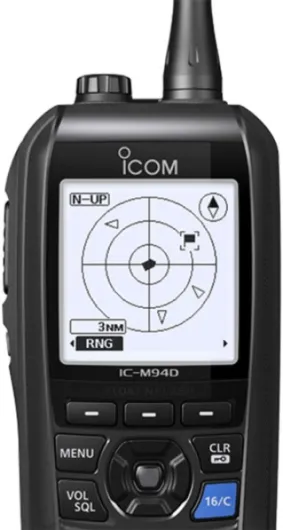
Out of the box, you get the radio, a charging base, a power adapter, the battery pack, belt clip, wrist strap and the usual paperwork. Nothing fancy, but it’s all there. The key selling point is that this is a handheld VHF with built-in AIS, GPS and DSC. So it’s not just a radio; it’s also a mini safety device and traffic monitor in your hand. You see nearby AIS targets directly on the screen, can send DSC distress with your GPS position, and use it as a basic navigator for waypoints and MOB.
In daily use, I’ve mostly used three things: standard voice comms on the usual channels, watching AIS targets when crossing busy areas, and the GPS position readout to quickly check where we are without digging out the phone or going down below to the plotter. The audio is loud enough that I can hear it clearly over engine noise at cruising speed, which is helped by the 1500mW speaker and the noise cancelling. It’s not hi-fi, but it’s clear and cuts through wind and engine rumble better than cheaper handhelds I’ve tried.
The AIS isn’t some gimmick graphic either. You can scroll through a list of ships, see their range and bearing, and get a rough idea of what’s coming your way. It’s nowhere near as comfortable as a big chartplotter map, but if you’re on a small open boat or rib, just having that list and CPA-style info in your pocket is reassuring. For me, that’s the main reason to pick this over a cheaper Icom model or a budget handheld from another brand.
One thing to be aware of: this is a Euro-spec DSC/AIS handheld, so you still need to program your MMSI, set up the basics, and actually know how to use DSC. The manual is a bit dry but clear enough. If you just want a simple push-to-talk radio and never plan to touch DSC, AIS or GPS, you’re paying extra for features you won’t really use here.
Pros
- Built-in AIS, DSC and GPS in a single floating handheld adds real safety and awareness
- Loud 1500mW audio and effective noise cancelling make it easy to hear in noisy conditions
- Robust waterproof build with Float’n Flash and AquaQuake that actually work in practice
Cons
- Higher price than basic handhelds, only worth it if you use the AIS/DSC features
- Interface is a bit busy and takes time to learn, with a small screen for AIS info
Conclusion
Editor's rating
After using the Icom IC-M94D Euro for a few weeks on different boats, my conclusion is simple: it’s a proper tool for people who care about safety and traffic awareness, not just a basic walkie-talkie for shouting on channel 16. The combo of AIS, DSC and GPS in a floating handheld is genuinely useful, especially on smaller boats or ribs that don’t have a full electronics setup. The audio is loud, the build feels solid, and the waterproofing and Float’n Flash actually do what they’re supposed to do.
On the flip side, it’s not the cheapest, the interface has a bit of a learning curve, and the battery, while decent, isn’t endless if you run AIS and the screen hard all day. If you already have good fixed gear with AIS and DSC, this is more of a nice backup than a must-buy. But if you’re running a simple setup and want one handheld that covers communication and adds a layer of safety, it makes sense. I’d recommend it to coastal cruisers, small motorboat owners, and anyone who regularly moves around the boat and wants a serious handheld on their lifejacket. If you just need a simple, cheap radio for occasional calls, you’ll find better value in a more basic model.