
Summary
Editor's rating
Is it worth the money compared to cheaper chargers?
Rugged, practical design with a few everyday annoyances
Build quality and how it holds up in real use
Charging speed and real-world behaviour on different batteries
What you actually get and what it’s meant to do
Reconditioning, supply mode and everyday usability
Pros
- Strong 15A output noticeably reduces charging time on medium to large batteries
- Supports almost all 12V battery types including AGM, EFB and LiFePO₄ with dedicated modes
- Reconditioning and supply modes are genuinely useful for reviving tired batteries and doing safe battery swaps
Cons
- High purchase price compared to basic 4–8A chargers
- Cables and clamps are sturdy but could be longer for awkward engine bays or boats

Specifications
View full product page →| Brand | CTEK |
A charger you buy once and drag between cars, boat and garage
I picked up the CTEK NXT 15 because I was tired of juggling a cheap 4A trickle charger and jump leads every time a car sat for a few weeks. Between a diesel estate, a small boat with a leisure battery and a start-stop hatchback with an AGM battery, I wanted one charger that could handle everything without me memorising a manual every time. On paper, this one covers pretty much all 12V batteries, including lithium (LiFePO₄), so I figured it was worth a proper try.
Over about three weeks, I used it on three different batteries: a tired 80Ah lead-acid starter battery that had been sitting at 11.7V, a 95Ah AGM stop-start battery that struggles in winter, and a 100Ah leisure battery on the boat that I’d neglected over the winter. I also briefly used the supply mode while swapping the main battery on the car to keep the ECU and radio presets alive. So this wasn’t just a one-time test; I moved it around and tried most of the modes.
First impression: it feels like a tool you might see in a workshop, not a flimsy gadget. The interface is simple enough, but you still need to pay attention to which mode you’re in, especially switching between lead-acid and lithium. I had to read the manual once properly, then after that it was mostly obvious. The big selling points for me were the 15A charging speed, the reconditioning mode, and the fact it can act as a 12V power supply.
Overall, my initial feeling is that it’s a serious, no-nonsense charger aimed more at people who actually care about their batteries or have a few vehicles, not someone who wants the cheapest box from the supermarket. It’s not perfect – the price stings and the cables could be longer – but it does feel like something I’ll keep using instead of shoving in a drawer and forgetting about.
Is it worth the money compared to cheaper chargers?
Let’s be honest: the NXT 15 is not cheap. You can get basic 4–8A chargers for a fraction of the price, and for someone with one small car that lives outside and only occasionally needs a top-up, those cheaper options might be enough. Where this CTEK starts to make sense is if you have multiple vehicles, bigger batteries, or if you actually care about battery health and want something you can rely on for years. The 15A output, proper lithium support, reconditioning and supply mode are the main things you’re paying for.
In my case, with three different lead-acid batteries and access to a LiFePO₄ pack on a camper, I feel the price is justifiable. It replaced my old cheap charger and the need to borrow a proper workshop charger when things went really flat. Also, the fact it can safely handle AGM, EFB and LiFePO₄ without me guessing settings is worth something. If you’ve ever cooked a battery with a dodgy charger, you know that saving one decent AGM or leisure battery basically pays for a big chunk of this unit’s cost.
Compared to other branded smart chargers in the same general range, the NXT 15 sits on the higher side but not completely out of line. You can find smaller CTEK models for less money, but they’re usually 5–10A and may not support lithium or have supply mode. If you don’t need lithium or supply mode, one of those smaller models might be better value. This one is more of a do-it-all unit that you buy once and use everywhere, which is where the value lies.
So, value-wise: for casual, once-a-year use, it’s probably overkill and too pricey. For someone with a couple of cars, a van, a boat, or a camper, and especially if you deal with flat batteries or want to maintain expensive AGMs or LiFePO₄ packs properly, it makes sense. It’s not a bargain, but it feels like money spent on a solid tool, not on marketing fluff. Just be honest with yourself about how often you’ll really use it before hitting the buy button.
Rugged, practical design with a few everyday annoyances
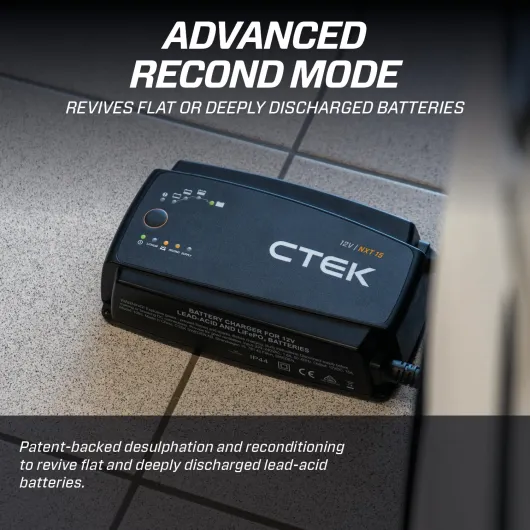
Physically, the NXT 15 is a chunky unit: about 26 cm long, 10 cm wide, and a bit over 26 cm tall according to the specs. In real life, it’s about the size of a thick hardback book but heavier. The casing feels solid, not hollow. It’s got a dust and splash proof housing, so I felt fine using it in a slightly damp garage and near the boat. I wouldn’t leave it sitting in a puddle, but it clearly isn’t allergic to a bit of moisture. The overall impression is workshop tool, not delicate electronics.
The cables are thick and rubbery, which is good for durability and cold weather. They stay flexible and don’t feel like they’ll crack in winter. The downside is the cable length: for me, they were just about enough, but when the car was nose-in against the wall, I had to move things around to reach the battery. Longer leads would have made life easier, especially for boats or when reaching into awkward engine bays. The clamps themselves are solid, with good spring tension and decent-sized jaws that bite well onto posts and studs. They’re not tiny toy clips, which is good when clamping onto slightly corroded terminals.
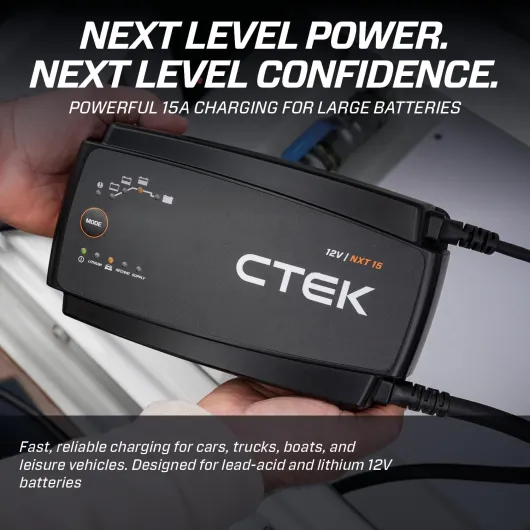
The front interface is simple: big mode button, clear icons, and status LEDs. I like that you can quickly see what stage it’s in without reading a screen. However, the icons are small and not super intuitive at first glance. The first evening, I had to keep the manual next to me to double-check I was in the right mode, especially switching between normal charging and reconditioning. After a couple of uses, it became second nature, but the learning curve is there. A simple text label would have been easier than some of the symbols.
One thing I appreciated is that it’s quiet and doesn’t have annoying fans kicking in and out. You can leave it running overnight and forget about it. There’s also a decent handle moulded into the casing, so carrying it around isn’t a pain. Overall, design is practical and robust, but not perfect: the main gripes are cable length and the slightly cryptic symbols. Nothing deal-breaking, just small things you notice when you’re using it in tight spaces or in a dim garage.
Build quality and how it holds up in real use
I obviously haven’t owned it for years, but in the few weeks I’ve had it, I tried to treat it like I normally treat tools: not gently, but not abusively either. It’s been dragged across the garage floor, used in a slightly damp shed by the boat, and tossed in the boot with jump leads and other junk. The casing hasn’t picked up any cracks, and the rubberised edges do a decent job of taking light knocks. It feels like it can handle regular use without babying it.
The cables are one of the better points in terms of durability. They’re thick, well insulated and don’t feel brittle, even when it was a bit cold in the garage. The strain reliefs where the cables enter the casing look solid; no obvious weak points there. The clamps are also on the sturdy side – no bending or twisting when clamped onto chunky battery posts or awkward brackets. They bite well and don’t feel like they’ll lose spring tension quickly.
CTEK backs it with a 5-year warranty, which is usually a good sign they’re not expecting it to die after a winter or two. Also, CTEK has a decent reputation in the battery world, so this doesn’t feel like a random rebranded charger that will disappear from the market in a year. That matters if you plan to keep it for a long time or use it in a small workshop or for multiple vehicles. It’s made in China, which doesn’t bother me personally as long as the quality control is there; in this case, nothing in the build screams cheap.
If I had to nit-pick on durability, I’d say the only potential long-term concern could be the front panel printing and LEDs if it’s constantly exposed to bright sun or heavy workshop grime. But that’s speculation. In the time I’ve used it, everything feels solid and ready for regular use. I’d be comfortable recommending it to someone who plans to keep it plugged and unplugged often, not just once a year when winter hits.
Charging speed and real-world behaviour on different batteries
The big selling point of the NXT 15 is the 15A output, and you do feel the difference compared to cheaper 4–5A chargers. On my 80Ah starter battery that was sitting at 11.7V, it pulled close to the full 15A at the start (judging from an inline meter I use) and then tapered off as it should. It took around 4–5 hours to reach a proper full charge where the charger switched to maintenance mode. With my old 4A charger, that kind of recovery would have taken most of a day. So if you’re used to waiting forever for a flat battery to come back, this feels a lot more practical.
On the 95Ah AGM stop-start battery, it worked without any drama. I selected the right mode for lead-acid, hooked it up under the bonnet, and left it overnight. The next morning, voltage and resting behaviour were clearly better, and the car’s stop-start actually kicked in again, which it hadn’t done for weeks. I can’t say it magically fixed an ageing AGM battery, but it definitely gave it a proper full charge that the car’s alternator doesn’t always manage on short trips. For AGM and EFB batteries, the proper charging profile matters, and this charger seems to handle that as advertised.
I also used it briefly on a LiFePO₄ battery (a 100Ah pack on a friend’s camper). Switching to lithium mode is simple, and the charger didn’t overthink it – it charged steadily and then stopped without trying to do any float trickery that can upset lithium. It’s not a full-on solar/LiFePO₄ management system, but as a basic charger it did the job cleanly. The important thing is remembering to switch back to lead-acid when you’re done, which is more a user error risk than a product flaw.
In terms of heat and noise, it stayed reasonably cool and totally silent. No fans blasting, no weird smells. It cycled through the stages as you’d expect from a smart charger: bulk, absorption, then maintenance. The LEDs clearly showed progress, even if they’re not super detailed. In practice, performance is solid and predictable. It doesn’t feel rushed or aggressive, but it’s much quicker than the small hobby chargers. If you regularly deal with drained or large batteries, the 15A rating makes a practical difference in how long you’re waiting around.
What you actually get and what it’s meant to do
Out of the box, the CTEK NXT 15 is pretty straightforward: you get the charger itself, heavy-duty battery clamps permanently attached via thick rubberised cables, and the usual paperwork. No fancy bag, no extra eyelet leads in my box – just the bare minimum. It’s clearly pitched as a professional-grade 15A charger that covers all typical 12V battery types: WET, MF, Ca/Ca, AGM, EFB, GEL and LiFePO₄. According to the specs, it’s suitable for batteries from about 30Ah up to 350Ah, which basically covers anything from a small car battery to decent-sized leisure banks.
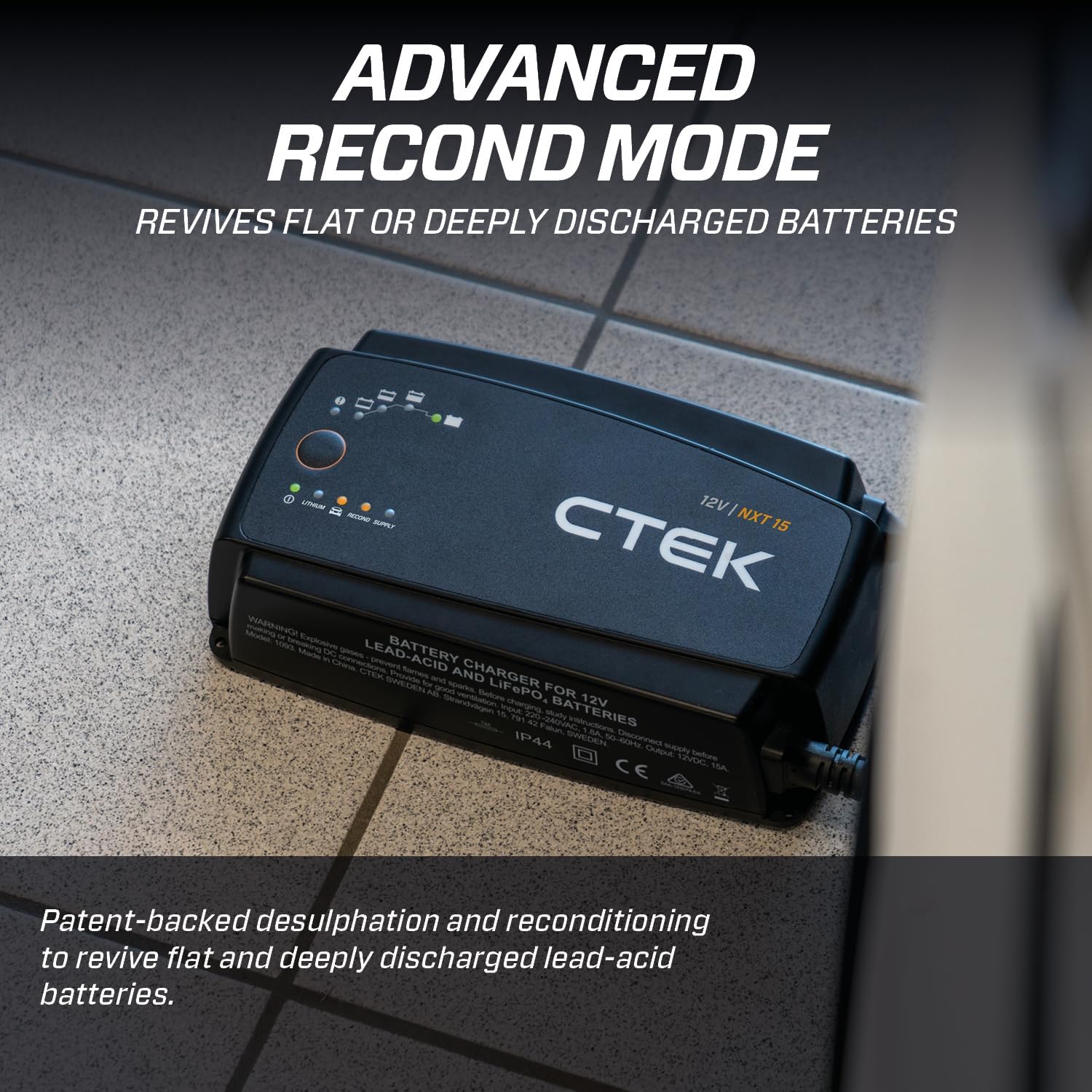
The front panel has a simple interface: a mode button, a battery type selector (lead-acid vs lithium), and a row of LEDs showing the different stages and modes (normal charge, recondition, supply, etc.). You don’t get a fancy colour screen or an app – this is old-school: lights and symbols. Once you understand the icons, it’s actually easier than some chargers that try to be clever and end up confusing. I liked that supply mode is clearly separated, so you’re less likely to accidentally leave it in the wrong mode when charging.
CTEK advertises a few key functions: normal smart charging, reconditioning for flat or sulphated lead-acid batteries, supply mode to keep the car powered during diagnostics or battery changes, and temperature compensation so it adjusts the charge based on ambient temp. In practice, that last bit is invisible – you don’t feel it doing anything – but it’s good to know it’s not overcooking the battery in a warm garage. There’s no fan whine; it’s passive and quiet, which I appreciated when leaving it overnight in the garage.
In terms of positioning, this sits well above basic 4–8A hobby chargers, but below the big workshop trolley units. So for someone with a couple of cars, a van, or a boat, it makes sense. If you only have one small petrol car and you just want something for the odd winter top-up, this is probably overkill. It’s built and specced for people who either care about battery health or run into flat batteries often enough that they want a solid tool instead of gambling with no-name chargers.
Reconditioning, supply mode and everyday usability
Beyond basic charging, the two features I was most curious about were reconditioning mode and supply mode. I tried reconditioning on my slightly abused 100Ah leisure battery that had been sitting half-flat over winter. Before, it would drop voltage pretty quickly under load. I ran a full recondition cycle overnight – it takes longer than a normal charge because it does a more aggressive phase to try and break up sulphation. After that, the battery held voltage better and gave me roughly an extra hour of usable time on the same fridge load compared to before. So did it bring the battery back to new? No. Did it squeeze more life out of a tired battery? Yes, noticeably.
On the very weak 80Ah starter battery, reconditioning helped a bit but didn’t perform miracles. It went from “barely cranks” to “starts but you can feel it’s not healthy”. That’s fair enough; if a battery is already at the end of its life, no charger is going to magically fix worn plates. I’d say reconditioning is useful for slightly neglected batteries, but don’t expect it to save something that’s already far gone. Still, it’s better than a basic charger that only does bulk/float and nothing else.
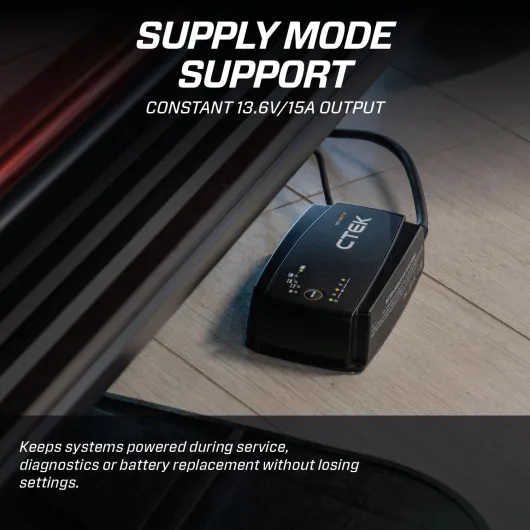
Supply mode was actually more useful than I expected. I used it while swapping the main battery on my car. I connected the charger to the jump points, set it to supply, and then removed the old battery. The car kept its settings, radio code, and there were no weird ECU tantrums afterwards. The supply mode gives a stable 12V feed, which is exactly what you want for that job. I also used it briefly as a power source for a 12V fridge while testing wiring on the boat. It held voltage fine and didn’t cut out or complain.
Day-to-day, the effectiveness comes down to how easy it is to hook up, set the right mode, and walk away knowing it’s not going to cook the battery. On that front, it does well. The temperature compensation is automatic, so you don’t have to fiddle with anything. The charger switches itself to maintenance once done, so you can leave it connected to a car that sits for weeks. In short, it’s effective for both recovery and maintenance, as long as you’re realistic about what reconditioning can and can’t fix.
Pros
- Strong 15A output noticeably reduces charging time on medium to large batteries
- Supports almost all 12V battery types including AGM, EFB and LiFePO₄ with dedicated modes
- Reconditioning and supply modes are genuinely useful for reviving tired batteries and doing safe battery swaps
Cons
- High purchase price compared to basic 4–8A chargers
- Cables and clamps are sturdy but could be longer for awkward engine bays or boats
Conclusion
Editor's rating
The CTEK NXT 15 is a serious 12V charger that actually earns its keep if you have more than one vehicle or you’re dealing with larger or more expensive batteries. The 15A output, proper support for all the common lead-acid types plus LiFePO₄, and the extra modes (reconditioning and supply) make it more than just a basic trickle charger. In my use, it charged faster than my old budget unit, recovered a couple of tired batteries to a usable state, and made a battery swap on my car much less stressful thanks to the stable supply mode.
It’s not perfect: the cables could be longer, the icons on the front panel take a bit of getting used to, and the price will put off anyone who only needs a charger once a year. But the build feels solid, it runs quietly, and the 5-year warranty plus CTEK’s reputation give some confidence that it’s not a throwaway gadget. If you’ve got one or two cars with AGM or EFB batteries, a boat or camper with a leisure battery, or you’re starting to use LiFePO₄, this charger makes sense as a long-term tool. If you just want to top up a single small battery occasionally, you can definitely save money with a simpler model.