
Summary
Editor's rating
Value for money: decent for tinkerers, less so if you want plug‑and‑play quality
Thin, bendable panels that are easy to place but feel a bit budget
How it behaves with a 12V battery and USB devices
Light but fragile feeling – fine for occasional use, questionable for full‑time
Real‑world power: forget 400W, think more like 200–250W on a good day
What you actually get in the box
Pros
- Lightweight, flexible panels that are easy to move and mount on curved surfaces
- Complete starter kit with panels, controller, and basic cables included
- Good enough power for light off‑grid use (phones, lights, small 12V loads) in full sun
Cons
- Real‑world power output well below the advertised 400W
- Basic PWM controller with cheap build and limited settings
- Panels feel fragile for long‑term permanent installs and come with very minimal instructions

Specifications
View full product page →| Brand | UIBAO |
A cheap way to test off‑grid power… with some compromises
I picked up this UIBAO 400W portable solar kit because I wanted something simple for my van and for occasional camping trips. I wasn’t looking for a full professional setup, just a way to keep a 12V battery topped up, run some lights, charge phones, and maybe a small 12V fridge in good sun. The price was clearly on the low side compared to big brands, so I went in expecting a few shortcuts here and there.
Over a couple of weeks, I used it on the roof of a small van, then on the ground at a campsite, and once in the garden just to see what it could really do. The kit I got had the two 200W flexible panels, the 40A controller, MC4 cables and the alligator clips. No battery included, I used a regular 12V 100Ah AGM battery I already had. I also plugged in phones and a power bank on the controller’s USB to see if it was usable day to day.
In practice, the whole thing works, but not at the numbers printed on the listing. That’s not really a surprise with this kind of no-name kit. You can get decent charging if you’ve got full sun and you position the panels properly, but if you expect a true 400W system, you’re going to be disappointed. Think of it more as a mid‑range setup rather than an actual 400W powerhouse.
So overall, my feeling is: it’s usable and actually good enough for light off‑grid use, but there are clear trade‑offs in build quality, the controller, and realistic output. If you’re okay fiddling a bit and you’re not relying on it for critical stuff, it can be good value. If you want something you can install once and forget, I’d look at a better‑known brand.
Value for money: decent for tinkerers, less so if you want plug‑and‑play quality
In terms of value, it really depends what you compare it to and what you expect. For the price of this UIBAO kit, you get 2 flexible panels, a controller, cables, and enough bits to start charging a 12V battery. If you bought two branded flexible panels and a proper MPPT controller separately, you’d almost certainly pay more. So on paper, it’s good value if you’re just trying out solar or you need something occasional for a van, boat, or emergency kit.
But there are trade‑offs. The actual power output is clearly below the advertised 400W, the controller is basic PWM, and the build quality is clearly budget level. If you end up replacing the controller with a better one a few months later, the value calculation changes. Same if a panel fails after a year. Also, support and warranty with these lesser‑known brands is usually hit or miss. If customer service matters to you, that’s something to factor in.
Compared to a cheap rigid panel setup, you’re paying extra mainly for flexibility and low weight. If you don’t need bendable panels and you have space for rigid ones, you can probably build a more robust and more powerful system for a similar budget. On the other hand, if you specifically need something light that can follow a curved surface or be stored easily, this kit starts to make more sense.
So, I’d say: the value is pretty solid for someone who’s handy, knows the limits, and is okay with a few compromises. For a beginner who wants something foolproof and long‑lasting with full support, I’d rather spend more on a better‑known brand or at least budget for a controller upgrade. It’s not a rip‑off, but it’s not some magic bargain either. It’s a cheap way into solar that works if you’re realistic about what you’re buying.
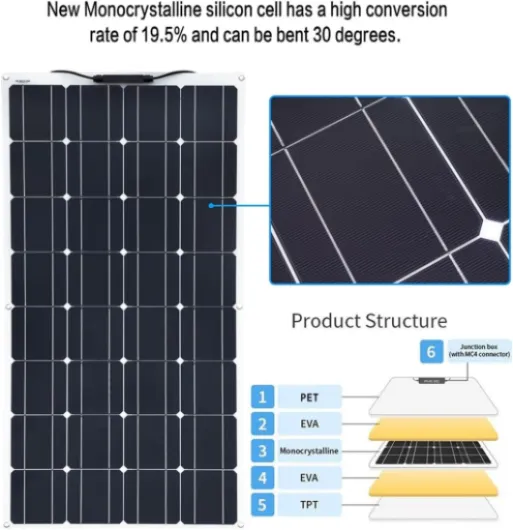
Thin, bendable panels that are easy to place but feel a bit budget
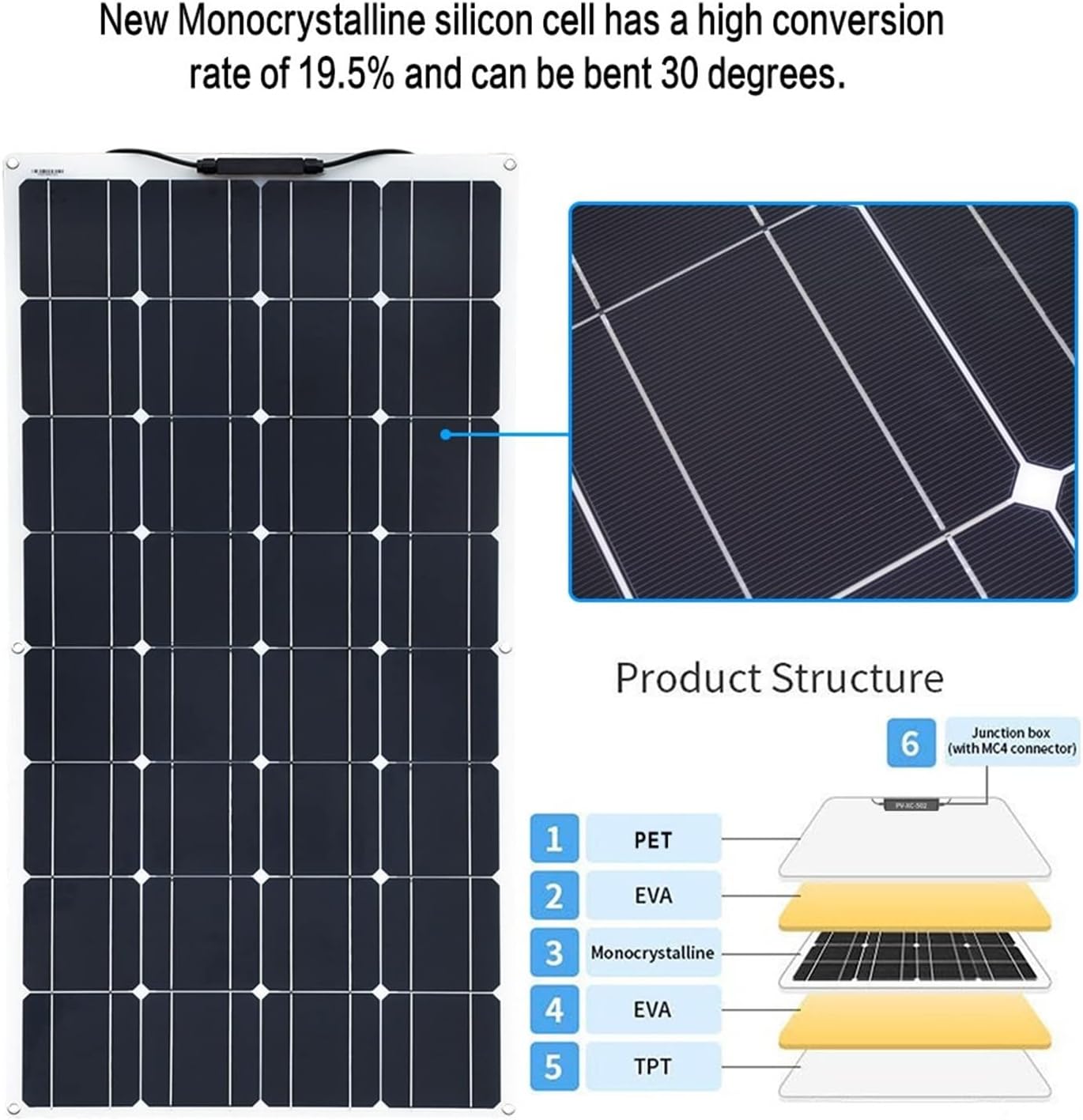
The overall design is focused on flexibility and low weight. Each panel is a thin monocrystalline sheet with a plastic back and a kind of textured front surface. You can bend them up to around 20 degrees without stressing them too much, which is handy on curved van roofs or slightly rounded boat decks. I stuck one panel over a slightly curved metal roof section and it sat fine without looking like it wanted to snap.
The eyelets in the corners and along the sides are useful. I used paracord and zip ties to secure them to a roof rack and later to a camping table. The listing says the eyelets are 10 mm copper, and that feels right. They look more like brass/copper‑plated metal than pure copper to me, but they did the job. Just don’t overtighten; the plastic around them isn’t super thick, and I can imagine them tearing out if you crank down too hard or if the wind really picks up.
The junction box on each panel is small and sealed. It’s supposed to be IP67, and I did leave the panels out in heavy rain once. No water inside, no condensation visible, so at least on a short test it held up. The MC4 connectors are generic but clicked in fine with my other cables. Compared to brand‑name panels I’ve used (Renogy, EcoFlow), the finish is clearly cheaper: edges are a bit rough, printing is minimal, and the back side feels thin. Not shocking for the price, but it’s noticeable.
The controller design is very basic. Small LCD, a few buttons, no detailed menu. You get battery voltage, charge mode, and that’s about it. It looks like every generic 40A PWM controller from AliExpress. It works, but it doesn’t inspire much trust long term. If you like clean installs, the bright plastic and messy screw terminals won’t make you happy. In short: the design is practical and light, but clearly built to a budget, and you feel it when you handle it.
How it behaves with a 12V battery and USB devices
Just to be clear: there’s no battery included. The kit is meant to charge an external 12V battery (AGM, GEL, flooded, etc.). I used a 100Ah AGM and briefly tried a small 60Ah lead‑acid. The controller has basic settings for battery type, but the manual is so minimal that you basically guess which icon matches your battery. Once set, it did follow a rough charge pattern: bulk, then a higher voltage, then float around 13.6–13.8V. It’s not super precise, but for a cheap kit it’s acceptable.
Charging speed depends entirely on sun and how low your battery is. With my 100Ah battery at about 50% (around 12.1–12.2V at rest), in strong sun the panels pushed around 12–15A according to my meter. That’s enough to bring it up to a comfortable level over a few hours, but it’s not fast. If you plan to run heavy loads, you’ll need either more panel area or a bigger battery bank. Compared to my friend’s setup with similar‑sized panels and a proper MPPT, my battery reached full charge a bit later, which lines up with the idea that this PWM controller isn’t squeezing all the juice out of the panels.
The USB ports on the controller are handy but basic. I charged two smartphones and a power bank at the same time. They charged fine but not as quickly as with a wall charger or a good power station. It’s fine for camping, but don’t expect laptop charging or anything more demanding from those ports. Also, the USB only really makes sense when the battery is connected; don’t try to run everything directly off the panel.
One positive point: the reverse protection and night leakage protection seem to work. At night, the battery voltage stayed stable, and there was no back‑drain from the battery into the panels that I could measure. So at least the basic safety side is covered. Just keep in mind: this kit is best as an entry‑level way to keep a 12V battery topped up, not as a fully optimized solar‑battery system. If you get serious about off‑grid living, you’ll probably want to upgrade the controller first.
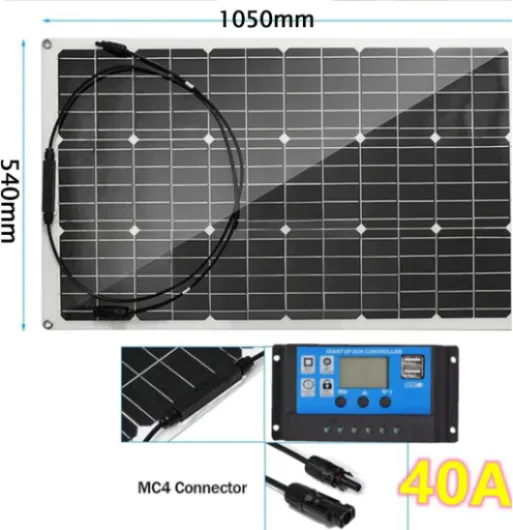
Light but fragile feeling – fine for occasional use, questionable for full‑time
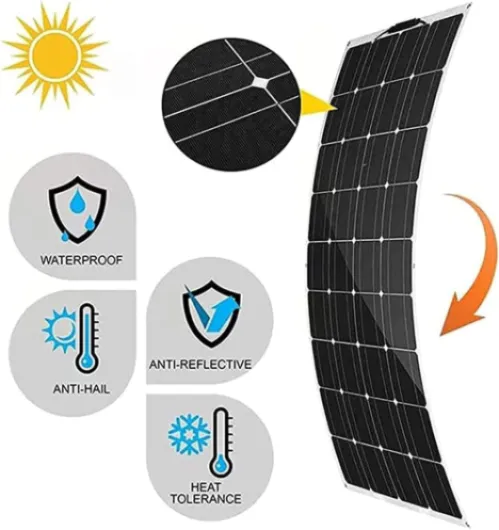
On the durability side, I can only speak from a couple of weeks of use, but the general feeling is: okay for casual use, I’d be cautious for permanent installs. The panels are thin and flexible, which is great for weight and portability, but you can feel that they won’t handle rough treatment like a rigid glass panel would. I tried not to step on them, and I’d strongly advise against walking on them, even though some flexible panels claim you can. You’ll probably crack cells or damage the surface.
I left them out in the sun and rain for several days straight. No obvious warping, no delamination, and the surface didn’t peel. The claimed temperature range of -40°C to +80°C looks good on paper. I obviously didn’t test the extremes, but on a hot day with the panels on a dark roof, they got very warm to the touch and still worked. So heat itself isn’t an immediate problem. UV resistance is harder to judge in a short test, but based on the plastic feel, I wouldn’t be shocked if they yellowed or cracked after a couple of years of full‑time exposure.
The eyelets held up with moderate wind, but I can see them tearing if someone uses bungee cords and cranks them tight. The backing material flexes a lot when you lift the panel by one corner, which again screams “handle with care”. If you want long‑term reliability on a van or boat that lives outside, I’d seriously consider adding some kind of backing plate or adhesive to support the whole surface, not just hanging it by the holes.
As for the controller, it works, but it feels like a generic unit that might fail one day without warning. The terminals are small, the plastic is thin, and there’s no brand marking beyond a sticker. For a weekend camper, that might be acceptable. For a remote cabin where you rely on this system all the time, I’d either keep a spare controller on hand or replace it with a known MPPT right away. So: durability is serviceable for light, occasional use, but I wouldn’t bet my only off‑grid setup on it long term.
Real‑world power: forget 400W, think more like 200–250W on a good day
This is the part everyone cares about: how much power do you actually get. On paper, it’s 2 × 200W at 18V. In reality, under clear midday sun (late spring, around 1 pm, panels aimed roughly at the sun), my basic watt meter showed between 180 and 230W total going into the controller. That’s with both panels wired in parallel. I never saw anything close to 400W. Not once. Clouds or haze drop it quickly into the 80–150W range.
For context, with that 200-ish watts, I was able to: keep a 12V 100Ah AGM battery topped up, run some LED lights in the van, charge two phones and a power bank, and occasionally run a small 12V compressor fridge during the day. Overnight, of course, the fridge runs off the battery alone. On sunny days, the battery recovered by mid‑afternoon. On cloudy days, it struggled. So the system works for light off‑grid use, but you have to manage your expectations and your consumption.
The controller itself is almost certainly a PWM model despite the 40A spec. That means you lose some efficiency compared to a decent MPPT. With 18V panels into a 12V battery, that loss adds up. I’m pretty sure that’s part of why the usable power feels lower than the theoretical rating. The voltage readings on the controller were roughly in line with my multimeter, so at least it’s not lying completely, but don’t expect fine‑tuned charging algorithms.
In weak light (early morning, late afternoon, cloudy weather), the panels still put out something, but it’s modest. The brand claims “optimum yield even in low light”, which is overselling it. It behaves like any other budget mono panel: okay in sun, meh in shade. Shade on even one part of a panel drops the power a lot, so placement matters. Overall, performance is usable but clearly below the advertised 400W. If you size your system assuming real‑world 200–250W, you’ll be less frustrated.
What you actually get in the box
Out of the box, you get two semi‑flexible 200W panels, a basic 40A PWM‑type controller with USB ports, MC4 connectors, alligator clips for direct battery connection, some Y‑splitter MC4 heads for series/parallel, and four small carabiners. No detailed manual in my case, just a very short leaflet with broken English and a couple of diagrams. If you’ve never touched solar before, you’ll probably need to watch a YouTube video to understand how to wire it safely.
The panels are thin (about 2.5 mm as advertised) and light, so you can move them around easily. They have six copper eyelets each, which helps with tying them down with rope or zip ties. The controller is plastic, light, and feels pretty cheap, but it powers on, shows voltage, and lets you set battery type. The USB ports are standard 5V and worked fine to charge a phone and a Bluetooth speaker, but don’t expect any fast‑charging protocols or miracles there.
I tested the kit with a 12V battery setup. The listing talks about 18V, which is the panel voltage, not the system voltage. So in practice, you plug the panels into the controller, then the controller into your 12V battery, and it steps things down. If you’ve used other small solar kits, the logic is the same. Compared to a more expensive kit I tried before (with a Victron MPPT), this one is definitely more “no frills” and a bit rough around the edges, but it’s usable if you double‑check your connections.
One thing I noticed: there’s no real mounting hardware apart from the carabiners and the eyelets. So if you want to mount this permanently on a van roof or a boat, you’ll need to buy extra brackets, adhesive, or some DIY solution. The packaging itself is okay, panels arrived without damage, but the protection foam was thin. If the courier is rough, I can see how someone might receive bent or cracked cells. So overall: the kit is complete enough to get started, but don’t expect a plug‑and‑play professional setup.
Pros
- Lightweight, flexible panels that are easy to move and mount on curved surfaces
- Complete starter kit with panels, controller, and basic cables included
- Good enough power for light off‑grid use (phones, lights, small 12V loads) in full sun
Cons
- Real‑world power output well below the advertised 400W
- Basic PWM controller with cheap build and limited settings
- Panels feel fragile for long‑term permanent installs and come with very minimal instructions
Conclusion
Editor's rating
After using the UIBAO 400W portable solar panel kit for a bit, my conclusion is pretty straightforward: it works, but at a lower level than the numbers on the box suggest. In real life you’re looking at something like 200–250W usable on a good sunny day, with a basic PWM controller and flexible panels that need to be handled with care. For light van life, weekend camping, boats that go out occasionally, or as a backup during power cuts, it’s good enough if you manage your expectations and don’t abuse the panels.
If you’re the kind of person who likes to tinker, doesn’t mind reading up on wiring, and maybe plans to upgrade the controller later, the kit can be decent value. You get something portable, easy to move, and flexible enough to mount on curved surfaces. On the flip side, if you want a robust, long‑term off‑grid setup for a cabin or full‑time van living, I’d skip this and invest in better panels and a quality MPPT controller from the start. The build quality, vague instructions, and optimistic wattage claims make it a bit of a gamble for serious use.
So, who is it for? Casual users, budget‑conscious campers, and people who want to experiment with solar without spending a fortune. Who should skip it? Anyone who needs reliable, predictable power day in, day out, or who doesn’t want to deal with DIY tweaks and possible upgrades down the line.