
Summary
Editor's rating
Value for money: time-saver more than bargain
Backpack design: usable, but not built for long treks
Torch, radio and power bank: usable but not exactly high-tech
Materials and build: decent quality, not indestructible
Durability and shelf life: good for storage, moderate for rough use
Real-world performance: okay for 72 hours, but tight for four adults
What you actually get in the EVAQ8 4-person kit
Pros
- All the basic emergency items for four people are pre-packed in one bag, saving time and effort
- Long-life food and water rations with clear expiry dates, suitable for multi-year storage
- Includes useful extras like a wind-up torch, radio, power bank and water purification tablets
Cons
- Water and food quantities are tight for four adults over 72 hours, more like bare minimum than comfortable
- Some components (multi-tool, power bank, gloves) are entry-level and may need upgrading
- Backpack is basic with no hip belt and limited comfort for longer carries or rough outdoor use

Specifications
View full product page →| Brand | EVAQ8 |
A ready-made emergency bag that saves time… but not perfect out of the box
I got the EVAQ8 4-person 72-hour emergency kit because I was tired of saying “I’ll build a go-bag one day” and never actually doing it. I wanted something I could just throw in the cupboard by the door and know that, if we had to leave in a hurry, at least the basics were covered. This kit is clearly built with that idea in mind: one big rucksack, pre-packed with food, water, a bit of gear and a small first aid kit.
Out of the box, the first thing I noticed is that everything is already inside the backpack, sealed and reasonably organised. You’re not getting a military-grade setup here, but you can tell it’s been assembled with some thought. There’s food and water rations for four adults for roughly three days, a wind-up torch, a basic radio, emergency blankets and sleeping bags, a power bank, some wipes, masks, and a few other odds and ends. It’s clearly aimed at people who want a simple “grab and go” solution rather than survival enthusiasts who build everything piece by piece.
I spent a weekend going through every single item, checking expiry dates, trying the torch and radio, and actually opening a food bar to see what it’s like. I also did a short walk with the packed bag to see how it carries. I’m not treating this like a camping kit, more like something you use when you need to get out fast or stay put at home without services for a while. That changes how you judge it: reliability and practicality matter more than comfort and luxury.
Overall, my first impression is that it’s a decent starting point but not a complete solution. You still need to add personal stuff: meds, proper torches, more first aid, maybe more water. For the price, it’s not outrageous, but it’s also not dirt cheap, so I’m a bit picky. It does save a lot of time and mental load, which is the main reason to buy it, but don’t expect to be fully sorted with just this one bag.
Value for money: time-saver more than bargain
Price-wise, this EVAQ8 kit sits in the middle of the market. It’s not the cheapest 4-person kit you can find, but it’s also not at the top end. What you’re really paying for here is convenience: someone has already sourced the food, water, basic tools and packed it in a bag for you. If you tried to buy every item separately and factor in your time, you might save a bit of money on the gear but lose a lot of hours researching and assembling.
When I break it down mentally, the cost roughly covers: a mid-range backpack, several days of rations for four people, a torch, radio, blankets, sleeping bags, basic first aid, and a small power bank. None of these items alone are premium, but as a bundle they make sense. The downside is that some of the components are clearly entry-level—especially the multi-tool and the power bank—so you’re paying for items you might later decide to replace with better ones.
If you’re the kind of person who likes to tinker, compare specs, and build your own kit from scratch, you can probably do better value-wise by buying individual components over time. On the other hand, if you’ve been putting off building any kit at all, this is a straightforward way to get from “nothing” to “reasonably covered” in one purchase. For families or people who just want peace of mind without spending weekends shopping for gear, that has real value.
My honest view: good value for people starting from zero and short on time, average value for gear nerds who will end up upgrading half the items anyway. The Amazon rating around 3.9/5 matches how I feel: solid, but not mind-blowing. If you catch it on a discount, it makes a lot more sense. At full price, it’s a fair deal, but I’d still budget a bit extra to add water, better first aid, and a stronger power bank over time.
Backpack design: usable, but not built for long treks
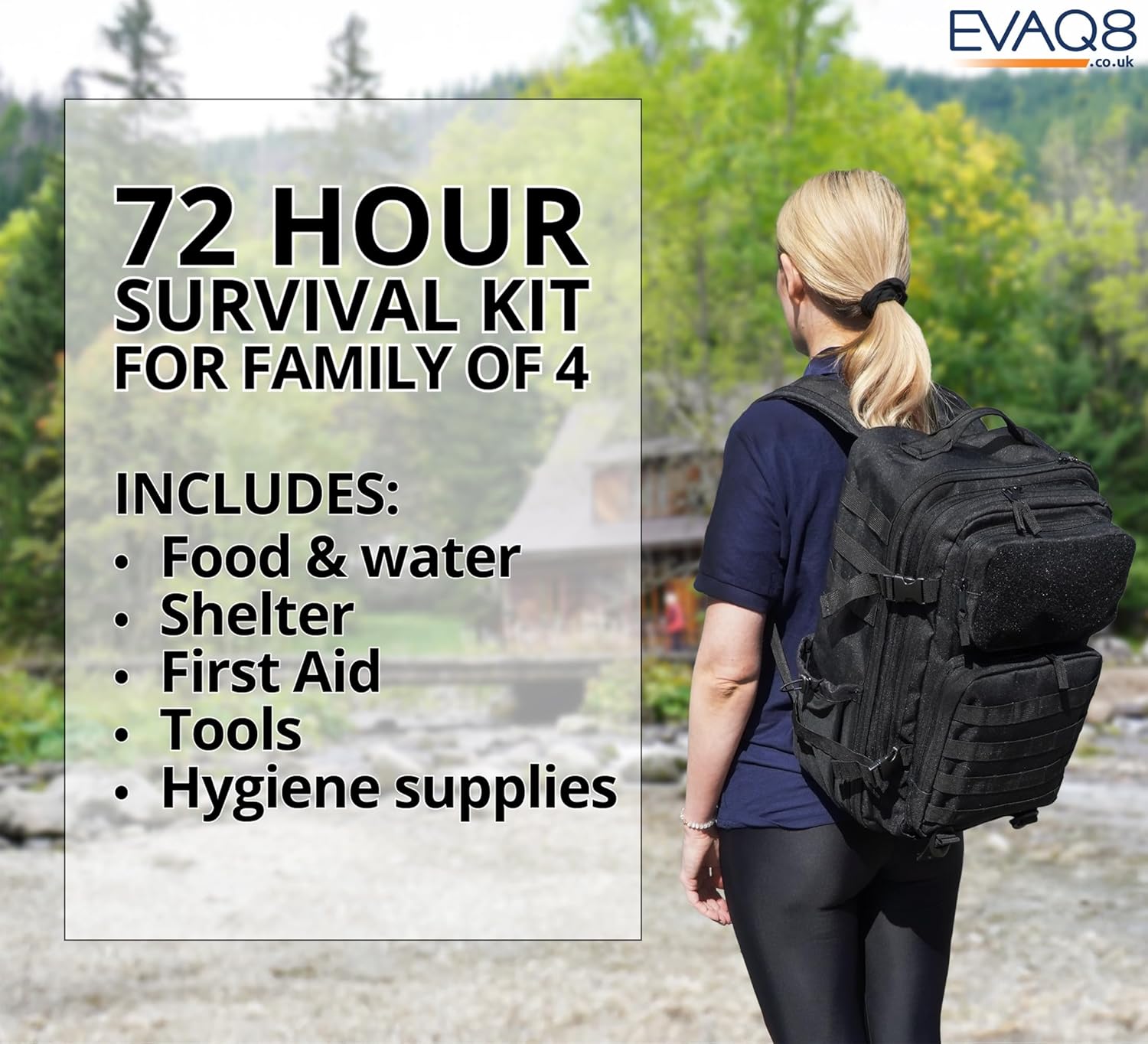
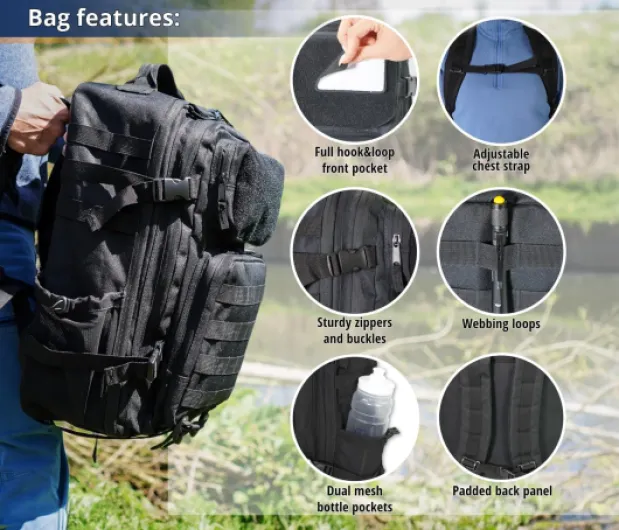
The backpack itself is a simple black rucksack made from nylon/polyester. It’s not some tactical pack with MOLLE straps everywhere; it looks more like a generic travel or school bag. That’s not necessarily a bad thing, because it’s discreet. In an emergency, you don’t always want to look like you’re carrying half a military store on your back. The zips feel okay, not premium, but they don’t seem like they’ll fall apart the first time you tug them.
Once fully loaded with all the kit, it’s not ultra heavy, but it’s not light either. The product page says 2 kg, but that’s clearly just the food rations weight; the total packed weight is more. When I put everything back in and weighed it roughly on a bathroom scale, I was closer to 7–8 kg. For a reasonably fit adult, that’s fine for short walks or getting to a car or shelter. For a long hike or for someone with back issues, it’s more of a challenge. The shoulder straps are padded but basic, and there’s no proper hip belt to shift the weight off your shoulders.
In terms of organisation, there are a couple of compartments and pockets, but nothing very advanced. You can improve things a lot by repacking: for example, keeping all the lighting and power stuff in one inner pocket, the first aid and hygiene items in another, and the documents/ID in a small dry bag. Out of the box, it’s more “everything in the main compartment” than carefully laid out. I ended up reorganising it so I could grab the torch and first aid kit without unpacking half the bag.
My opinion: the design is acceptable for emergencies, but it’s not a bag you’d want to carry all day in the mountains. For what it’s meant to do—sit ready in a cupboard and be thrown on your back for a short move—it does the job. If you’re into serious prepping or long-distance bug-out plans, you’ll probably want to transfer the contents into a more robust hiking pack with a proper frame and straps.
Torch, radio and power bank: usable but not exactly high-tech
On the power side, you basically get three things: a wind-up LED torch, a small AM/FM radio (battery powered), and an emergency power bank with a set of phone cables plus a pack of AA batteries. None of this is cutting-edge gear, but the idea is that you can still have light, information and a bit of phone charge even if the grid is down. I focused on testing how annoying they are to use, because in a stressful situation, fiddly gear is the worst.
The wind-up torch is simple: one minute of cranking gives you a few minutes of decent light, enough to move around or read something up close. It’s not a floodlight, but it’s brighter than a phone screen and doesn’t eat your phone battery. After a few cycles of winding and using it, my arm was a bit tired, but that’s normal for this type of torch. There’s no built-in battery level indicator, but you can feel when it’s running down as the light dims.
The radio runs off the included AA batteries. I popped the four AAs in and scanned for stations; it picked up the main national ones indoors without having to mess with the antenna too much. Volume is fine for a small room. It’s basic, but during a power cut, just being able to hear news is useful. I’d probably throw in a few extra AA batteries into the bag myself, because four won’t last forever if you use the radio a lot.
The power bank is the weak point for me. It works, but capacity is modest. It’s enough to give one smartphone a partial charge or two smaller top-ups. The included cable set is handy if you have mixed devices, but it’s not fast charging or anything fancy. For a real emergency, I’d keep this one as a backup and store a larger, modern power bank charged up at home. So: the included power gear is better than nothing and functional, but if staying connected is important to you, you’ll probably want to upgrade the power bank and add more spare batteries.
Materials and build: decent quality, not indestructible
The main materials are nylon and polyester for the backpack, plus a mix of plastics and light metals for the tools and gadgets. The fabric of the bag feels like mid-range luggage: not flimsy, but not super tough either. I wouldn’t drag it over rocks, but for normal use—car boot, cupboard, quick carry—it seems fine. The stitching looks neat enough, and the seams don’t show obvious weak points, at least not when new.
The included gear is a mixed bag. The wind-up LED torch is light plastic, but the crank mechanism feels okay. I gave it a few full winds and dropped it from waist height a couple of times; it survived without rattling or cutting out. The radio is similar: plasticky, but functional. The emergency power bank feels like a generic cheap unit you’d buy online, not a rugged outdoor battery. It’s better than nothing, but I wouldn’t rely on it as my only power source for days.
The multi-tool is clearly not a premium Leatherman-style tool. It’s more of a “good enough to open a can, cut some cord, and tighten a screw” item. The metal is a bit soft, so I wouldn’t use it for heavy tasks. The work gloves are basic but usable; they’ll protect your hands from rough surfaces, but they’re not heavy-duty construction gloves. The foil blankets and sleeping bags are standard emergency mylar type: noisy, thin, but they reflect heat and pack tiny.
From a materials point of view, I’d say the kit is built to be stored and used occasionally, not hammered every weekend. That’s fine for something that might sit untouched for years. Just be aware you’re getting mid-range quality across the board. If you know you live in a high-risk area and expect to actually use this kit more than once, it might be worth upgrading a few components over time, especially the multi-tool, gloves and power bank.
Durability and shelf life: good for storage, moderate for rough use
One of the key points with an emergency kit is whether it can just sit there for years without becoming useless. On that front, this EVAQ8 kit does reasonably well. The food and water rations are clearly labelled with long expiry dates, and they’re packed in tough foil packaging. In my kit, the rations had about 4.5 years of shelf life left when it arrived, which is fine. You’ll need to note the dates somewhere and remember to rotate them eventually, but that’s normal with any stored food.
The gear itself feels like it can handle being stored and occasionally checked without falling apart. I didn’t see any signs of corrosion or cheap coating flaking off. The mylar blankets and sleeping bags are the usual one- or two-use items: once you fully deploy them, folding them back neatly is almost impossible, but that’s just how these things are. I’d expect them to survive being pulled out and used once or twice without ripping, as long as you’re not dragging them over sharp rocks.
For rougher conditions—say, proper outdoor survival in bad weather for several days—I wouldn’t fully trust everything in here. The backpack is not waterproof; light rain is okay, but a downpour will soak it. If you live somewhere very wet, I’d at least add a rain cover or store the whole kit inside a dry bag. The tools and torch feel okay for occasional use, but if you plan to use them regularly (camping, hiking, etc.), they’ll probably show wear faster than higher-end gear.
In short, durability is geared towards long-term storage and emergency-only use, not daily abuse. As a “break glass in case of emergency” bag, it’s fine. If you want something to double as your regular camping kit, I’d upgrade the bag itself and a few of the tools. The good news is that nothing in my kit felt like it was about to fall apart straight away, and the critical consumables (food/water) have a sensible shelf life.
Real-world performance: okay for 72 hours, but tight for four adults
I tried to simulate a basic 72-hour situation at home: no tap water, no power, and only using what’s in the bag plus what’s already in the flat (beds, clothes, etc.). I didn’t go fully hardcore, but I wanted to see if the contents were actually usable or just comforting to look at. The first thing you notice is that the water rations are really just the bare minimum. Two litres split between four adults over three days is nothing. That’s why the water purification tablets and the two bottles matter: you’re clearly supposed to top up from another source (tap, stream, whatever) and make it safe.
The food rations are dense bars. Taste-wise, they’re bland but edible. Think slightly sweet, compressed biscuit. No one in my family was excited about them, but no one spat them out either. Each bar is high in calories, so you can get by on small portions. For three days, you’ll be fed but not satisfied. It’s emergency fuel, not proper meals. If you have kids or picky eaters, I’d definitely add some more normal snacks or tinned food to your household supplies.
The torch, radio and glow sticks all worked fine. The wind-up torch gave enough light to move around a dark flat safely after about a minute of cranking, and it held the charge long enough to be useful. The radio picked up local stations without too much fuss, which is handy if mobile networks are down. The power bank charged my phone from around 40% to about 80%, so it’s not a huge capacity, but it’s a useful backup. The mylar sleeping bags and blankets are what you expect: they help keep you warm if the heating’s off, but they’re noisy and not comfortable against bare skin. Over clothes, they’re okay.
Overall, in performance terms, the kit meets the promise of keeping four adults basically functional for 72 hours, but only if you already have some extra water and a bit of common sense. It’s not meant to fully replace your home supplies, it’s meant to bridge a gap. If you were actually outside in bad weather with this as your only gear, it would be rough. As a home or car emergency backup, it’s acceptable, as long as your expectations are realistic.
What you actually get in the EVAQ8 4-person kit
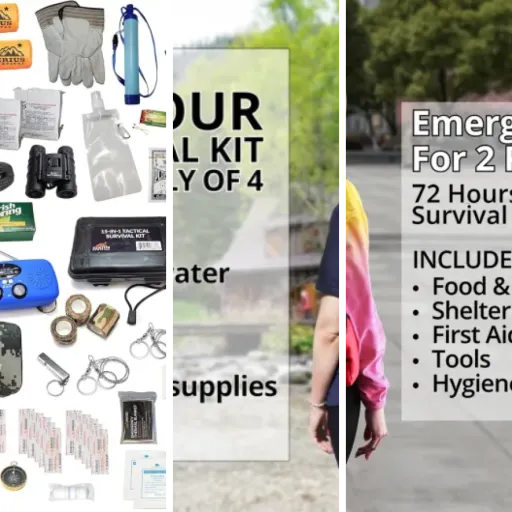
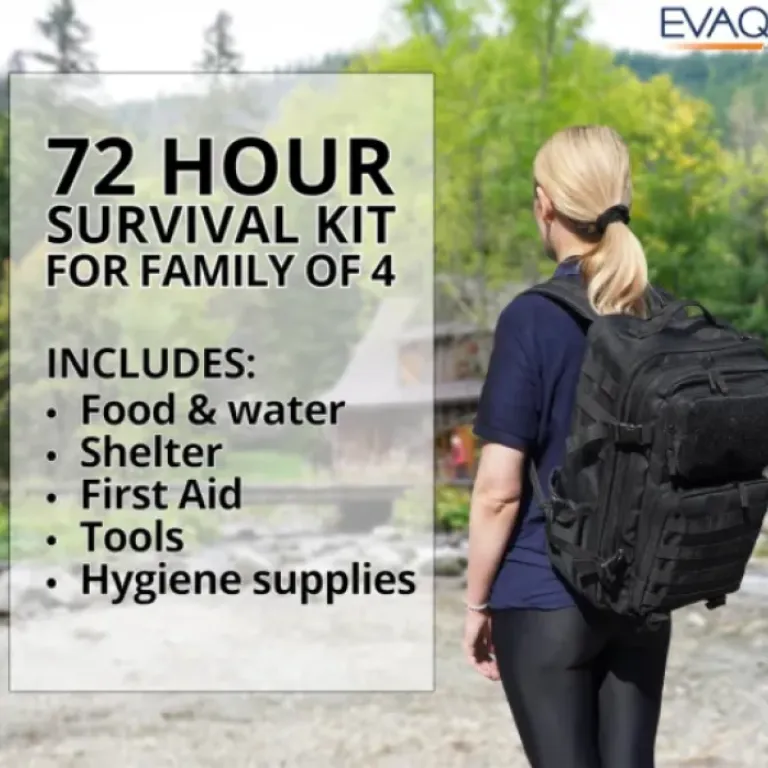
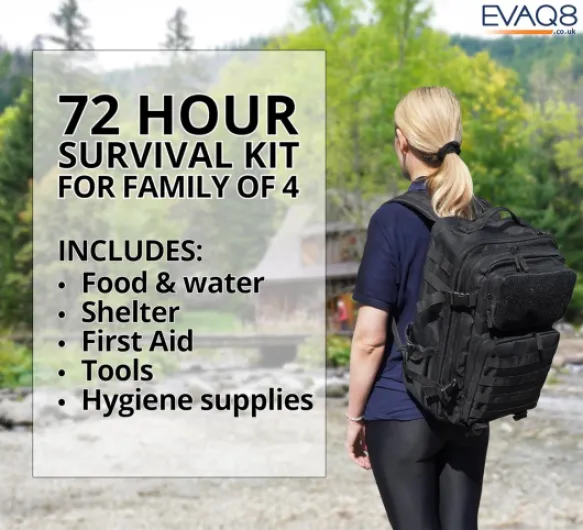
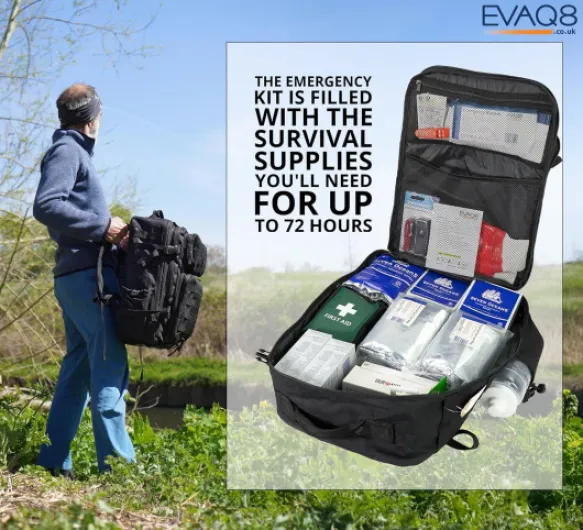
In the bag, you get a fairly standard set of emergency basics. The official list matches what I found: 1 big black rucksack, a wind-up LED torch, a compact AM/FM radio, 4 emergency food rations (total around 2 kg), 4 emergency water rations (about 2 litres total), 50 water purification tablets, 2 drinks bottles, 4 foil space blankets, 4 emergency sleeping bags, 4 light sticks, a safety whistle, a pair of work gloves, a small folding multi-tool, 4 disposable masks, 40 sanitising surface wipes, a soft first aid kit, an emergency power bank with mobile phone cables, and 4 AA batteries.
Everything comes pre-packed, but not vacuum compressed or anything fancy. The food and water are in sealed, long-life packs that feel like the usual emergency ration bricks you see in lifeboats. The first aid kit is the classic small pouch with bandages, plasters, some wipes and a few basic bits. The power bank is a generic one, nothing high-end, but at least it’s there along with a multi-cable so you can plug different phones.
In practice, for four adults, you have enough to avoid being totally stuck, but it’s tight. Two litres of water rations plus purification tablets is more like a bare minimum than actual comfort. The food blocks are more about calories than taste. You also only get one pair of gloves and one multi-tool for four people, so this is clearly designed as a shared kit, not four individual setups. If you were thinking “one full mini-kit per person”, that’s not what this is.
My take: the content list is honest and matches reality, but you should see this as a base layer. For a family of four, I’d add at least: more water (bottles or jerrycans stored separately), a better first aid kit, extra gloves, a head torch for each person, and some personal hygiene stuff. The EVAQ8 kit covers the essentials to keep you going for a short period, but it doesn’t cover comfort or redundancy very well.
Pros
- All the basic emergency items for four people are pre-packed in one bag, saving time and effort
- Long-life food and water rations with clear expiry dates, suitable for multi-year storage
- Includes useful extras like a wind-up torch, radio, power bank and water purification tablets
Cons
- Water and food quantities are tight for four adults over 72 hours, more like bare minimum than comfortable
- Some components (multi-tool, power bank, gloves) are entry-level and may need upgrading
- Backpack is basic with no hip belt and limited comfort for longer carries or rough outdoor use
Conclusion
Editor's rating
The EVAQ8 Emergency Survival Kit 4-Person 72-Hour Grab Bag is a solid starter pack if you currently have nothing ready for emergencies. It gives you the basics in one hit: food and water rations, light, a bit of power, basic first aid, and basic shelter (blankets and emergency sleeping bags), all pre-packed in a single bag. For a family that just wants something they can throw by the door or in the car and not think about too much, it does its job. It won’t turn you into a survival expert, but it will keep you from being totally unprepared.
On the flip side, it’s not a complete solution. The water rations are minimal, the power bank is small, and some of the tools are on the cheap side. For four adults, it’s more “bare minimum to get through a rough 72 hours” than “comfortable backup life”. If you’re into prepping or outdoor gear, you’ll probably want to upgrade the backpack, first aid kit, power bank and maybe add more lighting and gloves. The kit is best seen as a base layer you can build on, not the final word in emergency readiness.
I’d recommend this to people who have been procrastinating about building a go-bag and just want a ready-made option to cover the essentials quickly. It’s also fine for keeping in a flat, office or car as a shared emergency resource. If you already own good camping or hiking gear, or if you enjoy putting kits together, you might be better off assembling your own setup and cherry-picking higher-quality items. Overall, it’s a practical, time-saving option with a few compromises, and the 3.9/5 rating feels about right.