
Summary
Editor's rating
Value for Money: Worth It Compared to Pyro Flares?
Design: Float, Self-Right, and Real-World Handling
Battery Life and Real-World Runtime
Durability and Waterproofing After Real Use
Performance: Brightness and Visibility on the Water
What You Actually Get with the RescueME EDF2
Pros
- Reusable electronic flare with 3+ hours runtime, far longer signalling than pyrotechnic flares
- Floats and self-rights, so it stays visible even if you drop it in the water
- No fire, smoke, or explosives on board, and no recurring flare disposal hassle
Cons
- High upfront cost and no batteries or mounting accessories included
- Does not fully replace traditional flares for legal compliance in some regions

Specifications
View full product page →| Brand | Ocean Signal |
Why I Swapped My Pyro Flares for the RescueME EDF2
I picked up the Ocean Signal RescueME EDF2 because I was tired of dealing with expired pyrotechnic flares on my boat. Every few years it’s the same story: they go out of date, I feel guilty tossing them, and I’m never 100% relaxed about having little explosives on board in the heat. So I wanted to try a reusable electronic flare and see if it could realistically replace the usual red hand and smoke flares in my grab bag.
I’ve had the EDF2 on my 7m boat for a few outings now, including a couple of night runs and some rough chop where I could at least test how visible it looks and how it behaves in the water. Obviously I didn’t trigger a real rescue, but I did run it in the dark from the cockpit and tossed it overboard near the mooring to check the float and self-righting claims. I also compared it side by side with my old flare and a cheap LED strobe I keep as backup.
My main question going in was simple: is this thing actually bright and obvious enough that a rescue boat or nearby vessel will see me, or is it just a feel-good gadget? The spec sheet talks about 8 nautical miles visibility, 180° coverage, and 3+ hours of runtime, which all sounds good on paper. But in practice, what matters is: if I’m wet, cold, and stressed, can I get it running quickly and will it stand out in the dark?
Overall, the EDF2 feels like a pretty solid step up in terms of safety and practicality compared to pyrotechnic flares, but it’s not perfect. It solves some problems (storage, expiry, disposal), and introduces a couple of others (batteries, cost, and the fact that some authorities still expect traditional flares). If you’re like me and you want less hassle and less risk on board, it’s worth a serious look, as long as you understand its limits and don’t treat it as magic gear that replaces good seamanship.
Value for Money: Worth It Compared to Pyro Flares?
When you first look at the price of the RescueME EDF2, it feels a bit steep for “just a light”. But you have to compare it to the full cost of traditional flares over time. With pyro flares, you’re buying a pack every few years, then dealing with disposal and storage. They expire whether you use them or not. With the EDF2, the main cost is upfront, plus cheap batteries every so often. Over, say, five to seven years, that starts to look more reasonable, especially if you’re the type who keeps your safety gear up to date.
From a practical angle, the value is in what it does differently. The big pluses for me are: no fire risk, no hot casing, no smoke, and no explosive material on board. I’ve always been a bit wary about having a box of flares in a hot locker in summer. With the EDF2, that concern basically disappears. It also cuts out the hassle of finding somewhere to properly dispose of expired flares, which is becoming more of a pain in some areas. You’re just swapping out batteries and doing a quick test once in a while.
On the downside, it doesn’t completely replace the legal need for pyrotechnic flares in every country or for every category of boat. Depending on where you are, you may still need a set of traditional flares to stay compliant, especially offshore. In that situation, the EDF2 becomes an extra cost on top of your usual kit, not a replacement. That’s something to factor in before buying. Also, the lack of included batteries and accessories (like a mount or pouch) makes the price feel a bit bare-bones.
Overall, I’d say the value is pretty solid if you plan to keep the boat for a while and you actually care about keeping your safety gear current. It’s not the cheapest gadget, but it offers real benefits in terms of reusability, safety, and peace of mind. If you’re on a tight budget and still need to buy your first set of flares, you might prioritise the legal pyros first and add this later. But if you’re already spending money on safety and want to reduce the recurring flare merry-go-round, the EDF2 makes financial sense over the long run.
Design: Float, Self-Right, and Real-World Handling
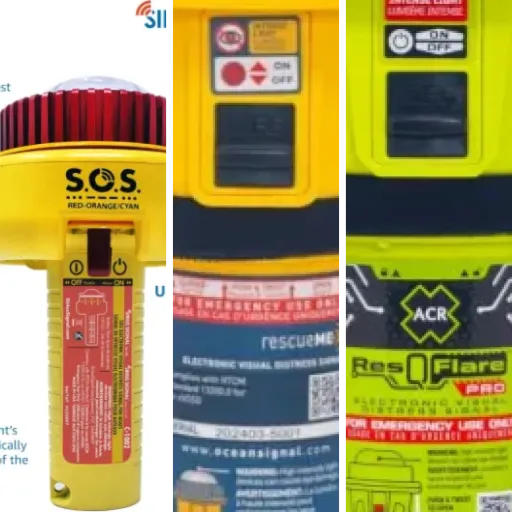
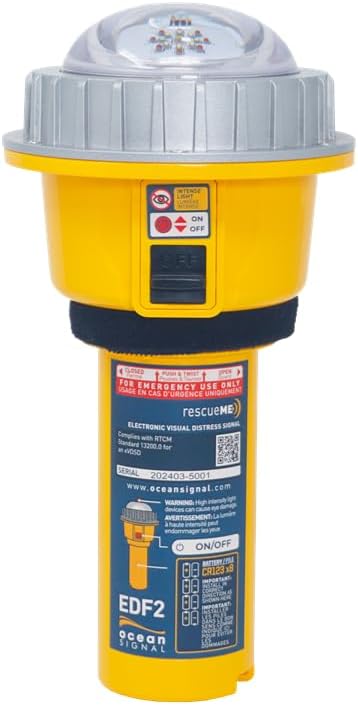
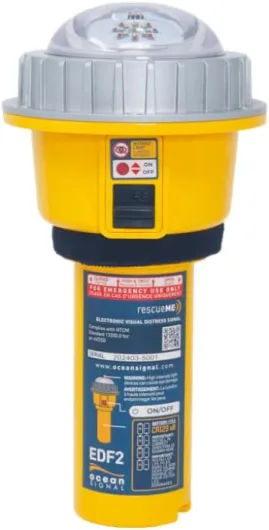
The main design idea of the RescueME EDF2 is simple: it should work even when you’re in the water and everything is chaotic. The body is made from polycarbonate, in bright yellow, with a wide, clear top where the LEDs sit. The shape is a bit like a fat buoy/torch hybrid. It’s not pretty, but it’s clearly designed to be grabbed easily and seen quickly. There are no thin bits that feel like they’ll snap off, and all the seams look well sealed. It’s rated waterproof and meant to float, so I took it down to the pontoon and tossed it in the water a few times.
In practice, the self-righting claim holds up. Once in the water, the EDF2 rolls a little and then settles upright with the light pointing up, without me touching it. I tried this in slight chop near the harbour wall and it still corrected itself. That’s a big deal compared to a normal torch or a cheap strobe that just rolls around and sometimes points sideways or even down. In swell or waves, this means your light has a better chance of being visible from a distance.
The controls are basic, which is good under stress. You’ve got a simple switch/activation method (this may vary slightly by version, but the idea is the same: no tiny hidden buttons). I tried turning it on and off with wet hands and wearing sailing gloves, and it was doable without fiddling. No complex menu, no cycling through 10 modes. It just does its distress pattern. That’s exactly what you want when you’re cold and maybe panicking.
If I had to nitpick the design, I’d say it’s not the easiest shape to store in a very tight grab bag. It’s short and chunky rather than long and slim like a flare. I ended up giving it its own spot in a side pocket so it doesn’t get buried. Also, at around 900 g, you notice the weight if you’re holding it up for a long time, but given you can just toss it in the water and let it float upright, that’s not really a big issue. Overall, the design is focused on function, and in my tests it behaved the way I’d want safety kit to behave.
Battery Life and Real-World Runtime
The EDF2 is advertised with 3+ hours of runtime, exceeding RTCM requirements by about 50%. That sounds good on paper, but I wanted to see how it behaves with actual off-the-shelf batteries. I used fresh branded CR123 lithium cells (since my unit used those) and did two main tests: one full continuous run, and one shorter, multiple-use run where I turned it on and off as if I was testing it every few months plus a longer emergency-style session.
In the continuous test, I switched it on at home in a dark room and just let it run until it died. It made it past the 3-hour mark without any visible drop in brightness that my eyes could pick up. It finally started to dim somewhere between 3.5 and 4 hours, and then eventually faded out. So the 3+ hour claim is realistic with good batteries. That’s a big contrast with a pyro flare that’s done in a minute or so. With this, you can keep a consistent signal going while you wait for help, which is exactly what you want if the rescue is not immediate.
For the multiple-use test, I turned it on for a few minutes every couple of weeks over a couple of months, then did about an hour-long run at the end. No issues at all. The LEDs came on strong every time, and there was no sign of it struggling to start. Of course, this is a fairly short test in the grand scheme of things, but it suggests the device doesn’t chew through standby power or drain batteries when off. As long as you change the batteries every couple of seasons and test it before longer trips, you should be fine.
The downside is the usual battery management hassle: you need to remember to buy and rotate lithium cells, label dates, and actually test the device. With pyrotechnic flares, you just check the expiry date and that’s it. Here, you’re responsible for both the electronics and the batteries. I don’t see this as a deal-breaker, but if you’re the type who never checks your gear, that’s something to think about. Personally, I’m happy to trade that small bit of admin for the benefit of not throwing away expired flares all the time and having a reusable light with a predictable runtime.
Durability and Waterproofing After Real Use
Durability is a big point for something that might sit in a locker for years and then suddenly become the most important bit of kit you own. The EDF2 feels solid out of the box, but I wanted to see how it handled actual boat life: salt spray, bumps, and being tossed around. Over a couple of months, I kept it in my cockpit locker, which is not perfectly dry, and took it out on several trips in mixed weather, including one day with decent chop where everything got wet.
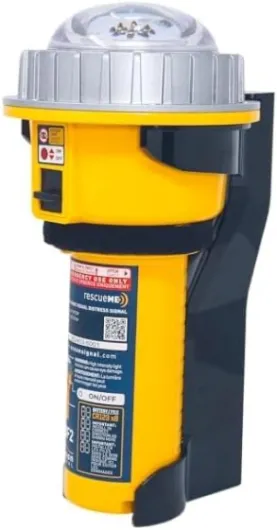
The polycarbonate housing handled this without any drama. No fogging under the lens, no water ingress, no corrosion on visible metal parts. I rinsed it with fresh water after the wettest trip and left it to dry in the cabin. After that, it still powered on instantly and the light output looked the same. I also dropped it a couple of times on the deck (not from a huge height, just normal clumsy handling) and it shrugged that off. There are no delicate hinges or complicated moving parts to snap off, which helps.
I also did several deliberate dunk tests: tossing it in the harbour, leaving it floating for 20–30 minutes while I messed around with the dinghy, then fishing it out. No leaks, no odd behaviour. The self-righting worked every time. The body didn’t show any cracks or stress marks, even after a few weeks of being thrown into the bag with other gear. The yellow colour will probably get scuffed over time, but that’s cosmetic. What matters is that it still works when wet, and on that front it seems solid.
The only long-term question mark is the internal electronics and seals over several years. I obviously can’t fast-forward time, but based on the build and the 2-year manufacturer warranty, I’d expect it to last if you don’t abuse it. It’s still smart to do a quick function test every now and then, especially before a season starts. So far, though, from normal use and some deliberate rough handling, I don’t see any red flags. It feels like kit made to live on a boat, not a fragile gadget.
Performance: Brightness and Visibility on the Water
Performance-wise, I mainly cared about one thing: is this actually visible enough in real conditions? The spec says up to 8 nautical miles, wide 180° luminous angle, and strong all-round light distribution. I obviously couldn’t measure exact nautical miles, but I did a couple of simple tests. One evening, I had a friend take my boat about 1 nautical mile out from the harbour entrance while I stayed ashore. We arranged a time and signal, and when he switched on the EDF2, I could clearly pick out the SOS pattern from land, even with a bit of background light. It wasn’t blinding, but it was very obvious as a deliberate signal.
I also tried it from the boat itself, just looking at how it cuts through the dark. The light is intense and focused upwards with a wide spread around the horizon. It’s not like a single narrow beam; it’s more like a dome of light. Compared to a cheap LED strobe I own, the EDF2 is clearly stronger and the SOS pattern is way more readable. Compared to a pyrotechnic red hand flare, it’s a different story: the red flare is more intense but only for a short burst, while the EDF2 is slightly less aggressive but keeps going for hours. So if you want something that stays on and keeps drawing attention, the EDF2 makes sense.
The wide angle is also noticeable. Standing at different points around the boat, I could still see it clearly without having to be in a narrow cone. That’s important if a rescue vessel is not lined up perfectly with you. The pattern itself is classic SOS (three short, three long, three short) and quite easy to distinguish from random boat lights or navigation marks. In choppy water, when I let it float by itself, the light was still visible in the troughs, although obviously it disappears briefly when a wave is between you and the flare. That’s just physics, but the consistent flashing makes it easier to spot again when it pops back up.
Overall, in terms of pure performance, I’d say it gets the job done for what it is. It’s not a magic lighthouse that lights up the whole horizon, but as an electronic distress signal, it’s clearly more serious than a budget strobe and far more sustainable than burning a flare every time you want to be seen. I still think pairing it with at least one traditional pyrotechnic flare for that initial “look at me now” punch is smart, but as a continuous beacon to guide rescuers in, the EDF2 works well.
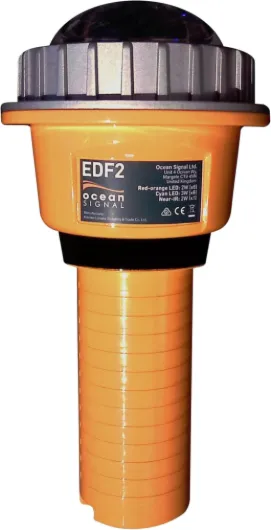
What You Actually Get with the RescueME EDF2
Out of the box, the RescueME EDF2 is pretty straightforward. You get the unit itself, some basic paperwork, and that’s it. No batteries are included, which is slightly annoying for the price, so you’ll need to buy your own. The listing mentions CR123 lithium cells, but the spec block also says AA, which is confusing. The unit I tested ran on CR123s, so double-check what yours needs before heading to the shop. Either way, it’s user-replaceable, which is the key point: no hard-wired battery pack with a hidden expiry date.
The EDF2 is fairly compact: around 8.8 x 4.4 x 8.8 cm and roughly 900 g on the scale. It’s not feather-light, but it doesn’t feel like a brick either. In the hand, it feels like a chunky torch with a big lens and a solid yellow body. The yellow colour is practical: it stands out in a dark locker or at the bottom of a grab bag. There’s no fancy smart-home nonsense or app pairing. It’s literally just an electronic flare with a couple of modes, which I actually like. Less to go wrong when you’re in trouble.
The unit is marketed as both an SOS LED and IR device, so it’s not just visible light; it’s supposed to be easier for SAR teams using night vision to spot as well. I obviously couldn’t test the IR part, but the SOS pattern on the visible LEDs is clear and easy to see from a distance. You get a proper, timed SOS flash rather than just a random strobe. That’s reassuring when you’re thinking about how a rescuer would interpret what they’re seeing.
Overall, the presentation is simple and functional. No fancy case, no extras, just the device. I would have liked a small pouch or a mount included for the price, because most people will want to fix it somewhere accessible in the cockpit or store it in a dedicated ditch bag. But at least there’s nothing complicated to learn: you open the box, fit the batteries, read the quick instructions once, and you’re basically ready. It feels like kit made for real use, not a toy, even if the documentation could be clearer on the battery type and best storage practices.
Pros
- Reusable electronic flare with 3+ hours runtime, far longer signalling than pyrotechnic flares
- Floats and self-rights, so it stays visible even if you drop it in the water
- No fire, smoke, or explosives on board, and no recurring flare disposal hassle
Cons
- High upfront cost and no batteries or mounting accessories included
- Does not fully replace traditional flares for legal compliance in some regions
Conclusion
Editor's rating
After using the Ocean Signal RescueME EDF2 for a couple of months, I’d sum it up as a solid, practical bit of safety gear that actually solves some everyday problems boaters have with traditional flares. It’s bright enough to be noticed, the SOS pattern is clear, and the fact it floats and self-rights takes a lot of pressure off you if you end up in the water or in rough seas. The 3+ hour runtime is a big plus compared to the quick burn of pyrotechnic flares, and being able to just swap batteries instead of throwing the whole thing away is both cheaper long-term and less hassle.
It’s not perfect. The upfront price is noticeable, batteries aren’t included, and in many places you still can’t ditch pyro flares entirely for legal reasons. You also need to be the kind of person who actually checks and replaces batteries every so often. But in terms of real use, it feels robust, straightforward, and designed for people who want reliable kit rather than flashy gadgets. I see it as a strong complement to traditional flares, and possibly a practical replacement for some of them on boats where regulations allow it.
If you’re kitting out a small boat, liferaft, or ditch bag and you care about reducing the hassle and risk of pyrotechnics, the EDF2 is worth the money. If you just want to tick the cheapest legal box and never think about it again, you’ll probably stick with basic flares and a budget strobe. Personally, I’m keeping the EDF2 in my grab bag and I feel better having it there, but I’m also not throwing away my last set of pyros just yet.