
Summary
Editor's rating
Value for Money: Worth It if You Already Have a Battery
Design: Simple, Chunky, and Mostly Practical
Battery and Runtime: Plan Around 1–1.5 Hours of Real Use
Materials and Build: Feels Solid, Not Premium
Durability After a Few Outings
Performance on the Water: What It Actually Feels Like
What You Actually Get in the Box
Pros
- Gives a real, noticeable push at roughly relaxed paddling speed on SUPs and kayaks
- Compact fin-style mount keeps the setup clean and easy to transport
- Runtime with a 20Ah 12V battery is close to the claimed 1–1.5 hours of continuous use
Cons
- Only on/off forward control with no speed adjustment or reverse
- Battery, fuse, and proper wiring are not included and require some DIY
- Long-term durability and support are uncertain due to the lesser-known brand and brushed motor

Specifications
View full product page →| Brand | Bennanmu |
Why I Wanted a Motor on My Board
I picked up this Bennanmu electric underwater thruster because I was honestly tired of fighting wind and current on my inflatable SUP and sit-on-top kayak. I’m not training for the Olympics, I just want to cruise, fish a bit, and get back to the launch without feeling like my shoulders are on fire. The idea of a small motor that clips into the fin box sounded pretty good, especially compared to lugging a full trolling motor and mount.
I’ve used it over a couple of weekends on a 10'6" inflatable SUP and a cheap fishing kayak with a US fin box adapter I already had. Conditions were mostly flatwater lake, a bit of light chop, and one session in a slow-moving river. I powered it with a 12V 20Ah LiFePO4 battery I already own, which is basically what the listing recommends. So this isn’t lab testing, just normal weekend warrior use with a realistic battery setup.
From the start, the main thing I wanted to know was: does this actually move you at a decent pace, or is it just a toy that barely helps? And second: is it a pain to mount, carry, and wire up, or can you realistically throw it in the car and use it without turning your board into a science project? I also kept an eye on how hot it gets, if it sucks weeds, and how noisy it is around fish.
Overall, it does what it says on the tin: it pushes you along and saves your arms. It’s not perfect, and some of the specs in the ad feel optimistic, but it’s not a useless gimmick either. If you go in with realistic expectations and already have a 12V battery, it’s a pretty solid way to give your SUP or kayak a bit of motor assist without going full boat setup.
Value for Money: Worth It if You Already Have a Battery
Pricing will jump around, but compared to bigger-name electric SUP drives and trolling motors, this Bennanmu thruster usually sits in the budget to mid-range zone. For what you get — a compact motor that slots into a fin box and actually pushes you at a usable speed — I’d say the value is pretty solid, especially if you already own a 12V battery and some basic wiring bits. The fact that it doesn’t come with a battery keeps the sticker price lower, but it also means some extra cost and hassle on your side.
Compared to a small trolling motor plus a mount, this setup is more compact and cleaner on a SUP. No big metal bracket hanging off the side, no tall shaft sticking up. On a kayak, a trolling motor is still more flexible (you get steering and often reverse), but it also costs more and is bulkier to transport. If your main goal is just to get a push in a straight line and give your shoulders a break, this thruster does that without turning your craft into a science project. You give up features, but you also avoid a bunch of clutter.
Where the value drops a bit is in the rough edges: minimal documentation, basic wiring, no speed control, and unknown long-term support. If something breaks out of warranty, you’re probably fixing it yourself or buying a new unit. A more premium brand would charge more but also offer better manuals, customer service, and maybe spare parts. So you’re trading some polish and peace of mind for a lower entry cost.
For me, as a casual paddler who likes a bit of tech but doesn’t want to spend as much as a full e-SUP kit, it hits a decent middle ground. It’s not the cheapest toy, not the fanciest solution, but it does what I bought it for: reduce paddling effort and extend my range a bit. If you’re budget-conscious, somewhat handy with 12V wiring, and okay with a few compromises, the value is good. If you want plug-and-play perfection with full support, you might be happier paying more for a big-name system.
Design: Simple, Chunky, and Mostly Practical
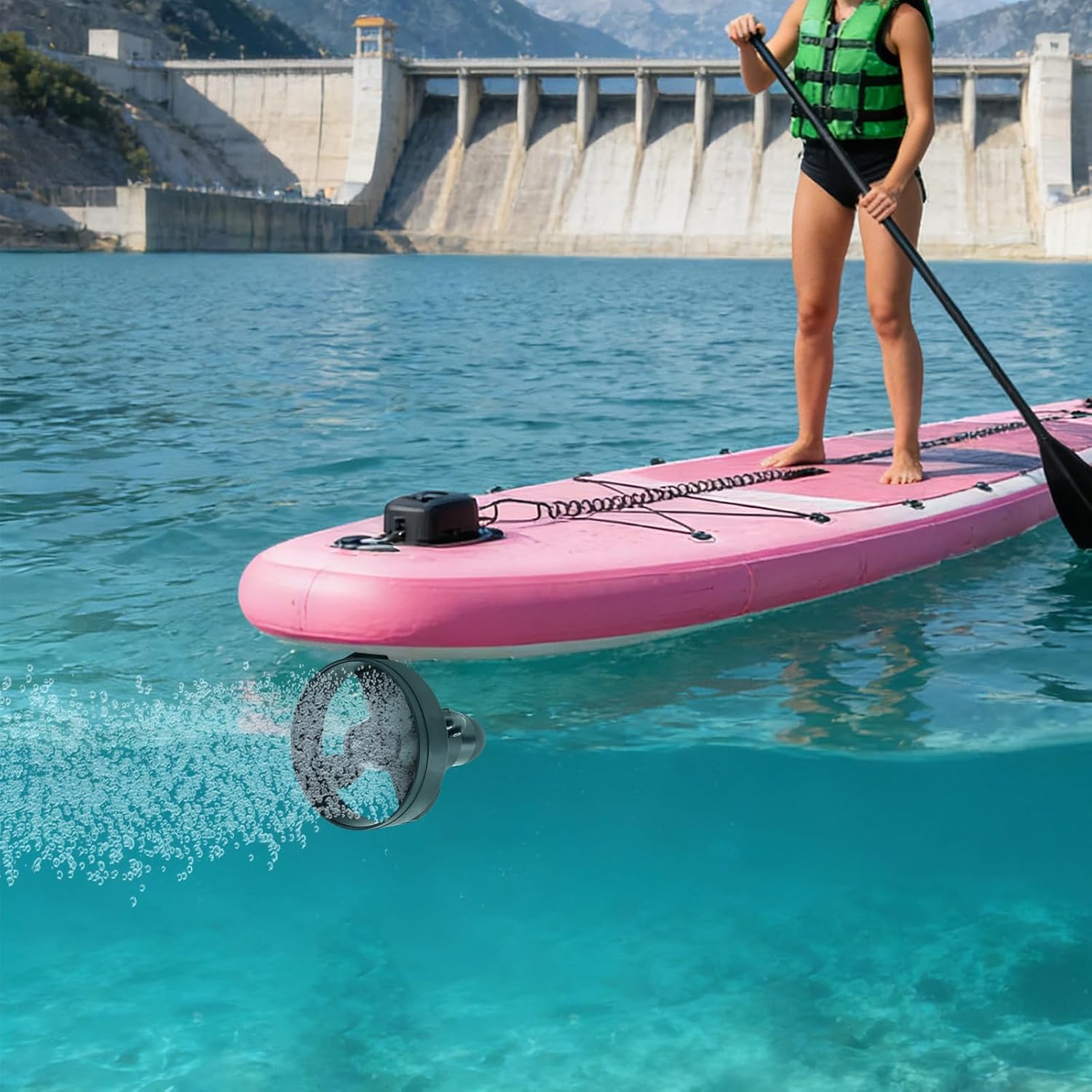
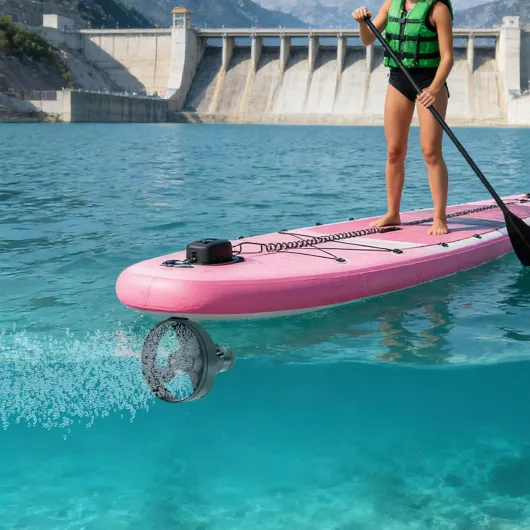
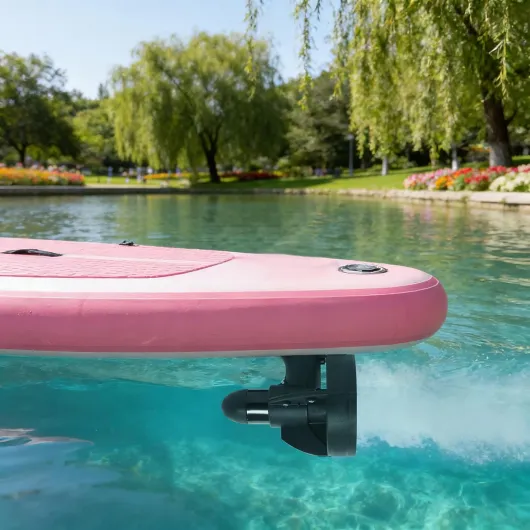
Design-wise, this thruster is pretty straightforward: a short cylindrical motor housing with a shroud around the prop, all mounted on a base that slides into a paddleboard fin box style slot. The look is very plain — black plastic and metal, no fancy branding, just a basic “this is a motor” vibe. I don’t care much about aesthetics on something that spends its life underwater, so that’s fine by me. More important is how it mounts and how it sits in the water.
The fin-style mounting base is clearly meant for SUPs or kayaks that already have a US fin box or similar. On my inflatable SUP, it dropped in with no drama and tightened down with the standard screw. On my cheap kayak, I had to use an adapter plate I already owned. If you don’t have that kind of mount, you’ll be improvising with brackets or drilling, so check your hull first. Once mounted, it sits a bit deeper than a normal fin, but not crazy — I only scraped bottom once in very shallow water.
I like that the prop is inside a shroud; it feels much safer when you’re hopping on and off the board in the shallows. The edges are smooth, and there aren’t any sharp corners that snag gear or bare feet. The cable exits from the top of the unit and runs forward, which is fine, but I’d have liked a slightly longer cable or a better strain relief. I ended up adding a couple of zip ties to keep it from bending too sharply near the housing.
The control button is the weakest part of the design. It’s just a small inline switch with basic waterproofing, no clear IP rating mentioned. It survived splash and one quick dunk when I slipped getting on the kayak, but I wouldn’t trust it to sit underwater for long. There’s also no real mounting solution for the button — you’re taping or zip-tying it where you want it. Overall, the design is functional but a bit DIY-feeling. It works, but you can tell this isn’t a big-brand polished product with every detail thought out.
Battery and Runtime: Plan Around 1–1.5 Hours of Real Use
The thruster runs on a 12V battery, and the seller suggests a 20Ah pack giving about 1.5 hours of runtime. I used a 12V 20Ah LiFePO4 battery, which is fairly light and common now. In my tests, running it almost constantly, I got roughly 1 hour and 20 minutes before the battery voltage dipped enough that I decided to stop. That’s pretty close to the claim, so no complaints there. If you’re heavier, carry more gear, or fight more wind, expect a bit less.
What’s important to understand is that this thing doesn’t manage the battery for you. There’s no built-in display, no low-voltage cutoff, no battery gauge. You just wire it up and go. I used a small inline voltmeter I already had so I could keep an eye on the battery. If you’re using LiFePO4 or lithium, I strongly recommend some sort of BMS and a fuse. With lead-acid, you’ll feel the power drop as it drains, but with lithium it holds steady then falls off, so monitoring is more important.
In practice, 1–1.5 hours of continuous use is actually quite a bit on a SUP or kayak. I wasn’t running it 100% of the time; I’d turn it off while drifting or when I felt like paddling a bit. Over a 3-hour outing, I used the motor maybe half the time and still had juice left. If you want full-day power with heavy use, you’ll either need a bigger battery (which gets heavy) or carry a spare. For casual evening paddles or a morning fishing session, a 20Ah pack is enough.
The downside is the total weight and bulk once you include the battery. My 20Ah LiFePO4 is around 2.5–3 kg, plus the 3 kg thruster, plus wiring and a small dry box. It’s manageable, but it turns the whole setup into more of a mini-boat project than a simple toss-and-go SUP. If you’re expecting magic with no compromises, that’s the catch. Still, for what it is, the power draw seems reasonable, and the runtime matches the specs fairly well, which is already better than some no-name motors I’ve seen.
Materials and Build: Feels Solid, Not Premium
The product page talks a lot about aluminum alloy, copper, and nylon, and that matches what you see when you handle it. The main motor housing and mounting plate feel like cast or machined aluminum with a decent paint or spray coating. The shroud and some external parts are a hard nylon-type plastic that doesn’t flex much. The prop itself looks like plastic as well, not metal, which is pretty normal at this price.
In the water, I bumped it against a few submerged branches and a rocky patch near shore. It picked up some light scuffs on the paint but nothing bent or cracked. The coating seems fairly tough; I didn’t see any bubbling or corrosion after a couple of dips in slightly brackish water, but to be fair, that’s only over a few outings. I did rinse it with fresh water after each session, which I’d strongly recommend if you’re using it in salt or dirty water. The screws and hardware look like stainless, but on budget stuff like this, time will tell.
The nylon shroud is thick enough that I didn’t worry about it snapping if I leaned the board on it while carrying. It does flex very slightly if you really push on it, but not in a worrying way. The prop clearance inside the shroud is fairly tight, so any big deformation would be bad, but I never had it rub or scrape. I did suck some weeds once; they wrapped around the prop but didn’t damage anything. I cleared them by hand in shallow water, which was easy enough.
The cable is where you can feel the cost-cutting a bit. The insulation is okay but a bit stiff, and the connectors aren’t anything special — just basic crimp-style terminals with heat shrink. I re-did mine with better crimp connectors and added an inline fuse, because I don’t fully trust generic wiring from unknown brands. Overall, the materials feel pretty solid for casual use, but if you’re expecting super marine-grade everything, this isn’t that. For weekend paddling and light fishing, it’s good enough, as long as you rinse it and don’t abuse it.
Durability After a Few Outings
I haven’t had this thing for a whole season yet, but after a handful of sessions in mixed conditions, it’s held up better than I expected for a cheap-ish motor from a lesser-known brand. No water ingress, no weird grinding noises, and no visible rust so far. I checked the screws and bolts after each trip, and nothing had worked loose. The prop still spins freely, and there’s no play in the shaft that I can feel by hand.
That said, I’ve been fairly careful with it. I avoid dragging the board with the motor installed over gravel or sand, and I don’t drop it on the ground. I also rinse it thoroughly with fresh water after each use and let it dry before tossing it back in the bag. If you just throw it in salt water, leave it in the sun, and never rinse it, I doubt it will stay happy for long. The finish is good, but it’s still a small electric motor with metal parts, not a tank.
The biggest unknown for durability is the brushed motor. Brushed motors are simple and cheap, but the brushes do wear over time, especially if you run them hard and hot. After my sessions, the housing was warm but not burning hot, so that’s a good sign. Long-term, if you’re using this every weekend all summer, I wouldn’t be shocked if it needs some maintenance or eventually fails. With the price and unknown manufacturer support, I’m not counting on easy spare parts.
The control button and cable still worry me a bit more than the motor itself. They’re fine so far, but they feel like the parts most likely to fail first — cable fatigue, water ingress into the switch, that sort of thing. If I keep using it a lot, I might eventually replace the button with a more robust waterproof switch. For now, I’d call durability promising but unproven: no issues yet, but I’m not treating it like a heavy-duty commercial unit either.

Performance on the Water: What It Actually Feels Like
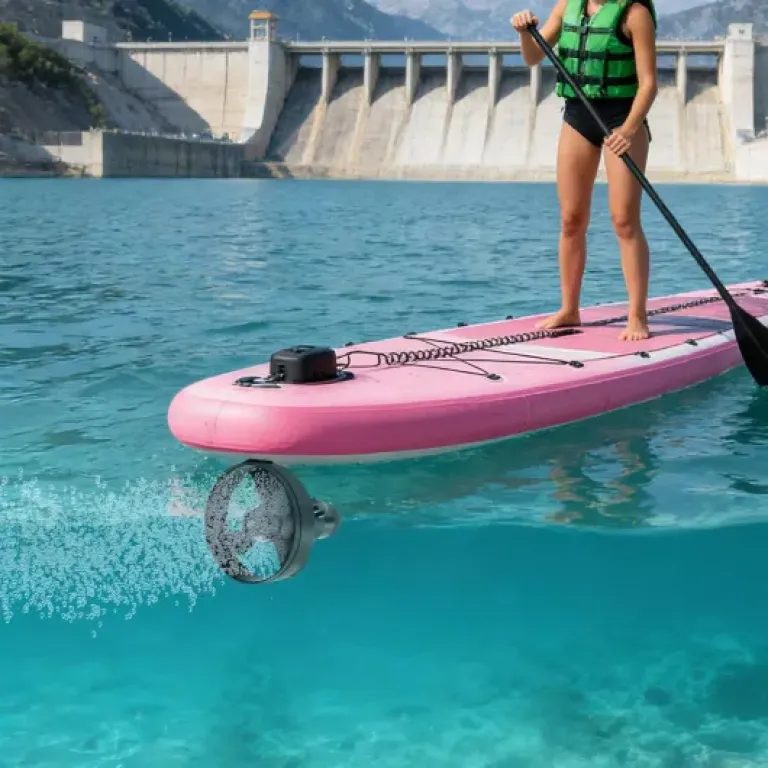
The listing claims up to 8 km/h and 200 kg of thrust. Let’s be honest: those numbers are optimistic in real-world use. On my 10'6" inflatable SUP with me (about 85 kg) plus a small dry bag, I was cruising around 4–5 km/h according to my GPS watch, in flat water and no wind. That’s roughly a relaxed paddling speed, which is exactly what I wanted: it keeps you moving without having to constantly paddle. On my sit-on-top kayak, it felt slightly faster, probably because the hull is a bit more efficient than the big inflatable board.
Where it shines is going against light wind or slow current. There’s a local river section where I usually have to paddle steadily just to hold position. With the thruster running, I could slowly creep upstream while sitting and not paddling at all. It’s not going to fight strong current or big waves, but it definitely takes the edge off and stops you from drifting backwards every time you rest your arms. For fishing, that’s pretty handy: you can reposition quietly without splashing paddles everywhere.
Noise-wise, it’s a low hum and a bit of vibration through the board or kayak. Underwater, I’m sure fish can hear it, but from my seat it wasn’t annoying. It’s definitely quieter than a typical trolling motor at higher speeds. I had it running while casting for perch, and I still got bites, so it’s not scaring everything away, at least in my case. The thrust feels linear: press the button, it ramps up and just pushes steadily. No jerk, no sudden surges.
One limitation is that there’s no speed control. It’s either on or off. Sometimes I wanted a slightly slower crawl for precise positioning while fishing, and I had to feather the button manually — on for two seconds, off for one, that kind of thing. It works, but a simple low/high switch would improve it a lot. Also, forget about reverse; if you overshoot, you’re either paddling or turning the boat around. Overall, I’d say performance is decent but not mind-blowing: it takes the strain off, moves you at a comfortable pace, and handles light opposing forces, but it’s not going to turn your SUP into a speedboat.
What You Actually Get in the Box
Out of the box, you get the thruster unit itself and a simple storage bag. That’s it. No battery, no charger, and in my case, no fancy mounting hardware beyond the fin-style base that’s already attached. The listing is clear that the battery isn’t included, but if you’ve never messed with 12V stuff before, just know you’ll need to sort out a battery, fuse, and maybe some connectors yourself. It’s not plug-and-play like an e-scooter.
The thruster is roughly the size of a chunky shoebox: about 24 x 18 x 18 cm, and the weight feels close to the claimed 3 kg. It’s light enough to carry with one hand but you definitely notice it in a backpack along with a battery. The bag is basic but fine — thin padding, zipper, and just enough space for the unit and cable. No extra pockets for tools or fuses, which would have been useful. I ended up tossing some zip ties and a small wrench in a separate pouch.
The controls are as simple as it gets: one forward-only button on a cable. No speed selector, no reverse, no display. You press it, the motor runs; you let go, it stops. I taped the button to my paddle shaft once and to the side of my kayak another time. Both worked, but the cable is a bit stiff, so you have to be careful not to snag it when moving around. Don’t expect any smart features or fancy throttle curves here.
The documentation is bare-bones. Mine came with a short leaflet in slightly rough English, enough to show the basic wiring and mounting idea but not much on troubleshooting or maintenance. If you’re used to brands that give full manuals with torque specs and exploded diagrams, this isn’t that. On the flip side, the thing is simple enough that you can figure it out by looking at it. In terms of presentation, I’d call it functional but minimalist: you get the core hardware, but you’re on your own for most of the setup details.
Pros
- Gives a real, noticeable push at roughly relaxed paddling speed on SUPs and kayaks
- Compact fin-style mount keeps the setup clean and easy to transport
- Runtime with a 20Ah 12V battery is close to the claimed 1–1.5 hours of continuous use
Cons
- Only on/off forward control with no speed adjustment or reverse
- Battery, fuse, and proper wiring are not included and require some DIY
- Long-term durability and support are uncertain due to the lesser-known brand and brushed motor
Conclusion
Editor's rating
After a few weekends with the Bennanmu electric underwater thruster, my take is pretty simple: it’s a decent, no-frills motor that makes SUP and kayak trips easier, as long as you’re not expecting miracles. It moves a normal-sized adult at around relaxed paddling speed, helps a lot against light wind and current, and saves your shoulders on the way back to the launch. The build feels solid enough for casual use, and the runtime with a 20Ah 12V battery lines up with the claimed 1–1.5 hours of continuous operation.
It’s not perfect. The specs in the listing are a bit optimistic, the control is just an on/off button with no speed options or reverse, and the wiring and documentation are pretty bare-bones. Long-term durability is still a question mark, especially for the brushed motor and the switch, and you need to bring your own battery and basic electrical know-how. But in practice, it gets the job done: it lets you cruise, fish, and explore without feeling wiped out.
I’d recommend this to people who already have a 12V battery, are comfortable doing simple wiring, and want a compact, straight-line assist for SUPs or kayaks. It suits casual paddlers, anglers who want quiet repositioning, and anyone who likes the idea of a lazy glide across flat water. If you need precise speed control, reverse, or heavy-duty daily use, or if you hate DIY setups, you’re probably better off with a more advanced (and pricier) motor system. For what it costs, though, this is a pretty solid little helper rather than a fancy gadget.