
Summary
Editor's rating
Value for money: decent size and presence for what you pay
Design and look: classic yacht vibe with aged sails
Materials and build quality: mostly wood, with some rough edges
Durability and long‑term feel: fine if you treat it like decor, not a toy
Assembly and day‑to‑day “performance” as decor
Unboxing and first look: not luxury, but not cheap junk either
Pros
- Large size (76 cm long, 97 cm high) gives real presence as a decor piece
- Mostly wooden construction with a solid base, feels more substantial than plastic models
- Classic J Class yacht design with aged sails fits vintage nautical decor well
Cons
- Finish and paint details are a bit rough in places, not for very picky collectors
- Instructions for rigging and assembly are basic and can be confusing
- Fragile masts and rigging make it unsuitable for areas where kids or pets can reach it

Specifications
View full product page →| Brand | Thorness |
A big decorative yacht that actually looks decent in a living room
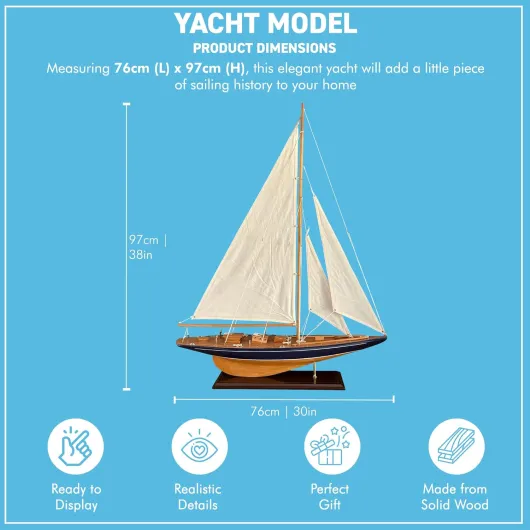
I picked up the Thorness J Class Wooden Sailing Yacht Model because I wanted one big statement piece for a sideboard in the living room, not another tiny trinket that disappears on a shelf. This one is 76 cm long and about 97 cm high once you’ve got the masts up, so it’s not shy at all. I’m not a hardcore model builder, more someone who likes nautical decor, so I was looking for something that looks good from a distance and doesn’t need weeks of fiddly assembly.
Out of the box, it comes partly assembled, which is honestly why I chose it over some of the full DIY kits. The hull is already built and painted, the wooden base is there, and you mostly have to deal with the masts, rigging, and sails. It’s clearly more of a display ornament than a serious scale model for purists, but it still has enough detail that it doesn’t feel cheap or toy‑like.
I’ve had it on display for a few weeks now in a medium‑bright room, and people do notice it as soon as they walk in. You can tell it’s going for that 1930s America’s Cup vibe, and the aged sails give it a slightly worn, old‑yacht look. Whether you like that or not depends on your taste; it’s not a clean, crisp white sail look. Personally, I think it fits the vintage style it’s advertised for, though it might surprise someone expecting a pristine finish.
Overall, my first impression is that it’s a decent decorative piece for the price, with a few quirks. It’s not museum quality, but it fills a space nicely and doesn’t feel like a plastic toy. If you want a big nautical object that you can assemble in under an afternoon and then forget about, this one basically ticks that box. If you’re a perfectionist model builder, you’ll probably find stuff to nitpick straight away.
Value for money: decent size and presence for what you pay
Looking at the price range this usually sits in on Amazon and the fact it’s about 76 cm long and 97 cm high, I’d say the value is decent but not mind‑blowing. You’re paying mainly for size and the fact it’s already partly assembled and made of wood. If you compare it to very cheap small boat ornaments, of course it’s more expensive, but those are tiny and often plastic. If you compare it to high‑end handcrafted ship models, those are way more expensive than this, sometimes several times the price.
For what you pay, you get a big decorative object that looks good from a normal distance and doesn’t feel like pure mass‑produced plastic. The trade‑off is some rough finishing details and a basic instruction sheet. Personally, I think that’s acceptable. I didn’t feel ripped off when I unboxed it, but I also didn’t feel like I’d stumbled on some huge bargain. It’s in that “fair for what it is” zone. The Amazon rating around 4/5 with only a couple of reviews also matches my feeling: it’s good, not flawless, and won’t suit every buyer.
Where it makes the most sense is if you specifically want: (1) a large nautical centrepiece, (2) something mainly wood, and (3) a partly assembled kit rather than a full DIY project. If those three points match what you’re hunting for, then the price is reasonable. If you just want a bit of boat decor in the background and don’t care about size, you can spend less and still get something that does the job visually.
So in terms of value, I’d summarise it like this: you’re paying for the combination of size, wood construction, and classic yacht look. There’s better finishing out there if you spend more, and there are cheaper options if you go smaller or plastic. In the middle ground, this Thorness model is pretty solid value for a casual decor fan, but serious model collectors will probably see it more as an entry‑level piece than a main showpiece.

Design and look: classic yacht vibe with aged sails
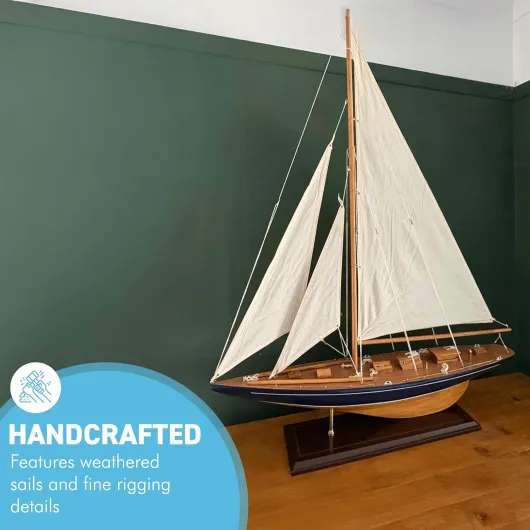
The design is clearly inspired by the 1930s J Class America’s Cup boats, and you can see that in the long, sleek hull and tall mast proportions. It has that typical racing yacht profile: low deck, long bow, and a decent amount of sail area. It’s not an exact copy of any one famous yacht, but it gives the general feel. If you’re into that vintage regatta look, it hits the basic notes without going too nerdy on the technical details.
The colour scheme is simple: navy blue hull with brown wooden elements and beige/aged sails. The hull paint looks glossy enough to catch light but not mirror‑shiny. The deck has some basic planking details painted or carved in, but don’t expect lots of tiny deck fittings or ultra‑precise railings. It’s more about the overall silhouette than micro‑details. From a distance, it reads as a classic yacht; close up, you can see it’s a decorative model, not a scale replica.
The sails are a big part of the look. They’re intentionally aged, so instead of bright white, they’re more of a cream or slightly yellowed fabric with a weathered look. I personally like it because it fits the vintage theme, but if you’re picturing crisp white sails like a brand‑new boat, this will feel a bit off. Also, the rigging is simplified: there are enough ropes to look convincing, but not the full spaghetti mess you’d see on a real J Class. That’s actually a plus for me, because it keeps the build manageable and the look clean enough for decor.
In practice, once it’s on a shelf, the design does what it’s supposed to do: it draws attention and clearly says “nautical” without being too kitschy. It’s not a toy pirate ship or a random boat; it looks like a racing yacht from a specific era. If you’re a purist sailor, you’ll notice what’s missing. If you’re just decorating a room, the design is good enough to feel classy but not overly detailed. Just be aware that the aged sails are a deliberate choice, not a defect, and they set the tone of the whole piece.
Materials and build quality: mostly wood, with some rough edges
The model is advertised as wooden, and that’s largely accurate: the hull, base, and main structural parts are wood. You can feel it when you lift it; it has a bit of weight and doesn’t feel hollow like cheap plastic decor. The wooden plinth is solid enough and keeps the boat stable, which is important at this height. It’s not super heavy, but if you have kids or pets running around, I’d still keep it somewhere they can’t easily bump it.
The paint on the hull is decent but not flawless. You can see some minor imperfections where the navy meets the waterline or where the brown parts join. The finish is okay for a decorative piece in this price range, but if you’re used to high‑end wooden models with perfectly sharp paint lines and varnished wood, you’ll notice the difference. On my unit, there were a couple of tiny paint chips on the underside of the hull, nothing visible once it’s on the stand, but it shows that quality control is more “good enough” than “perfect”.
The sails are some sort of fabric or fabric‑like material with that aged look printed or treated onto them. They’re not super thick, but they hang reasonably well once you tension the rigging. The ropes/rigging are basic string; they do the job visually but don’t feel premium. If you’re handy, you could probably replace some of the rigging yourself with better cord to upgrade the look, but for most people it’s fine as is.
Overall, I’d say the materials feel pretty solid for a mid‑range decorative model. It’s definitely above the cheap all‑plastic boats you sometimes see, but it’s not at the level of handcrafted, fully detailed wooden ship models that cost several times more. The wood gives it a nicer presence, but you have to accept some small flaws and a bit of variability. If you’re okay with that, it feels like reasonable value. If you’re picky about finish quality, you might find yourself touching up paint or adjusting things after unboxing.
Durability and long‑term feel: fine if you treat it like decor, not a toy
I’ve had the yacht up for a few weeks, and while that’s not years of testing, it’s enough to get a sense of how fragile it is. The hull and base feel solid. You can tap the sides and move it around carefully without any scary creaks. The weight is light‑to‑medium for the size, which is good for shelves but also means it’s not some heavy block of hardwood. I’d call it reasonably sturdy wood, not luxury hardwood.
The weak points are clearly the masts, rigging, and sails. They’re thin and mainly there for looks, so if you have kids who like to poke things, or a cat that thinks every string is a toy, you’re going to have problems. I wouldn’t put this in a kid’s room or within easy reach of pets. As long as it’s on a higher sideboard or shelf and people don’t touch it, it should last fine. Dust is the main enemy; I’ve been using a soft paintbrush to gently clean it, and so far nothing has come loose.
In terms of finish, I haven’t seen new chips or cracks appear since I set it up. The paint still looks the same, and the sails haven’t sagged more than they did on day one. If anything, once the rigging settled, the sails actually looked a bit more natural. I do think that if you move house often or keep relocating it, you’ll eventually loosen some ropes or even snap a mast if you’re clumsy. It’s not built to be moved around every week.
So durability wise, I’d say: good enough for a static decor piece, not great if you expect it to survive rough handling. Treat it like a fragile ornament, and it should hold up. If you want something practically indestructible, you’d be better off with a smaller, chunkier model or even a plastic one. This sits in the middle: more solid than it looks at first glance, but still something you respect when you clean or move it.
Assembly and day‑to‑day “performance” as decor
Obviously this thing doesn’t “perform” like a gadget, but there are still two practical sides: how easy it is to assemble and how it behaves once it’s in place. On the assembly part, it comes partly built, so you’re mainly dealing with putting the masts in, attaching the sails, and sorting the rigging. The instructions are usable but pretty barebones. I ended up ignoring some of the tiny arrows and just looking at the product photos online to match where the ropes should go. If you’re patient and have a bit of spatial sense, it’s fine; if you hate any kind of assembly, you may swear a bit.
Time‑wise, I spent about 90 minutes from opening the box to having it looking decent on the stand. A chunk of that was just untangling ropes and tightening them so the sails didn’t sag too much. You definitely want to take your time to get the mast straight and the lines even, or the whole boat will look crooked. A small tip: do a dry run without tying tight knots, step back, check alignment, then tighten everything once you’re happy. The model doesn’t include extra tools, but you only really need scissors and maybe a small pair of tweezers if your fingers are big.
Once assembled, it behaves like any other big decorative item. It’s stable on the wooden base as long as the surface is flat. I’ve dusted it a couple of times with a soft brush; the rigging and sails handled that without anything coming loose. I wouldn’t keep it in direct sunlight all day though, because the already aged sails could yellow more over time, and the paint might fade. It’s purely decorative: no moving parts to play with, no wheels on the base, nothing interactive. You basically set it, dust it once in a while, and that’s it.
In daily use, I’d say it does its job as a decor piece. It fills a space, gets a few comments from visitors, and doesn’t require maintenance beyond dusting. The only mild annoyance is that the height makes it a bit awkward to move around without grabbing something delicate, so you have to be careful when repositioning it. But overall, for a partly assembled model, the practical side is manageable and not too frustrating, as long as you’re expecting a bit of rope work at the start.
Unboxing and first look: not luxury, but not cheap junk either
When the box arrived, the first thing I checked was whether the boat had survived shipping. It’s long and tall, so I was half expecting some snapped mast or loose bits. The packaging is fairly standard: cardboard box, foam and plastic around the hull, and the masts and sails packed separately. Nothing fancy, but it did the job. In my case, there were no broken parts, just a couple of loose ropes that needed untangling, which is pretty normal for this kind of thing.
Inside, you get the hull already attached to its wooden plinth, the masts, the sails (already fixed to some of the spars), and a basic instruction sheet. The instructions are more of a diagram than a proper step‑by‑step booklet. If you’ve never seen rigging before, you may need to stare at it a bit and do some trial and error. It’s not rocket science, but it’s also not “plug and play”. I’d say expect an hour or two if you want it to look neat and reasonably symmetrical.
Visually, once you put the main pieces together, the boat looks quite good from a normal viewing distance of 1–2 metres. The navy blue and brown colour scheme is simple but works well in a living room or office. Close up, you can see that the paint job and some details are a bit rough in places: small imperfections in the lines, minor glue marks, and the odd uneven edge on the wood. Nothing outrageous, but it reminds you this is a decorative model in the mid‑range, not a high‑end collector piece.
One thing that stood out is the size: 76 cm long and 97 cm high is bigger than it sounds when you actually put it on a shelf. You really need a stable surface that’s at least 80 cm wide and not too shallow, because the base depth is about 13.5 cm but you don’t want it sitting right at the edge. So in terms of presentation, I’d say it looks pretty solid once assembled, but you do need to plan where you’re going to put it, and don’t expect fancy packaging or hyper‑detailed craftsmanship when you open the box.
Pros
- Large size (76 cm long, 97 cm high) gives real presence as a decor piece
- Mostly wooden construction with a solid base, feels more substantial than plastic models
- Classic J Class yacht design with aged sails fits vintage nautical decor well
Cons
- Finish and paint details are a bit rough in places, not for very picky collectors
- Instructions for rigging and assembly are basic and can be confusing
- Fragile masts and rigging make it unsuitable for areas where kids or pets can reach it
Conclusion
Editor's rating
After living with the Thorness J Class Wooden Sailing Yacht Model for a few weeks, my overall take is that it’s a good mid‑range decorative yacht that does what it’s supposed to do: fill a space with a clear nautical vibe and look decent from a couple of metres away. The size is its biggest strength. At 76 cm long and 97 cm high, it really does act as a centrepiece, not just a small accent. The wood construction and classic 1930s racing yacht design give it a bit more character than generic boat ornaments.
On the flip side, it’s not a precision model. The finish has small flaws, the instructions are basic, and the rigging and sails are more about effect than accuracy. You need a bit of patience to assemble it, and you definitely have to treat it as fragile decor, not something to handle often. The aged sails are also a love‑or‑hate detail: I liked the vintage feel, but anyone expecting clean white sails might be disappointed.
I’d recommend this to people who want a big nautical decor piece for a living room, office, restaurant, or hallway, and who are okay with doing a bit of setup and accepting some imperfections. It’s also fine as a gift for someone who likes boats but isn’t a hardcore model builder. If you’re a serious ship model collector or super picky about finish quality, you’ll probably find it too basic and might want to put your money into a higher‑end model instead.