
Summary
Editor's rating
Value for money: good push for the price, but you sacrifice polish
Design: simple layout with a few rough edges
Battery use: decent efficiency but you’re on your own
Comfort and ease of use: quiet and smooth, with some quirks
Build and durability: feels sturdy, but long-term is a question mark
Performance on the water: honest push, not a speed demon
What you actually get in the box
Pros
- Good thrust for small boats: roughly 4–5 mph on a 12 ft aluminum boat at full power
- Brushless motor is quiet, relatively efficient, and low maintenance compared to brushed units
- Infinitely variable speed control and simple forward/reverse button make trolling easy
Cons
- Weak documentation and almost no guidance on battery choice, wiring, or runtime
- Unknown brand with questionable long-term parts and support
- Alligator-clip battery connection and basic voltage-only display feel a bit DIY

Specifications
View full product page →| Brand | RainWeel |
A budget 1500W outboard that actually pushes a boat
I’ve been running this 1500W RainWeel electric outboard on a 12-foot aluminum fishing boat for a few weekends now. I mainly use it on a medium-sized lake, with two adults, gear, and a battery on board, so roughly 450–550 lbs total, well below the 1653 lbs it claims it can handle. I bought it because I was tired of the noise and maintenance of my old 4hp gas outboard and wanted something simple for trolling and slow cruising.
In practice, this motor sits somewhere between a strong trolling motor and a very small outboard. It’s not going to plane your boat, but it does move a light boat at a decent pace and is perfectly fine for trolling and calm-water cruising. I’d say it feels similar to a 2–3hp gas motor in terms of push, but with smoother control and no fumes. That’s the main reason I stuck with it instead of returning it.
It’s not perfect though. You can tell it’s from a no-name brand: the manual is vague, the labeling on the cables and controls could be better, and there’s zero hand-holding when it comes to picking the right battery or wiring. If you’ve never dealt with electric motors or boat electrics, you’ll probably need to watch a few YouTube videos or ask someone who knows what they’re doing.
Overall, my first impression after a few outings is: pretty solid for the price, but very DIY. It does what it says in terms of thrust and speed, but you trade off polish, documentation, and brand support. If you’re okay with that and just want something that pushes your small boat quietly, it’s worth a look. If you want plug-and-play with strong after-sales support, I’d look elsewhere.
Value for money: good push for the price, but you sacrifice polish
In terms of value, I’d put this motor in the “good but not flawless” category. For the power you get (1500W brushless) and the ability to move a small boat at 4–5 mph, the price is quite reasonable compared to big-name electric outboards. If you look at something like a Torqeedo or an equivalent from a major brand, you’re often paying several times more, especially if they include an integrated battery and smart display. Here, you’re clearly paying less, but you also get less in terms of ecosystem and support.
Where the value shows is if you already have a decent 12V battery or you don’t mind buying a separate one. The motor itself is the main cost, and then you’re free to choose a cheaper lead-acid or a nicer LiFePO4 depending on your budget. For someone like me who already had a 12V setup for a previous trolling motor, this made sense. I basically got more thrust and brushless efficiency without having to buy into a closed system.
On the downside, you feel the budget nature in a few areas: the manual is weak, the branding is all over the place (RainWeel, WASIOUR, generic labeling), and there’s no clear local support or dealer network. If something fails out of warranty, you’re probably buying another unit rather than repairing this one. Also, the lack of built-in protections (no obvious fuse, no advanced display) means you need to be a bit more responsible about how you set up your electrical system.
So, compared to big brands, this is good value for money if you’re a hands-on user who doesn’t mind doing some homework and maybe a bit of DIY. If you want a polished, idiot-proof solution with rock-solid support and a fancy screen telling you everything, this isn’t it. But if you just want quiet, electric push for a small boat at a lower cost, and you’re okay with the trade-offs, the value is actually pretty strong.
Design: simple layout with a few rough edges
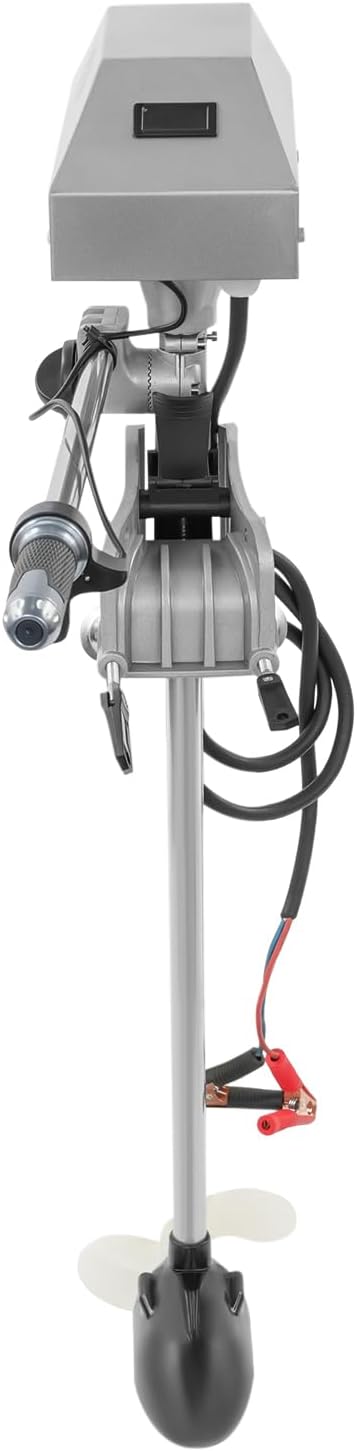
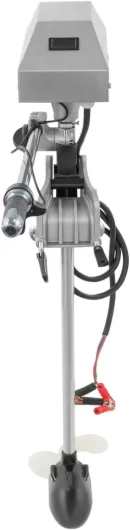
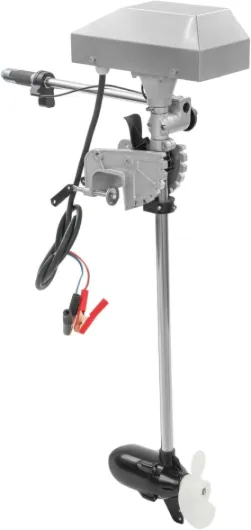
The overall design is pretty straightforward: vertical shaft, two-blade prop at the bottom, clamp bracket in the middle, and a foldable tiller handle on top. It mounts like a normal small outboard on the transom using adjustable clamps. The handle folds and you can angle the motor up and down, which helps when launching, beaching, or loading the boat onto a trailer. That part works as expected and feels fairly solid once tightened.
The tiller handle is where most of the user interaction happens. You twist it to adjust the speed – it’s infinitely variable, not just fixed steps – and there’s a red button for switching between forward and reverse. In theory, that’s great: you can dial in exactly the speed you want for trolling or slow maneuvering. In practice, the detent or marking for “neutral” is not very clear, so at first I found myself bumping the handle slightly and the prop would start turning when I thought it was at zero. After a couple of outings, I got used to where the neutral zone roughly is, but it could be better marked or designed.
The LED display is mounted near the handle and shows the battery voltage. It’s big enough to read in daylight, though in strong sun you sometimes need to shade it with your hand. There’s no backlighting control or extra info like power draw or estimated runtime – just voltage. It’s basic but useful to avoid completely draining your battery by accident. However, I would have liked at least a small bar graph or something more intuitive for people who don’t think in volts.
Ergonomically, I’d call the design “fine but not refined”. Everything is where you’d expect, but it doesn’t have the polished feel of a big-brand motor. The plastic on the handle and the display housing doesn’t feel cheap to the point of breaking, but it also doesn’t feel premium. For a budget electric outboard, it’s acceptable. If you’re coming from a Minn Kota or a Torqeedo, you’ll definitely notice the difference in fit and finish.
Battery use: decent efficiency but you’re on your own
This motor does not come with a battery, so you have to bring your own. I ran it on a 12V 100Ah LiFePO4 battery and also tested a 12V 100Ah lead-acid deep cycle for comparison. With the lithium battery, trolling at low to medium power, I was able to get roughly 5–6 hours of mixed use (slow cruising, some higher-power runs) before the voltage dropped to a level where I felt it was time to stop. With the lead-acid, runtime was shorter and the voltage sagged more under high load, which you can clearly see on the LED display.
The LED voltage display is the only battery management tool you get. It’s better than nothing, but it doesn’t tell you how many amps you’re pulling or how much capacity you have left. You need to know that, for example, around 12.8–13.3V on LiFePO4 is still pretty full, while dropping below about 12V (under light load) on lead-acid starts to mean you’re getting low. If that sounds confusing, that’s exactly the problem: beginners won’t get much guidance from the motor itself.
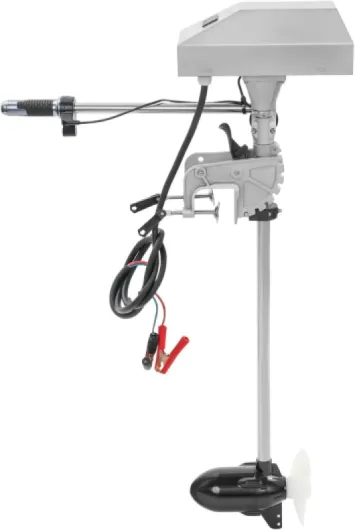
The motor connects with two large alligator clips on a 6.6 ft power cord. The length is enough to reach a battery sitting near the middle of the boat, which is nice for weight distribution. The cable thickness seems adequate for the power level – I didn’t notice any heating on the wires even after long runs at high power. However, I would have preferred ring terminals on a properly fused connection rather than clips. Clips are fine for casual use, but they can slip or corrode faster if you’re not careful.
In terms of consumption, at full power you can drain a 100Ah battery in a couple of hours, which matches the 1500W rating roughly (depending on efficiency and real draw). At low trolling speeds, it sips power and you can be out for most of the day. So efficiency is decent, but the product leaves all the planning and safety (fusing, battery choice, wiring) to you. If you know what you’re doing with 12V systems, that’s okay. If not, you’ll want to do some research or ask for help to avoid cooking a battery or blowing something.
Comfort and ease of use: quiet and smooth, with some quirks
From a comfort point of view, it’s a big step up from a small gas outboard. There’s no pull-start drama, no fumes, and way less vibration. You just connect the clips to the battery, twist the handle, and off you go. For slow cruising and trolling, the whole experience is pretty relaxing. You can actually talk without shouting, and you don’t finish the day smelling like gas and oil.
The foldable handle and the adjustable angle make it easy to find a position that doesn’t wreck your back. I’m about 6 feet tall, and I could sit on the rear bench and steer comfortably with one hand. When I had a friend drive who’s shorter, he just adjusted the angle a bit and it was fine for him too. The motor head doesn’t feel too heavy when tilting it up, so moving it in and out of the water isn’t a struggle.
The main annoyance is the lack of a clear neutral. On the first trip, I accidentally nudged the handle while leaning back and the prop started spinning slowly. Not dangerous, but annoying when you’re trying to stay put. After a while, I learned to always click the red button to neutral and slightly back off the throttle when I want to be sure it’s not engaged. It’s not a deal-breaker, just something you have to get used to.
Overall, I’d say the motor is comfortable to use once you understand its little habits. It’s not as polished as a premium electric outboard, but the quiet operation and the ease of just twisting a handle to go forward or reverse make boating more relaxed. If you’re using it mainly for fishing or calm family rides, the comfort factor is one of the strong points compared to a gas alternative.
Build and durability: feels sturdy, but long-term is a question mark
The motor uses aluminum alloy and stainless steel, with a sprayed coating on the metal parts. In hand, the shaft and bracket feel fairly robust. It doesn’t flex or wobble when you tighten it properly onto the transom. The propeller is a two-blade design that feels thicker and tougher than the flimsy plastic props you get on some cheap trolling motors. I bumped it into a submerged branch at low speed and it came out without any visible damage, just some light scuffing.
I’ve used it in both freshwater and slightly brackish water so far. After each salt-ish outing, I rinsed it with fresh water and checked for corrosion. After a few weekends, I haven’t seen any rust spots or peeling paint yet. The hardware (bolts, clamps) still looks clean. The real test will be after a full season or two, but at least early signs are positive. The manufacturer claims it’s suitable for both freshwater and saltwater, and the materials they chose do line up with that claim, as long as you rinse and don’t just leave it caked in salt.
The moving parts – mainly the tilt mechanism and the clamp screws – work fine but don’t feel super refined. The tilt adjustment is a bit stiff, and the plastic knob on one of the clamps feels like the weak point. I’ve been careful not to overtighten it because I could see it cracking if someone really cranks down. I’d rather have slightly overbuilt metal knobs there, but that would probably raise the cost.
As for the electronics and motor, brushless motors usually last a long time if they’re not abused. There’s no obvious way to service the internals yourself, so if the control board or something fails after the 2-year warranty, you’re likely on your own. That’s the risk with these off-brand units: build feels okay, but long-term parts availability is a big question mark. For the price I paid, I’m fine with getting a few solid seasons out of it. If I were expecting 10+ years of heavy use, I’d probably go with a bigger-name brand.
Performance on the water: honest push, not a speed demon
Performance-wise, this motor is pretty solid for small boats as long as your expectations are realistic. On my 12ft aluminum boat with two adults and gear (around 500 lbs total), at full power on a calm lake, we were moving at roughly 4–5 mph based on a phone GPS. That’s not fast, but it’s enough to get from one side of a medium lake to the other without feeling like you’re crawling. For trolling for pike and walleye, I usually run it at around 20–30% power, and that gives a nice slow speed in the 1–2 mph range, which is exactly what I wanted.
The infinitely variable speed control is genuinely useful. With older trolling motors I’ve used, you often get stepped speeds (1–5 or 1–10), and sometimes one setting is too slow and the next is too fast. Here, you just twist the handle a bit more or less and you get exactly what you want. The response is fairly smooth. There is a tiny delay when you hit the forward/reverse button, but nothing dangerous, just something you notice when docking or trying to hold position near a structure.
Noise-wise, it’s quiet but not totally silent. You hear a soft hum from the motor and some noise from the prop in the water, but compared to a gas outboard it’s night and day. You can talk at a normal volume, you don’t smell exhaust, and there’s no vibration shaking the boat. Fish definitely don’t seem to care about the noise at trolling speeds. At full power, there’s a bit more whine, but still far from annoying.
Where it falls a bit short is in strong wind or current. With a headwind and a bit of chop, the boat still moves forward, but you feel that the motor is working near its limit. If you’re planning to regularly fight heavy current or run a very heavy boat near the 1653 lb spec, I’d be cautious. For sheltered lakes, canals, and slow rivers, it’s fine. For open, windy water with a loaded boat, it’s more of a backup or trolling motor than your main means of transport.
What you actually get in the box
Out of the box, you get the motor itself, the mounting bracket, the two-blade propeller already installed, a couple of clips on the power leads, and the basic hardware to attach it to your transom. There’s no battery, no charger, and no fancy accessories. The manual is there, but it’s more of a parts overview than a real step-by-step guide. If you’re expecting a clear explanation of what size battery to buy, what gauge cables to use for longer runs, or how long it’ll run at different power levels, that info just isn’t there.
The motor is rated at 1500W with a claimed 4200 RPM top speed at the prop shaft. On paper that sounds strong, and in practice it does translate to decent thrust on a small boat. It’s a brushless motor, which is good because it should be more efficient and need less maintenance than older brushed trolling motors. The brand listed is RainWeel, but the manufacturer name on the listing and paperwork is different, which doesn’t inspire tons of confidence in long-term support. It feels like one of those generic Chinese units that gets sold under multiple names.
The wiring comes with two big alligator clips meant to connect straight to an external battery. That’s convenient if you’re used to just clipping onto a lead-acid battery, but it’s also easy to mess up if you’re not careful with polarity. The LED display reads voltage, which helps, but again, you need some basic understanding: 12V system, what’s full, what’s too low, etc. There’s no built-in battery management beyond that simple readout.
In practice, I’d describe the whole package as: functional but bare-bones. It’s everything you need to make the motor spin, nothing more. If you’re okay sourcing your own battery, fuse, and maybe better connectors, it’s fine. If you were hoping for a complete ready-to-go kit with clear guidance, you’ll find this a bit rough. For the price I paid, I wasn’t shocked, but it’s something to keep in mind.
Pros
- Good thrust for small boats: roughly 4–5 mph on a 12 ft aluminum boat at full power
- Brushless motor is quiet, relatively efficient, and low maintenance compared to brushed units
- Infinitely variable speed control and simple forward/reverse button make trolling easy
Cons
- Weak documentation and almost no guidance on battery choice, wiring, or runtime
- Unknown brand with questionable long-term parts and support
- Alligator-clip battery connection and basic voltage-only display feel a bit DIY
Conclusion
Editor's rating
After a few weekends on the water, I’d sum up this 1500W RainWeel electric outboard as: a strong, budget-friendly option for small boats, with some rough edges. It delivers real, usable thrust for 10–14 ft boats, runs quietly, and the infinitely variable speed control is genuinely handy for trolling and slow cruising. The brushless motor and metal construction give a decent impression of robustness, and it handles both freshwater and light saltwater use fine as long as you rinse it.
Where it falls short is polish and guidance. The manual is basic, the brand is relatively unknown, and you don’t get much help with battery sizing, wiring best practices, or long-term support. The alligator-clip connection and simple voltage display work, but they leave most of the responsibility on you. It’s also not the motor I’d pick as the only engine for a heavily loaded boat on big, windy water – it’s better as a trolling/auxiliary motor or for calm lakes and canals.
If you’re a practical, DIY-friendly boater who wants affordable electric propulsion and already understands (or is willing to learn) basic 12V setup, this motor is a good deal. You get solid push, quiet operation, and decent build for the money. If you want a fully integrated, plug-and-play system with strong customer service and a polished interface, you should probably save up for a more established brand instead.