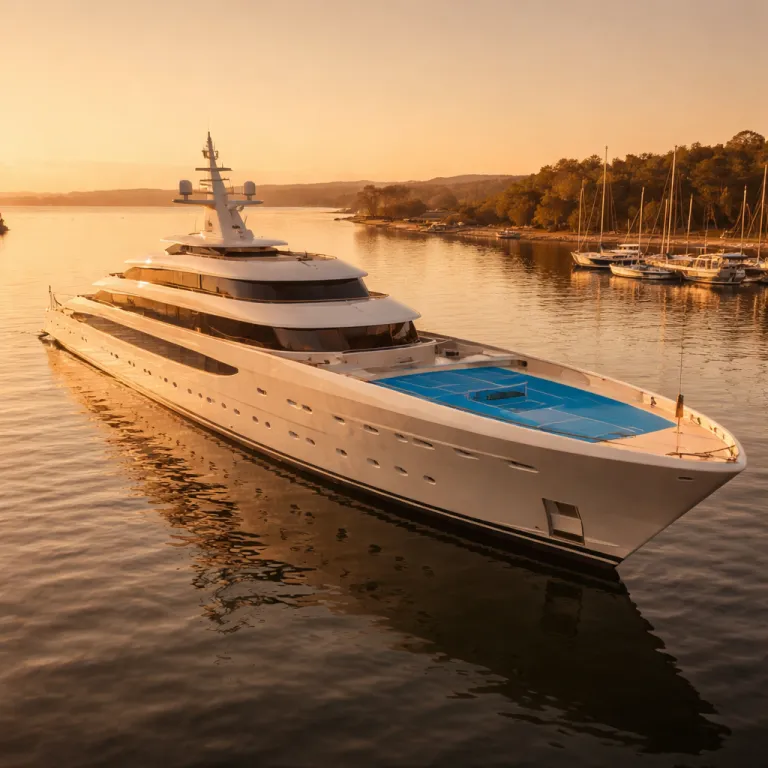

Feadship Project 826 and the sailing eye behind its profile
Feadship Project 826 is an 80 metre Feadship motor yacht that wears its sailing heritage on the sleeve. Styled by Malcolm McKeon, better known for high performance sailing yachts, the superyacht project shows what happens when a racing sailor sketches a steel and aluminium hull for long range passagemaking. The result is a Feadship superyacht with a lean profile and a purposeful bow that feels closer to a modern sloop than a floating palace.
From the first side view, the yacht design reads as a single sweeping project of lines rather than stacked decks, and that is classic Malcolm McKeon thinking translated into a different medium. The designer Malcolm McKeon has spent decades refining how sailing yachts carry power and reduce drag, and you can see that discipline in the way the main deck glazing is recessed and the upper deck overhangs are pared back. For owners used to fuller Feadship profiles, this new Feadship Project 826 language signals a shift toward yachts that look fast at any speed, not just at top speed knots.
The yard has not released full performance data, yet the long waterline and relatively modest superstructure suggest a generous knots range at efficient cruising speed. Experienced captains will read the hull shape and expect a comfortable motion at 12 to 14 knots cruising, with enough fuel capacity to cross oceans without drama. In the context of recent Feadship news, from the larger Project 1014 to the more experimental Project Solent, this project launched as a statement that yacht design can borrow from sailing without becoming a sailing yacht.
For owners comparing new yachts sale opportunities, that crossover matters because it changes how the yacht will be used day to day. A Feadship superyacht with a sailing influenced profile tends to encourage more time underway, more nights at anchor, fewer static marina seasons, and that is exactly where personal yacht culture is heading. When you look at other custom yachts with strong design narratives, such as the Cassidy Marie yacht analysed in this detailed yacht design case study, you see the same move toward purposeful profiles over floating real estate.
The rise of the beach club as the real heart of the yacht
Where Feadship Project 826 truly breaks internal precedent is the 165 square metre beach club carved into the stern. That beach club is the largest ever fitted on a Feadship and it turns the lower deck into a water level club rather than a back of house corridor. For a yacht of 80 metre length, dedicating that much volume to a single waterside space is a clear signal about how owners and guests actually live on board.
Instead of treating the beach as a secondary amenity, the designers have made the beach club the social spine of the superyacht project, with wellness, lounging and water sports all radiating from one glass rich hub. Expect a glass bottom pool overhead feeding dappled light into the club, a detail that has become almost mandatory on new custom yachts aiming to compete at the top of the yachts sale market. When you combine that glass bottom drama with fold down terraces, the boundary between interior and sea blurs in a way that older Feadship Thalassa era yachts rarely attempted.
For seasoned owners, the shift is practical as much as aesthetic, because crew choreography now builds around the beach club rather than the main deck saloon. Tenders, toys and wellness routines all flow through one controlled point, which improves privacy for guests while keeping service efficient at any speed knots. Anyone planning a refit on an existing motor yacht will recognise how hard it is to retrofit this kind of waterside volume, which is why new builds like Feadship Thalassa successors and Project 826 are pushing so aggressively in this direction.
Interior specialists have been tracking this move for several seasons, noting how luxury yacht interior design is migrating toward resort like beach spaces and calmer main deck lounges. A useful reference for this broader trend is the analysis of luxury yacht interior design in this in depth look at the art of yacht interiors, where the beach club is treated as a primary living room rather than a gym annex. Project 826 simply scales that idea up, turning the stern into a private club that happens to move at a comfortable knots cruising pace.
Helipad pickleball, hybrid roadmaps and yachts as private clubs
One of the most talked about details on Feadship Project 826 is the touch and go helipad on the foredeck that converts into a pickleball court when idle. That dual use deck says more about modern yacht culture than any brochure line about a cinema or a wine wall, because it shows how owners now value active club style amenities over static showpieces. When a helipad becomes a sports court, the yacht itself becomes a floating club where movement and play matter as much as formal dining.
This is not an isolated experiment, as other Feadship projects such as Project Solent and the forward looking Feadship Thalassa concepts are also exploring multi use decks and hybrid propulsion. Project 826 sits within the Feadship hybrid roadmap as a bridge between conventional diesel power, with its large fuel capacity for long range, and the more experimental systems being tested on later yachts. For owners tracking the latest news on innovation, comparisons with technically ambitious builds like the Tsaltà yacht, examined in this feature on yacht innovation and luxury at sea, help frame where this Feadship motor yacht stands today.
On board, the combination of a vast beach club, a forward sports deck and a refined main deck layout effectively turns the vessel into a private members club for a single family and their circle. Cruising speed and knots range still matter, of course, but the real luxury is how seamlessly guests can move from sea level to helipad to sky lounge without ever feeling they have left their own club. For experienced owners considering the next step after a traditional superyacht, Feadship Project 826 suggests that the future is not about the biggest profile in the harbour, but about the richest set of experiences per metre of hull and per hour of knots cruising — not the length overall, but the wake she leaves.