
Summary
Editor's rating
Is it worth the money compared to other antifouls?
Colour, finish and how it looks on the hull
What it’s made for and surface compatibility
How it holds up over a full season
Application, drying times and behaviour in real use
What you actually get in the tin
How well it actually keeps the hull clean
Pros
- Easy to apply with roller or brush, with realistic drying and re-coat times
- Good effectiveness against hard growth over a full cruising season
- Decent coverage from the 5L tin, making it good value for mid-sized boats
Cons
- Not suitable for aluminium hulls or gear, which limits where you can use it
- Colour looks off right after painting and only settles after a few days in the water
- Not the cheapest option if your boat only spends short periods afloat

Specifications
View full product page →| Brand | AB Tools |
A no-nonsense antifoul for people who just want the hull clean
I used this Hempel Classic Souvenirs Blue 5L on a 26-foot fibreglass cruiser that lives in salt water from roughly April to October. I’m not a pro painter, just someone who’s been doing his own antifouling for a few seasons, mostly using International and Seajet before this. I wanted something I could roll on in a weekend without babying it, and this one fit the bill on paper.
The promise is simple: easy to apply, decent coverage, keeps the slime and barnacles under control for a full season. No fancy marketing story, just a big 5L tin with a fairly standard cruising spec. I did two full coats plus a bit of extra around the waterline and leading edges, following the speed recommendation in the description (boat does around 18–20 mph flat out).
From the first use, it felt like a typical self-polishing/cruising antifoul: reasonably thick, covers well, and you don’t need pro-level gear. I did everything with a roller and a cheap brush for the awkward bits. Drying times at around 15–18°C were close to what they claim: touch dry in under half an hour, re-coat the same day without stressing.
After a season in the water, I’d sum it up like this: it’s not magic, but it gets the job done. There was some slime and a few stubborn spots on the keel, but way less barnacle growth than the cheaper paint I used the previous year. It’s not perfect, the colour behaviour is a bit odd at first, and it’s not for aluminium hulls, but for a normal cruising boat it’s pretty solid if you apply it properly.
Is it worth the money compared to other antifouls?
On value, this sits in the mid-range of antifouls: not the cheapest budget tin, not the top-end racing stuff. For 5L covering about 65 m², you’re basically getting enough for a mid-sized boat with two solid coats and a bit spare. If you compare that to buying smaller tins or some of the big-name brands, it works out reasonably good per square metre, especially if you shop around on price.
Compared to the cheaper no-name antifoul I used two seasons ago, this Hempel Classic performed better against hard growth and seemed to last more evenly across the hull. That alone justifies paying a bit more in my opinion, because spending extra hours scraping barnacles and grinding off mess at haul-out is not my idea of fun. On the other hand, if your boat is only in the water for a couple of months a year or lives mostly on a trailer, this is probably overkill.
Against more premium options like some of the higher-spec International or Seajet products, it doesn’t quite match the “lift and wash” cleanliness you sometimes get, but it’s also usually cheaper. You’re trading a bit of ultimate performance for a sensible price and easy application. For a normal cruising boat owner who just wants the hull reasonably clean and maintenance manageable, I think the balance is pretty fair.
So in terms of value for money, I’d say: good, as long as you actually need a full-season antifoul and are willing to do the prep work. It’s not a bargain-bin product, but it doesn’t feel overpriced either. If you want something that simply works without paying top dollar for racing claims, this is a solid middle-ground choice.
Colour, finish and how it looks on the hull
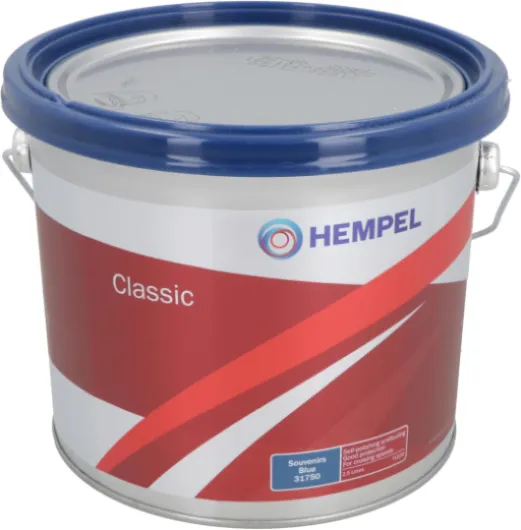
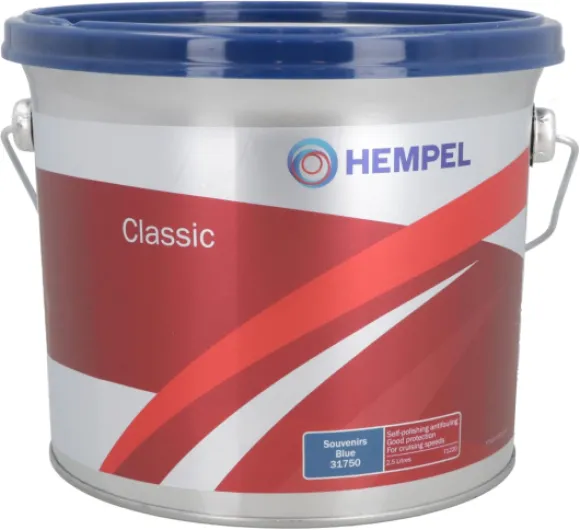
From a pure “design” perspective, we’re mostly talking about colour and finish, since it’s just paint. The Souvenirs Blue 31750 is a fairly classic marine blue. Out of the tin and just after application, it actually looks a bit lighter and slightly duller than you’d expect. The manufacturer even warns that it reaches its final colour after a few days in the water, and that’s exactly what I saw. After the boat sat in the marina for about 3–4 days, the blue deepened and looked more uniform.
Once it settled, the finish was semi-matte, uniform and decent-looking. It’s not glossy like topside paint, obviously, but for an antifoul it looked tidy. Brush marks in the tight areas (around the keel, supports, etc.) blended in once it dried. With a short-nap roller on the larger areas, I got a pretty smooth coat. If you’re a perfectionist, you can still see some overlap lines, but below the waterline that doesn’t bother me at all.
One thing to note: because it’s a self-polishing style paint, the surface does slowly wear and smooth out during the season. By haul-out, the colour was a bit patchier in high-flow areas like the bow and leading edge of the keel. That’s normal for this type of product, but if you’re expecting it to look freshly painted when you lift out, that’s not how these work. Functionally it’s fine, but visually it’s more “used but OK” than pristine.
In short, the design is very functional: a sensible blue that hides scuffs, a finish that looks clean enough for a cruising boat, and behaviour in the water that matches other mid-range antifouls. If you want multiple colour options or a very sharp cosmetic look, this isn’t the product that cares about that. It’s clearly built around practicality rather than style points.
What it’s made for and surface compatibility
This paint is clearly aimed at people with fibreglass, wood, plywood or steel hulls. That’s what’s printed everywhere, and that’s where it makes sense. I put it on a GRP hull that already had antifoul on it. I gave it a good pressure wash, a light sand, and checked for any flaking areas. On the spots where the old paint was dodgy, I feathered it back and spot-primed. The new Hempel Classic went over that without any drama – no lifting, no weird reactions, no soft patches after drying.
The big warning is do not use on aluminium. That’s pretty important, and it’s not just legal talk. A lot of antifouls contain copper-based biocides that don’t play well with aluminium, so if you’ve got an aluminium hull or outdrive, this is not for you. I used it around a steel keel and rudder and had no issues there, but I was careful to keep it off any aluminium trim and outdrives, masking them carefully.
The paint itself feels like a mid-viscosity antifoul. Not super runny, not a thick paste either. After a good stir (you really need to dig into the bottom of the tin), it levels out enough to roll without clumping. If you don’t stir it properly, you’ll end up with thin patches and then thicker stuff at the bottom of the tin, so that’s on the user. Once mixed, it stuck well even on some slightly rough old coatings, which tells me the binder system is pretty forgiving.
From a “materials” point of view, it behaves like a typical self-polishing copper-based antifoul: it slowly erodes, taking marine growth with it. That’s fine for normal cruising use. It’s not a hard racing paint and not a special low-friction formula. If you’re expecting that, you’ll be disappointed. But if your hull material matches the spec (GRP/wood/steel) and you prep it sensibly, the paint itself seems reliable and predictable, which is what I care about more than fancy chemistry details.
How it holds up over a full season
Durability-wise, I’d say this paint is in the “good but not bulletproof” category, which is fine for a classic cruising antifoul. After just over five months in the water, the coating was still clearly there on most of the hull. High-wear areas like the bow, leading edge of the keel, and rudder edges showed more erosion, but that’s exactly where you expect self-polishing antifoul to thin out first.
When I pressure-washed the hull at haul-out, the paint stayed on the surface pretty well. You get the usual coloured runoff, but it wasn’t stripping down to bare gelcoat or anything. Under the slime, the blue was still visible and fairly even. Only in a couple of spots where previous layers were already weak did I see small patches where it had worn back more aggressively. That’s more about old prep than this specific product.
Over the season, the colour retention claim is mostly accurate. It did reach its final colour after a few days in the water and stayed that way. By the end of the season, it was a bit duller and patchier where it had worn, but not dramatically. If you look closely on the hardstanding, you can see where the self-polishing action has been strongest, but from a few metres away, it still looks fine for something that’s lived underwater for months.
If you leave your boat in for a full year or in very aggressive fouling waters, I wouldn’t expect miracles – this is clearly aimed at seasonal cruising, not long-term liveaboard with no lift-outs. But for a normal 5–7 month season, two to three coats should comfortably get you through without the hull turning into a reef. I’d call the durability reliable for the price bracket, as long as you prep properly and stick to the coat recommendations.
Application, drying times and behaviour in real use
In terms of performance during application, this paint is easy-going. I applied it in a yard at around 15–18°C with moderate humidity. The spec says *touch dry after 30 minutes at 10°C or 15 minutes at 20°C*, and that’s roughly what I saw. By the time I finished the first coat around the hull, the starting point was already dry enough to walk past without worrying about brushing against it. No sagging or big runs unless I overloaded the roller on vertical surfaces.
Re-coat times are 8 hours at 10°C or 4 hours at 20°C. At my temps, I simply did first coat in the morning, took a break, then second coat mid to late afternoon. No issues with lifting or soft spots. The paint flashed off consistently, and I could tape and untape around the waterline without peeling. The guidance about not putting the boat in the water for 24 hours after painting is realistic. I launched about 36 hours after the last coat, and the film felt well set by then.
In actual use, the performance is what you’d expect from a self-polishing cruising antifoul. The boat didn’t feel slower or more draggy than previous seasons. If anything, compared to the year when I left the old, tired antifoul on, it felt slightly smoother, but that’s more about having a fresh coat than any special speed gain. During the season, I did a couple of short scrubs along the waterline with a soft brush from the pontoon, and the paint didn’t come off in big flakes – just a bit of coloured water, which is normal.
Overall, application performance is one of the strong points: straightforward rolling, reliable drying times, and no nasty surprises. As long as you stir it properly, respect the re-coat and launch timings, and don’t try to slap it on in freezing conditions, it behaves like a sensible, forgiving product. It’s not ultra-fast-cure or anything fancy, but for a DIY job over a weekend, it’s very workable.
What you actually get in the tin
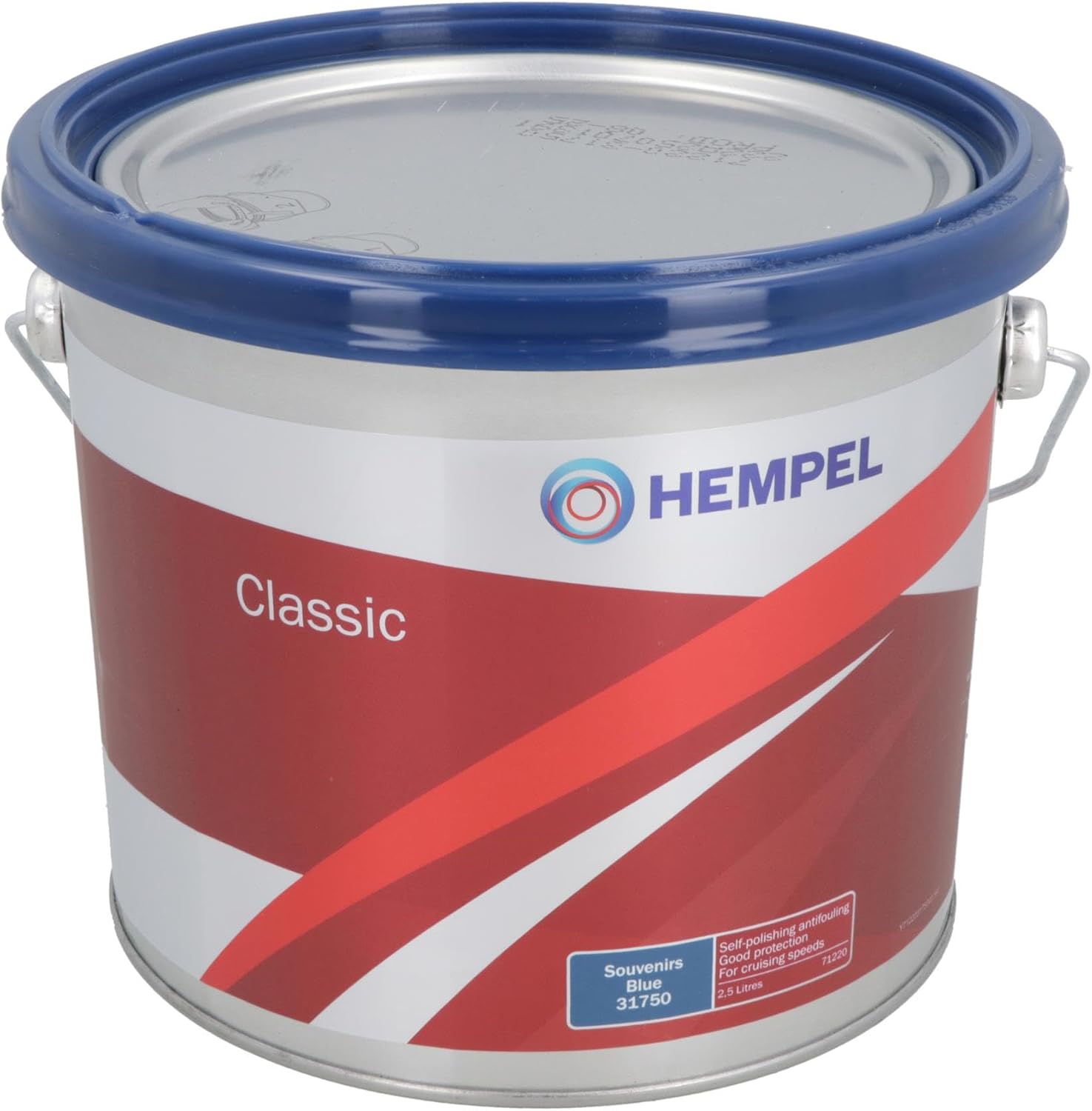
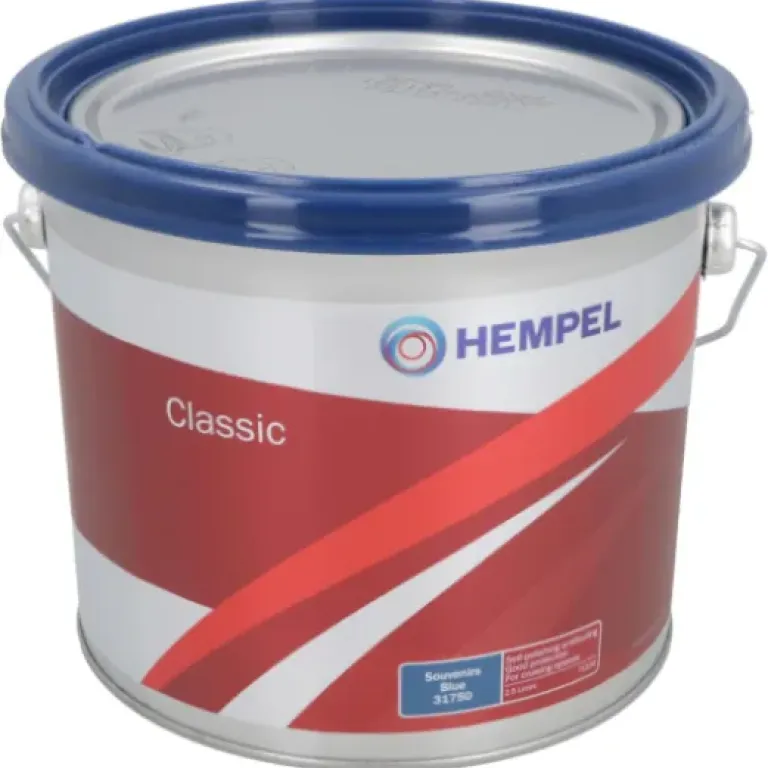
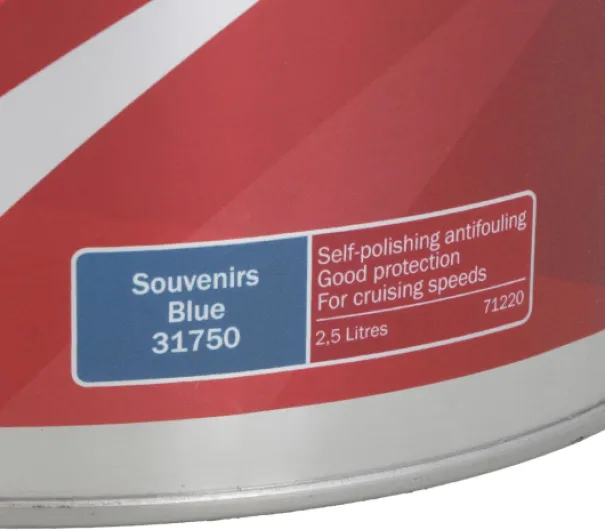
The product is basically a 5L can of Hempel Classic antifoul in Souvenirs Blue 31750, rebadged/supplied by AB Tools. There’s nothing fancy in the packaging: a standard metal tin, lid that needs a screwdriver or opener to pry off, and a label with the usual safety icons and basic instructions. If you’re used to marine paints, it’ll look completely normal, nothing premium, nothing cheap, just standard trade-style packaging.
On the label and in the description, the key info is: suitable for fibreglass, wood, plywood, and steel, but not recommended for aluminium. Coverage is quoted at about 13 m² per litre, so roughly 65 m² for the 5L tin. On my 26-footer (including keel and rudder), two coats plus a bit of extra at the waterline used just under the full tin, so their coverage number is fairly realistic if you don’t overwork it.
What’s a bit confusing is the product listing details like “Size: 44” and “Included components: AQ381_2pk”, which don’t tell you much in real life. In practice, what matters is: you’re getting enough paint for a mid-sized boat with two coats, and it’s the classic cruising antifoul, not some high-end racing formula. The colour is labelled as Souvenirs Blue 31750, which in the tin looks like a mid-to-dark blue, not super bright.
Overall, in terms of presentation, it’s very straightforward. No plastic pour spout, no mixing sticks, no extras. You’ll need your own stirrer, roller, tray, and masking tape. If you like lots of hand-holding instructions, you might find the label a bit basic, but anyone who’s done antifouling once or twice will have all they need. It feels more like something you’d pick up from a chandlery trade shelf than a DIY store “consumer” product.
How well it actually keeps the hull clean
This is the part that really matters: does it keep the growth off? I launched in early May and hauled out in late October, so roughly five and a half months in salt water, mostly marina berth with occasional trips out, cruising speeds around 12–18 mph. I followed the recommendation: two full coats, plus an extra pass along the waterline, bow, and leading edge of the keel since those areas usually get hammered.
When I hauled out, the hull had a thin layer of slime and some light weed around the waterline, which is completely normal. The important bit: there were very few hard barnacles compared to the cheaper antifoul I used the year before. On the previous paint, I had clusters of barnacles around the stern and on the keel that needed scraping. With this Hempel Classic, I had maybe a few scattered ones on the keel and some around fittings, but nothing crazy. A decent pressure wash took almost everything off in one go.
Effectiveness will always depend on your local water and how often you move the boat, but compared to my last product (a budget antifoul from a chandlery brand), this one held up better over the season. The stern area, which usually gets the most mess, was noticeably cleaner. I wouldn’t say it keeps the hull spotless – you’ll still get slime and light weed – but for a cruising boat that sits in the water for months, it did exactly what I expect: limit hard growth and keep cleaning manageable.
One thing to mention: if you’re regularly pushing higher than the recommended 17–23 mph and only do two coats, you might see more wear in high-flow areas. I had two runs at near max speed for longer stretches, and by haul-out the bow and front of the keel looked more worn than the rest. If you’re a speed-happy type, I’d listen to their advice and do three coats in those zones. Overall, I’d call the effectiveness pretty solid for a mid-range cruising antifoul – not miracle stuff, but better than the cheaper options I’ve used.
Pros
- Easy to apply with roller or brush, with realistic drying and re-coat times
- Good effectiveness against hard growth over a full cruising season
- Decent coverage from the 5L tin, making it good value for mid-sized boats
Cons
- Not suitable for aluminium hulls or gear, which limits where you can use it
- Colour looks off right after painting and only settles after a few days in the water
- Not the cheapest option if your boat only spends short periods afloat
Conclusion
Editor's rating
After a full season with Hempel Classic Souvenirs Blue on a 26-foot fibreglass cruiser, my overall take is that it’s a solid, no-drama cruising antifoul. It rolls on easily, dries in a realistic timeframe, and does what it’s supposed to do: keep hard growth under control so cleaning at haul-out isn’t a nightmare. You’ll still get slime and some weed, but that’s normal. Compared to cheaper paints I’ve used, there were clearly fewer barnacles and the coating wore more evenly.
The downsides are mostly practical details: the colour looks a bit odd right after painting until it’s been in the water a few days, it’s not suitable for aluminium at all, and it’s not some magic formula that keeps the hull spotless in heavy fouling areas. It’s also not the absolute cheapest option, so if your boat only touches water for short periods, it’s probably more than you need. But for a typical seasonal mooring or marina berth, two or three coats give you a decent balance of protection, ease of use, and cost.
I’d recommend this to DIY boat owners with fibreglass, wood, or steel hulls who want something reliable without getting into the expensive racing products. If you’re chasing every last knot of speed or leaving the boat in the water year-round in very aggressive waters, you might want to look at higher-spec options. For everyone else who just wants to roll on a couple of coats over a weekend and forget about it for the season, this paint gets the job done without fuss.