
Summary
Editor's rating
Is it worth the money compared to other options?
Consistency, mixing, and how it behaves in the pot
How it holds up after some use and exposure
Cure time, hardness, UV resistance, and real-world use
What you actually get in the kit
Does it actually repair and blend in?
Pros
- Cures hard and tack-free thanks to wax, with predictable 10–15 minute working time
- Includes MEKP and six tint pigments, so you can handle multiple repair types out of one kit
- Sands and polishes well to a high-gloss finish that blends decently with existing gelcoat
Cons
- Gel is a bit thinner than some brands, so it can sag if applied too thick on vertical surfaces
- Pigment quantity is limited for dark colors and full-quart tinting; better suited to small touch-ups

Specifications
View full product page →| Brand | Marine Coat One |
A no-BS gelcoat kit for real-world boat repairs
I used this Marine Coat One Iso/NPG white gel coat with wax on a small fiberglass fishing boat and a couple of old hatch covers. I'm not a pro boatyard guy, just a reasonably handy owner who’s patched a few hulls and decks over the years. I wanted to see if this kit could handle typical DIY repairs: scratches, a couple of deeper gouges at the bow, and some spider cracks on the deck. Nothing fancy, just the usual wear and tear.
What pushed me to try this one instead of the usual West Marine or generic gelcoat was the combo: quart of gelcoat + MEKP + six tint pigments all in one package. I was tired of buying gelcoat, then realizing I also needed catalyst, then hunting for pigments that half the time don’t match. Here, at least on paper, everything needed is in the box. That’s the theory. I wanted to see how it behaves in practice: mix ratio, working time, sanding, gloss, and color match.
Over a couple of weekends, I used it in different ways: straight white on the inside of the hull, lightly tinted to match an off-white deck, and a slightly darker patch near the waterline. I tested it in around 70–80°F (21–27°C) weather, outdoors, no fancy tent, just basic prep: sanding, cleaning with acetone, masking. So this review is from the angle of a regular boat owner, not a shop with spray booths and pro tools.
Overall, the kit is pretty solid and practical, but it’s not magic. You still need to prep well, measure the catalyst, and accept that color matching from white base has limits. It hardens well, sands fine, and the finish looks good once buffed. On the downside, the pigments are better for small touch-ups than for recoloring the whole quart, and the gel is a bit on the thin side compared to some other brands. If you know that going in, it does the job.
Is it worth the money compared to other options?
Price-wise, this sits in the middle of the pack. It’s not the cheapest no-name gelcoat, but it’s usually cheaper than buying a quart of West Marine gelcoat plus separate pigments. The fact that it comes with MEKP and six pigments included does help the overall value, especially if you’re starting from scratch and don’t already have catalyst and tints lying around. For a boat owner doing a few repairs a year, one kit like this can cover a lot of small jobs.
Where the value is good is for DIY touch-ups and medium repairs. You get enough material to fix multiple chips, cracks, and a couple of larger spots, and you don’t have to chase separate components. The downside is that the pigment quantity isn’t enough to tint the entire quart to a dark color, like one Amazon reviewer mentioned. If your plan is to recolor a big panel to a deep blue or gray, you’ll either need more pigment or a different base color. So in that scenario, the kit is less attractive.
Compared to cheaper Amazon gelcoats I’ve tried, this one cures more reliably and sands better. I’ve had bargain products stay slightly tacky or cure unevenly, which ends up costing more in time and frustration. Here, the product behaves like proper marine gelcoat. So even if the price per quart is a bit higher than the bottom-of-the-barrel options, I’d rather pay a bit more and not redo the job.
Considering the performance, included accessories, and the fact that it’s a veteran-owned company that seems to actually respond to customers (based on reviews and my quick email question), I’d say the value is good but not mind-blowing. If you only have one tiny chip to fix, it might be overkill. But if you’ve got a list of repairs and want a reliable kit that will last you through several projects, the price makes sense.
Consistency, mixing, and how it behaves in the pot
From a "design" standpoint, what matters here is the viscosity and working behavior. This gelcoat is slightly thinner than some of the West Marine-branded stuff I’ve used. Not watery, but a bit less pasty. In practice, that means it spreads and brushes easily, which is nice for leveling, but you need to be a little more careful on vertical surfaces to avoid sags if you put it on too thick. I didn’t have major runs, but you can see it wants to flow if you get greedy with the layer thickness.
Mixing with MEKP is straightforward. I followed roughly 1–1.5% catalyst depending on temperature (so about 10–15 drops per ounce, or by weight when I bothered to measure properly). At around 75°F (24°C), I was getting 10–15 minutes of workable time before it started to gel, which lines up with what the Amazon reviewer said. That’s enough time to dab into chips and pull a brush over small areas, but not enough for huge sections unless you mix in smaller batches. Don’t mix half the can at once, that’s asking for a smoking cup.
When adding pigment, the gelcoat handles it well. I mixed the pigment into the base gelcoat first, then added the MEKP. The color disperses fairly evenly without clumping, as long as you stir properly. I stayed under the recommended 1% pigment load, and there were no issues with curing. The more pigment you add, the more you’ll notice the gel time changing slightly, so don’t go crazy. Just sneak up on the color with small additions.
Once down, the gelcoat doesn’t really sag if you apply in reasonable thickness. I did two passes on a vertical bow section: first a slightly thinner coat to get coverage, let it gel, then a second pass to build thickness for sanding. That worked well and avoided runs. If you’re used to super thick paste-like fairing compounds, this will feel more fluid, but it’s still manageable with a decent brush or small roller. Overall, the way it behaves during mixing and application is pretty friendly for a DIYer who’s willing to measure and work in small batches.
How it holds up after some use and exposure
I’ve had the repairs done with this gelcoat through a few outings and some rough handling, plus a couple of weeks sitting in the sun on the trailer. That’s not years of testing, but it’s enough to see if a product is weak or dodgy. So far, the durability feels solid. No hairline cracks have reappeared, no edges lifting, and the transition between old and new gelcoat is still smooth to the touch.
The deck area I fixed is in a spot where people step on it constantly when getting in and out of the boat. I did that on purpose to see if the patch would wear differently. After a handful of trips with coolers, wet feet, and some sand, the repair still looks the same. The gloss is slightly less than the freshly polished surrounding area, but that’s just normal wear. Structurally, it’s holding up fine. I also checked for any water intrusion signs around the bow repair and didn’t spot anything weird.
The product being ISO/NPG polyester is usually a good sign for durability and water resistance compared to cheaper resins. That lines up with how it behaves. It doesn’t feel brittle; it has a bit of give like normal gelcoat. When I tapped the repaired area and the original hull with a knuckle, they sound similar, which tends to mean the patch is well bonded and not hollow or weak.
As for durability of the kit itself once opened, the quart can seems to keep well if you wipe the rim, seal the lid properly, and store it in a cool place. I reopened it a couple of weeks after the first use and the remaining gelcoat was still usable, no big skin on top. Long term, like all polyester products, it will eventually age in the can, but you should easily get several rounds of repairs out of one quart if you don’t let it cook in the sun. For typical boat-owner use over a season, durability looks good both on the boat and in storage.
Cure time, hardness, UV resistance, and real-world use
From a performance angle, I cared about four things: how fast it cures, how hard it gets, whether it stays tack-free, and how it holds up in the sun and water. On cure time, the advertised 24 hours dry / 7 days full cure matches what I saw. At typical garage/yard temperatures, it was solid enough to sand the next day. I left some test patches outside; after a week, they felt fully hardened and didn’t mark when I pressed a fingernail in strongly.
The hardness is good. Once cured, it feels like proper gelcoat, not a soft patch. I wet-sanded from 320 up to 1000/1500 and then buffed. It didn’t smear or gum up, which for me is the sign the catalyst ratio and cure are right. When I compared it to an older West Marine gelcoat repair I did a couple of years ago, the hardness felt very similar. I also didn’t see any shrinkage lines or edges sinking in after a couple of weeks, which sometimes happens with cheap resins.
On UV and blister resistance, I obviously can’t judge years of exposure yet, but I can say that after a few weeks of sun and some freshwater trips, there was no yellowing, chalking, or dulling. The finish still looked as glossy as the day I polished it. The product claims UV and blister resistance, and so far I don’t see any early warning signs. Long-term, it will probably age like any other quality gelcoat: slower fading if you keep it waxed and cleaned.
Real-world use: I dragged anchor lines, fenders, and gear over the repaired deck area, and bounced a fender on the bow repair while docking. No chipping or flaking so far. The coating behaves like the original hull surface, which is exactly what you want. I wouldn’t call it bulletproof—if you slam it into a dock, it will scratch like any gelcoat—but for normal use, it’s holding up well. So in terms of performance, it’s reliable and predictable, which is what I care about more than fancy claims.
What you actually get in the kit
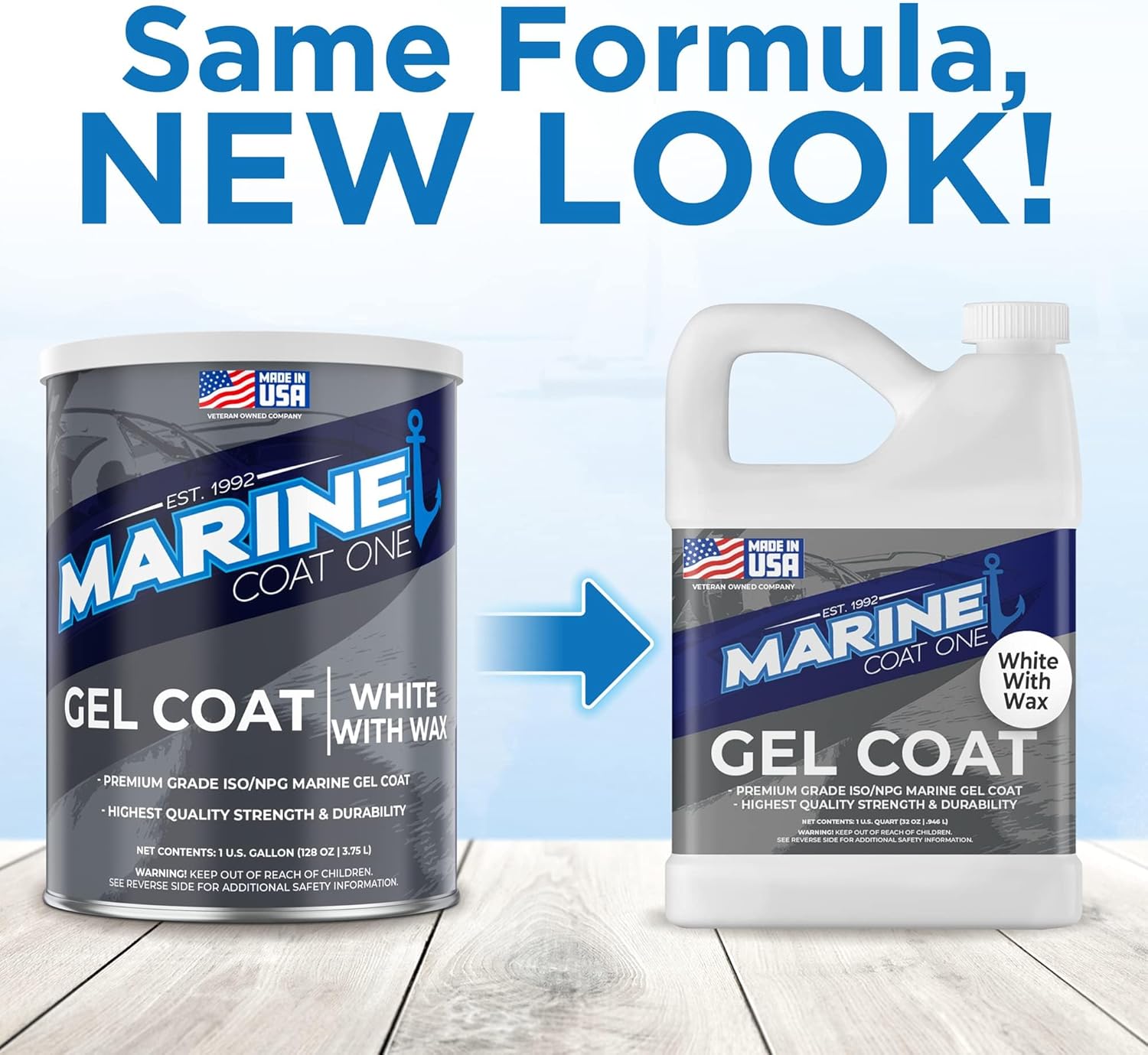
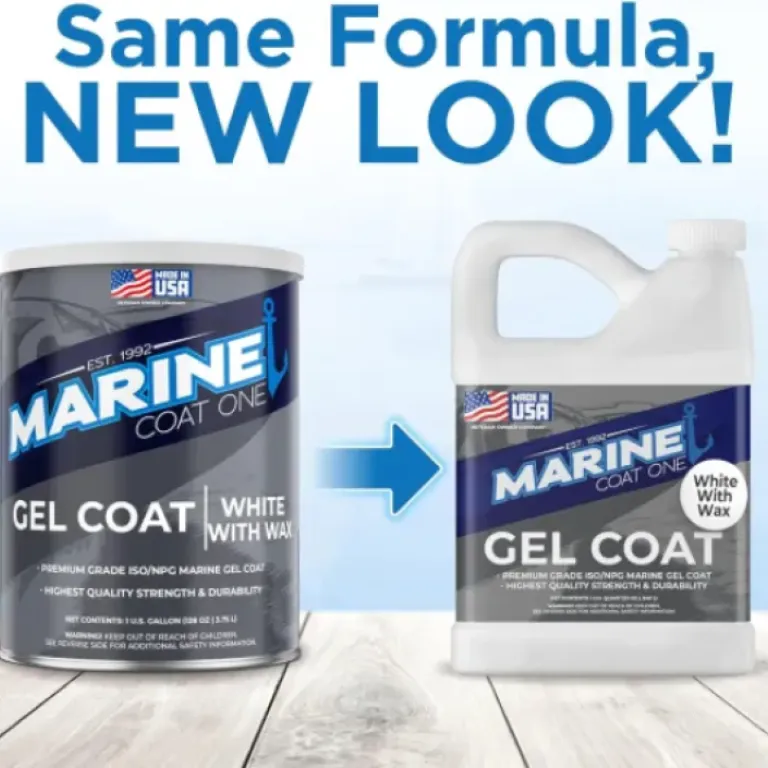
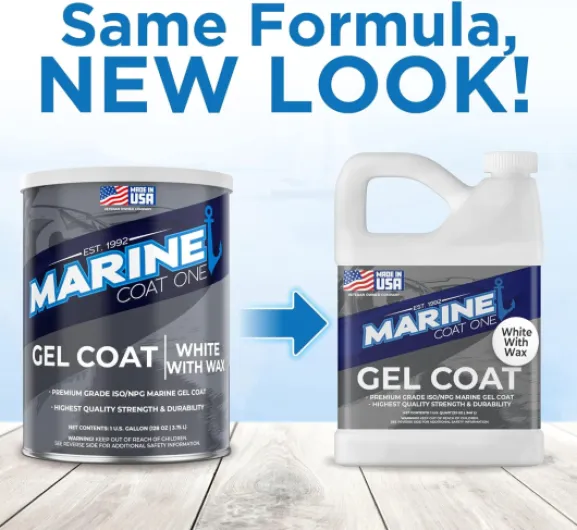
Inside the box you get a quart can of white gel coat with wax, a small bottle (1 oz) of MEKP catalyst, and six little pigment tubes (about 1/4 oz each) in white, black, yellow, blue, red, and brown. No mixing sticks, no cups, no gloves, so you still need to bring your own basic supplies. The can is a standard metal paint-style can with a lid you pop off with a screwdriver. Nothing fancy, but it seals fine and doesn’t feel flimsy.
The gel itself is a pre-waxed ISO/NPG polyester gelcoat. The "with wax" part matters: it cures tack-free, so you don’t have to cover it with plastic film or spray PVA. For a home user, that’s one less headache. The label has the basic mixing info (MEKP percentage, cure time, etc.), but don’t expect a detailed manual. You get the essentials, but if it’s your first time with gelcoat, you’ll probably end up checking a YouTube video or two.
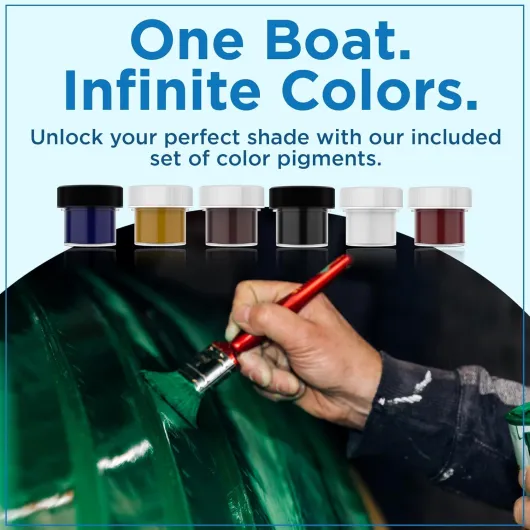
The pigments are small but useful. Each is in a little squeeze tube, which makes it easier to dose drops instead of scooping paste out of a jar. They’re strong enough that a small amount already shifts the white, but as the product page says, they’re more for tinting to lighter pastel/off-whites than for making a deep, solid color. If you plan to do a big dark hull section, this kit alone will not be enough pigment. For touch-ups, small patches, or slightly off-white decks, it’s fine.
In terms of first impression, the kit comes across as functional and no-nonsense. It’s not pretty packaging, but I care more about whether the lid seals and the catalyst bottle hasn’t leaked. In my case, everything arrived intact, no spills, no crusted gel. So from a "what’s in the box" angle, you get exactly what’s advertised: a quart of gelcoat that’s ready to catalyze, plus enough pigment to play with color on a bunch of small repairs.
Does it actually repair and blend in?
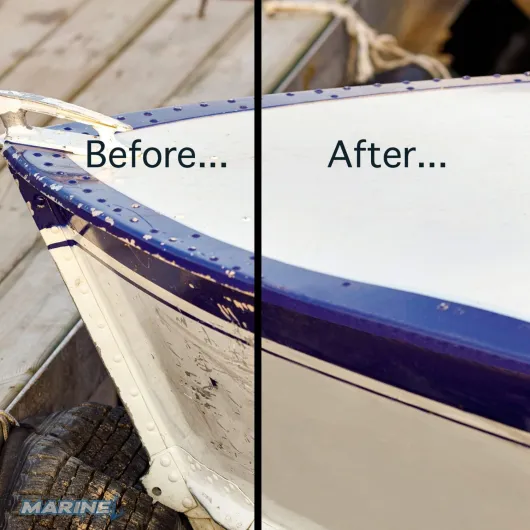
On the core job—filling and hiding damage—this kit does the job well if you put in the prep and sanding time. I used it on three types of defects: shallow scratches, a couple of 2–3 mm deep gouges at the bow, and some spider cracks in a high-traffic deck area. For the deeper spots, I first beveled the edges and filled with a small amount of thickened polyester filler, then came back with this gelcoat as the top layer. For the shallow stuff, I went straight with gelcoat after sanding and cleaning.
The gelcoat cures hard and sands predictably. After 24 hours, it was already sandable with 220–320 grit without clogging the paper too badly. After the full week, it felt fully cured and quite tough. I stepped on the repaired deck area, dragged a cooler over it, and there was no soft feel or imprinting. The gloss after polishing is decent and matches the rest of the boat reasonably well, especially in the sun where small differences are less noticeable. It’s not factory-perfect, but for DIY, it’s more than acceptable.
Color matching is where reality hits. Starting from pure white and trying to match an older, slightly aged off-white hull is always a bit of a guessing game. With the included pigments, I could get close enough that the repair doesn’t jump out from a couple of meters away. Up close, if you know where to look, you can see it. That’s normal. The pigments work better for small chips and scratches than for big panels. If you expect an invisible repair on a 20-year-old boat, this kit won’t magically do that, but it’s not really the product’s fault.
In short, the effectiveness is solid: permanent-feeling repairs, hard cure, no tackiness thanks to the wax, and a good shine after sanding and buffing. The only real limit is your own prep work and color mixing skills. If you’re patient with sanding and polishing, you can get a pretty clean finish that doesn’t scream "home repair" at first glance.
Pros
- Cures hard and tack-free thanks to wax, with predictable 10–15 minute working time
- Includes MEKP and six tint pigments, so you can handle multiple repair types out of one kit
- Sands and polishes well to a high-gloss finish that blends decently with existing gelcoat
Cons
- Gel is a bit thinner than some brands, so it can sag if applied too thick on vertical surfaces
- Pigment quantity is limited for dark colors and full-quart tinting; better suited to small touch-ups
Conclusion
Editor's rating
Overall, this Marine Coat One Iso/NPG White Gel Coat with Wax is a solid, practical kit for boat owners who want to handle their own fiberglass repairs without turning the garage into a full-on boatyard. It mixes easily, cures hard, sands well, and gives a glossy finish that’s close enough to factory for most people. The built-in wax means you don’t fight with tacky surfaces, which is a big plus if you’re doing this outside with basic tools. The working time and cure behavior are predictable, which matters more to me than fancy claims on the label.
It’s not perfect. The gel is a bit thinner than some competitors, so you need to watch for sags on vertical surfaces and build in a couple of passes instead of globbing it on. The included pigments are very handy for small and medium touch-ups, but they’re not enough to tint the whole quart to a dark color, and matching an aged hull color from a white base will always be approximate. If you expect invisible, factory-level color matches, you’ll probably be disappointed, but that’s more about expectations than the product itself.
I’d recommend this kit to DIY boat owners who already have basic sanding and polishing gear and are comfortable mixing resins. It’s well suited for repairing scratches, chips, spider cracks, and moderate damage on fiberglass hulls and decks. If you’re doing a full hull respray or need a precise color match on a dark gelcoat, you’re better off going to a professional supplier or a shop that can custom-match your color. For the average user with a “fix this list of dings before the season” situation, this kit gets the job done with less hassle than piecing everything together separately.