
Summary
Editor's rating
Is 5L of this stuff worth the money?
Thick, black, and a bit messy – but manageable
What it sticks to and how it behaves on different hulls
How it holds up over the season
Application, drying times, and real-world use
What you actually get in the tin
Does it actually keep the growth off?
Pros
- Easy to apply with roller or brush, with realistic drying and re-coat times
- Good protection against hard growth over a full season in average-to-dirty waters
- 5L tin offers decent coverage and good value per litre for DIY boat owners
Cons
- Not suitable for aluminium hulls or outdrives
- Messy black pigment and strong solvent smell, so good prep and ventilation are needed

Specifications
View full product page →| Brand | AB Tools |
Black paint, dirty job, simple result
I used this Hempel Classic Black Antifoul 5L from AB Tools on my 24-foot fibreglass cruiser at the start of the season. The hull was stripped, pressure-washed and lightly sanded beforehand, so the paint wasn’t fighting against old flaky layers. I’m not a pro painter, just a boat owner who’s used a few different antifouls over the years, mainly International and cheap yard brands. So I went into this expecting something mid-range that hopefully just did its job without hassle.
The first thing I noticed is how straightforward it is to work with. It’s not some fancy two-part system; it’s a single-pack antifoul that you stir, pour into a tray, and roll on. No complicated mixing, no tight working times. I did the whole boat in my driveway with a roller and a cheap brush for the awkward bits. It felt like painting a fence, just messier and with a stronger smell.
After a few months in the water, what matters most to me is simple: does it keep the slime and barnacles under control, and does it stay on the hull instead of flaking off? So far, it’s been pretty solid on both points. My mooring is in fairly grubby water with a lot of growth, and previous cheap antifouls have turned into a shaggy mess by mid-season. With this one, the hull still gets a bit of slime, but it wipes off easily and I haven’t seen hard growth taking hold.
In short, this isn’t some magic product, but for a DIY job it’s been reliable. It goes on easily, dries fast enough that you can get two coats done in a day if the weather is decent, and the boat has stayed cleaner than I expected. It’s not perfect and there are some downsides, especially with the mess and the smell, but overall it feels like decent, no-frills protection for the money.
Is 5L of this stuff worth the money?
Value-wise, you’re buying a 5L tin that claims to cover about 65 m² at 13 m² per litre. On my 24-foot boat, two generous coats used a bit over half the tin, so I’ve got enough left for touch-ups and maybe a full refresh next year if I’m careful. Compared to buying smaller 2.5L tins from some other brands, the 5L size works out cheaper per litre, especially if you’ve got more than one boat or you’re sharing with a mate. So on pure quantity, it’s decent.
In terms of performance for the price, I’d put it in the "good value" bracket. It’s not the cheapest antifoul you can find, but it’s also not at the top of the price range like some premium racing paints. Considering that it kept hard growth under control for a full season and didn’t peel off, I feel like I got my money’s worth. I’ve spent similar amounts on other brands that didn’t hold up as well, so from my side this feels like a fair deal.
Where you might question the value is if you keep your boat on a trailer most of the time or only leave it in the water for a couple of weeks a year. In that case, any antifoul is probably overkill, and you’re paying for protection you don’t really need. But if your boat lives in the water for months at a time, the cost of the paint is small compared to the hassle and fuel loss from a fouled hull. In that context, paying a bit more for something that actually works is sensible.
Overall, I’d say this is good value for regular boat owners who do their own maintenance and want a reliable, no-drama antifoul. It’s not the bargain-basement choice, but you’re getting solid coverage, decent durability, and predictable performance. For me, that’s worth the price. If you’re chasing the absolute lowest cost per litre and don’t mind more frequent redoing, you might look elsewhere, but you’ll likely be trading time and effort for the savings.
Thick, black, and a bit messy – but manageable
From a "design" point of view, we’re talking about the paint itself: thickness, how it spreads, and how it behaves on the hull. The paint is fairly thick straight out of the tin. After a good stir, it still has a heavy, creamy consistency that clings to the roller nicely. That’s good, because you don’t want antifoul running all over the floor. I used a medium-pile roller and a cheap 2-inch brush for the seams and around the keel. The paint loads easily onto the roller and you can get a decent area covered before you have to reload.
The black colour looks a bit dull and uneven when first applied, and that might worry some people. On my hull, the first coat looked patchy and greyish in places, especially where it was going over older, sanded antifoul. But the tin actually warns you: it reaches its final colour after a few days in the water. That turned out to be true. After a week afloat, the colour evened out into a solid, consistent black. So if it looks a bit off straight after painting, don’t panic.
The paint doesn’t sag too badly unless you really overload the roller. I had one or two small runs near the keel where I got lazy and slapped it on too thick, but nothing serious. It also doesn’t dry so fast that you’re fighting lap marks. You’ve got enough working time to blend your edges, but it still tacks up quickly enough that dust and grit don’t stick like crazy if you’re in a slightly breezy yard.
The main downside in terms of "design" is that it’s messy and the black pigment gets everywhere. If you don’t tape off your waterline and wear gloves, you’ll regret it. It also has that strong solvent smell you’d expect from this kind of paint, so ventilation is important. But that’s normal for antifoul. Overall, the way it’s formulated makes it easy to apply without having to be a professional painter, which is probably the most important thing here.
What it sticks to and how it behaves on different hulls
This antifoul is designed for fibreglass, wood, plywood and steel. I’ve used it on my fibreglass hull, and a mate used the same tin on a small steel fishing boat, so I’ve seen it on both. On fibreglass, adhesion was good as long as the surface was properly prepped: pressure-washed, lightly sanded, and dust-free. I didn’t use a fresh primer because I was going over existing antifoul that was still sound, just thinned out and keyed. After one season, I haven’t seen any large flakes coming off, just the usual light wear on high-friction spots like the bow and rudder.
On the steel hull, my friend went a bit more serious with prep: wire brushed the rust, used a proper primer on bare metal, then two coats of this Hempel. Half a season in, the paint is still firmly on. No big blisters or peeling, just some normal scuffing where he bashes the slipway. So in terms of how it bonds to different materials, it seems solid as long as you respect the basics: clean, dry, and primed where needed.
The important warning is aluminium: it’s clearly marked as not recommended. That’s not marketing fluff; mixing the wrong antifoul with aluminium can cause corrosion issues. So if you’ve got an aluminium hull or outdrive, this isn’t for you. Stick to products that are specifically marked as safe for aluminium. I wouldn’t try to be clever here; the risk isn’t worth it.
Overall, the "materials" side of this product is pretty simple: it’s a conventional self-polishing antifoul that plays nicely with common hull materials, provided you prep properly and don’t try to use it on aluminium. It’s not some fancy eco formula or low-odour variant; it’s traditional, solvent-based paint that behaves like you’d expect. If you’re okay with that and you’re used to working with this type of product, it’s straightforward enough.
How it holds up over the season
Durability is where some antifouls fall apart, literally. With this Hempel Classic, after one full season in the water (roughly seven months afloat), the paint was still attached in most places. I had done two reasonably thick coats. When I hauled out, I checked the usual problem zones: bow, waterline, keel edges, and around the rudder. The bow had the expected wear from water flow, and the keel edges showed some thinning, but I didn’t see big flakes peeling off or bare patches exposing gelcoat.
On the flat mid-hull areas, the antifoul layer was still there and doing its job. A pressure wash took off the slime and some loose pigment, but the colour remained and I didn’t blast down to the previous layer. That’s a good sign. With one of the cheaper paints I used a few years ago, a strong jet wash basically stripped half the hull, which meant a full re-do the next year. This time, I feel comfortable just touching up the high-wear areas and putting on another full coat, not starting from zero.
The colour retention claim is pretty accurate. Once it had been in the water a few days, the black stayed black. It didn’t fade to a weird brown or grey over the season. Underwater, it looked like a normal, slightly matt black hull. If you’re picky about looks, this is decent. It’s not glossy, but antifoul rarely is. The main thing is that it didn’t chalk off so badly that the colour disappeared.
Long-term, I’d say this is a paint you can rely on for a full season in average conditions. If you’re in very aggressive fouling waters or running a high-speed boat, you might need that third coat they recommend, especially around the bow and waterline. But for a typical leisure cruiser or small fishing boat, two coats seem to hold up fine. It’s not bulletproof, but it’s clearly a step up from the bargain-bin stuff that looks good for a month and then starts falling apart.
Application, drying times, and real-world use
From a performance point of view, I’m looking at how it behaves during application and over time in the water. Application was straightforward: I managed to do two coats in a weekend without killing myself. On a cool but dry day around 15–17°C, the paint was touch dry in about 20–25 minutes, which lines up pretty well with the 15–30 minute claim on the tin. I did my first coat in the morning, had lunch, and then did the second coat late afternoon. No issues with lifting or dragging the previous coat.
The re-coat time of 4–8 hours is realistic. I wouldn’t push it on the short side if it’s cold or damp, but in average spring conditions it was fine. The 24-hour wait before launching is also reasonable. I painted on Sunday, launched on Monday afternoon, and the finish held up. No soft spots or weird blisters. The paint also seemed to reach its "final" colour a few days after being in the water, just like they say. At first it looked a bit chalky in places, then underwater it settled into a consistent black.
On the water, the hull feels smooth to the touch, not glassy like a high-end racing finish, but not rough either. When I hauled out after a few months, there was normal wear at the leading edges, but the rest of the hull still had a clear antifoul layer. It doesn’t seem to powder off excessively when you touch it, which is good because some self-polishing paints leave your hands covered in pigment with the slightest contact. This one does leave some residue, but not crazy amounts.
The only performance gripe is the mess factor. Because it’s black, every little drip shows, and if you don’t lay down proper ground sheets you’ll be scrubbing for a while. Also, the solvent smell is strong, so working in an enclosed shed without a mask is a bad idea. But that’s standard for this kind of product. Overall, in real-world use, it behaves like a reliable, mid-level antifoul: easy enough to apply, predictable drying, and no nasty surprises once the boat is back in the water.
What you actually get in the tin
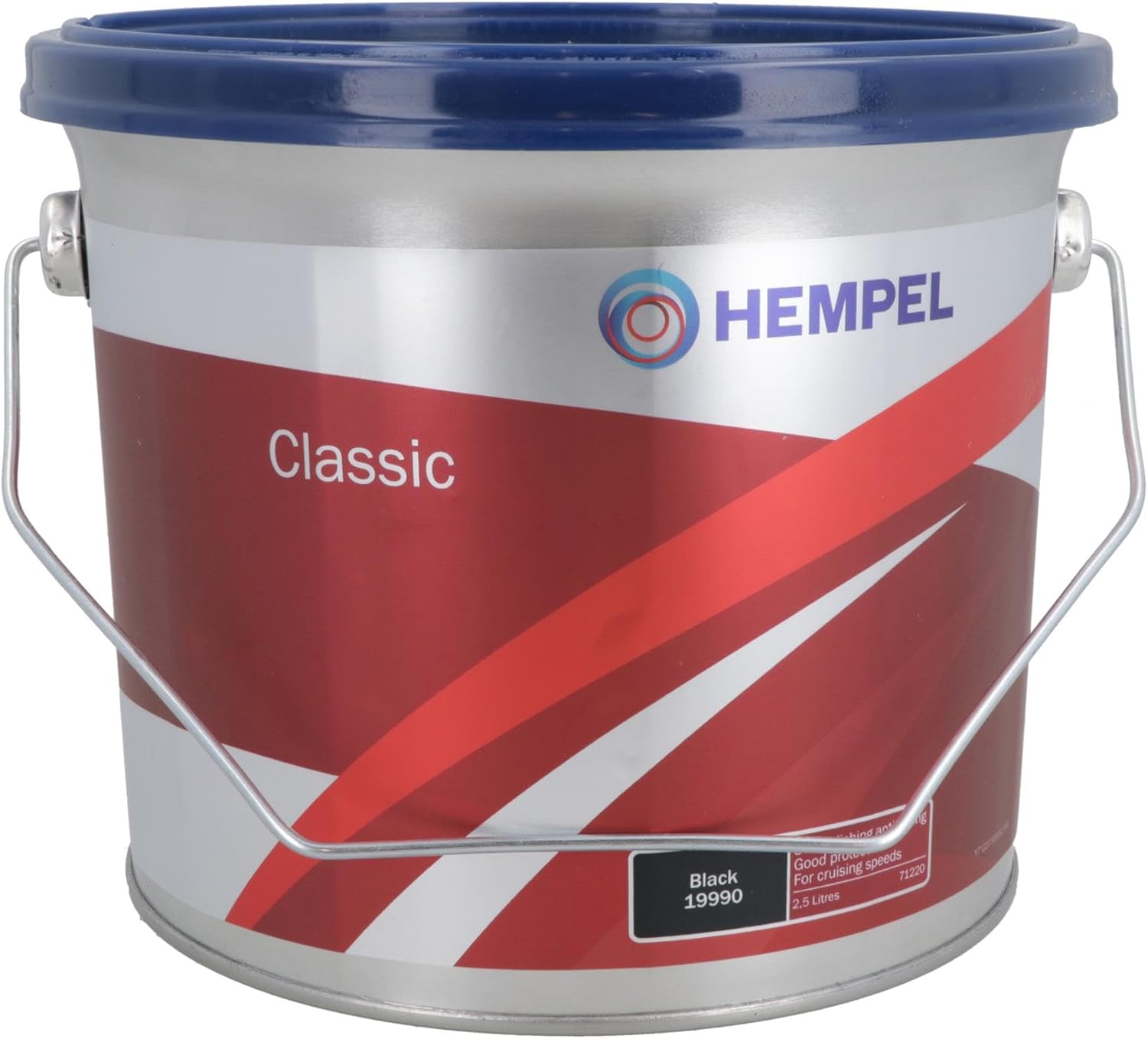
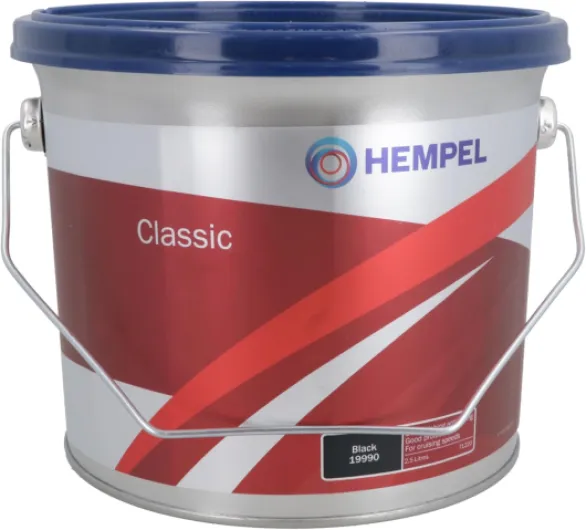
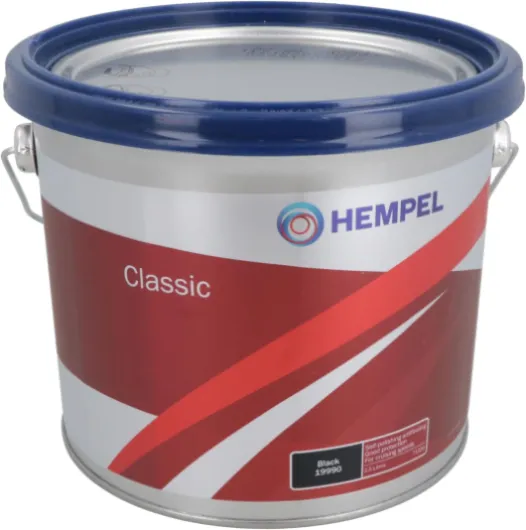
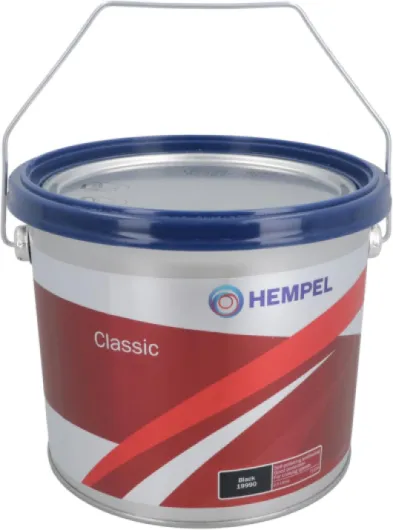
The product is pretty straightforward: a 5L tin of Hempel Classic Black antifouling, colour code 19990, supplied by AB Tools. No extras, no fancy accessories, just the paint. The label is clear enough, with the basic info: coverage around 13 m² per litre, so roughly 65 m² per tin, recommended two to three coats depending on speed, and the usual safety warnings. It’s not the kind of packaging that makes you go "wow"; it just looks like serious marine paint, which is fine by me.
What I liked is that the instructions are actually usable for normal people. It clearly says what surfaces it’s for: fibreglass, wood, plywood and steel. It also clearly says it’s not recommended for aluminium, which is important because some people just throw whatever on their hull and hope for the best. The drying times are also written in a simple way: touch dry in 30 minutes at 10°C or 15 minutes at 20°C, re-coat after 8 hours at 10°C or 4 hours at 20°C, and wait 24 hours before launching. In practice, that matched pretty well with my experience on a mild spring day.
One thing that’s a bit confusing is the Amazon listing details, which look like they’ve been copy-pasted from another product (weird model number, size 44, included components called AQ380_2pk, etc.). On the actual tin, none of that nonsense appears. It’s just the usual Hempel branding, product name, colour, and instructions. So if you’re reading the listing and scratching your head at the “size 44” thing, ignore it. You’re just getting one 5L tin of paint, nothing “pack-like” about it.
Overall, the presentation is basic but functional. The handle is sturdy enough to carry the full 5L around the yard without worrying it’ll snap, the lid reseals reasonably well if you don’t mangle it, and there’s enough information on the label that you don’t have to guess how to use it. It doesn’t look premium or cheap; it just looks like a work product, which fits what it actually is.
Does it actually keep the growth off?
This is the part that really matters: does the Hempel Classic Black actually stop the hull from turning into a reef? I launched in early spring and pulled the boat out for a scrub after about four months in a fairly dirty estuary. With two coats applied, my 24-footer spends most of its time at low cruising speeds, around 6–8 knots, and sits on a swinging mooring. That’s usually a perfect recipe for slime and barnacles. With some cheaper antifouls I’ve used, the hull has come out mid-season with heavy slime and quite a bit of hard growth, especially around the waterline and keel.
With this Hempel Classic, the hull had a noticeable slime layer, but it was soft and wiped off easily with a sponge and a hose. More importantly, there were very few barnacles. I found a handful clustered around the transom and some fittings, but the flat hull areas were mostly clean. For me, that’s exactly what I want from an antifoul: it doesn’t have to keep the hull spotless, just free from hard growth that kills performance and is a pain to remove.
In terms of speed and fuel, I didn’t notice any big drop-off over those four months. The boat still reached its usual cruising speed without feeling like I was dragging a net. Previously, with a cheap yard-brand antifoul, I could feel the boat getting more sluggish after just a couple of months. That didn’t happen this time. So while it’s not magic, it clearly holds off the worst of the growth better than the budget stuff I’ve tried.
The one thing to keep in mind is that it’s designed for "cruising speeds" and the instructions say two coats up to around 17–23 mph, and three coats if you regularly exceed that. If you’re running a fast powerboat and you cheap out with a single thin coat, don’t expect miracles. Used as directed, though, I’d say the effectiveness is pretty solid for a mid-priced antifoul. There are probably more aggressive formulas out there, but for a normal leisure boat that sits in the water all season, it gets the job done.
Pros
- Easy to apply with roller or brush, with realistic drying and re-coat times
- Good protection against hard growth over a full season in average-to-dirty waters
- 5L tin offers decent coverage and good value per litre for DIY boat owners
Cons
- Not suitable for aluminium hulls or outdrives
- Messy black pigment and strong solvent smell, so good prep and ventilation are needed
Conclusion
Editor's rating
After a full season using Hempel Classic Black Antifoul 5L on my 24-foot fibreglass cruiser, my overall impression is pretty simple: it’s a solid, no-nonsense antifoul that does what it says. Application is straightforward with a roller and brush, the drying times are realistic, and the paint settles into a consistent black once the boat has been in the water a few days. It’s messy and it smells strong, like any solvent-based antifoul, but there were no nasty surprises during application or launch.
In the water, it held off hard growth well in a fairly dirty mooring, with only soft slime that washed off easily. After about seven months afloat, the hull still had a good layer of paint, no major peeling, and the colour hadn’t washed out. For a mid-priced product, that’s exactly the level of performance I expect. It’s not some miracle coating, but it’s clearly better than the bargain paints I’ve used before.
I’d recommend this to boat owners who keep their fibreglass, wood, plywood or steel boats in the water for most of the season and want a DIY-friendly antifoul that just gets the job done. It suits cruising speeds and typical leisure use. If you’ve got an aluminium hull, this is a no-go, and if you’re running a very fast powerboat or racing yacht, you might want something more specialised. But for the average boater who wants decent protection, reasonable price, and no drama, this is a pretty solid choice.