Summary
Analysis score
Average of the criteria rated below
Value for Money: Worth Paying More Than Generic Straps?
Design: Retractable Housing and One-Handed Ratchet in Focus
Materials and Corrosion Limits: Alloy Steel Built for Freshwater
Durability: User Confidence vs. Environment Limits
Performance and Ease of Use: Does the System Do Its Job?
What the BoatBuckle G2 Transom Straps Offer on Paper
Pros
- Retractable, bolt-on design keeps straps permanently on the trailer and eliminates loose tails
- 2-inch-wide webbing with 2,500 lb break strength (1,667 lb WLL) provides strong, confidence-inspiring tie-down
- Consistently praised in reviews for ease of use, quick operation, and solid feel
Cons
- Alloy steel "Freshwater" version is not suitable for brackish or saltwater use
- Higher price than basic non-retractable straps, less attractive for very occasional towing

Specifications
View full product page →| Brand | BoatBuckle |
Bolt-On Tie-Downs That Aim to Cut Launch Ramp Hassle
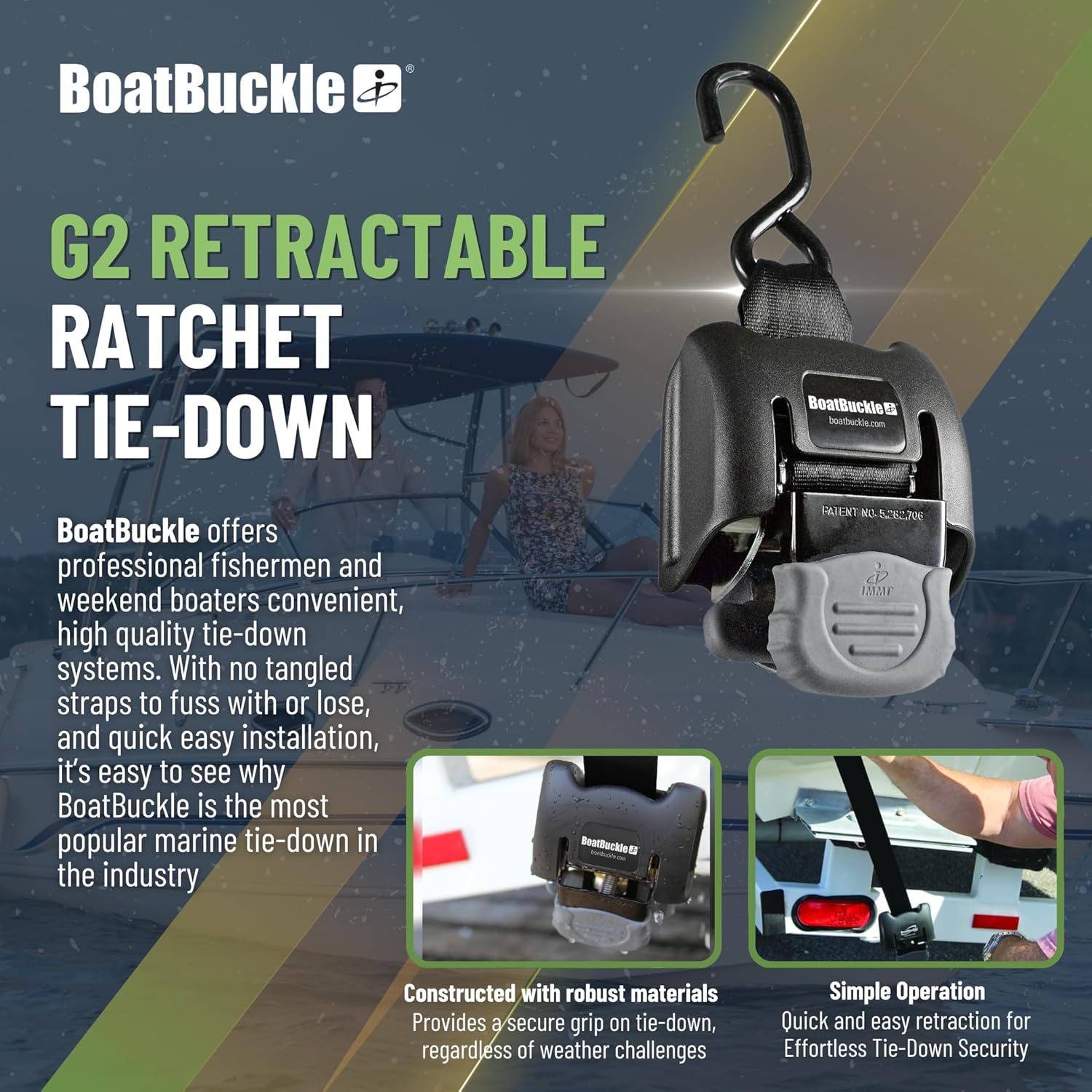
The BoatBuckle G2 Transom Boat Tie Down Straps are clearly aimed at people who are tired of loose straps, knots, and wrestling with webbing at the ramp. On paper, these are 2-inch-wide, 43-inch-long, bolt-on retractable ratchet straps rated at 2,500 lbs break strength (1,667 lbs working load limit) and sold as a 2-pack. They’re designed to stay permanently mounted on your trailer, so instead of digging around for straps, you just unhook, hook, ratchet, and you’re done. With a 4.7/5 average from over 200 Amazon ratings, buyers seem broadly satisfied.
The big promise here is speed and convenience without sacrificing security. The retractable mechanism keeps the strap wound inside the housing, which should mean no more long tails flapping in the wind or getting tangled in the garage. A rubber-coated SUR-Grip handle and quick-release lever are supposed to make one-handed operation realistic, even when you’re rushing to get off the ramp.
These aren’t just for boats either. One verified buyer says they use them to tie down a Honda Pioneer 700 on a trailer and highlights the 2-inch webbing as a key confidence booster compared to cheaper 1-inch straps. That kind of cross-usage suggests the design is versatile enough for ATVs, UTVs, and other small equipment, as long as the load is within the working limit and the mounting points make sense. So this is more of a general-purpose trailer tie-down system with boating as the main target.
There is one important limitation: this specific Alloy Steel "Freshwater" version is explicitly not meant for salt or brackish water. The manufacturer points users toward the stainless steel BoatBuckle G2 versions (F14256EC/F14256) for harsher environments. In my opinion, that’s the first big filter: for freshwater trailer owners who want a cleaner, faster tie-down routine, this model looks appealing; for coastal users, it’s the wrong product from the start.
Value for Money: Worth Paying More Than Generic Straps?
Value-wise, the BoatBuckle G2 transom straps sit in a middle ground: they’re more expensive than basic 1-inch manual straps, but cheaper than full stainless systems or premium industrial tie-downs. With a 4.7/5 rating and comments like "Great product," "well worth it," and "time saver," most buyers seem to feel they got good value for the money. People specifically call out ease of use and reduced hassle at the ramp, which are hard to put a price tag on if you trailer often.
Compared to cheaper options, one buyer’s experience is telling: they mention trying a Rhino brand strap where the ratchet failed after just a few pulls, then switching to these BoatBuckles and being much happier. That kind of story is exactly the value argument for stepping above the bargain tier: pay a bit more now to avoid annoyance and early failures. Another buyer praises the 2-inch width versus “1-inch toys,” which again shows that some users are willing to pay a premium for hardware that inspires more confidence.
Of course, if you trailer only a few times a year and are willing to fuss with loose straps and rolling them up, traditional non-retractable tie-downs will be cheaper. You lose the integrated mounting and auto-retract convenience, but for very occasional use, that might be acceptable. The BoatBuckle G2 really makes sense for people who value speed and simplicity every trip: frequent anglers, weekend boaters, or side-by-side owners who are constantly loading and unloading.
In my opinion, for a freshwater boater who trailers regularly, the balance between price, convenience, and reliability looks favorable. You get a well-reviewed, proven design from an established manufacturer (IMMI/BoatBuckle), with clear specs and a track record in the comments. The only clear miss on value is if you buy this Alloy Steel version for saltwater use; in that case, it’s false economy, and going straight to the stainless model is the smarter long-term spend.
Design: Retractable Housing and One-Handed Ratchet in Focus
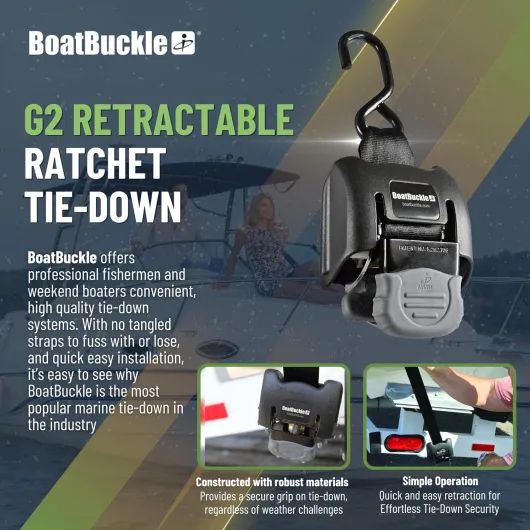
The design centers around a bolt-on housing that contains the retractable strap mechanism and ratchet. You mount this housing directly to the trailer frame near the rear, using the included hardware. Once installed, the strap lives there permanently. That means no more digging in a truck bed for loose straps, and no risk of forgetting them at home. The housing itself is compact enough to sit near the trailer’s rear crossmember without getting in the way of loading, at least according to comments from buyers who highlight easy installation and a clean final look.
The strap is 2 inches wide and extends to 43 inches, which should be adequate for most small-to-mid-size boats and PWCs where the transom eyes sit close to the trailer frame. The fastener type is a J-hook, a common shape for grabbing tie-down eyes or frame sections. This isn’t a long-haul cargo strap; the length is tuned for permanent trailer mounting where you only need a short reach. Reviews from users who put them on boat trailers and UTV trailers suggest that this length works as intended in typical setups.
The ratchet handle has a rubber-coated SUR-Grip and a quick-release lever. Buyers regularly mention that the handle feels solid and that operation is intuitive: they emphasize that it’s "real easy to use" and that the units feel robust compared to cheaper alternatives. The retract function also has a design benefit on the road: no strap tails flapping. Once tensioned, there isn’t extra slack to tie off or worry about, which cuts both noise and potential wear from wind whipping.
In my opinion, the design choice that stands out most is the decision to make these permanently-mounted hardware rather than removable straps. That’s a trade-off: you lose some flexibility to move them between trailers, but you gain speed and consistency. For someone who trailers the same boat or side-by-side every weekend, this design makes sense. For someone who uses one set of straps for multiple trailers or cargo types, fixed mounting is less ideal and might push them toward traditional straps instead.
Materials and Corrosion Limits: Alloy Steel Built for Freshwater
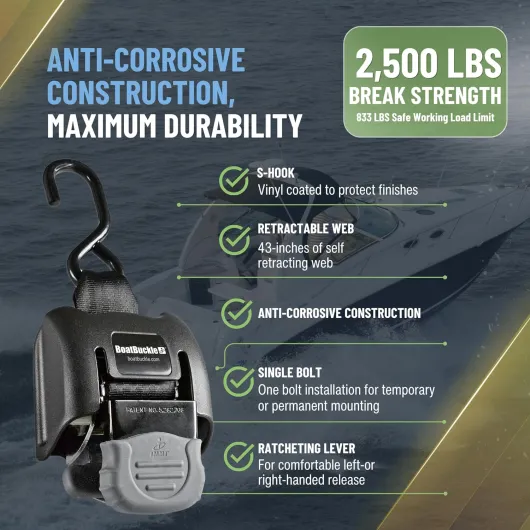
Material-wise, this version of the BoatBuckle G2 uses alloy steel hardware with corrosion-resistant treatment, paired with heavy-duty synthetic webbing that’s 2 inches wide. The manufacturer clearly positions this model for freshwater use, stating outright that these straps are not suitable for brackish or saltwater environments. For coastal conditions, they steer people toward their stainless steel G2 variant (part numbers F14256EC/F14256), which is built with more aggressive anti-corrosive construction.
This split is important. Alloy steel with some corrosion protection is usually fine for trailers dunked in lakes and rinsed after use, but regular exposure to salt is another story. Several experienced boaters know that anything less than stainless tends to rust out quickly when exposed to salt spray and saltwater launches. The brand’s own note about this limitation confirms that expectation. So in my opinion, the material choice is adequate but not overbuilt for freshwater users and budget-conscious buyers, while coastal users should skip this version entirely.
The webbing is described as heavy-duty, and one buyer specifically contrasts the 2-inch belt width with cheaper 1-inch straps they "would not trust." Wider webbing spreads the load over a larger area and usually resists cutting and fraying better, assuming the stitching and edge finishing are done properly. While there are no detailed comments dissecting the stitching quality, the overall 4.7/5 rating and the lack of widespread complaints about frayed straps suggest that the webbing holds up reasonably well under normal use.
Overall, the materials look aligned with the target: solid freshwater use, mid-range price, decent longevity if you’re not constantly in aggressive environments. It’s not the top-tier stainless option, but it’s also not bargain-bin hardware. For someone putting a fishing boat in a lake every weekend and storing the trailer outside, expect to do basic maintenance (rinsing, maybe a shot of lubricant on the ratchet spring now and then) to keep corrosion in check. If you know you’re hard on gear or often leave the trailer parked in damp, salty air, the stainless line is the safer bet.
Durability: User Confidence vs. Environment Limits
Durability for a product like this comes down to three main pieces: the ratchet and retractor mechanism, the webbing, and the corrosion resistance of the hardware. The 4.7/5 average rating over more than 200 reviews suggests that serious failures are not common. Buyers repeatedly mention that the units feel well made and heavy-duty, especially compared to generic 1-inch straps. Comments like “very strong” and “real solid feel” keep coming up, which points to decent build quality in the eyes of users.
The retractable mechanism is often a weak point in cheaper products, but here, several buyers say the straps "retract very well" and highlight how they stay neat over time. That’s a good sign for the internal spring and spool. There’s also a buyer who switched from another brand after that competitor’s ratchet failed quickly, and they describe being happier with the sturdiness of these BoatBuckles. While that’s only one comparison, it underlines that the mechanisms here are at least holding up better than some budget alternatives.
However, the manufacturer’s own warning about not using this Alloy Steel version in brackish or saltwater is an important durability flag. If a product is explicitly limited to freshwater, that usually means the coating and hardware are not designed for long-term exposure to salt. Buyers planning to use these on coastal ramps or who park near the ocean should expect rust and shorter life if they ignore that guidance. The brand’s recommendation to move up to the stainless G2 line for those scenarios is pretty clear.
In my opinion, for a freshwater trailer that sees regular but not abusive use, these should offer several seasons of reliable service, especially if you rinse the hardware and occasionally check for corrosion or webbing damage. They are not indestructible, and constant outdoor exposure will age any strap, but the mix of buyer feedback and the absence of widespread failure reports indicates that the durability is solid for the price tier—provided you keep them in the environment they were designed for.
Performance and Ease of Use: Does the System Do Its Job?
On the performance side, the BoatBuckle G2 straps bring a 2,500 lb break strength and 1,667 lb working load limit per strap. For a pair, that’s more than enough margin for common aluminum fishing boats, smaller fiberglass runabouts, and PWCs, as long as they’re also supported correctly at the bow and on the trailer bunks. Reviews from owners hauling both boats and a Honda Pioneer 700 side-by-side suggest these ratings are not just marketing numbers; users report that the straps feel strong and secure when tensioned.
Ease of use is where these seem to shine. Multiple verified buyers highlight how quick they are to tighten and release. One calls them a “time saver,” another says they "tie down quick, real easy to use," and several emphasize that installation itself is simple. Compared to separate straps and ratchets that you have to thread, tension, and then roll up, this integrated system cuts down the steps: the strap is already threaded, the housing is already mounted, and the excess length is automatically handled by the retractor.
Another performance point mentioned in the reviews is reliability compared to cheaper brands. One buyer explicitly compares these to a set of Rhino straps whose ratchet mechanism reportedly failed after only a few pulls. They say that the BoatBuckles feel much more solid and that the retract function works smoothly. That anecdote lines up with the general pattern in the comments: people seem to feel they got a sturdier, more dependable strap relative to low-cost alternatives, even if they paid a bit more upfront.
In my opinion, for someone who trailers often, consistent operation and no fuss with strap tails matter as much as raw strength numbers. On that front, the feedback is largely positive. There aren’t widespread complaints about the retractor jamming or the ratchet slipping, which are common issues in low-quality designs. So while this isn’t industrial cargo gear, it looks like a solid performer for its intended use: securing a boat or UTV to a trailer with minimal hassle at the ramp or trailhead.
What the BoatBuckle G2 Transom Straps Offer on Paper
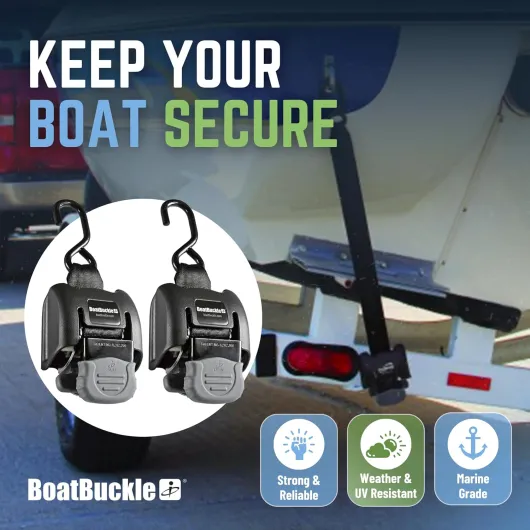
On paper, the BoatBuckle G2 transom straps are fairly straightforward: 2-inch x 43-inch retractable ratchet straps, bolt-on installation, 2-pack, alloy steel hardware, and rated to 2,500 lbs break strength with a 1,667 lbs working load limit per strap. They are designed for trailers and watercraft, and the manufacturer lists them as compatible with most trailers that have transom tie-down points. Hardware is included, and there’s an optional universal mounting kit (F14254A) for angled or trickier installations.
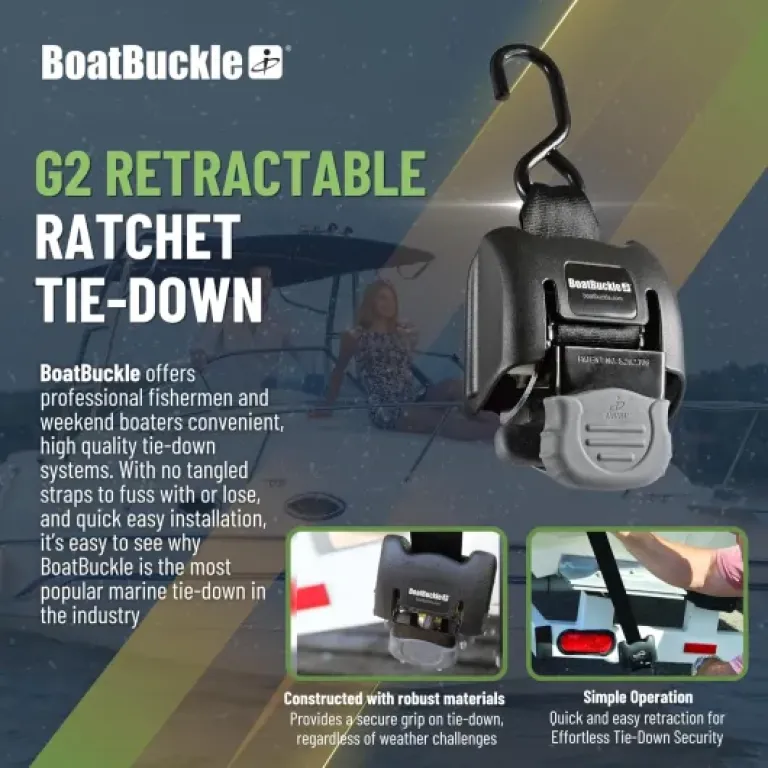
The key functional element is the retractable mechanism. Instead of a loose strap that you have to roll up and stash, the unused length is stored inside the housing. You pull out only what you need, hook to the transom eye or frame, then ratchet down. When you’re done, you release and the strap automatically retracts back into the casing. Reviews repeatedly highlight this as a major convenience gain, especially compared to cheap fixed straps that end up tangled or dragging.
The handle is described as a SUR-Grip rubber-coated handle with a quick-release button, marketed for one-handed use. Several buyers mention that they feel solid and that operation is straightforward: hook, ratchet, release, retract. You’re getting two units in the box, so it covers both sides of the transom right away. There’s no fancy electronics, no moving parts beyond the ratchet and spring-loaded retractor, which is probably why many commenters call them "easy" or "simple" to use.
From a positioning standpoint, these sit above generic no-name straps in both design and price, but below the stainless BoatBuckle versions that target saltwater. In my opinion, the spec sheet is focused on practical efficiency: enough capacity for typical fishing boats, runabouts, and PWCs; permanent mounting to cut setup time; and a wide webbing size that inspires more confidence than the 1-inch "toy" straps one buyer criticizes. Nothing fancy, but if they hold up, they fill a clear niche for people who trailer often.
Pros
- Retractable, bolt-on design keeps straps permanently on the trailer and eliminates loose tails
- 2-inch-wide webbing with 2,500 lb break strength (1,667 lb WLL) provides strong, confidence-inspiring tie-down
- Consistently praised in reviews for ease of use, quick operation, and solid feel
Cons
- Alloy steel "Freshwater" version is not suitable for brackish or saltwater use
- Higher price than basic non-retractable straps, less attractive for very occasional towing
Conclusion
Analysis score
The BoatBuckle G2 Transom Boat Tie Down Straps look like a solid choice for freshwater boaters and trailer owners who are tired of wrestling with loose straps and tangled webbing. The spec sheet is sensible: 2-inch-wide webbing, 43-inch length, 2,500 lb break strength, and a permanent bolt-on, retractable design. In the reviews, buyers repeatedly highlight how quick they are to use, how neat the straps stay, and how much more confident they feel with 2-inch webbing compared to cheap 1-inch options. The 4.7/5 average rating, plus comments about a "real solid feel," suggest that for their intended use, they get the job done with minimal drama.
They’re not perfect for everyone. The biggest limitation is environmental: this Alloy Steel "Freshwater" version is not suited to salt or brackish water, and the manufacturer openly says so. If you boat on the coast, you really should move up to the stainless G2 line. Also, if you tow only a couple of times a year, the extra cost over basic straps may not be worth it, since the main benefit here is speed and convenience on frequent trips. But for someone who trailers a fishing boat, runabout, jetski, or even a side-by-side regularly, and wants a cleaner, faster routine at the ramp, these BoatBuckle G2 straps look like a reliable and efficient upgrade over generic tie-downs.