
Summary
Editor's rating
Value for money: where it shines and where it cuts corners
Bag design: big, red, and built to be dragged around
Materials and build: sturdy bag, mixed-quality internals
Durability after a few weeks of real handling
Day-to-day performance: carrying, organising, and deploying
What you actually get in the bag
Effectiveness in real and simulated use
Pros
- Very comprehensive contents that go well beyond basic first aid kits
- Sturdy, washable paramedic-style bag with decent internal organisation
- Good value as a pre-assembled base kit that meets and exceeds BS8599-1
Cons
- Some tools and advanced items feel like budget versions of professional gear
- Missing a few key trauma items (e.g. tourniquet, oral airways) that many users will want to add

Specifications
View full product page →| Brand | EVAQ8 |
A proper trauma bag, not a £10 glovebox kit
I’ve been using the EVAQ8 Paramedic Advanced First Aid Kit for a few weeks now as my “grab bag” for events and to keep in the car boot. I’m not a doctor, but I’ve done a fair bit of first aid and basic trauma training, and I was looking for something more serious than the tiny workplace kits you see everywhere. This one is sold as meeting and exceeding BS8599-1, and it’s clearly aimed at first responders rather than just sticking plasters for paper cuts.
First thing: it’s big and it’s heavy. Around 3.5 kg and roughly the size of a decent cabin bag. If you’re thinking “I’ll just tuck this under the driver’s seat”, forget it. This is more like a dedicated emergency bag for the boot, a site office, or a small team doing events or construction work. It feels like overkill for someone who only wants a few plasters and painkillers.
My use has been mostly drills, exercises and a couple of minor real incidents (cuts, a sprain, a fainting episode). So I haven’t used the full trauma side in a real roadside crash, but I have unpacked and repacked everything, tried the gear on actual people during scenarios, and carried it around enough to see what holds up and what’s annoying. That’s where the strengths and weaknesses show up quickly.
Overall, it’s a properly stocked, serious kit, but it’s not perfect. Some items feel a bit budget compared to professional ambulance gear, and you’ll probably want to swap a few bits if you’re picky or already know what you like. Still, for the price and the amount of stuff you get, it’s a pretty solid starting point for anyone who wants more than a basic first aid box and is actually willing to learn how to use it.
Value for money: where it shines and where it cuts corners
On value, you have to look at what you’re actually paying for: a large, decent-quality paramedic-style bag plus around 100 pieces of first aid and trauma gear, assembled in the UK, meeting and exceeding BS8599-1. If you tried to buy a similar bag and then individually source all the contents from a professional supplier, you’d almost certainly spend more overall, especially once you add shipping and the time spent choosing everything. So as a pre-built starting point, it’s pretty good value.
That said, not everything inside is top-tier. Some of the diagnostic tools and advanced items are clearly budget versions, and that’s where they’ve saved cost. You’re paying for breadth of contents rather than ultra-high quality on every single piece. For most non-ambulance users, that trade-off makes sense: you’d rather have a full range of tools that are "good enough" than just a few premium items and a half-empty bag. But if you’re very picky or already have favourite brands, factor in the cost of swapping a few things out.
Compared to small workplace kits or basic home first aid boxes, this is obviously more expensive and much more than most people need. If all you want is plasters, some bandages and a few wipes, this is overkill and not great value for you. Where it makes sense is for people who genuinely want the capability to handle more serious incidents: construction sites, remote work, volunteer responders, or anyone prepping for emergencies where ambulance response might be delayed.
Overall, I’d rate the value as good, with realistic expectations. You’re not getting hospital-grade kit at a bargain-bin price, but you are getting a well-stocked, well-organised bag that covers a lot of scenarios straight out of the box. Budget a bit extra to add a tourniquet, maybe better gloves, and upgrade a couple of tools over time, and you end up with a very capable trauma setup without having to start from scratch.
Bag design: big, red, and built to be dragged around
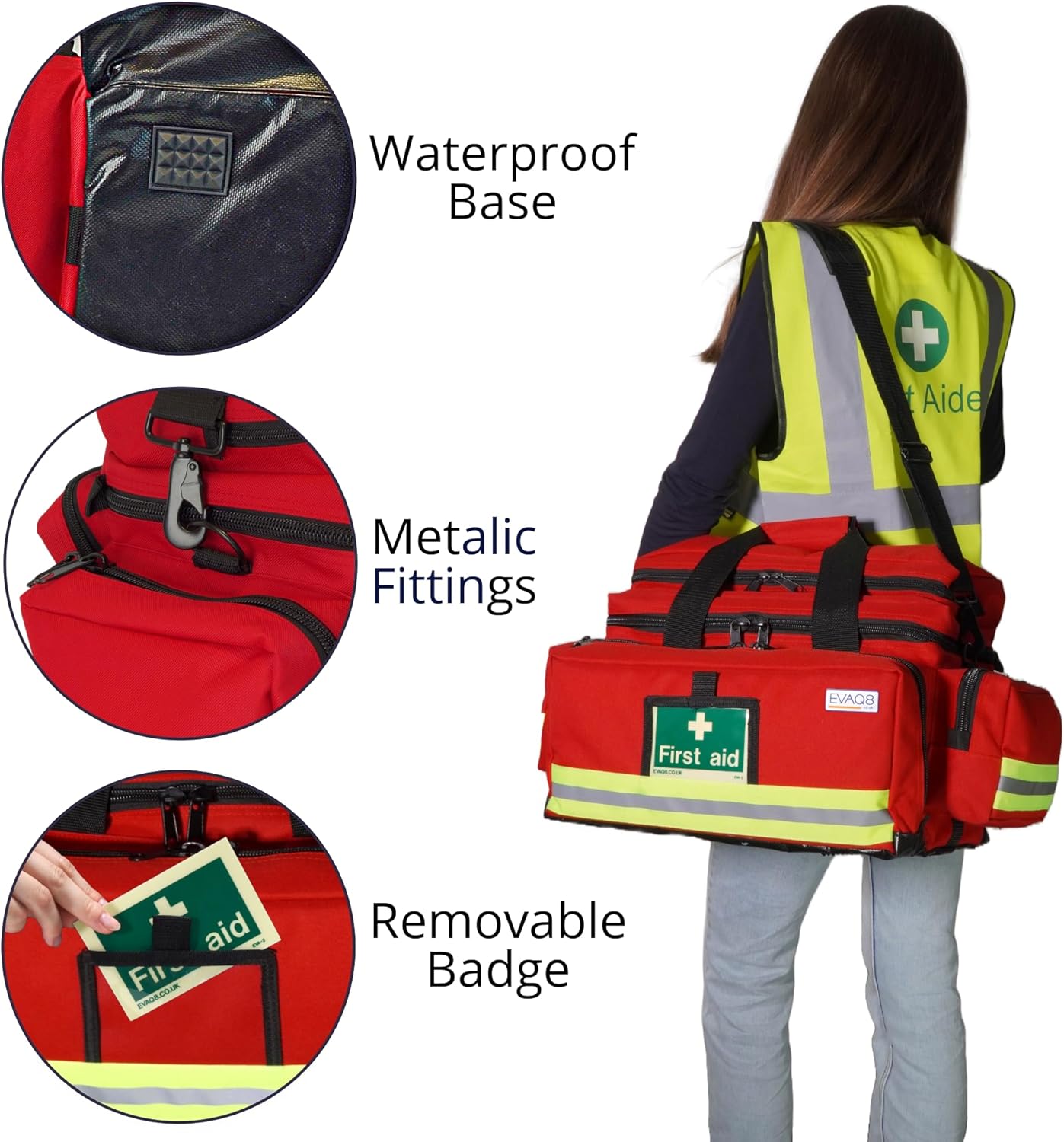
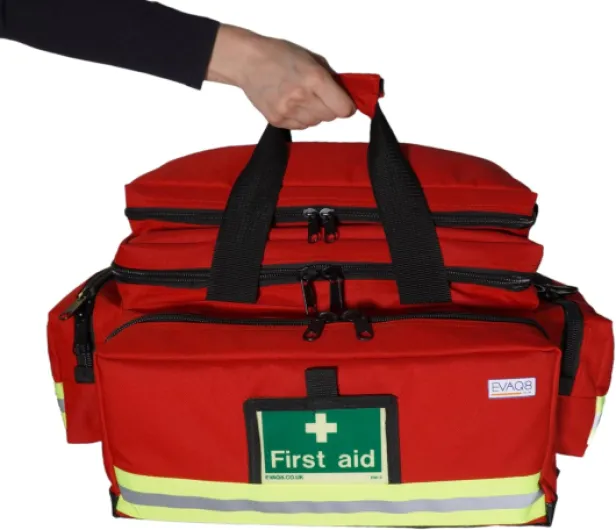
The bag itself is probably the part I was most satisfied with. It’s a large red paramedic bag, roughly 40 x 25 x 20 cm on the spec sheet (it feels a bit bigger when stuffed), and around 3.5 kg with everything inside. There are carry handles and a shoulder strap, and it’s clearly meant to live in a car boot or on a shelf, not on your back for a 10 km hike. For site work, events, or keeping at home for emergencies, the size makes sense. For a solo hiking kit, it’s ridiculous.
Inside, there are multiple zipped compartments and elastic loops. It doesn’t have ultra-fancy modular pouches like some tactical bags, but it’s organized enough that you can open it and quickly see what’s where. After a couple of drills, I knew where to reach for big dressings, where the collar was, where the BVM sat. I did end up reorganising a bit, putting bleeding control stuff together and moving the diagnostic tools to one side, but that’s normal for any serious kit.
On the outside, the bright red colour and the medical cross are easy to spot, which is handy when several bags are piled in the back of a vehicle. The zips are decent – not luxury, but they haven’t snagged or popped open on me yet, even when the bag is pretty stuffed. There’s enough structure that it doesn’t collapse into a floppy mess, but it’s still soft-sided, so you can squeeze it into awkward spaces.
If I had to nit-pick, I’d say the shoulder strap padding is just OK. Carrying it any distance, you feel the weight. Also, no obvious external MOLLE or attachment points if you’re into hanging extra pouches. But in terms of practical design for normal users, it’s solid: easy to grab, easy to identify, and it opens wide enough that you’re not digging blindly for things while someone’s bleeding on the floor.
Materials and build: sturdy bag, mixed-quality internals
The bag material itself feels like a tough, washable synthetic – think decent rucksack fabric rather than flimsy supermarket tote. It wipes clean easily, which is important if you’re using it outdoors or on building sites. I’ve had it on muddy ground, in the back of a dusty van, and it still looks fine after a quick wipe. The stitching on the handles and main seams looks strong enough for regular use. I haven’t seen any fraying or loose threads after a few weeks of hauling it around.
Inside, the story is more mixed. The standard consumables (bandages, dressings, eyewash, gloves) are what you’d expect from a mid-range first aid supplier: not junk, but not premium hospital brands either. The dressings are properly wrapped and sterile, and the gloves are usable, though I’d personally add a pack of higher-quality nitrile gloves if you’re picky. The thermometer, torch and basic tools feel functional but cheap – they work, but they’re not the kind of thing you’d rave about. They’re there to get the job done, not impress anyone.
The more advanced bits like the BVM, collar and splint are where the "cheap copies" comment from one Amazon review makes some sense. They are clearly budget versions of what you’d find in an ambulance. For example, the BVM works, but the plastic feels a bit stiff compared to the more flexible, expensive ones I’ve used in training. The cervical collar is adjustable and does the job, but it doesn’t feel as refined or comfortable as branded models. Same for the splint – perfectly usable, just not top-tier.
In practice, for a non-ambulance, non-hospital user, this level of quality is acceptable. If you’re outfitting a volunteer group, a small company, or your own car for emergencies, it’s fine. If you’re a professional paramedic used to high-spec kit, you’ll probably end up swapping some of these items for brands you trust more. So I’d say: bag and basic consumables are pretty solid, advanced tools are "good enough" but not impressive, and that’s exactly what you’d expect at this price point.
Durability after a few weeks of real handling
I haven’t had this kit for years, but after a few weeks of dragging it to training sessions, keeping it in the car boot, and dumping it on rough ground, I’ve got a decent feel for how tough it is. The exterior fabric is holding up well. No tears, no scuffs worth mentioning, and it doesn’t soak up dirt too badly. A quick wipe with a damp cloth and it looks presentable again. For something that might get thrown around in vans or on building sites, that’s important.
The handles and shoulder strap anchor points are usually the first thing to give out on cheaper bags. So far, these seem well stitched and solid. I’ve carried the bag fully loaded by one handle and by the strap, and there’s no sign of strain or loose stitching. The zips are a decent size and haven’t snagged or lost teeth. They’re not the chunky heavy-duty ones you see on very expensive tactical gear, but for normal use they’re fine.
Inside, the plastic packaging of the consumables is still intact, and nothing looks crushed or split. The splint hasn’t deformed, the collar still adjusts smoothly, and the BVM hasn’t gone sticky or brittle. The cheaper tools, like the torch and stethoscope, feel like the weak links in terms of long-term durability. They’re still working, but they don’t give that “this will last for years” impression. Personally, I treat those as semi-disposable: use them until they fail, then replace with better quality if you actually rely on them often.
Given the price bracket and the intended uses (construction, emergency preparedness, first response, trauma), I’d say durability is good enough for regular but not brutal professional use. For a volunteer responder, a small business first aid lead, or someone who wants a serious home/emergency car kit, it’s more than adequate. If you’re operating daily in harsh environments, I’d keep the bag but slowly upgrade key components to more rugged brands as budget allows.
Day-to-day performance: carrying, organising, and deploying
Performance for me comes down to three things: how easy it is to carry, how quickly you can find stuff, and whether anything fails when you’re under pressure. On carrying, as I said, it’s on the heavy side but still manageable. I’ve lugged it from car to field a few times, and while you notice the weight, the handles feel solid and the shoulder strap doesn’t dig in too badly for short distances. You won’t want to carry it for an hour, but for realistic use – from boot to incident – it’s fine.
On organisation, once I’d spent an evening going through everything and setting it up the way I like, I found it pretty efficient. I grouped items by function: all bleeding control in one main section, airway and breathing tools together, diagnostics and "nice to have" bits in another part. During drills, I could open the bag and get to what I wanted in a few seconds. There are enough internal pockets to stop things from turning into a pile of random packaging, but you do need to maintain the layout. If multiple people use the kit and don’t repack it properly, it will get chaotic.
In terms of reliability, nothing has broken on me yet. Zips still work, internal seams are intact, and I haven’t had any dressings split open in the bag. The cheaper-feeling tools (stethoscope, torch) are still functioning, though they don’t feel like they’d survive years of abuse. For a small team or personal use, that’s probably fine. If you’re planning heavy, daily professional use, I’d upgrade those items sooner rather than later.
Overall, performance is solid for the price and target user. It’s quick enough to deploy in a stressful situation if you know your way around it, and it holds up to regular moving and repacking. The main performance upgrade I’d suggest isn’t even hardware – it’s getting a bit of proper training, running a few drills with friends or colleagues, and customising the layout. Do that, and this bag becomes a very functional part of your emergency setup rather than just an expensive red box gathering dust.
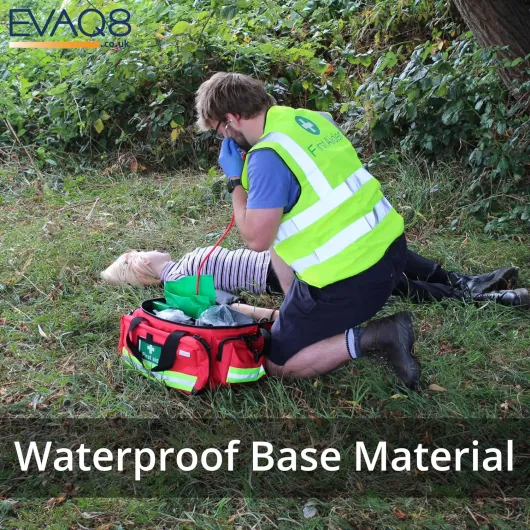
What you actually get in the bag
The main thing to understand is that this is not just a box of plasters with a fancy label. The EVAQ8 kit comes as a big red paramedic-style bag, fully loaded. Inside you’ve got the standard British Standard first aid contents (dressings, bandages, wipes, eyewash, gloves, scissors, etc.), plus more advanced gear like a BVM (bag-valve mask), cervical collar, splint, sphygmomanometer (blood pressure cuff), stethoscope, torch, and thermometer. Everything is CE marked, which is reassuring if you’re using it in a work context.
The layout inside is fairly logical out of the box. There are multiple compartments and pockets, so you don’t just have a giant jumble of bandages. I liked that trauma dressings and bigger items were easy to spot. However, once you start adding your own extras (which you probably will), it can get messy unless you’re disciplined about where everything goes. It’s not colour-coded like some high-end professional bags, so you need to learn your own layout.
From a contents point of view, it covers most of the big basics: bleeding control, immobilisation, basic monitoring (BP, temp), and basic airway support via the BVM. A couple of Amazon reviewers complained the kit uses cheaper versions of equipment, and I’d say that’s partly true. The stethoscope and sphyg are more “training / basic responder” level than hospital-grade. They work, but if you’re used to high-end gear, you’ll notice the difference straight away.
What’s missing? For something called “Paramedic Advanced”, there are a few things I’d personally add: oral airways, an aspirator/suction device, and of course oxygen isn’t included (which is normal, but still worth noting). Also, no tourniquet included as standard in mine, which I think is important for trauma these days. So the kit is a strong base, but I’d treat it as a starting platform rather than a complete, no-questions-asked solution if you really want a full trauma setup.
Effectiveness in real and simulated use
In terms of actual use, I’ve taken this kit to a couple of training sessions and had it on hand for a few minor real incidents. For basic first aid – cuts, scrapes, minor bleeding, and a sprain – it handled everything without any problem. There were more than enough dressings and bandages, and the variety of sizes meant I wasn’t improvising too much. For these everyday situations, it’s honestly overkill in a good way: you’re not going to run out of gauze after one incident.
Where it gets interesting is in trauma drills. We ran a few scenarios with simulated heavy bleeding and a suspected neck injury. The trauma dressings and bandages did what they’re supposed to do. The collar was easy enough to size and apply, even on someone lying awkwardly, and the splint worked fine for immobilising a leg. The BVM took a bit of fiddling to get a decent seal on the face, but that’s as much about user technique as the equipment. Once positioned properly, it worked, but I wouldn’t hand it to someone who’s never been trained and expect miracles.
The diagnostic tools are basic but useful. The blood pressure cuff and stethoscope are not the most accurate or comfortable I’ve ever used, but for getting a rough idea during training or a basic check, they’re acceptable. The torch is bright enough to check pupils and look into dark corners of a vehicle, but I’d still keep a better headlamp on me. The thermometer is a simple digital one – again, it works, nothing special. The main point is: the kit gives you enough tools to actually assess and manage a casualty beyond “stick a plaster on and call 999”.
The big caveat: this kit is only as effective as the person using it. There’s enough advanced gear in here that untrained people could easily be overwhelmed or use it badly. No tourniquet in mine meant I had to add my own, and I’d strongly suggest anyone serious about trauma care does the same. With some training and a bit of customising, it becomes a very capable setup for first response, especially in rural areas or on risky worksites where ambulance response might be slow.
Pros
- Very comprehensive contents that go well beyond basic first aid kits
- Sturdy, washable paramedic-style bag with decent internal organisation
- Good value as a pre-assembled base kit that meets and exceeds BS8599-1
Cons
- Some tools and advanced items feel like budget versions of professional gear
- Missing a few key trauma items (e.g. tourniquet, oral airways) that many users will want to add
Conclusion
Editor's rating
The EVAQ8 Paramedic Advanced First Aid Kit is a serious step up from standard workplace or household kits. The bag is sturdy, well-sized for car boot or site use, and the contents cover a wide range of situations, from everyday cuts to more serious trauma. It’s clearly aimed at people who have, or plan to get, some proper training. If you’re involved in construction, events, volunteer response, or you just want your emergency gear to be more than plasters and paracetamol, it’s a solid option.
It’s not perfect. Some of the equipment inside feels budget compared to what you’d find in an ambulance, and a few important items like a tourniquet or oral airways are missing if you really want a full trauma setup. I’d treat it as a strong base kit: use it as is to start with, then gradually replace or upgrade certain tools as you learn what you actually use. For most non-professional users, the balance between price, amount of gear, and overall quality is pretty reasonable.
If you just want something small for the kitchen drawer, this is overkill and not the right buy. But if you’re the "responsible one" in your group, run a small business with higher-risk work, or you’re into serious emergency preparedness, this bag gives you a lot to work with straight out of the box and can grow with you as your skills improve.