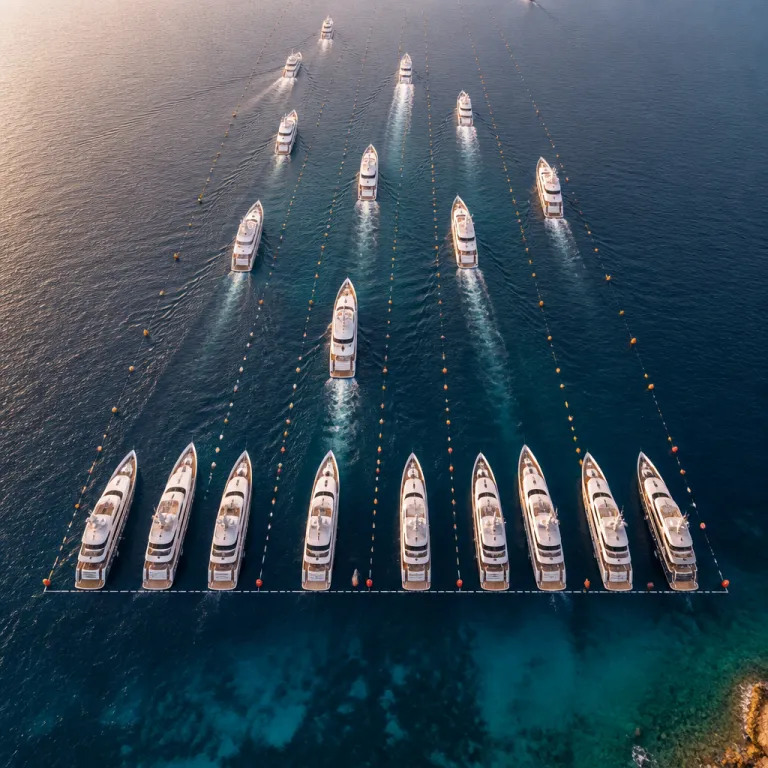
From dockside theatre to open water truth: why the superyacht regatta calendar really leads
The superyacht regatta calendar 2026 is not a social accessory; it is the industry’s real test tank. While the Monaco Yacht Show in late September will still dominate headlines and cocktail chatter, the quiet consensus among naval architects and captains is that design opinions are now forged on the racecourse rather than on the quay. Boat shows sell what already exists, but a serious superyacht regatta shows how a yacht behaves when the wind, the sea state and the crew stop being theoretical.
Watch a modern superyacht racing off Porto Cervo during the Loro Piana Superyacht Regatta and you immediately see what a static stand in Cannes can never reveal. Hull form, appendage package and sail plan either work together in harmony or expose compromises, and the same yachts that look flawless under a spray of champagne at a yacht club terrace suddenly show weather helm, slamming or sluggish acceleration when pushed in a tight race. In BOAT International’s 2023 Loro Piana race report, for example, a 46‑metre sloop that had been praised for its lines at Monaco was logged at more than 1.2 knots slower upwind than a leaner 42‑metre competitor in 16 knots of breeze, purely because of excess displacement and a conservative sail plan. That is why the racing season ahead, from Sardinia to the Caribbean, will shape the next generation of naval architecture more than any glossy edition superyacht showcase.
Handling under load is the first truth a regatta reveals, especially when a maxi yacht is pressed hard in a congested start line. In a proper superyacht race, helms feel rudder feedback at 12 knots of boat speed, tacticians call for rapid sail changes and designers later study the data to refine weight distribution, while at a boat show the same yachts sit motionless with stabilisers pinned and generators humming. As one long‑time captain told BOAT International in its 2023 regatta survey, “You only really know a yacht after you’ve started it on a crowded line in 20 knots.” That transparency is exactly why serious yards and owners quietly take these racing events more seriously than any red carpet premiere.
What a regatta shows that a show stand hides
On the dock in Palma or Saint Tropez, a superyacht will always look composed, but only a regatta exposes how that composure survives a squall line. During a tight Superyacht Cup–style start, you see whether the bow team can wrestle a Code Zero into its sock in time, whether the captive winches keep up with rapid trim calls and whether the deck ergonomics allow safe movement when the yacht is heeled at 20 degrees. Those are the moments when owners realise that a beautiful cockpit is meaningless if the crew cannot cross it at speed during serious racing.
Rig fatigue is another truth that the 2026 racing circuit drags into the daylight, because repeated hoists and gybes during a sailing week will quickly show which rigs were optimised for occasional cruising rather than sustained competition. A carbon mast that looks magnificent at a show can start creaking ominously after three days of hard sailing, and the same applies to standing rigging, furlers and boom hardware that were value engineered for weight but not for longevity. In the 2022 Superyacht Challenge Antigua, for instance, official damage reports noted three headsail furling failures and one boom vang fracture in a fleet of 25 yachts over four race days, all traced to components originally specified for lighter‑duty use. Designers and yards quietly watch these regatta events, taking notes on which yachts maintain rig tune and which need emergency work before the next race day.
Weight discipline, often treated as an abstract number on a spec sheet, becomes brutally real when a superyacht challenge fleet lines up on a reaching leg. The lighter yachts accelerate out of tacks, hold higher angles and carry smaller headsails, while heavier yachts wallow and force their crews into constant trimming just to stay in touch with the race leaders. BOAT International’s 2021 St Barths Bucket performance analysis, for example, recorded a 38‑metre performance cruiser averaging 10.4 knots on a 28‑mile coastal course, while a more opulent 45‑metre cruiser‑racer in the same class averaged 8.9 knots despite similar sail area, a gap largely attributed to an extra 40 tonnes of interior fit‑out and systems. No amount of clever marketing at a boat show in September will erase the memory of a heavy yacht being rolled by a leaner competitor during a televised regatta, and that is why naval architects now treat the superyacht regatta calendar 2026 as a live laboratory rather than a mere social diary.
Regattas as living product reviews
For a yacht‑passionate reader, think of each superyacht regatta as a long‑form product review conducted at 15 knots instead of in a showroom. The Superyacht Cup format in Palma, the superyacht challenge style racing in Antigua and the more relaxed Voiles Saint Tropez gatherings all provide different testing grounds, yet each one generates hard data about sail handling loads, autopilot behaviour and helm balance. Those insights feed directly into the next edition superyacht designs, influencing everything from keel geometry to the placement of the coffee machine in the crew mess.
Boat shows still matter, of course, especially for the sub 30 metre segment where many buyers will never race and care more about interior volume than about a Cyclades Cup style beat into a chop. Yet when you speak with captains who have both raced and exhibited, they will tell you that a single tough sailing week in a mixed fleet teaches them more about a yacht’s character than an entire season of dockside tours. In a 2022 survey by a leading brokerage house, more than 70 per cent of responding captains ranked “behaviour in 20–25 knots under sail” as a top‑three factor when advising on new builds, ahead of interior styling. That is the quiet shift behind the modern superyacht racing calendar, and it is why the smartest owners now time their refits and new builds around key regattas rather than around the show circuit.
The social architecture follows the same logic, because the conversations that happen on a chase boat between races are more candid than anything said over a canapé at a branded lounge. Designers, sailmakers and owners debrief real racing incidents, from a near miss at a mark rounding to a headsail tear in rising breeze, and those stories travel faster through the industry than any press release. In that sense, the superyacht regatta calendar 2026 is not just a schedule of races; it is the backbone of an informal peer review system that quietly shapes which yachts earn respect and which are quietly avoided.
Three regattas that will set the tone for design conversations
Among the many events on the superyacht regatta calendar 2026, three gatherings will carry disproportionate weight in design offices and shipyard boardrooms. The Loro Piana Superyacht Regatta in Porto Cervo, Les Voiles de Saint Tropez and The Superyacht Cup Palma form a kind of informal trilogy, each one probing different aspects of performance, comfort and handling. Together, these regattas will do more to shape opinion than any line‑up of yachts at Monaco or Cannes, because they test yachts in the conditions they were supposedly built to master.
In Porto Cervo, the combination of narrow channels, rocky outcrops and variable breeze turns the Loro Piana Superyacht Regatta into a navigation and sail‑handling exam for every maxi yacht on the line. A yacht that looks majestic at a yacht club reception must thread through the Maddalena archipelago at speed, with tacticians calling laylines to the centimetre and crews executing gybes under spinnaker while the rocks loom close. When a superyacht racing fleet survives that challenge without incident, designers gain confidence in deck layouts, sail inventories and helm visibility, while any near misses quickly become case studies in what to change before the next season.
The Superyacht Cup Palma, often shortened to the superyacht cup Palma in casual dock talk, plays a different role in the superyacht regatta calendar 2026 because its sea‑breeze conditions and tight courses highlight pure boat speed and crew choreography. Here, the focus is on how quickly a yacht accelerates out of tacks, how efficiently the crew can peel from a reaching sail to a downwind sail and how well the systems support that tempo without overheating or failing. A yacht that dominates in Palma will influence conversations about hull volume, rig stiffness and even interior weight distribution, because everyone in the fleet can see which design choices translate into real gains on the racecourse.
Saint Tropez and the art of dual personality yachts
Les Voiles de Saint Tropez, often referred to in shorthand as voiles Saint Tropez, occupies a special place in the superyacht regatta calendar 2026 because it straddles the line between racing and Riviera theatre. Yachts must look at home stern‑to on the quay, yet they also need to handle a mistral‑driven beat with dignity, and that dual personality is exactly what many owners now demand. When a yacht can race hard during the day and still host a refined dinner at anchor off Pampelonne, it becomes the template for future designs that refuse to choose between performance and pleasure.
For yards, the conversations in Saint Tropez often matter more than the ones at the Monaco Yacht Show, even though the latter will still dominate mainstream coverage in late September. Naval architects walk the docks comparing notes on which yachts held their rigs steady in the chop, which hulls tracked cleanly downwind and which interiors remained quiet under sail, and those observations feed directly into the next wave of design briefs. As one Mediterranean‑based designer put it in a recent industry round‑table, “If a yacht can survive a mistral at Voiles and still look elegant stern‑to that evening, it will sell itself.” That is why the superyacht regatta calendar 2026, anchored by Porto Cervo, Palma and Saint Tropez, will quietly steer the industry’s aesthetic and technical priorities long after the show banners come down.
There is also a geographic and cultural dimension, because these Mediterranean regattas sit alongside Caribbean events and Pacific gatherings like the Millennium Cup to create a global feedback loop. A yacht that performs well in the lighter airs of Palma may reveal different strengths or weaknesses in the swell of a Caribbean race, and designers who pay attention to both contexts produce yachts that feel composed from Ibiza to Antigua. For yacht‑passionate readers who follow every race report, the superyacht regatta calendar 2026 becomes a narrative arc, showing how each yacht evolves across different events rather than as a static object at a single show.
Clubs, communities and where opinions really form
Behind every influential regatta sits a yacht club that curates not just courses but conversations, and that social architecture is where opinions about yachts harden into reputations. Whether it is the Yacht Club Costa Smeralda in Porto Cervo, the Real Club Náutico de Palma or a storied American institution like the California Yacht Club, these communities provide continuity between racing seasons and connect owners, captains and designers across oceans. Reading about a club’s culture, for example through a detailed profile of a Southern California beacon for yachting and community, helps explain why certain regattas punch above their weight in shaping industry taste.
Regatta weeks also blur the line between professional and passionate, because the same sailors who trim mainsails for a living will later share unvarnished opinions with aspiring owners over a quiet drink. Those candid exchanges rarely happen at boat shows, where every conversation is framed by sales targets and brand messaging, yet they are common in the more relaxed yet focused environment of a racing dock. The superyacht regatta calendar 2026, viewed through this lens, is less a list of events and more a map of where the most honest conversations about yachts will take place.
For the reader who may not yet own a yacht but follows every race, engaging with these communities, even digitally, is a way to gain real insight into what matters at sea. Listening to how crews talk about sail handling loads, deck ergonomics or helm feel during a tough race will teach you more than any brochure about teak thickness or marble selection. In the end, the regattas where these conversations unfold will shape your expectations long before you ever step onto a sales pontoon.
Caribbean trades, Pacific swells and the rise of performance led luxury
Move away from the Mediterranean and the superyacht regatta calendar 2026 becomes even more revealing, because the Caribbean and Pacific circuits test different aspects of design and seamanship. Racing off Antigua in the trades, or threading through New Zealand waters during the Millennium Cup, exposes how a yacht behaves in ocean swell rather than in coastal chop. Those conditions are where hull volume, bow shape and structural stiffness either justify their cost or reveal uncomfortable compromises.
Events like the Superyacht Challenge Antigua, often shortened in dock talk to a superyacht challenge in Antigua, combine long coastal courses with tight mark roundings that punish poor sail selection and reward crews who understand their yacht’s polar curves. A yacht that accelerates cleanly out of a tack in 18 knots of breeze off English Harbour will feel very different from one that needs a full minute to regain speed, and that difference is immediately obvious to every observer on the water. When those same yachts later appear at a boat show, the memory of their racing performance quietly colours how brokers, captains and potential buyers talk about them.
The Caribbean season also includes iconic gatherings like the St Barths Bucket, often written as Barths Bucket in casual schedules, where a fleet of superyachts and maxi yachts race around volcanic headlands in turquoise water. Here, the focus shifts to how comfortably a yacht can maintain speed in a seaway, how dry the decks remain at 10 knots upwind and how well the interior insulation keeps the main saloon civilised while the hull slams through swell. Those are not details you can assess from a dockside tour in September, yet they are exactly the qualities that determine whether a yacht feels like a thoroughbred or a show pony.
Pacific perspectives and the millennium cup effect
The Millennium Cup in New Zealand adds another layer to the superyacht regatta calendar 2026, because its courses through the Bay of Islands combine strong tidal flows with rapidly changing weather. Yachts that were optimised for Mediterranean light airs must prove they can handle squalls, cold fronts and confused seas, and that often exposes weaknesses in deck drainage, sail inventories or autopilot tuning. Designers who pay attention to these races gain a more holistic understanding of how their creations behave across the full spectrum of real‑world conditions.
For owners and charterers, following these Pacific and Caribbean events is a way to calibrate expectations before booking a yacht for a demanding itinerary. If you plan to charter in the Cyclades, for example, paying attention to how a yacht performs in a Cyclades Cup style race will tell you whether it can handle the Meltemi with grace or will simply pound uncomfortably to windward. That kind of insight is far more valuable than any staged photograph of a yacht at anchor, because it speaks directly to comfort, safety and the ability to keep a schedule when the forecast turns unfriendly.
There is also a growing crossover between performance‑focused regattas and lifestyle‑oriented events, as seen in gatherings that blend racing with shoreside experiences like powersports or adventure excursions. Reading about how a yacht club powersports programme integrates with a regatta week, for instance, shows how organisers are rethinking what a modern superyacht event can be. The superyacht regatta calendar 2026 reflects this shift, with more events offering a mix of serious racing and curated experiences that appeal to both hardcore sailors and lifestyle‑driven guests.
Why performance now shapes luxury, not the other way around
Across these global events, a clear pattern emerges: performance is increasingly driving luxury decisions rather than being an afterthought. Owners who once prioritised marble bathrooms over mast sections now ask how a yacht will behave in a 25‑knot beat off Antigua or a tight reach off Porto Cervo before signing a contract. That change in mindset is a direct result of the visibility and narrative power of the superyacht regatta calendar 2026, which turns abstract design choices into vivid, shared experiences.
For the yacht‑passionate reader, this means that following regattas is no longer just a spectator sport; it is a way to educate your eye and refine your taste. Watching how different yachts handle, heel and recover in real conditions will teach you to see beyond glossy finishes and focus on the underlying naval architecture. When you eventually step onto a yacht at a show, you will carry with you the memory of how similar designs behaved under sail, and that knowledge will quietly guide your questions and your choices.
In that sense, the regatta circuit has become the industry’s unscripted documentary, while the boat shows remain its carefully edited trailer. Both have their place, but only one shows the full story from first gun to last finish. The superyacht regatta calendar 2026 is where that story will be written, one start line at a time.
Where boat shows still matter, and how both worlds now intersect
Arguing that the superyacht regatta calendar 2026 matters more than the boat show does not mean that shows have become irrelevant. Monaco, Cannes and Genoa still dominate when it comes to financing, dealer relationships and the crucial sub 30 metre segment where many buyers will never race. For these clients, the ability to compare multiple yachts side by side, meet shipyard executives and negotiate terms in a single long weekend remains invaluable.
Boat shows also excel at showcasing innovation in tenders, toys and onboard systems that may never be tested in a regatta, from hybrid propulsion packages to advanced hotel‑load management. The Monaco Yacht Show, with initiatives like the Blue Wake programme, has become a focal point for sustainability conversations that extend beyond pure sailing performance. Those discussions influence how new yachts are specified, even if the final proof of concept will later play out on a racecourse rather than on a static stand.
There is also the reality that many owners first fall in love with yachting at a show, where the spectacle of stern‑to lines and polished passerelles is hard to resist. For a first‑time buyer, walking through a series of yachts in Monaco or visiting a private preview like the MYBA charter show in Sanremo can provide a structured way to understand layouts, crew areas and charter potential. An in‑depth guide to what such a Mediterranean private preview means for your summer booking can be as useful as a race report when you are still learning the basics.
How regattas and shows now feed each other
The interesting shift is that regattas and shows are no longer competing narratives but parts of a single feedback loop. A yacht that performs well in the superyacht regatta calendar 2026 will arrive at Monaco or Cannes with a halo of credibility that no marketing budget can buy, because brokers can point to real racing results rather than just renderings. Conversely, a yacht that debuts at a show with a strong technical story will be expected to prove itself on the racecourse within a season or two, especially if it claims any performance pedigree.
Designers and yards now plan their calendars accordingly, timing launches so that a yacht can appear at a major show and then quickly join a high‑profile regatta like The Superyacht Cup Palma or Les Voiles de Saint Tropez. That sequencing allows them to capture both the commercial energy of the show and the reputational capital of a strong racing performance, creating a virtuous circle that benefits owners, crews and builders alike. The superyacht regatta calendar 2026, in this sense, has become the proving ground that validates the promises made under the bright lights of the exhibition halls.
For the yacht‑passionate reader, the practical takeaway is clear: use shows to understand the market and regattas to understand the yachts. Walk the docks in September to see what is available, then follow the racing season to see which designs actually deliver on their claims. In the end, it is not the length overall that matters, but the wake she leaves when the gun goes and the sails fill.
Key figures that frame the modern superyacht regatta landscape
- According to industry tracking by BOAT International and other specialist titles, more than 150 superyachts over 24 metres now participate in organised racing each year, a significant increase compared with a decade ago when fewer than 80 such yachts regularly joined regattas. Individual event entry lists, such as those published annually by The Superyacht Cup Palma and the St Barths Bucket, support this upward trend and show fleets routinely topping 25–30 yachts per edition.
- Data from the Superyacht Cup Palma and similar Mediterranean events shows that typical racecourses for large cruising yachts range between 20 and 35 nautical miles per day, providing enough varied conditions to generate meaningful performance data for designers and crews. Official sailing instructions and post‑race reports from these regattas routinely publish course lengths and formats, with some coastal races stretching beyond 40 miles in strong sea‑breeze conditions.
- Participation figures published by the St Barths Bucket Regatta indicate that fleets of 30 to 40 superyachts can bring several hundred professional sailors and support staff to a host island, creating a substantial local economic impact alongside the on‑water spectacle. Local tourism boards and event economic‑impact studies have echoed these estimates in recent years, citing visitor spending in the low tens of millions of euros during peak regatta weeks.
- Reports from the Monaco Yacht Show organisers highlight that more than 100 superyachts are usually on display at the event, underscoring how shows still dominate in terms of sheer inventory even as regattas increasingly shape performance reputations. Official post‑show statistics regularly break down the number of yachts by size bracket and build year, with recent editions showing more than 40 per cent of the fleet under five years old.
- Surveys conducted among captains and senior crew by leading brokerage houses consistently show that a majority now consider real‑world sailing behaviour and ease of handling as top‑three priorities when advising owners on new builds or refits, reflecting the influence of regatta experience on professional opinion. In one 2023 new‑build outlook, more than 60 per cent of respondents reported that race‑derived data had directly influenced at least one major design decision, from keel choice to rig specification.