
Summary
Editor's rating
Value for money: good starter kit if your budget is tight
Design and interface: looks cool, feels a bit cheap
Weatherproofing and build: seems okay so far, but it’s still budget gear
Sound, Bluetooth and radio: okay for cruising, not for serious listening
What you actually get in the box
Everyday use: does it actually make boat days better?
Pros
- Complete kit (head unit, speakers, antenna) at a budget price
- Bluetooth works reliably enough for everyday use
- Weatherproofing seems decent for light to moderate marine use
Cons
- Sound quality and volume are limited with the included speakers
- Interface and buttons feel cheap and are not very user-friendly
- Radio reception and overall build are clearly entry-level

Specifications
View full product page →| Brand | BOSS Audio Systems |
Boat tunes on a budget
I put this Boss MCK632WB.6 marine kit (single-DIN Bluetooth receiver, 6.5" speakers, and antenna) on a small fishing boat that I use most weekends. I’m not an audiophile, I just wanted some music and radio without worrying about waves splashing over everything. I’ve used it for about a month now, a few hours each outing, in a mix of sun, spray, and a bit of light rain.
The short version: it works, it’s not fancy, and you can tell it’s a budget kit. The sound is fine at low to medium volume, Bluetooth is easy enough, and the weatherproofing seems okay so far. But the interface feels cheap, the radio isn’t the strongest, and the speakers start to distort when you crank them up. It matches the price, basically.
Compared to the older Kenwood marine unit I had before (head unit only, no speakers), this Boss kit feels a bit less solid, both in the buttons and in the sound. On the other hand, for roughly what I paid, getting a receiver, two speakers and an antenna in one box is hard to complain about if you just want background music while cruising or fishing.
If you’re expecting car-level sound quality or heavy-duty marine gear for big offshore trips, you’ll probably be a bit disappointed. But if your expectations are realistic — cheap, simple, Bluetooth, some lights for fun — it does the job. That’s the mindset you should have going into this.
Value for money: good starter kit if your budget is tight
Looking at the price point and what’s in the box, I’d say the value is pretty solid, especially if you’re starting from zero on your boat. You get a weather-resistant head unit, two matching speakers, and an antenna in one shot. Buying all that separately from more premium brands would easily cost you two or three times more, even before install costs. So from a pure budget standpoint, it makes sense.
Of course, you feel where the money was saved: cheaper plastics, weaker tuner, average speakers, and a clunky UI. If you’re picky about audio and plan to use your boat system a lot, you might be happier spending more on a better head unit and separate speakers. When I compare it to the mid-range marine setups I’ve heard on friends’ boats (JBL, Fusion, etc.), the difference in sound and build quality is obvious. But those systems also cost a lot more, so it’s not a fair fight.
For someone like me who just wanted sound without going overboard on budget, it hits a decent balance. I do think the included speakers are the weak link; if you ever feel limited by the sound, upgrading to better 6.5" marine speakers later will probably give you the biggest improvement without changing the whole system. The head unit itself is basic but usable, and if it lasts a few seasons, I’ll consider the purchase worth it.
So, from a value perspective: if your expectations match the price — simple, functional, slightly rough around the edges — you’ll probably feel you got fair value. If you’re expecting premium performance from a kit at this cost, you’ll be disappointed. For budget-conscious boat owners, especially on smaller boats, it’s a reasonable compromise.

Design and interface: looks cool, feels a bit cheap
The head unit has that classic single-DIN rectangular face with RGB lighting around the buttons and display. You can change the colors and there are a ton of combinations (they say 16 million, which is just marketing talk for full RGB). In practice, I picked a blue/white combo and left it there. It does help with visibility at night, and it gives the console a slightly more modern look compared to my old plain-green Kenwood.
Where it shows its price is the physical feel. The buttons are a bit spongy and small, especially the track skip and mode buttons. When the boat is moving and you’re bouncing around, trying to hit the right button with wet fingers is not ideal. The volume knob works but doesn’t feel very sturdy; it turns smoothly enough but has that lightweight, plastic feel. I wouldn’t be shocked if it gets wobbly after a couple of seasons.
The screen is basic — just a simple text display for radio frequency, track info, and source. In bright sun it’s readable but not great; you sometimes need to shade it with your hand to see clearly. At night or in the shade it’s fine. The layout of the interface is old-fashioned: long presses, short presses, cryptic icons. Once you learn the pattern, you manage, but it’s not intuitive like a modern car stereo with a nice UI.
On the positive side, the front USB and aux ports are handy, and they’re easy to reach. The design is clearly focused on function over style: black plastic, no fancy metal trim, just a basic marine-friendly look. If you’re expecting something that looks premium, this isn’t it. If you just want something that doesn’t look terrible in a white or grey boat console, it’s acceptable. I’d call the design “decent but nothing more.”
Weatherproofing and build: seems okay so far, but it’s still budget gear
The main reason I went for a marine kit instead of just throwing in a cheap car stereo is the weatherproofing. So far, the Boss unit has handled light spray, humid mornings, and a bit of rain without any drama. The faceplate wipes off easily, and I haven’t seen any fogging behind the display yet. The buttons still click, and no corrosion is visible on the exposed screws or terminals after about a month of weekend use.
The speakers are advertised as weatherproof, and I mounted them where they occasionally get splashed. After a few trips, the grills still look good, and there’s no crackling or waterlogged sound. That said, the plastic on the speakers and the head unit both feel on the thinner side. They’re clearly not in the same league as higher-end marine brands that use heavier materials and better sealing. I’d be cautious about long-term exposure in very harsh saltwater conditions.
One thing I noticed: the wiring insulation is fine but not top-notch. I added extra heat-shrink and proper marine connectors because the included hardware isn’t what I’d trust for many seasons in a salty environment. If you just twist and tape or use the basic connectors from the box, I wouldn’t be surprised if you start getting issues after a year or two, especially if your boat lives in the water.
In short, for a lake or occasional coastal boat that’s covered or stored when not in use, I think this kit will last a reasonable time if you install it properly. For a hardcore saltwater environment, daily use, or an open boat that lives outside year-round, I’d either invest in higher-end gear or at least be ready to replace parts sooner. It feels like “entry-level marine” more than “heavy-duty marine.”
Sound, Bluetooth and radio: okay for cruising, not for serious listening
On the performance side, I’d say this kit is fine as long as you keep your expectations in check. With the included 6.5" speakers, the sound is clear enough at low to medium volume. Vocals come through well, podcasts are easy to follow, and background music while you’re idling or going slowly is totally fine. Once you start pushing the volume up to compensate for wind and engine noise, you hit the limits fast.
The speakers start to distort when you get close to max volume, especially with bass-heavy tracks. There isn’t much low-end to begin with, and if you crank the bass in the EQ, it just muddies the sound and makes the speakers rattle a bit. I ended up leaving the EQ mostly flat, maybe a small bump on treble, and that gave the best result. For a couple of people relaxing on the boat, it’s acceptable. For a loud party with a big outboard roaring, it’s not going to cut it.
Bluetooth performance was actually one of the better parts. Pairing with my Android phone took less than a minute, and after that it reconnected automatically most of the time. I had one or two moments where it didn’t reconnect and I had to go into my phone’s Bluetooth menu to tap it again, but nothing dramatic. Range is what you’d expect: as long as your phone is somewhere near the console, it’s solid. If I walked to the bow with the phone in my pocket, I’d occasionally get a small cut or stutter, but nothing constant.
The radio tuner is average. Local strong stations come in clean, weaker ones are hissy and drop out more than on my previous Kenwood unit. The included dipole antenna is really basic; it works, but don’t expect miracles. If radio is important to you, I’d consider upgrading the antenna or not going too far from strong transmitters. Overall, performance matches the price: good enough for casual use, clearly below mid-range marine systems in both power and clarity.
What you actually get in the box
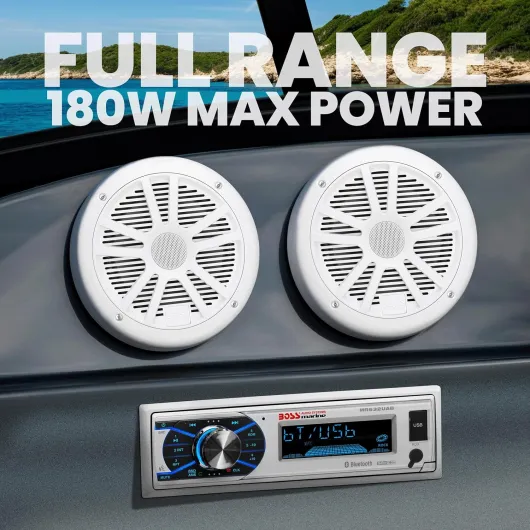
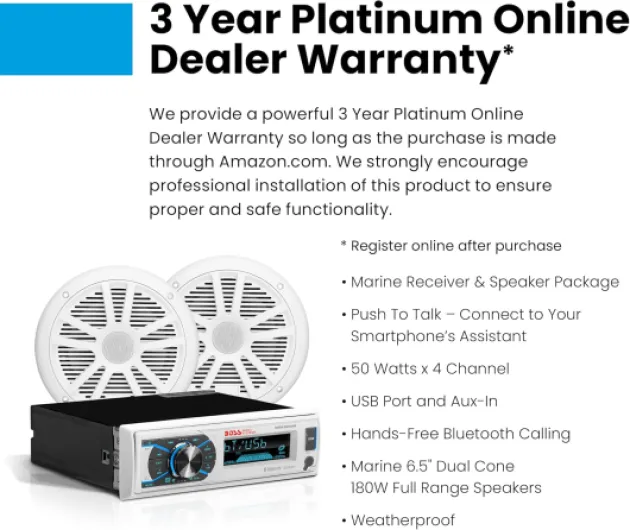
In the box you get the single-DIN Boss marine receiver, a pair of 6.5" coaxial speakers, a basic marine dipole antenna, a small remote, wiring harness, and some mounting hardware. So it’s a pretty complete starter kit if your boat has nothing installed yet. The unit is rated 4 x 50W (so 200W max on paper), but like most cheap stereos, that number is optimistic. In real life it’s more like “good enough for casual listening,” not party-level loud.
The receiver itself is a mechless design, so no CD or DVD — just Bluetooth, USB, Aux-in, and AM/FM. For a boat, that’s fine; I don’t miss the CD slot at all. I mainly used Bluetooth from my phone plus a bit of FM radio for local stations. It also supports MP3 from USB, which I tested with a small stick; it read the files quickly but the folder navigation is pretty clunky and old-school.
One thing worth noting: this is an international product, and the manual and labeling feel generic. Instructions are okay but not super clear if it’s your first install. If you’ve installed car stereos before, you’ll get it; if not, expect to spend a bit of time figuring out wiring and mounting in a marine console. The wiring harness is standard enough though, nothing weird.
Overall, as a package, it’s pretty solid for a budget build: you don’t have to go hunting for matching marine speakers or an antenna. But that also means you’re locked into the included speakers unless you decide to upgrade later. Personally, I see it as a starter kit: get sound on the boat quickly, then maybe swap the speakers for better ones down the road if you care about quality.
Everyday use: does it actually make boat days better?
In daily use, the thing I liked most is simply that it works without much fuss. I hop on the boat, turn the key, the stereo powers up, Bluetooth usually reconnects to my phone, and within a minute I’ve got Spotify or radio playing. For casual trips, that’s really all I need. I’m not fiddling with settings every time, and once I set the volume and EQ, I barely touch it except to skip tracks.
Where it falls short is user-friendliness when you want to do anything more than the basics. Changing sources, saving radio presets, or digging through USB folders is clunky and not intuitive. The remote is tiny and feels cheap, and honestly I stopped using it after trying it twice. It works, but the buttons are small and not very precise, so I just reach for the head unit instead.
Another practical point: the RGB lighting is fun, but I ended up turning it down because some colors are a bit too bright at night and can be distracting in a small cockpit. At least you have control over it, so it’s not a big issue. For people who like a bit of “bling” on their dash, it’s a plus; for others, it’s just a gimmick you set once and forget.
Overall, as a tool to bring music and radio onto a basic boat, it does the job. It’s not perfect, but it doesn’t get in the way once you learn its quirks. If you want a super clean interface, big clear buttons, and very smooth navigation, you’ll feel the limitations. If your main routine is: power on, Bluetooth from your phone, set a playlist and leave it, this kit is perfectly workable.
Pros
- Complete kit (head unit, speakers, antenna) at a budget price
- Bluetooth works reliably enough for everyday use
- Weatherproofing seems decent for light to moderate marine use
Cons
- Sound quality and volume are limited with the included speakers
- Interface and buttons feel cheap and are not very user-friendly
- Radio reception and overall build are clearly entry-level
Conclusion
Editor's rating
After using the Boss MCK632WB.6 marine stereo kit on my boat for a while, my opinion is pretty clear: it’s a decent budget solution that gets you Bluetooth, radio, and basic speakers without draining your wallet. The weatherproofing seems acceptable so far, Bluetooth is easy enough to live with, and installation is straightforward if you’ve done car stereos before. Sound quality is okay at moderate volume, and for casual cruising or fishing days, it’s perfectly fine.
On the downside, it feels and behaves like an entry-level product. The interface is outdated, the buttons and knob feel cheap, the radio tuner is only average, and the included speakers struggle when you push them. If you’re used to better car or marine systems, you’ll notice the drop in quality. I see it as a starter kit: good to bring life to an older or smaller boat, with the option to upgrade speakers later if you want a bit more punch.
Who is it for? People who want simple music on the boat, don’t want to spend a lot, and are okay with “good enough” sound and build. Who should skip it? Anyone who’s picky about audio, uses their boat a lot in tough saltwater conditions, or wants a very polished, modern interface. For the price, I’d give it a solid, no-nonsense rating: not great, not terrible, but fair value.