
Summary
Editor's rating
Value for money: where it really makes sense
Simple 3-bow design that favors function over style
Aluminum frame and 600D fabric: decent, not premium
Holding up so far, but clearly built to a budget
On-water performance: shade, stability, and handling wind
What you actually get in the box
Pros
- Complete kit with frame, fabric, hardware, and storage boot included
- 600D marine-grade polyester and 1" aluminum frame feel solid for the price
- Easy enough to assemble and install for a reasonably handy person
- Provides good shade and stays stable at normal cruising speeds
Cons
- Nylon deck mounts and some hardware feel budget and may be the first parts to wear
- Not ideal for heavy, high-speed, or full-time saltwater use over many years
- Instructions are basic and install takes longer than the optimistic "few minutes" claim

Specifications
View full product page →| Brand | Seamander |
A budget Bimini that actually holds up
I put this Seamander 3 bow Bimini (6' L x 85"–90" W x 46" H, burgundy) on my older runabout because I was tired of cooking in the sun and I didn’t feel like dropping $600+ on an OEM top. I went in with pretty low expectations, to be honest. Unknown brand, price on the low side, and those Amazon listings all sound the same after a while. But I figured if it lasted a couple of seasons, that would already be a win.
The first surprise was how straightforward the install was. The product page says “one or two people can do it in a few minutes” which is a bit optimistic, but the frame is partially pre-assembled and all the hardware is in the box, so you’re not hunting for random screws. I did it mostly solo with a second pair of hands for lining it up before drilling. From unboxing to fully mounted was roughly an afternoon with coffee breaks, not a five-minute job, but still reasonable.
On the water, the main thing I noticed is that it feels stable and doesn’t flap around like a cheap tarp. The 4 straps and the 3-bow frame keep it pretty tight. It’s not some fancy custom shop canvas, but once it’s up you forget about it and just enjoy the shade, which is really the whole point. I’ve had it up at cruising speeds and it stays put, no scary bending or rattling.
Overall, my first impression after a few outings is: it’s a pretty solid mid-range Bimini for people who don’t want to pay factory prices. It’s not perfect, and there are some corners clearly cut versus premium brands, but for a casual boater who just wants shade and a bit of spray protection, it gets the job done without feeling like junk. I’d call it an honest product: what you get matches the price, maybe even a bit more.
Value for money: where it really makes sense
For me, the big selling point of this Seamander Bimini is the value. Compared to the $600+ quotes I saw for factory or custom tops, this one sits in a much friendlier price bracket while still feeling like a proper product, not a temporary hack. The Amazon rating around 4.7/5 lines up with my experience: people seem pleasantly surprised that it’s better than they expected for the money.
You’re getting a complete kit: frame, fabric, hardware, and storage boot. No need to buy extra brackets or special fasteners unless you want to upgrade the nylon mounts. Install does cost you some time, but if you’re even slightly handy, you save a big chunk versus paying a shop to do it. Once it’s on, the functionality is basically the same as far more expensive tops: shade, some rain protection, and a place to hide from the midday sun.
There are obviously trade-offs at this price. The materials aren’t premium brand canvas, the hardware is a mix of stainless and plastic, and the finish isn’t showroom-perfect. If you’re super picky about long-term UV resistance or you keep your boat in saltwater full-time, a higher-end brand might make more sense in the long run. But for freshwater, weekend boating, or an older boat you don’t want to over-invest in, this hits a very reasonable sweet spot.
So in plain terms: if you just want a solid, functional Bimini without wrecking your budget, this one is a good deal. If you expect luxury materials and 10+ years of heavy use, you’re in the wrong price category. For most casual boat owners, the value is hard to argue with, even if it’s not perfect.
Simple 3-bow design that favors function over style
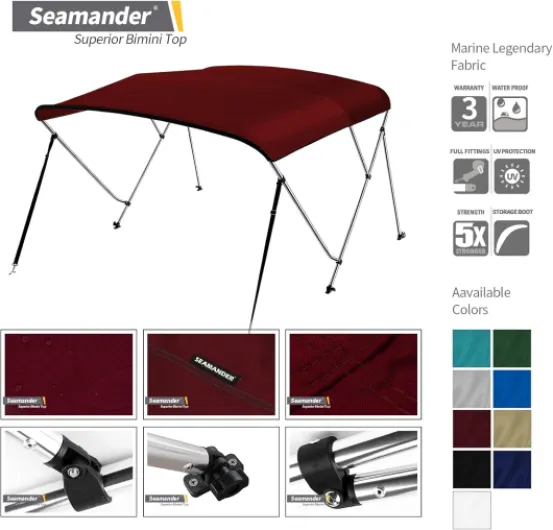
The design is about as straightforward as it gets: 3-bow frame, 4 tie-down straps, and a 6-foot canopy length. Mine is the 85"–90" width version, and that range is pretty forgiving. I measured my mounting points center-to-center and landed right in that window, so the frame sits square and the fabric tensions properly. The 46" height is a good middle ground – high enough to stand under if you’re not super tall, low enough that it doesn’t catch every gust of wind.
Visually, it’s plain. The burgundy color is nice enough and matches the photos online, but don’t expect perfect color matching to older seats or gelcoat. On my boat, the burgundy is slightly deeper than my faded upholstery, but once you’re out on the water, nobody cares. The stitching lines are straight for the most part. I found a couple of minor cosmetic imperfections at the seams, but nothing that looks like it will blow out immediately.
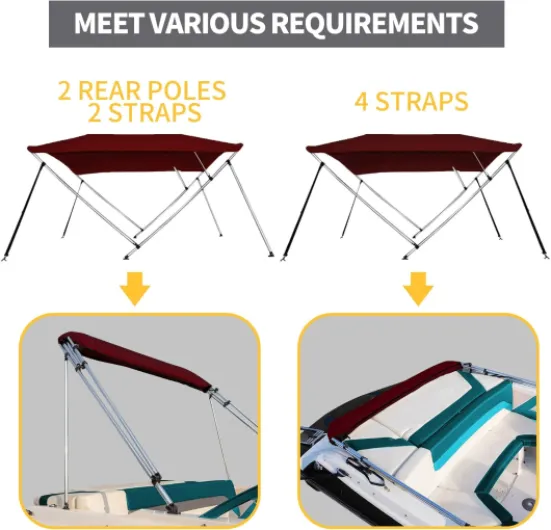
The 4-strap setup is what really defines the design in use. Two straps go forward, two go aft, and that stabilizes the whole thing. You can adjust the angle easily, so you can tilt the top a bit depending on the sun. I like that I can quickly unclip the front straps to fold it back when I don’t need it. The buckles and hooks are basic but functional. They’re not heavy-duty yacht hardware, but if you snug them down they hold.
One thing to know: this is clearly designed more for small to mid-sized boats and personal watercraft, not big offshore rigs. At higher speeds, you feel the drag, which is normal for a Bimini. I wouldn’t run at full throttle in rough chop with it fully up all the time. Design-wise, it’s built for casual cruising, lakes, and calm bays. If that’s your use case, the design makes sense and doesn’t try to be more than it is.
Aluminum frame and 600D fabric: decent, not premium
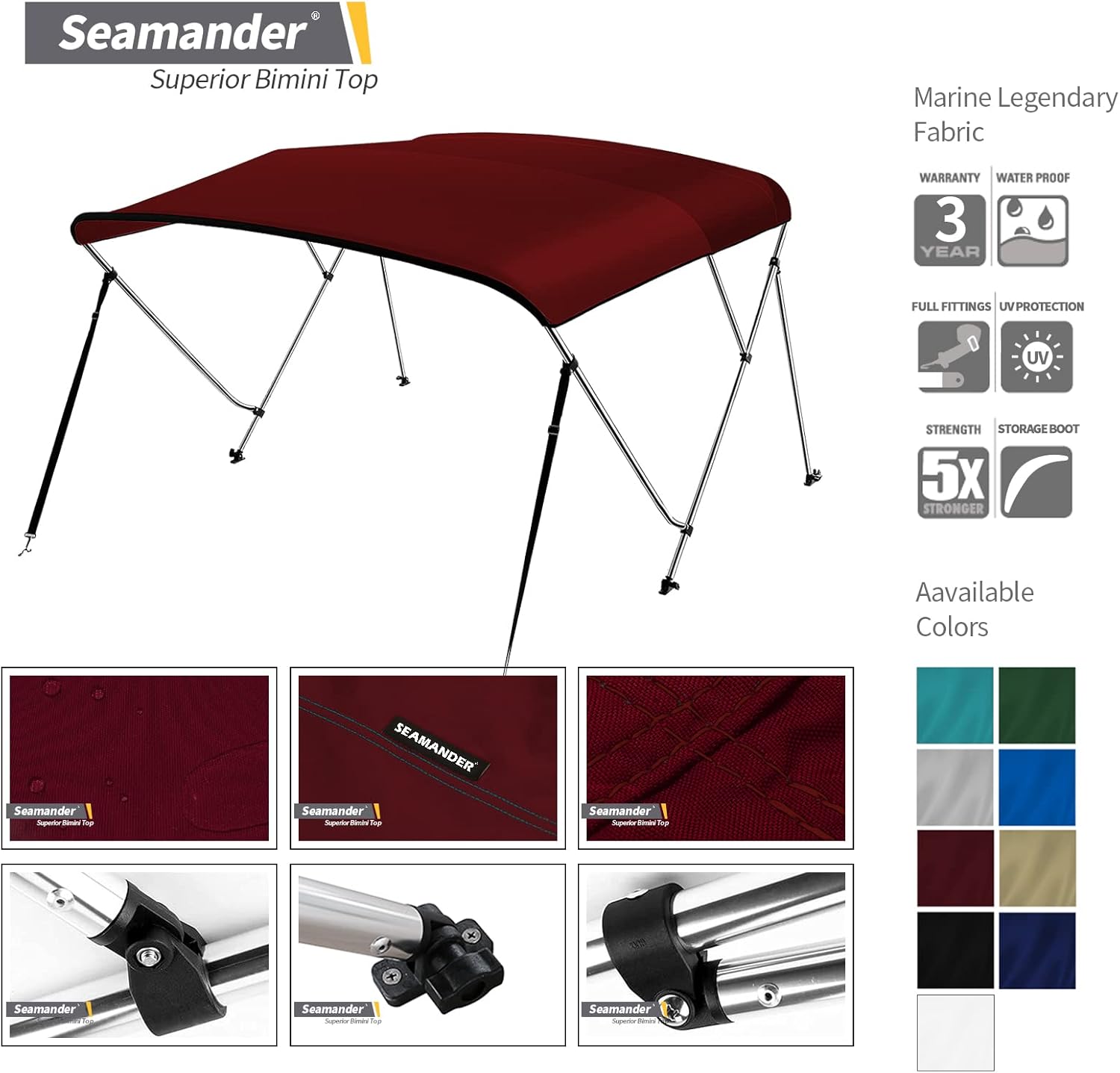
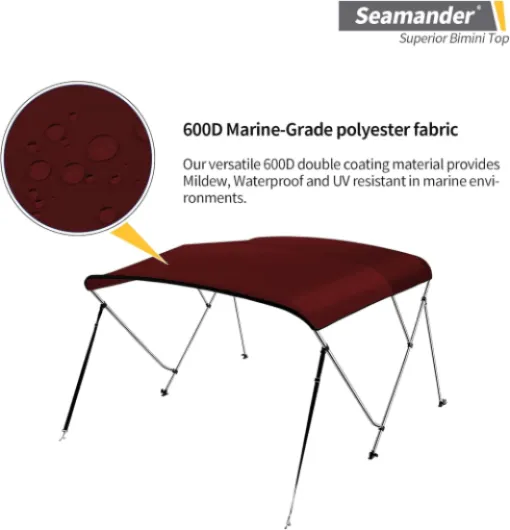
Material-wise, Seamander went with 1" diameter anodized aluminum tubing for the frame and 600D marine-grade polyester for the fabric, with a double PU coating on the back. That’s a pretty standard combo in this price range. The aluminum keeps the weight down, so you can lift and fold it easily without feeling like you’re wrestling with a jungle gym. The anodizing helps against corrosion, and so far I haven’t seen any white powdery oxidation spots after some time on the water.
The 600D polyester feels robust enough in the hands. It’s not stiff like some vinyl-coated fabrics, but it’s not flimsy either. The double PU backing gives it a slightly rubbery feel on the inside, which is what helps with water resistance. During a light rain, water beads and runs off instead of soaking through immediately. I haven’t sat through a full-on storm under it (and I wouldn’t rely on a Bimini for that anyway), but for spray and short showers, it behaves fine.
Stitching is usually where cheaper tops show their limits. On this one, the seams are double-stitched in the main stress areas, and they’ve held up so far. I checked the corners where the bows slide through – no tearing or stretching yet. Could it fray faster than a Sunbrella-type fabric? Probably, over several seasons. But that’s kind of expected at this budget. If you’re out every single weekend in harsh sun and salt, you might want higher-end fabric; for casual use, this is acceptable.
The hardware is a mix of stainless steel and nylon. The stainless parts (saddles, screws, hooks) look fine and haven’t rusted on me yet. The nylon deck mounts are the weak link if you’re picky – they work, but if you’re rough on your gear or have a heavier boat, you might eventually swap them for metal mounts for extra peace of mind. Out of the box, though, the material quality is good enough that you don’t feel like you’re installing disposable gear.
Holding up so far, but clearly built to a budget
Durability is always the big question with cheaper Bimini tops. After some time using this Seamander, my impression is that it’s solid enough for weekend and seasonal use, but it’s not a tank. I’ve had it up through several outings with sun, some light rain, and a bit of wind, and there are no obvious signs of failure yet – no bent bows, no ripped seams, no loose mounts.
The aluminum frame feels stiff enough when everything is tightened down. I’ve folded it forward and back plenty of times, and the pivot points still feel snug. There is a bit of flex if you push on it hard, but that’s normal with 1" aluminum tubing. I always make sure to support the frame when trailering instead of letting it bounce – that’s just good practice if you want it to last more than a season or two.
The fabric is where long-term durability will really show. So far, the color hasn’t faded noticeably, but I’m also not leaving the boat uncovered in the sun every single day. The double PU coating inside still looks intact, no flaking. I do try to let it dry before zipping it into the storage boot to avoid mildew. If you just leave it wet and closed for weeks, you’ll probably shorten its life quite a bit, like any canvas.
The weak spots to watch over time will be: nylon deck mounts, stitching at the bow sleeves, and the zipper on the boot. If you’re rough with it, those will be the first to complain. That said, replacements are cheap and easy to find if something does go. For the price, I’m fine with the idea that this is a 3–5 season top with basic care, not a 15-year investment. If you go in with that mindset, its durability is acceptable and lines up with what you’re paying.
On-water performance: shade, stability, and handling wind
On the water, the main job of this Bimini is shade, and on that front it does its job well. The 6-foot length gives decent coverage over the cockpit area on my boat. Two adults sitting and a kid moving around stay mostly out of direct sun when it’s overhead. In the late afternoon when the sun is low, you still get some light coming in from the sides, but that’s pretty much the case with any open Bimini.
In terms of speed, I’ve run it comfortably at around 20–25 mph in calm conditions with no drama. The frame doesn’t twist, and the straps don’t start singing or flapping wildly if you tension them correctly. You can feel the extra drag, obviously, but that’s normal. I personally fold it down if I’m going faster or if the wind picks up, just to avoid stress on the mounts long-term. I wouldn’t call this a high-speed offshore setup; it’s more a cruising and leisure top.
Wind handling is decent. On a breezy lake day, the fabric doesn’t balloon like a parachute thanks to the 3-bow tension and the 4 straps. You do get some vibration and a bit of noise at certain angles, but nothing crazy. If you’re picky, you can play with strap lengths to find the smoothest position. The frame joints don’t rattle much once the thumb screws are tightened properly.
As for water, it sheds light rain and spray pretty well. I had one short shower where we stayed under it instead of racing back to the dock, and we only got a few drips at the seams. It’s not a full enclosure, obviously, so wind-blown rain still finds you from the sides. But compared to having no top at all, it’s night and day. Performance-wise, for everyday casual boating, I’d say it’s perfectly usable and reliable enough, as long as you respect its limits and don’t treat it like a permanent storm shelter.
What you actually get in the box
Out of the box, the Seamander Bimini is fairly basic but not sloppy. The canopy, the aluminum frame, a storage boot, and a surprisingly complete hardware kit are all there. No missing pieces in my case. You get stainless steel saddles, screws, hooks, nylon deck mounts, jaw slides, thumb screws, nuts and bolts – basically everything you need to mount it to a fiberglass deck or rails. I didn’t have to run to the hardware store, which I appreciate a lot.
The frame comes partially assembled, which speeds things up. You still have to connect the bows, attach the jaw slides, and figure out the exact mounting points on your boat. The instruction sheet is nothing fancy, but it’s clear enough. It’s mostly diagrams with short notes. If you’ve ever put together a piece of Ikea furniture, you’ll manage this. I used a drill, tape measure, pencil, and a wrench – nothing special. One user review said it fit straight into factory rails; in my case, I had to drill, but the alignment wasn’t complicated.
One part I actually liked more than expected is the built-in storage boot. Instead of a loose bag you’ll lose in the garage, this one is designed to stay with the Bimini. When you fold the frame down, you just zip the boot around the fabric. It’s simple, but it makes trailering and storage less annoying. The zipper isn’t heavy-duty industrial quality, but it runs smoothly and hasn’t snagged yet.
So in terms of presentation, you’re not getting some fancy branded unboxing experience, but you do get a complete kit that’s ready to mount without extra purchases. For the price range, that’s really what matters. No glossy extras, just the essentials, and they’re all there. If you’re comfortable drilling into your boat and measuring twice, you’ll be fine with what’s in the box.
Pros
- Complete kit with frame, fabric, hardware, and storage boot included
- 600D marine-grade polyester and 1" aluminum frame feel solid for the price
- Easy enough to assemble and install for a reasonably handy person
- Provides good shade and stays stable at normal cruising speeds
Cons
- Nylon deck mounts and some hardware feel budget and may be the first parts to wear
- Not ideal for heavy, high-speed, or full-time saltwater use over many years
- Instructions are basic and install takes longer than the optimistic "few minutes" claim
Conclusion
Editor's rating
After actually living with the Seamander 3 Bow Bimini for a while, my take is pretty simple: it’s a good, no-nonsense canopy for people who want shade without spending factory money. The aluminum frame and 600D fabric feel decent, the hardware kit is complete, and once it’s installed, it just quietly does its job. It’s not fancy, but it doesn’t feel like a toy either. Shade coverage is good for a small to mid-sized boat, and the 4-strap system keeps it stable at normal cruising speeds.
It’s not perfect. The nylon mounts and basic hardware remind you that this is a budget-friendly product, and I wouldn’t expect it to survive years of hard commercial use or brutal sun without some wear. If you’re obsessive about top-tier materials or you boat in rough conditions all the time, spending more on a premium brand will still make sense. But for a typical weekend boater on lakes or calm bays, especially with an older boat, this Bimini is good value for money and practical. It’s the kind of upgrade that makes your time on the water more comfortable without turning into a major project or a huge bill.