
Summary
Editor's rating
Value for money: decent if you know what you’re buying
Slim metal bar, simple layout, a bit barebones
Aluminum plate and stainless buttons: decent but not heavy-duty pro grade
Early signs on durability: fine so far, but I wouldn’t abuse it
How it actually performs on a 12V boat setup
What you actually get with this panel
Pros
- Slim aluminum and stainless design that fits in tight dashboards and looks cleaner than cheap plastic panels
- Six self-locking push buttons with blue LED indicators, handy at night to see what’s on
- IP65 splash resistance and decent build quality for light to moderate marine or RV use at a reasonable price
Cons
- Low current capability with 3A fuses shared between two circuits, not ideal for high-draw devices without relays
- Barebones rear wiring and fuse holders plus no labels included, so installation and finish need extra DIY effort

Specifications
View full product page →| Brand | Iztoss |
A cheap way to tidy up your switches
I put this Iztoss 6 gang aluminum push button panel on a small fishing boat that I’m slowly rewiring. I was mainly looking for something simple to group a few 12V accessories: navigation lights, deck light, bilge pump, a small fan and a USB socket. I didn’t want to spend a fortune on the big name marine brands for what is basically just an ON/OFF panel. This one popped up with decent reviews and a small size, so I gave it a shot.
Out of the box, you can tell it’s not a premium brand, but it doesn’t look cheap in a toy-like way either. The aluminum plate is thin but straight, the stainless push buttons feel okay, and the blue LEDs are fairly bright. Nothing fancy, no labels included, and the wiring is not pre-loomed like on higher-end panels, so you have to know a minimum about 12V wiring to make it clean and safe.
I wired it to a 12V system even though the sheet says 24V DC, and it worked fine. The panel comes with three 3A fuses, each fuse feeding two buttons, so six circuits total. That setup is pretty basic but it’s enough for small loads like lights and fans. If you want to run something hungrier, like a big pump or a fridge, you’ll need extra relays or separate fused feeds. It’s not plug-and-play for heavy gear.
After a few weeks on the boat, exposed to humidity and a couple of good hose-downs, the panel still works and the buttons haven’t jammed. For the price, I’d say it’s a practical and no-frills solution, but you have to accept its limits: low current rating, no labeling, and DIY-level wiring. If you’re comfortable with that, it’s a decent little control bar. If you want something turnkey and beefy, you should probably look higher up the range.
Value for money: decent if you know what you’re buying
On the price side, this Iztoss panel usually sits quite a bit cheaper than the big marine brands with similar button counts. You don’t get brand recognition or fancy features, but you save money. For my small boat project, that was the main reason I chose it: I’d rather put the budget into proper cabling, breakers and a decent battery than spend a lot just on a switch panel. In that context, this product makes sense: it gives you six circuits, indicator lights and basic fusing for a modest cost.
That said, it’s not a miracle deal. You still have to buy extra stuff: proper wire, crimp connectors, extra fuses if you want spares, labels, maybe relays for higher loads. When you add all that, the panel is just one piece of the puzzle. Compared to some cheap rocker switch panels that come pre-wired with a bus bar and labels, this one is a bit more barebones. You pay for the metal and stainless look, not for a complete plug-and-play kit. If you just want the cheapest way to get switches, there are plastic panels that will cost less and be easier to wire.
Where I think the value is decent is for people who care a bit about appearance and footprint. The slim aluminum bar with stainless buttons looks nicer and more compact than a bulky plastic box, especially in a camper or a custom van build. If that matters to you, then the price/performance ratio is okay. If you don’t care how it looks and just want switches in a hole, you can probably spend less and get something more basic.
So overall, I’d rate the value as solid but not mind-blowing. It’s fairly priced for what it offers: six metal push buttons, IP65 front, integrated 3A fuses. There is better gear out there if you’re ready to pay more, and there is cheaper plastic stuff if you’re not picky. This panel sits in the middle: not fancy, not trash, just a reasonable compromise for small marine or RV projects.
Slim metal bar, simple layout, a bit barebones
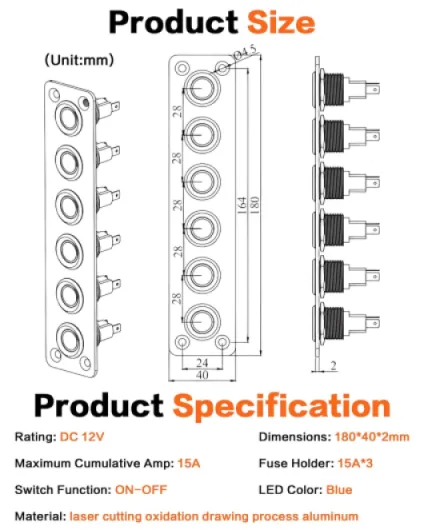
Design-wise, the first thing you notice is how slim and compact this panel is. The aluminum plate is only 2 mm thick, and the whole bar is 18 cm long and 4 cm high. On my small boat dash, that was actually a big plus: I could fit it in a narrow spot between the steering wheel and a gauge, where a standard rocker panel wouldn’t have fit. If you’re working with tight camper cabinets or a small helm console, that slim bar format is handy. It looks cleaner than having random toggle switches drilled all over the place.
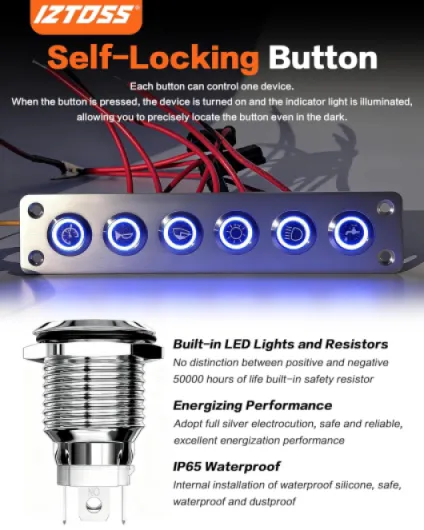
The look is quite plain: brushed black (or dark) aluminum plate, six identical stainless steel buttons in a line, each with a blue LED ring. No printed icons, no labels, nothing. It’s up to you to label the functions with a label maker or stickers if you don’t want to guess in the dark. Personally, I stuck a cheap label tape strip above each button (NAV, DECK, PUMP, etc.). It works, but it would have been nice if the manufacturer at least included a small sheet of generic labels like most rocker panels do.
Ergonomically, the buttons are easy to hit, even with wet fingers. They have a clear click and a noticeable travel, so you feel when they’re on or off. The only small annoyance is that, in bright daylight, the difference between pressed and not pressed is not super obvious at a glance. You mostly rely on the blue LED ring to know what’s active. At night, that’s fine and even handy. During the day, especially with polarized sunglasses on, the LEDs are less visible and you sometimes check twice.
Overall, the design feels functional but a bit unfinished: the metal and buttons give a solid impression, but the lack of labels and the very basic rear layout scream budget product. If you like clean, simple lines and don’t mind DIY labeling, you’ll probably be okay with it. If you prefer a polished, fully finished look with icons and integrated bus bars like on premium marine panels, this one will feel a bit cheap visually, even though it’s not ugly.
Aluminum plate and stainless buttons: decent but not heavy-duty pro grade
The panel uses a laser-cut anodized aluminum plate and stainless steel push buttons. In hand, the plate is light and quite thin, but it doesn’t flex much once it’s screwed down. The anodizing seems uniform, no sharp edges from the cutting, and the mounting holes line up properly. It’s not the thick, chunky aluminum you see on high-end marine gear, but for a small dashboard panel, it’s enough. If you’re expecting something that feels like a tank, you might be a bit underwhelmed when you first handle it.
The stainless buttons are the best part material-wise. They feel solid, the threads for mounting nuts are clean, and the action is consistent across all six buttons. After getting splashed and handled with salty wet hands, I haven’t noticed any rust spots or discoloration so far. The LEDs inside the buttons are still working, and there’s no condensation inside the lenses yet. For a budget panel, that’s already a good sign. I’ve had cheaper plastic rocker switches from no-name brands start to feel gritty or oxidized in less time.
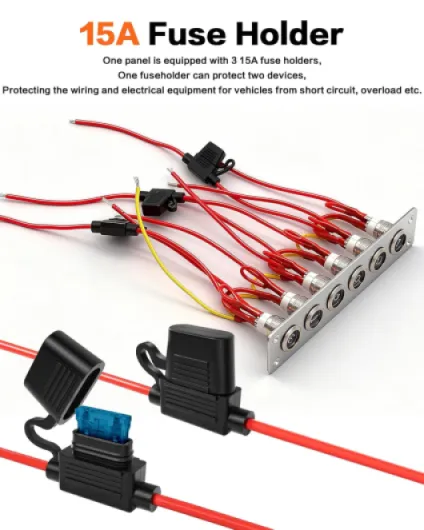
On the backside, you can clearly see the cost savings. The wiring tabs and fuse holders look okay but not amazing. The fuse holders are plastic, with simple spade connectors. They grip the supplied 3A fuses fine, but they don’t inspire the same confidence as a proper marine fuse block. If you tug too hard on the wires, you feel that something could eventually loosen if not secured properly. This is the kind of panel where you absolutely want to tie and support the wiring harness so that nothing is hanging off the switch terminals.
In short, materials are decent for light to moderate use: metal front, stainless buttons, basic plastic and metal on the rear. It’s clearly above the very cheap all-plastic panels, but it’s also clearly below the big marine brands in terms of heft and overall finish. For a small boat, camper, or DIY van build, I think the material quality is acceptable. For a commercial vessel or something that gets constant abuse, I’d probably go with something more robust and certified.
Early signs on durability: fine so far, but I wouldn’t abuse it
Durability is always the big question with these unknown-brand panels. I’ve had this Iztoss unit on the boat for a few weeks, including a couple of rough outings and some pretty aggressive hose-downs when cleaning. So far, no water ingress issues: the buttons still feel smooth, the LEDs all work, and the panel face hasn’t started to peel or corrode. The IP65 rating seems realistic for splashes and spray. I wouldn’t trust it fully exposed to waves or constant submersion, but for a normal dashboard, it’s doing fine.
The aluminum plate hasn’t warped or bent, even though it’s thin. Once screwed to the console, it feels solid. The stainless buttons also show no signs of rust. I did notice a tiny bit of oxidation starting on one of the rear terminals, but I hadn’t sprayed any protective coating yet. After seeing that, I hit the rear side with a light coat of dielectric grease and a bit of corrosion inhibitor spray, which I would honestly recommend for any budget marine electrical part, not just this one.
The weak point, in my opinion, is more the rear connectors and fuse holders than the front. If you’re rough when pushing or pulling the harness, I can see a terminal getting loose over time, especially on a vibrating boat or RV. This is not a sealed, potted, super rugged assembly. It’s a DIY-level panel where your installation quality will heavily influence how long it lasts. If you tie everything down properly, use crimp connectors, heat shrink and a bit of protective spray, I think it will hold up reasonably well.
Given the price point and the unknown brand, I’m not expecting this panel to last 15 years in a salty open environment. But for weekend use, stored under a cover or inside a van or caravan, it feels good enough. If it fails in a couple of years, it’s not a huge investment lost. If you want guaranteed long-term durability on a work boat or full-time liveaboard, I’d still go for a more established marine brand, even if it costs more.
How it actually performs on a 12V boat setup
In use, the panel does what it’s supposed to: it turns stuff on and off. I wired mine to a 12V system with navigation lights, a small LED floodlight, a bilge pump through a relay, and a little cabin fan. All of these are low to medium draw. The panel handled them without any issues. The 3A fuses never tripped with these loads, and the buttons never got warm. The self-locking action is consistent, and there’s no double-clicking or misfires. It’s about as basic as it gets, but it works.
The blue LED indicators are handy, especially at night. When a circuit is on, you get a clear ring of light around the button. On my boat, that made it easy to see at a glance what was running, especially for the bilge pump circuit. During the day under bright sun, the LEDs are obviously less visible, but you can still see them if you look closely. If you hate bright panels at night, be aware the LEDs are not dimmable; you’d have to mod the wiring with resistors or a dimmer if you really want to tone them down.
One limitation is the 3A rating per fuse pair. Because each fuse protects two devices, you can’t really stack two heavy loads on the same fuse pair without running into trouble. For example, two strong halogen deck lights on one pair would not be a good idea. In my case, I kept each fuse pair for very light stuff (two LED circuits) or used a relay for the pump so the panel only sees the coil current, not the motor current. If you’re okay planning your wiring around that, performance is fine. If you want to directly power big loads, this panel is not made for that.
After a few weeks, I haven’t had any glitches: no random resets, no flickering LEDs, no stuck buttons. I did re-tighten the wiring screws once after the first outing, just in case. Overall, performance is stable but clearly aimed at light-duty 12V/24V accessories. It’s not a high-amp power distribution center, it’s a small control interface. As long as you treat it as such and don’t overload it, it gets the job done reliably enough for hobby use.
What you actually get with this panel
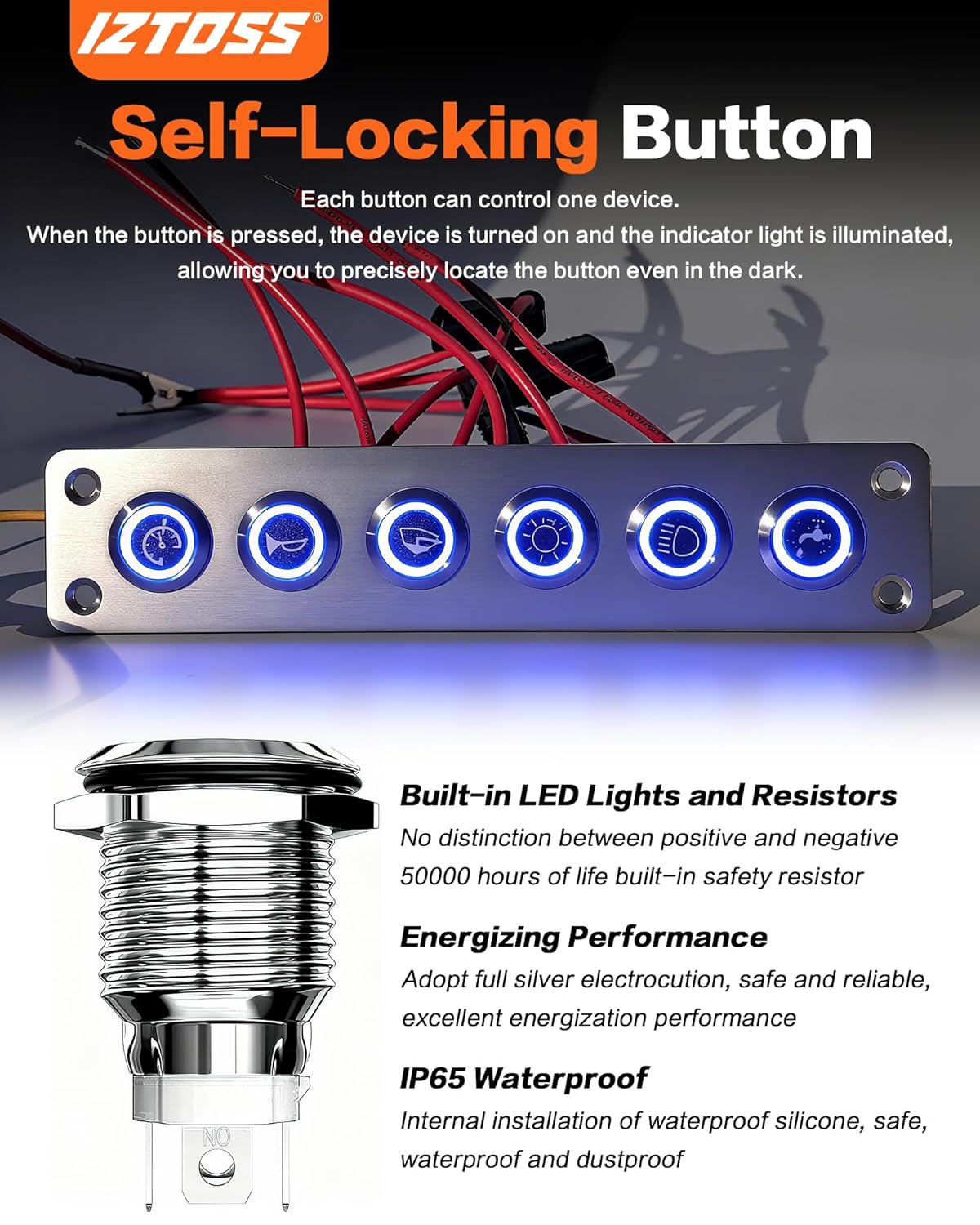
The Iztoss panel is basically a 6-way ON/OFF push button switch bar with a slim aluminum faceplate. Size is about 180 x 40 x 2 mm, so it’s narrow and easy to fit in tight dashboards, camper cabinets or a small helm. You get six stainless steel push buttons, all self-locking: you press once, it stays in, circuit is on; press again, it pops out and cuts power. Each button has its own blue LED ring that lights up when the circuit is on. There’s no separate backlight when off, so in the dark you only see what’s currently powered.
Behind the panel, the wiring is pretty straightforward but barebones. You have terminals for each button, and three built-in fuse holders with 3A fuses. One fuse feeds two switches, which is simple but not very flexible. If you blow a fuse, you lose two accessories at once. It’s not the end of the world on a small boat, but it’s something to keep in mind. Also, there’s no bus bar or common ground built in, so you still need to manage your ground wiring separately.
The product page mentions IP65 waterproof rating, which basically means it handles splashes and dust, but you shouldn’t dunk it. In practice, I installed it on an open boat under a small console cover. It’s been sprayed and washed, and the panel survived without any weird behavior. I wouldn’t mount it fully exposed on a jet ski or in a spot that’s underwater half the time, but for a regular boat dashboard or RV interior, it’s fine.
Overall, the feature set is basic: six ON/OFF circuits, indicator lights, integrated light fusing and a slim panel. No fancy rocker legends, no USB ports, no voltmeter, nothing smart despite the listing talking about Wi‑Fi and touch control (which is just wrong, it’s a simple mechanical push button panel). If you know what you’re buying, it’s okay. If you expect some kind of connected gadget, you’ll be disappointed because it’s just a dumb switch bar, and that’s it.
Pros
- Slim aluminum and stainless design that fits in tight dashboards and looks cleaner than cheap plastic panels
- Six self-locking push buttons with blue LED indicators, handy at night to see what’s on
- IP65 splash resistance and decent build quality for light to moderate marine or RV use at a reasonable price
Cons
- Low current capability with 3A fuses shared between two circuits, not ideal for high-draw devices without relays
- Barebones rear wiring and fuse holders plus no labels included, so installation and finish need extra DIY effort
Conclusion
Editor's rating
After using the Iztoss 6 gang aluminum push button panel on a small 12V boat setup, my opinion is pretty straightforward: it does the job, as long as you respect its limits. The front side is the strong point: slim aluminum plate, stainless buttons with blue LEDs, IP65 splash protection. It looks decent, doesn’t eat much space, and the buttons are easy to use even with wet hands. For grouping a few low-draw accessories like lights, fans or a pump through a relay, it works fine.
The downsides are mostly on the technical and finish side. The 3A fuse setup (one fuse for two circuits) limits what you can run directly, the rear connectors and fuse holders feel more DIY than professional, and there are no labels or extra features. It’s not something I’d put on a work boat that runs every day or in a spot that gets constantly smashed by waves. But for a weekend boat, caravan, van conversion or small RV project where you want a simple, compact control bar without spending big-brand money, it’s a reasonable choice.
If you’re comfortable with basic 12V wiring, willing to tidy up the harness and maybe add relays for heavier loads, this panel is good value and should serve you well. If you want a fully pre-wired, high-amp, long-term marine solution with all the bells and whistles, or if you’re allergic to no-name brands, you should skip it and look at more established panels, even if that means paying more.