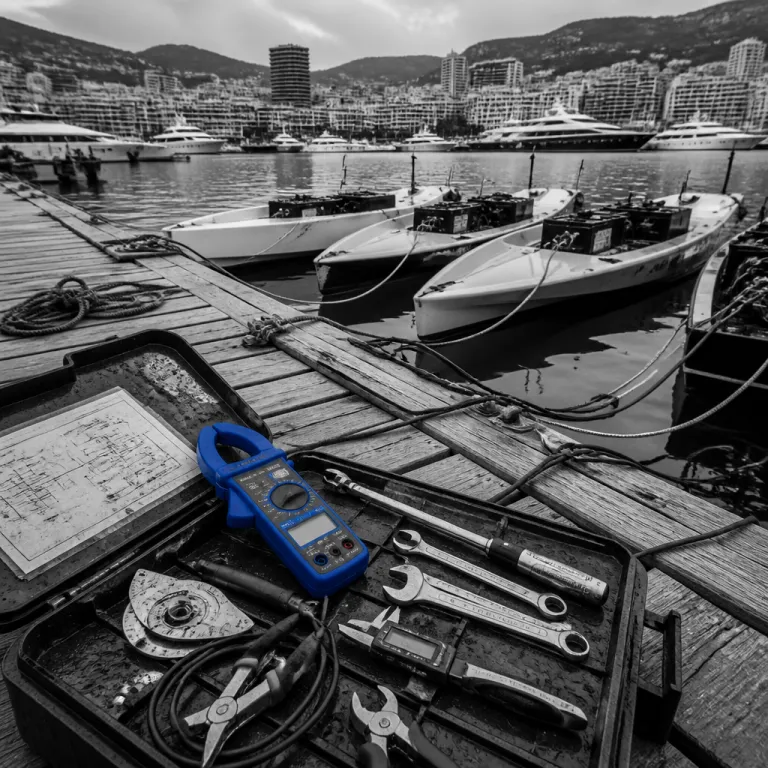
From university pontoons in Monaco to 60 metre contracts
Monaco’s main harbour feels different when the Monaco Energy Boat Challenge replaces superyacht sterns with student prototypes. Along the quay at Port Hercule, 56 university teams and independent équipes, according to Yacht Club de Monaco’s 2024 technical programme and entry list, turned the usually polished yacht club backdrop into a working sea‑experience laboratory, with hulls craned in beside tenders from Lürssen, Ferretti Group and Azimut Benetti that quietly signalled where the yachting industry is really spending its R&D budget. For an owner planning a 20 to 60 metre yacht, those student boats in the open sea just beyond the breakwater are less a curiosity and more an early briefing on propulsion choices that will shape your next design build contract.
The event’s three technical pillars — the Energy Class, the Open Sea Class and the Solar Class — translate surprisingly cleanly into real world yacht segments. Energy Class prototypes, supplied with a standard hull by Yacht Club de Monaco and reimagined by engineering students, mirror the constraints of a semi‑custom 30 metre where naval architecture is fixed but the energy system is open to negotiation, from lithium packs to hybrid hydrogen fuel cells. One Ferretti Group engineer, speaking during a dockside technical debrief, described the brief as “designing a 300 kWh floating power bank that can swap from diesel‑electric today to fuel cells tomorrow without moving a bulkhead”. Open Sea entries, often longer and more heavily engineered, resemble fast chase boats or pocket explorers that must balance speed, range and seakeeping in real swell rather than in a flat inner basin.
Solar Class craft, feather light and almost silent, look far removed from a steel displacement yacht, yet their solar array management and artificial‑intelligence‑assisted routing software are already informing hotel load strategies on larger electric boat projects. When you walk the YCM pontoons during the Monaco Energy Boat Challenge, you see university teams from the United States, China and Europe solving the same energy density equations your naval architect is quietly running for a future 50 metre refit. The gap between a student energy boat and a commercial tender is no longer a decade wide; it is often a single funding round and a classification approval away, especially when a 40 kWh student battery module, at roughly 120 to 180 Wh per kilogram depending on chemistry, scales directly into a 400 kWh tender pack using the same cell format and safety philosophy.
Hydrogen, methanol, batteries and what they mean for owners
Hydrogen dominated the conversation again, with six hydrogen projects in Monaco — a figure cited in Yacht Club de Monaco’s 2024 technical programme — showing crisp acceleration and impressive speed off the line. In the confined waters off Yacht Club de Monaco, hydrogen fuel cell boats demonstrated why many yards see them as a long‑term answer for lower‑carbon yachting, especially when paired with electric boat drivetrains that already feel mature at tender scale. Yet the lone methanol project, running quietly in the open sea outside the main harbour and highlighted in the official race briefing as the only methanol‑powered entry, may be closer to what a 55 metre owner will actually sign for within five years, given methanol’s higher volumetric energy density and simpler liquid‑fuel handling.
For yachts between 20 and 40 metres, the most realistic near‑term path is a high‑capacity battery system backed by a conventional engine burning drop‑in fuels, with solar support sized more for hotel loads than for primary propulsion. That is exactly the architecture you see distilled in several Energy Class entries, where students use artificial intelligence to arbitrate between battery draw, solar input and hydrogen range extenders in real time. Scale that logic up, and you have the hybrid profiles already sketched into specification books at Ferretti and Azimut Benetti, where naval architecture teams are designing machinery spaces that can later accept methanol‑ready engines or modular fuel cell racks without sacrificing guest volume.
Hydrogen in its pure form still struggles with storage volume on a 60 metre yacht, especially if you want to keep a beach club and a full tender garage; at typical current densities, compressed hydrogen at 350 to 700 bar can require roughly three to four times the tank volume of diesel for the same usable energy. Methanol, by contrast, slots more easily into existing tank arrangements, with around half the volumetric energy density of marine gas oil but using familiar liquid‑fuel systems, which is why the Alternative Fuels and Sustainable Yachting Conference at YCM devoted serious time to methanol reformers alongside nuclear concepts and next‑generation batteries. If you follow the Mediterranean racing circuit from Antigua regattas to the Fort Lauderdale show, the smartest move now is to specify generous electrical capacity, DC distribution and flexible tank geometry, so your future energy boat upgrade is a refit, not a rebuild.
Why big yards back students and how regulation accelerates change
Seeing Lürssen, Ferretti Group and Azimut Benetti flags flying over student pits in Monaco is not philanthropy; it is product development in public. These shipyards know that IMO Tier III rules and the extension of the EU Emissions Trading System to large yachts over 5 000 gross tonnes — measures referenced in the EU’s “Fit for 55” maritime package and in YCM’s conference briefings — are turning clean propulsion from a moral choice into a line item on the operating budget. When carbon has a price and NOx limits bite in emission control areas, the owner who invested early in efficient hull design and flexible energy systems will simply enjoy more open sea time for the same annual spend.
At the Monaco Energy Boat Challenge, you could watch engineering students from 22 countries iterate on foils, propellers and control software with a freedom that in‑house yard teams rarely enjoy. Sealab‑class projects, often run in partnership with research institutes, pushed cutting‑edge materials and control algorithms that would be hard to justify on a production yacht today, yet they offer a preview of the artificial‑intelligence‑assisted trim and routing tools that will quietly arrive on bridge consoles within a few seasons. For owners used to judging a yacht by her interior design, the real luxury now is an engineering package that keeps regulatory headaches and fuel bills in check.
The practical takeaway for your next contract is simple: write optionality into the specification. Ask your yacht club broker or designer to reserve space for future hydrogen or methanol systems, insist on detailed energy audits during the design build phase, and pay attention to how your chosen yard engages with events like the Monaco Energy Boat Challenge rather than only with glossy boat shows. In a harbour where students race electric hulls past the Yacht Club de Monaco’s terrace, the measure of a modern yacht is not the length overall, but the wake she leaves.