
Summary
Editor's rating
Value: decent for the price, as long as you know its limits
Design: bulky but readable, with a pivot that actually helps
Materials and build: ABS plastic that feels basic but not flimsy
Durability: holds up for light use, but I wouldn’t abuse it
Performance: okay accuracy if you install and align it properly
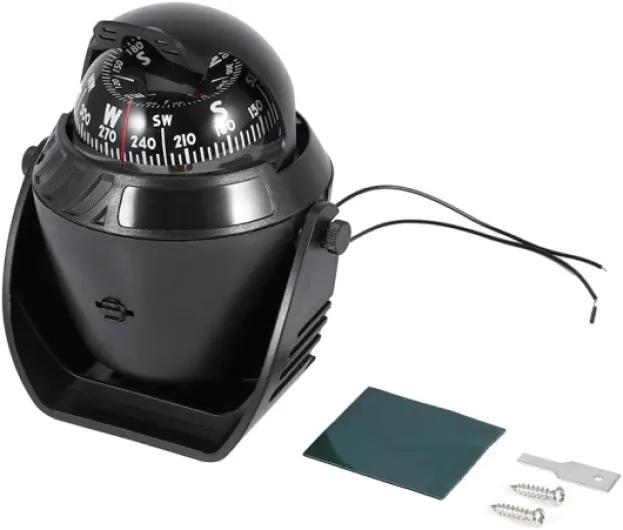
What you actually get when you unbox it
Pros
- Readable dial with LED backlight that works well in low light
- Adjustable pivoting base makes it easy to aim toward the driver or helm
- Acceptable accuracy for casual use if installed away from magnetic interference
Cons
- Plastic and mounting hardware feel basic and more suited to light use than harsh marine conditions
- Adhesive pad alone isn’t very reassuring in hot or rough environments; screws are almost mandatory
- Arrow points to south, which can confuse users expecting a standard north-pointing compass

Specifications
View full product page →| Brand | Dioche |
A budget digital compass I actually dared to use on the water
I picked up this Dioche digital marine compass because I wanted something simple for a small boat and for the dashboard of my van. No fancy GPS, just a basic direction reference that works when the phone battery is dead or there’s no signal. I wasn’t expecting miracles at this price, but I at least wanted something that points in a consistent direction and doesn’t fall apart after a weekend.
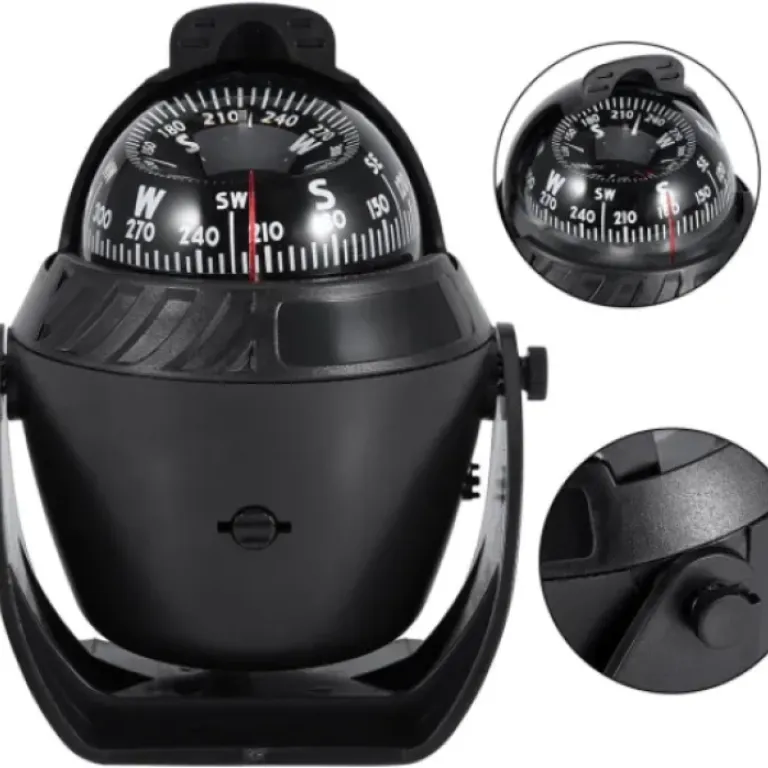
First contact: it’s bigger than it looks in the pictures, more like a small dashboard clock than a tiny button compass. It’s a 12V electronic compass with an LED-lit dial, and the whole thing pivots on a base so you can angle it towards you. The brand shouts about “high precision”, but in reality I just needed it to be roughly right and stable enough not to jump 20 degrees every time I hit a wave or a pothole.
I tested it for several days: two outings on a small motor boat and about a week in the car on the dashboard. I also checked it against a basic handheld Silva compass and the map app on my phone to see if it was roughly aligned. The short version: it works, but only if you take the time to install and adjust it properly. Out of the box, stuck anywhere randomly, it’s not magic.
Overall, my feeling is that this is a decent budget tool for casual use, not something I’d trust as my only navigation instrument in rough conditions or offshore. It’s fine for orientation, for a van or small boat on a lake, but if you’re expecting professional-grade accuracy, you’ll probably be annoyed. It’s good enough for the price, with a few quirks you need to know before buying.
Value: decent for the price, as long as you know its limits
Given the price range this compass sits in, I’d say the value is pretty solid, but with some conditions. You’re not paying for a high-end marine brand; you’re paying for a functional compass with LED lighting that you can throw on a boat or car without too much stress. If you only need a basic heading reference for a small boat on a lake, a kayak with a motor, or a camper van, it’s hard to argue that you need something much more expensive.
Where the value can feel less good is if you buy it with the wrong expectations. The product page talks about “high precision” and uses the word “digital”, which can make you think it’s as accurate and stable as a proper, well-damped marine compass or a numeric digital heading sensor. It’s not. It’s a classic magnetic card in a plastic housing with a light. For basic use, that’s enough, but for serious navigation, I’d see it more as a cheap backup than a primary tool.
Compared to a basic handheld compass from a known outdoor brand, this Dioche gives you the convenience of a fixed mount and LED light, but you lose the portability and ruggedness. Compared to a true marine compass from a big brand, it’s far cheaper, but you also give up build quality, better damping, and better long-term resistance to UV and salt. So it sits in the middle: better than a random keychain compass, clearly below proper marine gear.
If you’re realistic and just want something that “kind of works” for direction on a small budget, I think the price is fair. If you’re equipping a serious boat for longer trips or rough conditions, I would personally spend more and get a recognized marine compass, and keep this one as a cheap spare or for a secondary position. In other words: good value for light, casual use; mediocre value if you expect professional performance.
Design: bulky but readable, with a pivot that actually helps
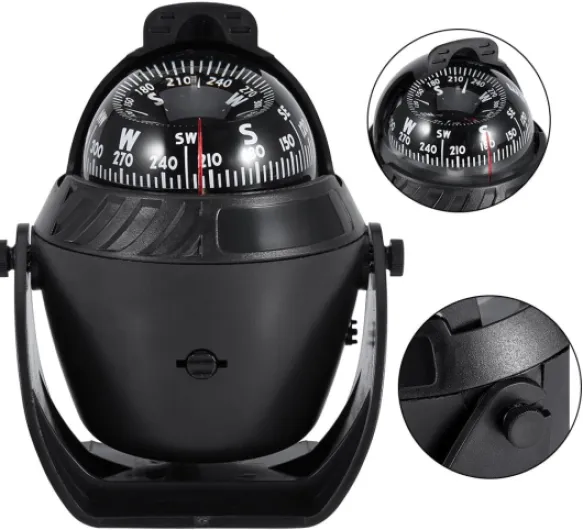
Design-wise, the compass has a fairly simple look: a black ABS plastic housing, a curved transparent cover, and a base that lets you tilt the whole unit. It’s not pretty, but it’s functional. The footprint is roughly the size of a large computer mouse, so you need a flat area of about 14 x 10 cm to place it without it looking awkward. On a car dashboard, it’s quite visible; on a small boat console, it blends in better because you usually have more gear around.
The best part of the design is the adjustable base. You can tilt the compass towards your eyes, which matters a lot once you’re actually driving or at the helm. On my car, I tried it both on the left side near the A-pillar and in the center. Being able to angle it meant I could still read it even when the sun was hitting the windshield. On the boat, I mounted it slightly off-center, and the tilt helped keep the lubber line aligned with the bow direction.
The markings on the dial are fairly thick and high-contrast, which helps a lot. The lubber line is clear, and the main cardinal points are easy to see. The fact that the arrow points to south instead of north feels odd at first, but once you understand that, you just use the opposite direction if you’re used to north-referenced reading. Still, for someone who doesn’t read the manual, this can be confusing and could make you think it’s “wrong” when it’s actually doing what it’s supposed to.
On the downside, the whole unit looks a bit “cheap gadget” from up close. The plastic is shiny and light, and you don’t get that reassuring feel you have with a proper marine instrument. Also, because it’s quite big, it can block a bit of your view if you place it badly in a car. So from a design standpoint: practical and readable, but not discreet, and clearly oriented towards budget setups rather than high-end boat dashboards where aesthetics matter.
Materials and build: ABS plastic that feels basic but not flimsy
The compass is made of ABS plastic, which is common for this kind of gadget. It’s light, doesn’t feel premium, but it also doesn’t feel like it will crack at the first bump. I pressed quite hard on the housing and tried twisting it slightly; there’s a bit of flex, but nothing alarming. The transparent dome doesn’t creak and seems well-fitted, with no obvious gap where water could easily sneak in during light spray or humidity.
The mounting base and the pivot joint are also plastic. That’s usually where cheap products fail: the hinge loosens, and the thing starts wobbling. After a week in the car and two boat trips, the tilt mechanism was still holding its angle. I wouldn’t hang something heavy from it, but for just holding the compass, it’s fine. The screws included are standard small metal screws; they’re not stainless marine-grade from what I can see, but for interior use or under a canopy they’re acceptable. For a real saltwater environment, I would personally replace them with stainless screws from a hardware store.
The EVA foam adhesive pad is okay, but not magic. On my car’s textured dashboard, it held as long as I cleaned the surface with alcohol first, but I can see it coming off if the car sits in the sun all day and the interior gets very hot. On the boat, I didn’t trust the adhesive alone: I used screws straight into the console. For a marine product, I think relying only on foam tape is a bit optimistic, so at least they do include the screws as a backup.
In terms of corrosion resistance, the ABS housing itself is obviously not going to rust. The only concern long-term will be the metal bits inside and the screws. For occasional marine use or freshwater lakes, I think it’s fine. For a boat that lives permanently in a salty environment and gets hammered by waves, I’d be more cautious. Overall, the materials are in line with the price: basic but acceptable, with some corners cut, especially around the mounting hardware and finish quality.
Durability: holds up for light use, but I wouldn’t abuse it
In terms of durability, I obviously haven’t used it for years, but I tried to simulate real use: heat in the car, vibration, and some spray on the boat. After a week on the dashboard in direct sun, the plastic didn’t warp, and the adhesive didn’t completely give up, though I did notice the pad getting a bit softer when the interior got very hot. I would not rely on the adhesive alone in a long-term hot environment; screws are safer.
On the boat, I got it slightly wet with spray and wiped it down after each outing. No fogging inside the dome, no water infiltration, and the LED still worked fine. It’s clearly not a fully sealed, professional-grade marine compass, but for occasional use and normal conditions, it seems to handle moisture reasonably well. I wouldn’t leave it exposed to constant direct rain without any cover, though.
The pivot base didn’t loosen during my tests, which is usually the first sign of a cheap build. I moved the angle several times, bumped it lightly with my hand, and it stayed in place. The internal card (the part that rotates) spins smoothly; it doesn’t stick or jitter unless you put it near something magnetic. When hitting waves or potholes, the card swings a bit, then stabilizes in a second or two, which is what you’d expect from a light compass.
My honest guess is that this compass will last fine for people who use it on a weekend boat or as a backup in a car or camper. If you’re a heavy user who is out on the water every day in rough salty conditions, I think the plastic and mounting hardware will show their limits after a while. So I’d call the durability adequate for casual use, but not built for harsh professional environments.
Performance: okay accuracy if you install and align it properly
On the performance side, I focused on two things: accuracy and stability. In the car, once I found a spot that wasn’t right above a big metal frame or next to the speakers, the compass was roughly within 5–10 degrees of what my phone and handheld compass were showing. For casual driving and orientation, that’s perfectly usable. If you put it too close to a strong magnetic source, you see it drift a lot more, which is normal for any magnetic compass.
On the boat, I mounted it near the center console and compared headings with a simple handheld marine compass. Again, once installed away from the main wiring bundle and metal supports, readings were in the same ballpark, with small differences that I’d call acceptable for a cheap unit. The key is to take a few minutes after installation to rotate the base slightly and check against a known reference (phone, charted course, shoreline alignment) and then leave it in that position.
The LED backlight is useful at dusk and at night. It’s not insanely bright, but enough so you can see the dial clearly without straining your eyes. In total darkness, it’s comfortable; in full sunlight, the LED doesn’t change much, but that’s normal. I didn’t notice flickering or weird behavior when the boat engine revs changed or when I turned on other electronics, which is a good sign for the power side.
Where it falls short is if you expect precision navigation. If you’re the type who wants to steer on a very exact bearing for long distances at sea, this is not the tool. It’s more a general direction indicator. Also, the fact that the arrow points south feels like a design choice that creates confusion for some people. It’s not really a performance issue, but it does add a mental step. In short: for basic orientation, it gets the job done; for serious navigation, I’d use it only as a backup reference, not as the main instrument.
What you actually get when you unbox it
In the box, you get the compass unit, a small mounting base (already attached), some screws, and an EVA foam adhesive pad. No fancy packaging, just basic cardboard and a plastic bag, which fits the low-cost vibe. There’s a short instruction sheet that explains the mounting and the fact that the arrow points to south, not north, which is important and easy to miss if you just glance at it.
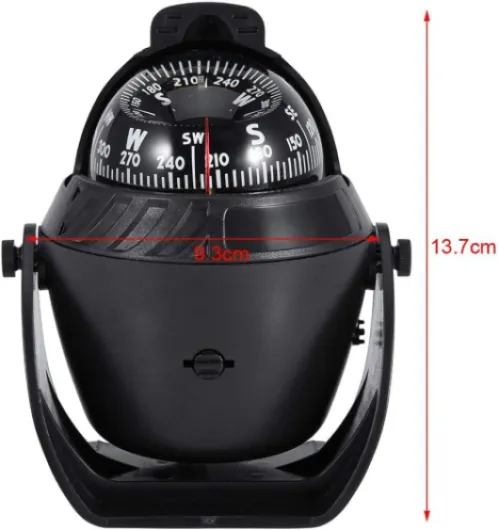
The device itself is about 13.7 cm long and 9.3 cm wide, so it takes a bit of space on a small dashboard. It’s powered from the vehicle’s 12V system for the LED lighting, but the actual compass function is magnetic, not GPS. That means it can be affected by metal parts and electronics around it, which you really feel when you install it too close to the steering column or speakers. The LED is there just to light up the dial so you can read it at night.
One thing that might confuse people: this is sold as a “digital” compass, but the display itself is not a digital screen with numbers; it’s more like an analog dial with an LED backlight. So if you’re expecting a numeric heading like “245°”, that’s not it. You get a standard compass card with markings and a lubber line for your heading. It’s more like a classic marine compass, just with an electronic light and a plastic shell that looks a bit modern.
In practice, the product sits halfway between a traditional boat compass and a cheap car gadget. It’s simple, no fancy functions, no GPS, no data logging. It’s just there to give you a heading reference. That’s fine, but the “high precision” and “digital” words in the listing can be a bit misleading if you don’t read the details. As long as you understand you’re buying a basic magnetic compass with LED light, the product matches what you get in the box.
Pros
- Readable dial with LED backlight that works well in low light
- Adjustable pivoting base makes it easy to aim toward the driver or helm
- Acceptable accuracy for casual use if installed away from magnetic interference
Cons
- Plastic and mounting hardware feel basic and more suited to light use than harsh marine conditions
- Adhesive pad alone isn’t very reassuring in hot or rough environments; screws are almost mandatory
- Arrow points to south, which can confuse users expecting a standard north-pointing compass
Conclusion
Editor's rating
After using the Dioche digital marine compass in both a car and a small boat, my conclusion is pretty straightforward: it’s a budget compass that does the basic job, as long as you install it correctly and don’t expect it to behave like expensive marine equipment. It’s readable, the LED backlight is handy at night, and the pivoting base actually makes everyday use more comfortable. Accuracy is acceptable for orientation, roughly within 5–10 degrees when mounted away from strong magnetic interference, which is enough for casual use.
On the flip side, the build is clearly on the low-cost side: shiny ABS plastic, basic screws, and an adhesive pad that I wouldn’t fully trust in a hot car or on a rough boat without also using screws. It’s not something I’d rely on as my only navigation instrument offshore or in bad weather. I see it more as a helper: for a small lake boat, a fishing dinghy, a camper van, or as a backup reference on the dashboard.
If you’re looking for a cheap, simple compass that you can read easily day and night and you’re okay with “good enough” precision, this one makes sense. If you’re expecting rock-solid marine-grade hardware and perfect bearings, you’ll probably be disappointed and should look at more serious brands, even if it costs more. Overall, it’s decent value for casual users on a budget, not a professional tool.