
Summary
Editor's rating
Value: fair price for reliable recreational fins
Design: long blade, simple strap, no nonsense
Comfort: good once in the water, a bit bulky on land
Materials: mostly plastic, but thought through
Durability: feels sturdy so far, but not indestructible
Performance: strong propulsion without needing pro technique
What you actually get in the box
Pros
- Good propulsion for snorkelling and casual swimming without needing expert technique
- Comfortable foot pocket with soft heel pad and easy-on elastic strap
- Feels sturdy and well-built, with materials that handle salt and chlorine fine so far
Cons
- Long and a bit heavy for travel or crowded pools
- Fit in L/XL can feel slightly loose barefoot at the bottom of the size range

Specifications
View full product page →| Brand | Cressi |
Long fins that actually feel usable for casual swimmers
I bought the Cressi Maui long fins in L/XL mainly for holiday snorkelling and some pool training, nothing professional. I’ve used them for around three weeks now: a few pool sessions of 45–60 minutes and four days of snorkelling in the sea. So this is very much the view of a normal user, not a freediving expert. My shoe size is 44–45 EU, fairly wide feet, and I used them both barefoot and with thin neoprene socks.
The first thing that struck me is how straightforward they are. No fancy gimmicks, just long plastic blades with a soft heel pad and elastic straps. Out of the box they looked a bit big and I was worried they’d be tiring, but in the water they’re actually pretty manageable. They give a good kick without feeling like you’re dragging two planks behind you.
Compared to the short travel fins I used before, these clearly push more water. I noticed it right away when swimming against a light current: fewer kicks to cover the same distance. At the same time, they don’t feel like hardcore freediving fins that demand perfect technique. If your flutter kick is a bit messy, they still work fine, you just splash a bit more.
They’re not perfect though. They’re on the heavier side for travel, and after about an hour of continuous kicking I do feel some fatigue in my ankles. Also, the sizing L/XL is quite generous, so if you’re at the bottom of that range and go barefoot, you might feel some play. Overall though, for casual snorkelling and basic fin training, they get the job done without any nasty surprises.
Value: fair price for reliable recreational fins
In terms of value, I’d say these sit in a good middle ground. They’re not bargain-basement cheap, but they’re also far from the high-end freediving or technical scuba fins that cost a lot more. For the price, you get a pair of long fins that push well, are reasonably comfortable, and come from a brand that at least has a history in water sports. You’re clearly paying for basic reliability, not for fancy materials or flashy design.
Compared to the short travel fins I used before in a similar price range, the Cressi Maui give noticeably better propulsion and feel more robust. The trade-off is they’re bulkier to pack in a suitcase and a bit heavier. If you travel with only hand luggage, that might be an issue. But if you’re checking a bag, they’re manageable. For holiday snorkelling and occasional pool training, I feel like I’m getting my money’s worth.
Where the value is slightly less strong is if you only swim a couple of times a year. In that case, cheaper short fins might be enough, and you’d save on weight and size. These make more sense if you plan to actually use them more regularly or if you want the extra power of a long blade without going into specialist gear. The 2-year warranty is a small bonus that adds to the feeling that you’re not buying disposable plastic.
Overall, I’d call the value “pretty solid”. Not a crazy bargain, but fair for what you get: simple, effective fins that should last a while and do their job without fuss. If that’s what you’re after, the price makes sense. If you want something ultra light or very compact for travel, you might want to look at other options.
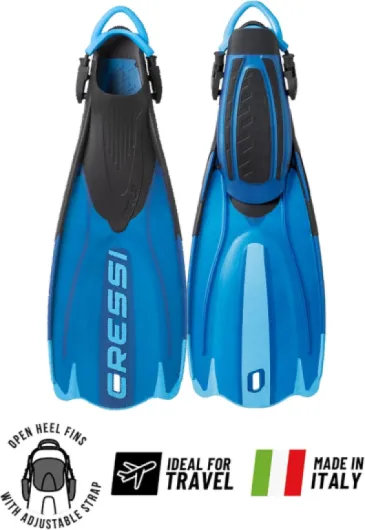
Design: long blade, simple strap, no nonsense
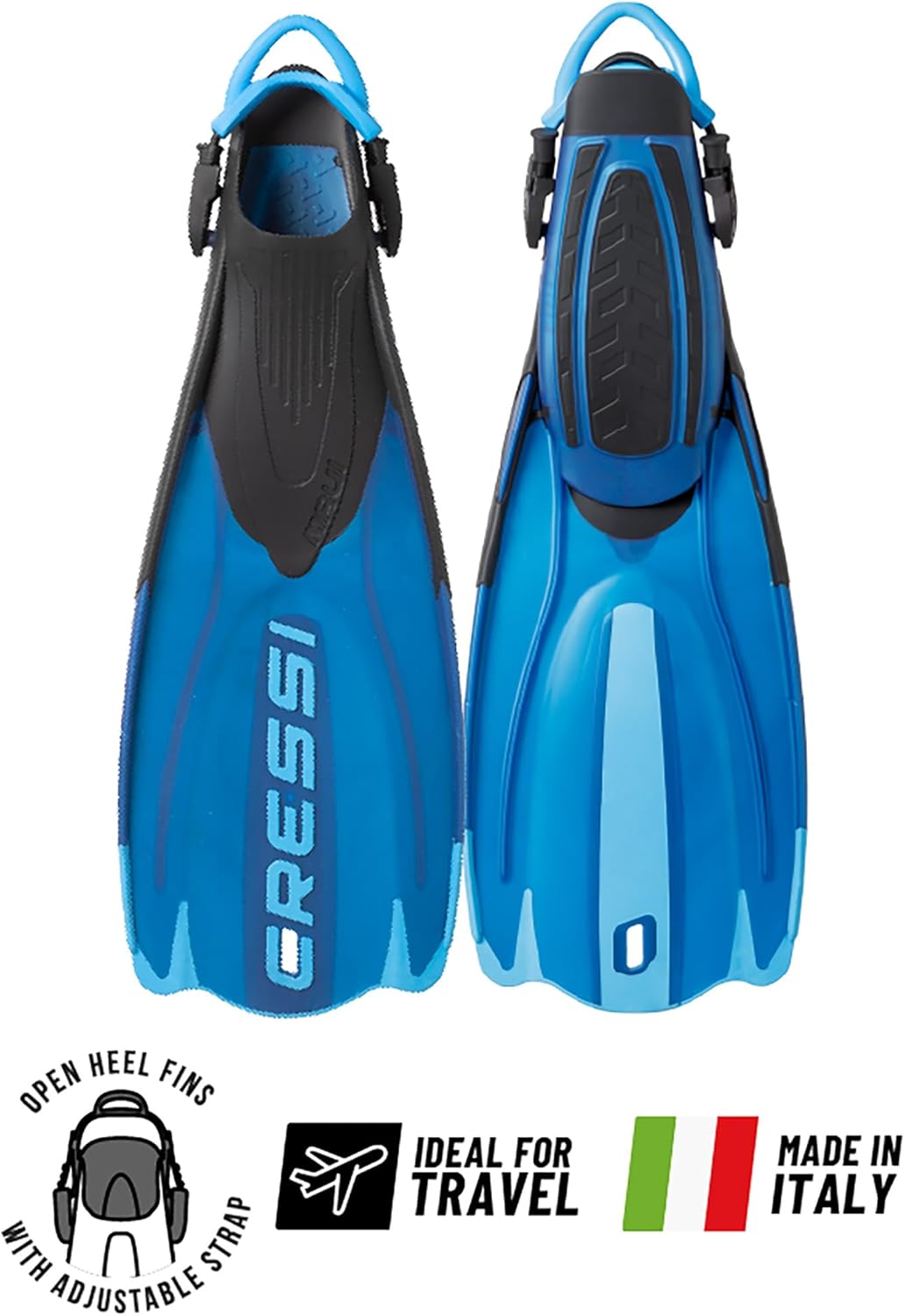
The design is pretty classic for recreational long fins. You’ve got a long plastic blade that’s slightly curved, with side rails that feel a bit stiffer than the centre. The foot pocket is closed at the front (full foot style), but the back is open with the elastic strap and a soft rubber heel pad. So it’s kind of a hybrid between a full-foot fin and an open-heel one. That mix actually works well if you want to use them both barefoot and with thin socks or light booties.
Visually, they’re not trying to be flashy. Two-tone blue, some texture on the blade, and the Cressi logo. The blade has a bit of flex when you bend it by hand, but it’s not floppy. In the water, that translates into a kick that feels firm but not like you’re fighting the fin. I’d say stiffness is in the middle range: enough power for snorkelling and light scuba, but not so stiff that a beginner will hate them after ten minutes.
One design detail I liked is the heel pad. It’s made from softer rubber and is slightly shaped to cup the heel. When you’re climbing a ladder back onto a boat, that padding makes a difference compared to bare plastic digging into your Achilles. The elastic strap is covered with fabric, which is meant to protect it from UV and salt damage. Time will tell, but after repeated sea use and a few lazy rinses, it still looks fine, no cracks or fraying.
If I had to nit-pick, the fins are quite long, so walking around on land with them is awkward, especially on rocks or narrow boat steps. That’s just the nature of long fins though, not a specific flaw of this model. Also, because there is no buckle adjustment, if your foot is at the lower end of the size range, you might feel they’re slightly loose, especially barefoot. In my case (44–45), they felt secure with thin socks and just a tiny bit of movement barefoot, nothing dramatic but worth noting.
Comfort: good once in the water, a bit bulky on land
Comfort was my main concern because long fins can be a pain, literally. I’ve had cheaper fins that felt like they were cutting into the top of my foot after 20 minutes. With the Cressi Maui, it’s a different story. The foot pocket is fairly soft and doesn’t have sharp edges inside. Barefoot, I felt comfortable for full 45–60 minute sessions in the pool. No rubbing on the toes or the top of the foot, and the heel pad really helps avoid pressure on the Achilles area.
With 2 mm neoprene socks, the fit was even better for me. I’m around EU 44–45 and in L/XL they feel snug but not cramped with socks. The elastic strap stretches enough to get your foot in without a fight, but once it’s in, it holds well. I never had the feeling that the fin might slip off, even when doing stronger kicks or diving down a few metres while snorkelling. The lack of buckles also means there’s nothing hard digging into your ankle, which I appreciated.
Out of the water, like any long fin, they’re less comfortable. Walking with them on is awkward, and because the blade is long and a bit heavy, your ankles work a bit when you’re climbing stairs or boat ladders. That’s normal for this type of gear, but if you’re used to short travel fins, you’ll notice the difference. I usually just put them on at the last second in the water to avoid waddling around with them.
In terms of muscle fatigue, they’re okay but not effortless. After an hour of continuous swimming, I could feel it in my ankles and thighs, but not in a painful way, more like a decent workout. If you’re totally untrained or have weak ankles, you might need to start with shorter sessions. Overall, for casual snorkellers and swimmers, I’d say comfort is pretty solid, as long as you pick the right size and maybe use thin socks if you’re between sizes.
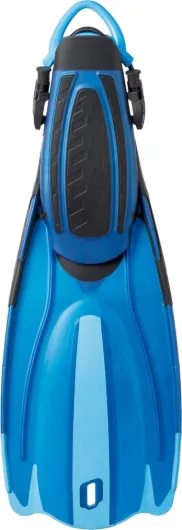
Materials: mostly plastic, but thought through
The fins are officially listed as plastic, and that’s accurate for the blade. It’s a fairly rigid plastic that doesn’t feel brittle. You can flex the blade by hand and it springs back without any creaking or whitening of the material. The foot pocket area uses a softer, rubbery compound, which is noticeably more flexible. You can squeeze it and it gives way, which is what you want around your foot so it doesn’t feel like a hard shell.
The EBS strap is basically elastic bungee covered with fabric. That fabric sheath is there so the elastic doesn’t get hammered directly by sun and salt. It also stops it from pinching your skin. After several sessions in saltwater, then drying in the shade (I wasn’t super careful), there’s no visible damage. No cracking, no loss of tension so far. The heel pad is made from softer anatomical rubber. You can push your thumb into it and it compresses slightly, which is nice when kicking for longer periods.
One thing to keep in mind: because the main blade is plastic, it’s not as light as some composite fins. My pair in L/XL weighs around 1.3 kg according to the specs, and that feels about right in hand. For travel, that’s not ultra light, but it’s still manageable in a suitcase. In the water, you don’t really feel the weight, only when you’re carrying them around or climbing out.
Overall, the materials feel solid for recreational use. You’re not getting top-end carbon or fancy composites, but that’s not what this product is aiming for. It’s basic but sturdy. If you rinse them after sea use and don’t leave them baking in the sun all day, I don’t see any obvious weak points in the construction at this stage. The dual-material approach (stiffer blade, softer foot pocket) does its job: power where you need it, comfort where it matters.
Durability: feels sturdy so far, but not indestructible
Durability is always tricky to judge quickly, but after several weeks of use in both pool chlorine and saltwater, the Cressi Maui fins are holding up well. The blade shows no warping, no cracks and no obvious marks besides a few superficial scratches from contact with rocks and pool walls. The plastic feels like it can take some abuse, which is reassuring if you’re not super gentle with your gear.
The foot pocket and heel pad still look almost new. No tearing, no noticeable stretching, and the softer rubber hasn’t started to peel away from the harder plastic parts. The bonding between the two materials seems solid. I’ve pulled the fins on and off quite roughly a few times on the boat, and nothing has come loose. That’s a good sign for the long term, especially around the heel area where some fins tend to fail.
The EBS elastic strap is the part I was most curious about. So far, the tension feels the same as on day one. The fabric cover hasn’t frayed, and there are no visible salt crystals or stiff spots, even after drying in the shade without a perfect rinse every time. It’s still early days, but it doesn’t give the impression of a weak part. The fact that there are no buckles also means there’s less hardware to break.
I wouldn’t treat them like rental fins that get thrown around on deck all season, but for a regular user who rinses them reasonably often and doesn’t leave them baking in direct sun all day, they feel like they’ll last several seasons. You also get a 2-year manufacturer warranty, which is decent at this price. So, not bomb-proof professional gear, but solid enough for normal holiday and hobby use.
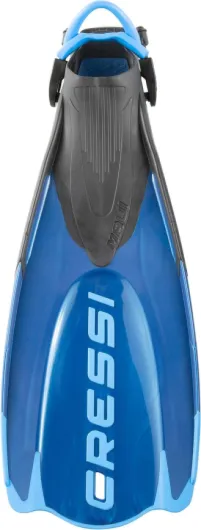
Performance: strong propulsion without needing pro technique
In the water, these fins do what they’re supposed to: they move you forward with less effort than short fins. The long blade gives a noticeable boost, especially when snorkelling on the surface. I compared them directly with my older short travel fins in the same spot. With the Cressi Maui, I reached a buoy about 50–60 metres out with fewer kicks and less feeling of strain. Against a light current, I could still progress at a steady pace without sprinting.
The kick feels fairly stable. They don’t twist or wobble much, even if your technique isn’t perfect. When I did some quick sprints in the pool, the fins responded well and gave a clear increase in speed. For easy cruising, a relaxed flutter kick is enough. I also tried a few dolphin kicks and they handled it fine, though these are clearly more oriented towards standard snorkelling than serious freediving.
For basic scuba, they’re acceptable too. I used them on one shallow dive (around 10–12 metres) with light gear. They had enough power to manoeuvre and deal with small currents, but if you’re planning heavy-duty scuba in strong currents or with a lot of equipment, you might want stiffer fins. For recreational depth and calm conditions, they’re more than enough.
One small downside: because the blade is long, they can feel a bit overkill in a crowded pool. You have to be careful not to kick the person in front of you, and turns at the wall are less agile than with short fins. But that’s the trade-off for the extra propulsion. Overall, for snorkelling, casual training, and light scuba, their performance is solid and easy to handle for non-experts.
What you actually get in the box
Out of the box, the Cressi Maui fins are pretty simple: you get one pair of fins, nothing else. No mesh bag, no spare straps, no fancy manual. Just a cardboard sleeve with some basic info and the fins wrapped in plastic. For the price point, I wasn’t expecting much more, but if you’re used to more complete sets, don’t look for extras here. It’s very much a “here are your fins, go swim” situation.
The model I have is the long version in Blue/Azure, size L/XL (44–47 EU). The colour is exactly what you see on the product page: a medium blue blade with lighter blue accents. It’s not flashy, but you’re visible enough in the water that your buddy can spot you. On the fins you see the Cressi logo and some basic markings, but nothing over-designed. It looks like typical dive shop gear, which is fine by me.
The heel area has this EBS elastic strap system covered with fabric. When you first see it, it looks almost like a bungee cord with a padded section. You don’t get buckles to adjust; instead, the elastic stretches to fit. That means there’s basically no setup: you pull them on and go. For someone who doesn’t want to fiddle with clips on a rocking boat, that’s a plus. On the other hand, if you like precise micro-adjustments to fit, you might miss the traditional buckle system.
Overall, the presentation is basic but practical. You’re clearly buying fins meant to be used, not displayed. No marketing overload on the packaging, just enough info to know the size, colour and warranty (2 years). It matches the product: straightforward, functional, not trying to be more than it is.
Pros
- Good propulsion for snorkelling and casual swimming without needing expert technique
- Comfortable foot pocket with soft heel pad and easy-on elastic strap
- Feels sturdy and well-built, with materials that handle salt and chlorine fine so far
Cons
- Long and a bit heavy for travel or crowded pools
- Fit in L/XL can feel slightly loose barefoot at the bottom of the size range
Conclusion
Editor's rating
The Cressi Maui long fins are a good pick if you’re a casual snorkeller or swimmer who wants more propulsion than short fins without diving into specialist gear. They’re straightforward: long plastic blades, comfortable enough foot pocket, and an elastic strap that makes them easy to put on and take off. In the water, they give solid thrust, handle light currents well, and don’t punish you too much if your technique isn’t perfect. For pool training or relaxed holiday use, they do exactly what you expect.
They’re not ideal for everyone though. They’re relatively long and a bit heavy for travel, and in crowded pools they can feel like overkill. If you only swim a few times a year or you’re obsessed with ultra-compact gear, you might find them a bit much. Also, if you’re at the very bottom of the L/XL size range and go barefoot, the fit might feel slightly loose, so thin socks are a good idea. They’re fine for light scuba, but if you dive a lot in strong currents or with heavy gear, you might want stiffer fins.
Overall, I’d recommend them to people who snorkel regularly on holidays, do some casual fin training, or want a simple, reliable pair of long fins from a known brand without spending a fortune. If you want ultra-high performance or super travel-friendly size, look elsewhere. For regular recreational use, they’re a solid, no-drama option that gets the job done.