
Summary
Editor's rating
Price versus what you actually get
Compact blade, open heel, and travel-focused design
Fit, foot pocket, and real-world comfort
Rubber pocket and EVA/TPR blade: solid but not luxury
Build quality and how they hold up to abuse
How they actually move you in the water
What you actually get out of the box
Pros
- Comfortable rubber foot pocket that works barefoot or with thin socks
- Compact, lightweight design that fits easily in luggage while still giving decent thrust
- Sturdy strap and buckle system with a big thumb loop that makes them easy to put on and take off
Cons
- Short blade limits power in strong currents or for more demanding dives
- No extras like a mesh carry bag included despite mid-range pricing

Specifications
View full product page →| Brand | Cressi |
Short fins for real use, not just pool toys
I’ve been using these Cressi Star fins (size L/XL, I’m UK 10.5) for a few pool sessions and a couple of snorkeling days off the coast. I bought them mainly as a compact option to throw in a carry-on, because my long fins are a pain to travel with. I wasn’t expecting miracles from such short blades, more something that just gets the job done without killing my legs.
First impression: they’re pretty compact and light, but they don’t feel like cheap plastic. The open heel and strap system is closer to what you get on real scuba fins than on basic snorkeling toys. You can tell Cressi actually comes from the diving world and not from random beach gear. I’ve used a few generic Amazon fins before, and those felt flimsy compared to these.
In practice, I used them barefoot in a warm pool and with thin neoprene socks in the sea. Both worked. No hotspots, no crazy rubbing, and the straps stayed locked. I did a few surface swims of 30–40 minutes and a handful of short duck dives down to 3–4 meters. You feel the shorter blade, but you’re not stuck like with hotel rental junk. They move you along at a decent pace without needing bodybuilder legs.
So far, I’d sum them up like this: solid little travel fins with real performance for snorkeling and pool work, but not a full replacement for proper long fins if you’re planning strong currents or deep dives. They sit nicely in the middle: more serious than tourist gear, less bulky than full-size scuba fins.
Price versus what you actually get
In terms of price, these sit in the mid-range for short travel fins. They’re not the cheapest ones you’ll find online, but they’re also far from the top-end scuba fins that cost a small fortune. For the money, you’re paying mainly for a known dive brand, better materials than generic no-name fins, and a design that’s actually thought through for real use, not just beach rentals.
Compared to the random cheap fins I’ve tried before (the kind that show up under “snorkeling set” with a mask and snorkel included), the Cressi Star fins feel like a clear step up. The comfort alone is worth a chunk of the price difference. I’ve had cheap fins that gave me blisters after 20 minutes or felt like they could crack if I kicked hard. Here, you get a more secure and comfortable fit, plus a blade that actually converts your effort into decent propulsion.
On the downside, you don’t get extras like a mesh bag or a fancy case, and they’re still short fins. If you know you’ll be diving in strong currents or doing a lot of deep dives, you might be better off spending a bit more on full-length fins and accepting the extra bulk in your luggage. For pure pool use, you could also get cheaper training fins, but those usually don’t have the same open-heel strap system or versatility with socks.
Overall, I’d say the value is good, especially if you travel regularly and want one pair of fins that can handle both pool practice and holiday snorkeling without taking over your suitcase. They’re not a bargain-bin deal, but you’re clearly getting something better than entry-level plastic. For most casual snorkelers and occasional divers, the price-to-performance ratio makes sense.
Compact blade, open heel, and travel-focused design
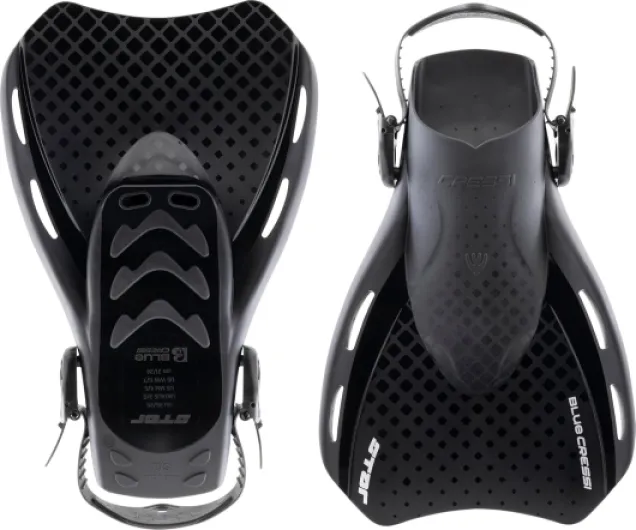
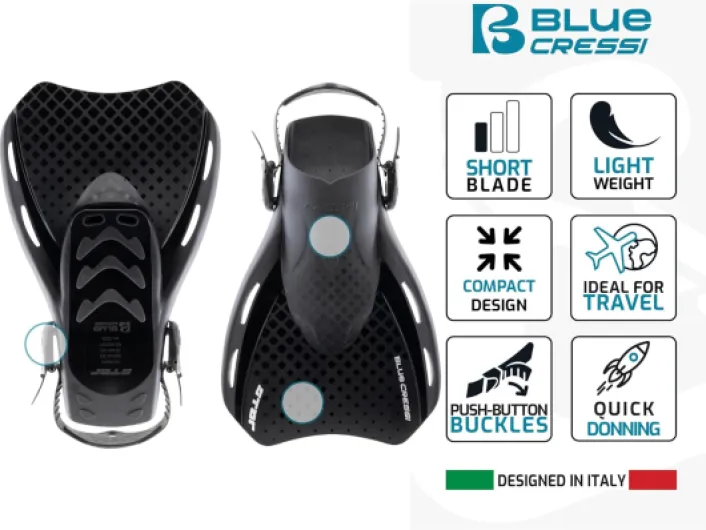
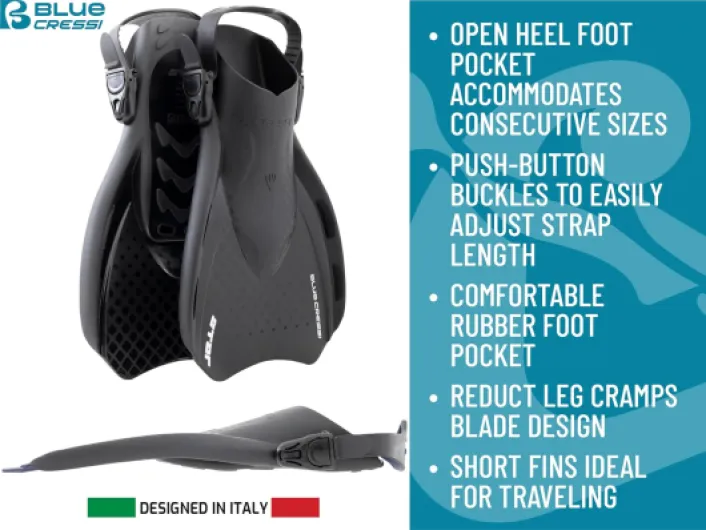
The main design choice here is the short, vented blade combined with an open-heel foot pocket. Compared to my longer Mares snorkeling fins, these Cressi Star fins are noticeably shorter and a bit wider. The idea is clearly to give you enough thrust for casual snorkeling and pool work, while keeping the fins small enough to pack easily and use in tight spaces like crowded pools or shallow rocky entries.
The blade has vents near the top and a dual-composite structure. In the water, that translates into a kick that feels smoother than a flat, fully rigid blade. You don’t get that heavy resistance at the end of each kick, but you still feel a decent push. For surface swimming, that’s actually pretty nice. You can keep a steady flutter kick without your legs burning after five minutes. For strong currents, though, the short length means you’ll hit a limit sooner than with long fins.
The open-heel design with adjustable straps is a big plus if you share gear or switch between barefoot and neoprene socks. I used them barefoot in the pool and with 3 mm socks in the sea. Adjusting the strap between the two took a few seconds per fin. The buckles feel solid and don’t pop open accidentally. The big thumb loop at the back is simple but genuinely useful when you’re standing in the water and trying not to fall while putting them on.
One thing to note: because they’re short and fairly stiff in the middle, the fins respond quickly to small kicks, which is good for maneuvering around rocks or in a pool lane. But if you’re used to big, slow kicks with long fins, you’ll need to adjust your technique a bit. They’re designed more for relaxed, frequent small kicks rather than huge, powerful strokes. For the use case they’re aimed at—travel, snorkeling, pool training—the design actually makes sense and feels well thought out.
Fit, foot pocket, and real-world comfort
I’m UK 10.5 with a fairly wide forefoot, and I took the L/XL size that covers UK 9–12. Comfort was one of my main worries because short fins are often treated like toys and not shaped properly. Here, the foot pocket is actually well done. The rubber is soft enough to flex around the top of the foot, and there’s enough volume so you don’t feel like your toes are getting crushed. At the same time, it’s not so loose that your foot swims around.
In the pool, I used them barefoot for about an hour total, doing laps and some drills. No rubbing on the heel, no red marks on the sides of my feet. The only thing I felt was a slight pressure on the top of the foot when I overtightened the strap at first. Once I loosened it a notch, it was fine. The strap distributes pressure fairly evenly, and the heel cup holds your foot without digging into the Achilles tendon. That’s something I’ve had issues with on cheaper fins where the back edge is too sharp.
In the sea, I wore 3 mm neoprene socks for two 40-minute snorkeling sessions. With socks, the fit was snug but comfortable. I adjusted the straps a bit looser, and there was no heel slip even when kicking harder. Climbing in and out over rocks, the big thumb loop helped a lot: I could hold onto a rock with one hand and pull the fin off with the other without fighting it. Walking a few steps in shallow water with the fins on is manageable because they’re short, so you’re less likely to trip compared to long blades.
Overall, comfort is one of the strong points. They’re not as plush as some high-end scuba fins, but for travel and casual use, they’re definitely above average. If your feet are extremely narrow or extremely wide, you might need to play with socks or strap tension, but for a normal foot within the size range, they’re pretty forgiving. I didn’t finish any session thinking about my feet, which is basically the best compliment you can give fins.
Rubber pocket and EVA/TPR blade: solid but not luxury
Material-wise, Cressi went with a rubber foot pocket and an EVA/TPR type plastic for the blade and frame. In the hand, the pocket feels soft and slightly grippy, more like a real dive fin than the hard plastic you get on cheap supermarket fins. The blade is stiffer, with a bit of flex if you bend it, but it’s not floppy. You can feel the dual-composite idea: softer zones to help flex, stiffer ribs to channel the power.
In the water, that mix works fairly well. The rubber foot pocket wraps around the foot and doesn’t feel like it’s cutting into the top of your foot or your heel. I did a couple of 45-minute swims and got no blisters or weird pressure points, which is usually where cheap materials show their limits. The EVA/TPR blade feels robust enough that I wasn’t scared to bump it into rocks or pool walls. I did knock them a few times getting in and out over stones, and there are only light scuff marks, nothing serious.
They don’t have that super high-end feel of some expensive carbon or advanced polymer fins, but that’s not really the point here. These are mid-range materials that are clearly chosen for durability and ease of use. The buckles and straps also feel thicker than the usual low-cost stuff: the plastic doesn’t creak when you pull on it, and the strap has enough elasticity to stay snug without feeling like a rigid band.
Overall, I’d say the materials are pretty solid for the price range. You’re not getting premium tech, but you’re also not getting brittle plastic that’s going to crack after a season. For travel fins that might get thrown in bags, stepped on on the boat, or rinsed quickly and left to dry in the sun, they seem up to the task. Time will tell on long-term UV exposure, but after my sessions and some rough handling, they still look close to new.
Build quality and how they hold up to abuse
I haven’t owned them for years obviously, but I did try to be a bit rough in my short test window to see how they react. I used them in a chlorinated pool a few times and in the sea with some contact against rocks and steps. After each session, I gave them a quick rinse and let them dry in the shade. So far, there’s no sign of the rubber drying out or the plastic whitening or cracking, which is a good start.
The parts that usually fail first on fins are the buckles and straps. Here, the buckles feel solid and have a reassuring click when you adjust them. I pulled on the straps quite hard a few times, both when tightening and when yanking the fins off, and nothing slipped or felt like it was about to snap. The strap itself is quite thick and elastic enough to take some abuse. If something does fail in the long run, it would probably be this part, but at least it doesn’t feel fragile out of the box.
The blade edges and vent areas also look robust. I kicked a few pool walls and scraped the bottom in shallow rocky areas without being super careful. The fins came out with minor cosmetic scuffs but no chunks missing or deep cuts. The connection between the foot pocket and the blade is clean, with no visible gaps or weak-looking joints. That’s often where cheaper fins start to separate after a while.
Given the 2-year manufacturer warranty and Cressi’s general reputation in diving gear, I’d expect these to last several seasons for a casual user who travels a few times a year and maybe uses them in a pool occasionally. If you’re a dive instructor using them daily, you might want something more heavy-duty, but for holiday and weekend use, the durability seems more than acceptable. Not bulletproof, but definitely not flimsy.
How they actually move you in the water
Let’s be clear: these are short fins, so you shouldn’t expect the same power as big scuba or freediving fins. That said, for their size, they perform pretty well. In the pool, doing steady laps on the surface, I was roughly 10–15% slower than with my longer snorkeling fins, but with less leg fatigue over time. The shorter blade and vented design make for a lighter kick. You can keep a high cadence without your thighs burning, which is good for casual swimmers or people working on technique rather than speed records.
In the sea, I tested them in mild conditions: light chop, no serious current. For snorkeling on the surface, they’re more than enough. I could easily keep up a relaxed pace following fish and moving between spots. Duck diving down to 3–4 meters was fine too. You feel the lack of length when you try to accelerate quickly from the bottom, but you still get enough push to get back up without struggling. If you’re planning proper freediving or strong current drift dives, I’d still choose long fins, but that’s not really what these are built for.
One thing I liked is the control. Because they’re short and respond quickly to small kicks, turning around, backing up a bit to avoid touching coral, or maneuvering around rocks feels easy. You don’t have that feeling of oversteering you sometimes get with long blades. For beginners or for people in crowded snorkeling spots, that’s quite handy. You can change direction without having to plan three kicks ahead.
So in terms of raw performance, I’d call them “pretty solid for travel fins.” They won’t replace big fins for demanding dives, but for pool training, resort snorkeling, and casual fun in the sea, they get the job done without making you feel underpowered. If you go in with realistic expectations for a compact fin, you’ll probably be satisfied with how they move you around.
What you actually get out of the box
Out of the box, it’s simple: you get one pair of fins, no bag, no extras, no manual beyond a basic tag. The model I have is the all black / black version in L/XL, which is meant to cover UK 9–12. The fins are short, so don’t expect those long freediving blades. Each fin is about the length of my forearm. That’s what makes them interesting for travel: they fit easily in a regular suitcase or even a bigger backpack.
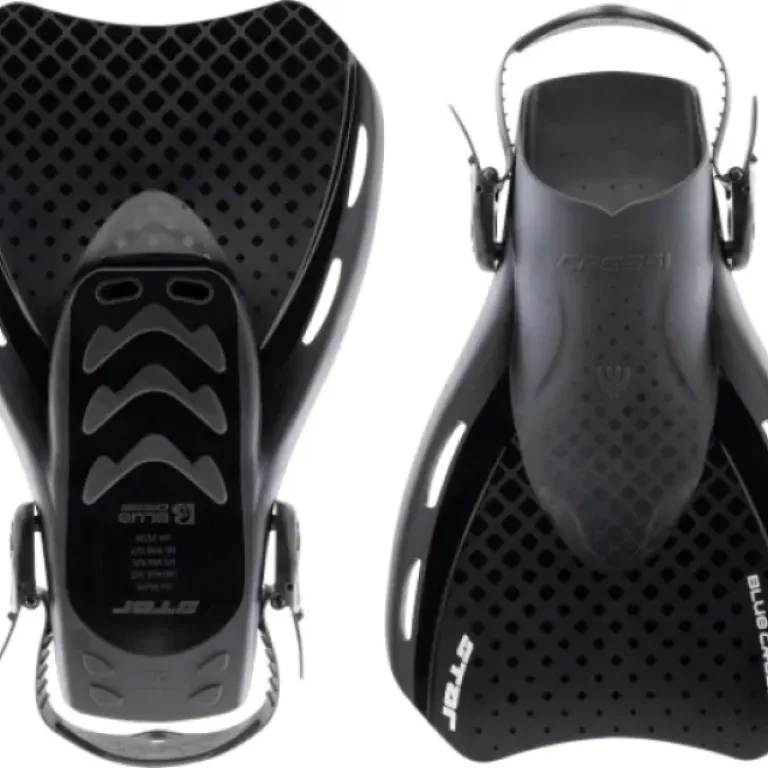
The overall look is pretty basic but in a good way. No flashy colours or weird patterns. They look like functional dive gear, not beach toys. The blade has vents and a dual-material construction, with a stiffer central area and softer sides. The foot pocket is made of a softer rubber, the rest feels more like EVA/TPR plastic. You see a clear distinction between the flexible pocket and the more rigid blade.
On the back, you’ve got classic adjustable straps with quick-release buckles. The thumb loop is actually big enough to grab easily, even with wet fingers. That’s not just a gimmick; when you’re on a rocking boat or standing in the surf, being able to yank the fins on or off without fighting tiny tabs makes a difference. The buckles rotate enough to adapt to the angle of your foot without digging into your ankles.
Overall, the presentation is very straight to the point: one solid pair of compact fins, ready to go. No fancy packaging, no carrying bag. It feels more like gear you’d buy in a dive shop than a gift item. If you want something that looks premium in the box, this isn’t it. If you just care about having functional fins that don’t take up half your luggage, they tick the box.
Pros
- Comfortable rubber foot pocket that works barefoot or with thin socks
- Compact, lightweight design that fits easily in luggage while still giving decent thrust
- Sturdy strap and buckle system with a big thumb loop that makes them easy to put on and take off
Cons
- Short blade limits power in strong currents or for more demanding dives
- No extras like a mesh carry bag included despite mid-range pricing
Conclusion
Editor's rating
After using the Cressi Star fins in both pool and sea, my takeaway is pretty straightforward: they’re solid compact fins that do what they’re supposed to do without drama. The main strengths are the comfortable rubber foot pocket, the secure strap and buckle system, and the fact that, despite their short length, they still give you decent propulsion for snorkeling and casual swimming. They feel like real dive gear, just shrunk down for travel and pool use.
They’re not perfect, of course. The short blade has its limits in terms of raw power, so if you’re planning heavy-duty diving in strong currents or serious freediving, you’ll want longer fins. You also don’t get any extras in the box, and they’re not the cheapest option if you only want something for occasional hotel pool splashing. But if you travel a bit, like to snorkel properly rather than just float around, and want fins that fit easily in your luggage without killing your legs, they make a lot of sense.
I’d recommend these mainly to travelers, casual snorkelers, and people who want a decent pair of fins for pool training or holiday use, with enough comfort and build quality to last several seasons. If you’re a hardcore diver or chasing maximum performance, look at longer, more technical fins. For everyone else who just wants compact, reliable fins that get the job done, these are a pretty solid choice.