
Summary
Editor's rating
Is it worth the money compared to other options?
Small, simple design with a very long leash
Battery life: long sessions, but no fancy indicators
Build quality and how tough it actually feels
Image quality and real-world use on the water
What you actually get and what it really does
Pros
- Long-lasting 5000 mAh battery that easily covers a full day of fishing
- 30 m sturdy cable lets you reach deeper spots from boat, bank, or ice
- Simple, plug-and-play live video that clearly shows fish, bait, and structure in decent conditions
Cons
- Real-world video looks closer to 640×480 than the advertised 1080P
- Cable management is cumbersome, especially from a moving boat
- Build quality feels budget and non-modular, so a damaged cable or camera likely means replacing the whole unit

Specifications
View full product page →| Brand | Agrdeed |
A wired underwater camera that’s more toy than pro tool
I’ve been using this Agrdeed underwater fishing camera for a handful of sessions: two short trips on a small lake from a boat, one evening on a river, plus one quick test in a garden pond just to see what the image actually looks like. So this isn’t lab testing, it’s just how it behaved in real, slightly messy conditions. I already own a basic Deeper sonar and I’ve played with a friend’s more expensive underwater cam, so I’ve got a rough idea of what you can expect at different price points.
The first thing to know: this is not a high-end, pro-level tool. It’s a simple wired camera with a small screen. It’s more about seeing what’s going on under the surface for fun and a bit of info than about hardcore fish finding with precise depth charts and all that. If you’re expecting something like a Humminbird or Garmin sonar, you’re going to be disappointed. If you just want to drop a camera and watch fish swim around or check what the bottom looks like, it’s more in that lane.
In practice, I used it mainly to check structure: where the weeds stop, where it turns into rocks or mud, and if there are actually fish cruising near my bait. It’s handy for that, especially in clear water. But between the 30 m cable, the basic resolution, and the slightly cheap-feeling build, you can feel where they saved money. You get a tool that works, but you also have to accept some compromises.
Overall first impression: good little gadget for the price if you keep your expectations realistic. It’s fun, kids like it, and it’s useful for checking underwater terrain. But it’s not something I’d rely on as my main fish-finding system, and it doesn’t feel like gear that will survive years of hard abuse without care.
Is it worth the money compared to other options?
Looking at the price range this sits in, I’d say the value is pretty solid, as long as you understand what you’re buying. You get a complete underwater viewing setup – screen, camera, 30 m cable, and a big battery – for about what some brands charge just for a basic sonar sensor. If your main goal is to literally see fish and structure with your own eyes, that’s tough to beat at this cost. For kids who like watching fish in a pond or from a jetty, it’s also a fun toy that actually has some fishing utility.
Where the value drops a bit is if you were hoping for a true "fish finder" in the sonar sense. This doesn’t map depth, doesn’t show fish icons, and doesn’t give you any numerical data. It’s just a camera. For some people, that’s enough. For others, they’d be better off putting the money towards an entry-level sonar from a known brand. Also, the whole 1080P claim in the title vs. 640×480 in the specs feels a bit like marketing stretch, so you have to accept that you’re not getting crystal-clear HD.
Compared to more expensive underwater cameras (Aqua-Vu, Marcum, etc.), you’re obviously missing things like better resolution, recording, stronger lights, and rugged cases. But you’re also paying a fraction of the price. If you fish casually and just want to check spots now and then, dropping big money on a pro system doesn’t always make sense. This Agrdeed unit kind of fills that gap: cheap enough that it’s not a big risk, useful enough that it doesn’t just sit in a drawer.
So in terms of value for money, I’d put it at a good 4 out of 5. It’s not flawless, and there are some quality and spec compromises, but for what you pay you get a working underwater camera that actually helps you understand what’s happening under the surface. If you want rock-solid build and top image quality, spend more. If you want a fun and practical gadget on a budget, it’s worth considering.
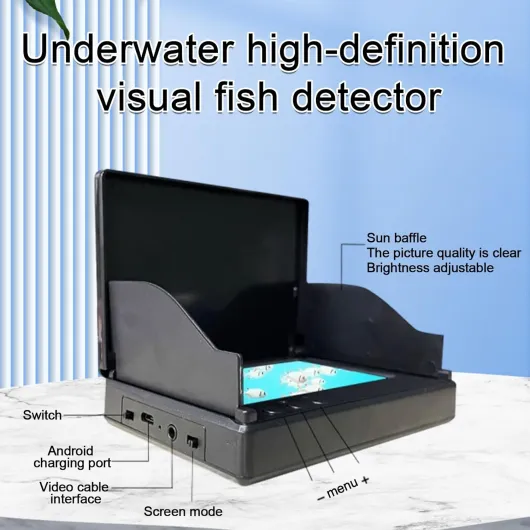
Small, simple design with a very long leash
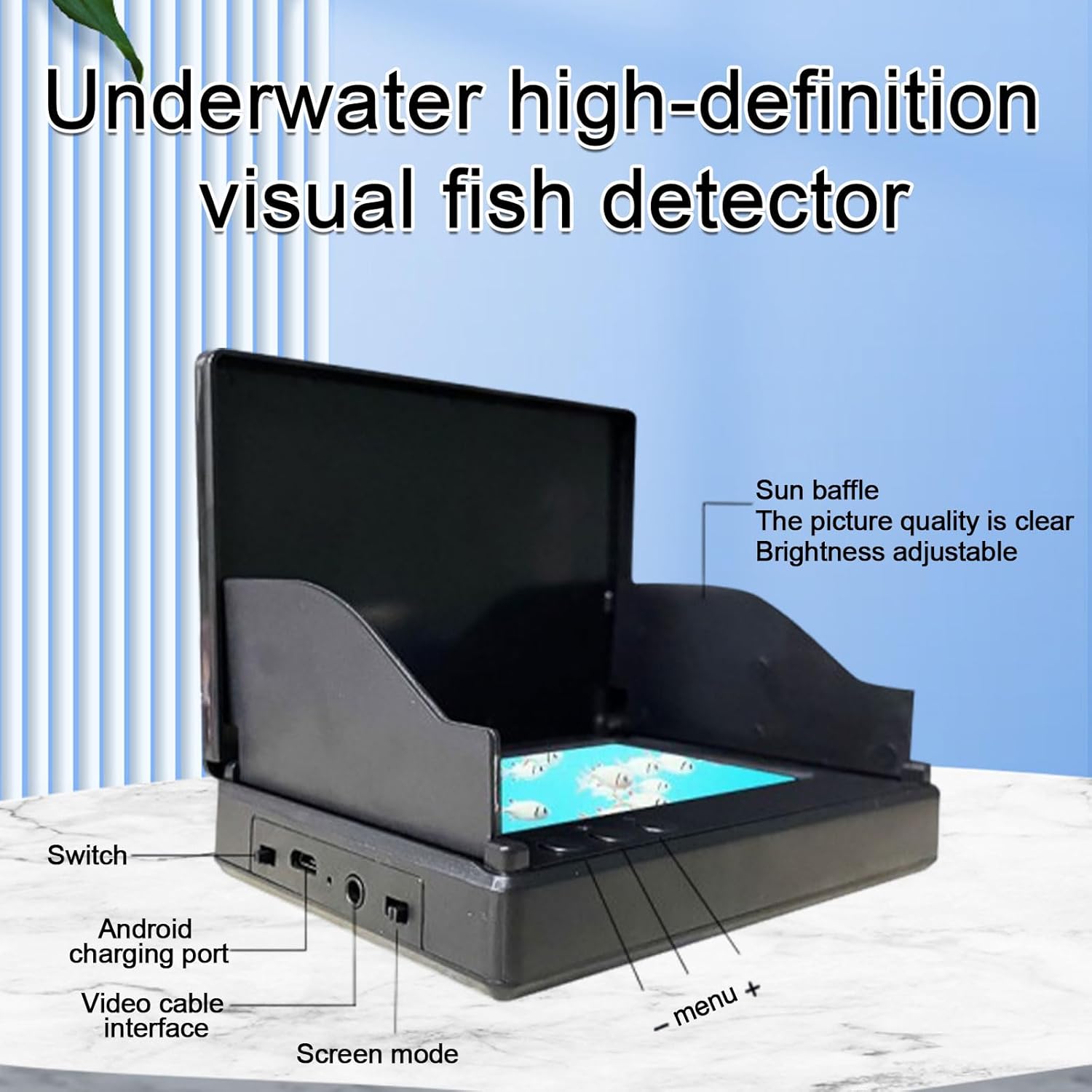
Design-wise, it’s very no-nonsense: small rectangular 4.3'' IPS screen, a few buttons on the front, and the cable coming out of the side. The body is rated IP65, so it’s fine with splashes and rain, but I wouldn’t drop the screen unit into the water on purpose. The camera head itself is waterproof obviously, and it’s shaped like a small bullet/torpedo with the LEDs around the lens. It doesn’t look fancy, but it’s compact enough that fish don’t seem too spooked once it’s sitting still.
The big design feature is that everything is wired and fixed. The camera is permanently attached to the 30 m cable, and that cable is permanently attached to the screen unit. No connectors to unplug, which is probably good for waterproofing but bad if something gets damaged. If you kink the cable badly or cut it on a rock, you’re basically done; there’s no easy way to replace just the cable or the camera. For a budget product, that’s kind of expected, but it’s worth knowing before you start dragging it over sharp stuff.
The bracket for mounting on a fishing rod is a nice idea but in practice I didn’t use it much. Once the camera is in the water, I found it easier to manage the cable by hand or hang it off the side of the boat. With 30 m of cable, the rod mount ends up feeling awkward unless you’re only dropping it a few meters. If you mainly want to use it for ice fishing or from a fixed spot (like a jetty), the design makes more sense: screen on your lap or a bucket, cable going straight down.
Overall, the design is functional but clearly budget. Plastic feels light, buttons are a bit clicky and cheap, and there’s no real protection on the screen. I’d absolutely throw it in a small padded pouch or box instead of just tossing it loose in a tackle bag. It doesn’t scream “fragile toy,” but it also doesn’t feel like rugged military gear. For the price, I’d say the design choices are fair, just don’t abuse it and expect miracles.
Battery life: long sessions, but no fancy indicators
The built-in 5000 mAh battery is one of the better points of this camera. The brand claims around 8–9 hours, and from my use that’s roughly accurate. I ran it for a full afternoon session (about 5 hours on and off, screen brightness at a normal level, LEDs used occasionally), and I still had juice left. On another test I left it running at home in a bucket just to see how long it would last, and it made it past the 8‑hour mark before dying. So for a normal day of fishing, you’re not going to be stressing about the battery.
Charging is via a basic USB cable. I just plugged it into a regular phone charger and it took a few hours to go from nearly empty to full, nothing surprising there. There’s a basic battery icon on the screen, but it’s not super precise – more like rough segments than an exact percentage. So you know if you’re half full or almost empty, but not much more detail than that. Still, given the long runtime, I never felt caught out by it.
One thing I liked is that you can also plug it into a power bank if you really want to stretch it on long trips. I tried running it from a small 10,000 mAh power bank just to check, and it worked fine; no weird behavior or cutouts. For camping or multi-day trips, that’s handy: charge it at night, and you’re good for another day. There’s no hot-swappable battery or anything fancy like that, but for this price range, that’s normal.
Overall, I’d say the battery is one of the strong points of the device. You set it up, fish all day, and you don’t really think about it. The only minor gripe is the lack of a detailed battery percentage and no fast-charging claim, but for a simple gadget like this, that’s nitpicking. As long as you charge it before going out, it just runs.
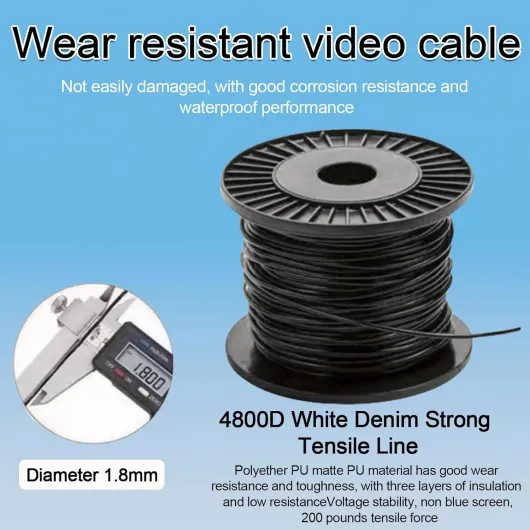
Build quality and how tough it actually feels
Durability is where you feel that this is a budget product from an unknown brand. After a few outings, nothing has broken on mine, but I’m also not throwing it around. The screen unit casing is light plastic, and while it doesn’t feel like it will crack from a small bump, I wouldn’t trust it to survive being stepped on or crushed in a packed tackle box. The IP65 rating is fine for rain and splashes – I had it out in light drizzle and it was totally fine – but I’m careful not to dunk the screen itself.
The camera head and cable feel more solid. The cable is fairly thick and has a bit of stiffness to it, and they claim it can handle up to 60 kg of load. I obviously didn’t hang 60 kg off it, but I did snag it once on some submerged branches. I pulled pretty hard to free it and nothing snapped or stripped, so that’s reassuring. Still, cable damage is the most likely failure point long-term. If you drag it over rocks or shells a lot, I’d expect the outer jacket to start showing wear after a while.
One thing to keep in mind: everything is fixed and non-modular. If the cable gets badly damaged or the camera head leaks, there’s no simple way to replace just that piece. On more expensive systems you sometimes get detachable cables or serviceable parts – here it’s all one unit. So from a long-term durability perspective, you kind of treat it like a single gadget: if one critical part dies, you’re looking at a full replacement.
After my use, I’d call the durability "decent if you’re not rough." It’s fine for normal weekend fishing, pond watching, and the occasional boat trip, especially if you store it in a small case and don’t yank the cable around like a winch. If you’re the type who throws gear in the back of a pickup and lets it rattle around, I’d be less confident. In that sense, it’s aligned with the price: not junk, but also not bomb-proof.
Image quality and real-world use on the water
On the performance side, the camera is okay but not mind-blowing. In clear water and daylight, you can clearly see fish, your lure or bait, and the structure. The claimed 1080P doesn’t match what I’m seeing; it definitely looks more like standard definition, which lines up with the 640×480 spec in the description. So if you’re picky about image sharpness, this will feel a bit soft. For actual fishing use, though, it does the job: I could see small perch and roach, and even watch how they reacted to my bait.
The six infrared LEDs help a bit in lower light, but don’t expect miracles there either. In murky water or late in the evening, the image gets grainy and washed out pretty fast. IR light also tends to reflect off particles in the water, so if the water is cloudy you mostly see a glowing fog. In a reasonably clear lake at around 3–4 m depth, I still had a usable picture as long as there was some ambient light. For ice fishing or deeper water, it’s going to depend heavily on how clear your spot is.
Latency is basically nonexistent since it’s wired – what you see on the screen is happening in real time, which is nice when you’re trying to see how fish react. Compared to a sonar, the big difference is that this is visual only: no depth numbers, no fish arches, nothing. You see what the camera sees, that’s it. It’s great for understanding how fish behave around structure or bait, but if you want to scan a big area quickly, a sonar is much more efficient.
In use, the biggest downside performance-wise is handling the cable. Wind, current, and boat drift all move the camera around. You spend time untwisting and repositioning if you want a stable view. From the bank or through ice, where the camera just hangs straight down, it’s much more pleasant. So I’d say performance is solid for static or semi-static fishing (ice, pier, anchored boat), a bit annoying if you’re drifting or constantly moving spots.
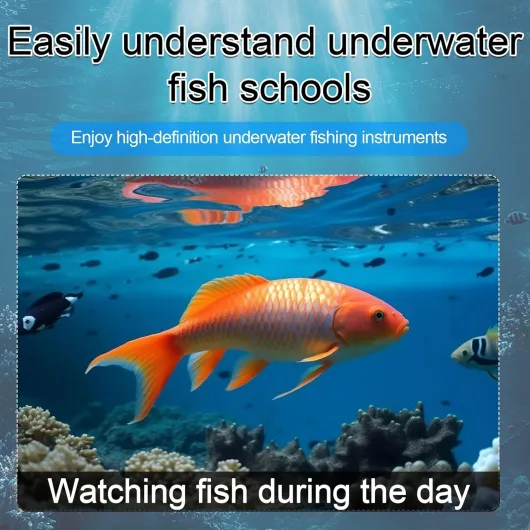
What you actually get and what it really does
Out of the box, you get: the 4.3-inch screen unit, the camera head with a 30 m cable permanently attached, a small bracket to fix it to a rod, a USB charging cable, and a basic manual. The manual is a bit rough (translation isn’t great), but you don’t really need it; the thing has like three buttons and is mostly plug-and-play. There’s no app, no Wi‑Fi, no recording to a card mentioned in the listing I saw – it’s just live video on the screen. So if you were hoping to save clips or share them easily, that’s not really the point of this model.
The brand claims 1080p in the title but the specs talk about 640×480 video. In real life, it looks closer to 480p than 1080p. Don’t expect crisp HD like a GoPro. You see fish, you see weeds, you see the hook, but details are a bit mushy, especially if visibility isn’t great. That said, for actually checking "are there fish here and what’s the bottom like?" it’s good enough. In clear water, I could easily see small fish around the bait at 1–2 meters from the camera.
The 30 m cable is both a strength and a pain. Strength because you can really drop it deep from a boat or pier, and it’s rated to hold up to 60 kg so you’re not going to snap it easily if something tangles it. On the other hand, managing 30 m of cable is annoying. It tangles, it gets wet and dirty, and you end up with a bit of a mess in the boat or on the bank if you’re not methodical winding it back up.
Function-wise, I’d describe it as:
- Underwater viewer (see bottom, weeds, fish)
- Basic fish presence checker (you can literally see if anything is moving around)
- Kids’ entertainment (watching fish in a pond or off a jetty is fun)
Pros
- Long-lasting 5000 mAh battery that easily covers a full day of fishing
- 30 m sturdy cable lets you reach deeper spots from boat, bank, or ice
- Simple, plug-and-play live video that clearly shows fish, bait, and structure in decent conditions
Cons
- Real-world video looks closer to 640×480 than the advertised 1080P
- Cable management is cumbersome, especially from a moving boat
- Build quality feels budget and non-modular, so a damaged cable or camera likely means replacing the whole unit
Conclusion
Editor's rating
After using this Agrdeed underwater fishing camera in a few real situations, my take is pretty simple: it’s a fun, useful, budget-friendly gadget, but it’s not pro gear and it’s not a real sonar. The image is good enough to see fish, bait, and structure, the 30 m cable lets you reach decent depths, and the battery life is long enough for a full day without worrying. For casual anglers, parents with kids who like watching fish, or anyone curious about what’s actually under their feet, it gets the job done without costing a fortune.
On the flip side, you have to live with a few downsides: resolution that feels more like 480p than the "1080P" in the title, a big cable that can be annoying to manage, and build quality that’s fine but clearly budget. There’s also no recording, no app, and no real fish-finding data beyond what you see on the screen. If you want real mapping, depth numbers, and serious durability, you’re better off with a known-brand sonar or a higher-end camera.
So who is it for? It suits anglers who fish from shore, jetties, small boats, or ice and want a visual check of spots without spending a lot. It’s also good for simple observation in ponds or tanks, like the Amazon reviewer using it for goldfish. Who should skip it? People who want precise fish-finding tools, high image quality, or ultra-rugged gear for heavy use. For me, it lands as a decent, slightly rough-around-the-edges tool that offers good value if you keep your expectations realistic.