
Summary
Editor's rating
Value: strong performance per euro, with a few compromises
Design: long blade, simple look, built for push not style
Comfort: good when sized right, but bare feet can suffer
Materials and build: stiff blade, softer pocket, decent quality for the price
Durability: looks solid, but treat the blade–foot joint with respect
Performance: strong push and efficient, but they’ll work your legs
What you actually get when you buy these fins
Pros
- Strong thrust and efficient kick for snorkelling, skin-diving and light scuba
- Sturdy polypropylene blade and decent build quality for the price
- Simple, full-foot design with good power transfer and low drag
Cons
- Can cause chafing when used barefoot for long sessions; socks are recommended
- Full-foot design limits use mostly to warm water and pool conditions
- Fit can be tricky if you are between sizes or have wide/high-volume feet

Specifications
View full product page →| Brand | Cressi |
Full-foot fins that don’t mess around
I’ve been using the Cressi Pro Star full foot fins in size 45/46 (black) for a handful of pool sessions and a couple of sea trips, mainly snorkelling and a bit of light scuba in warm water. I usually wear EU 45 in trainers and 44.5–45 in street shoes, so this size is right in my range. I used them both barefoot and with thin neoprene socks to see the difference. I’m not sponsored, I paid for them, and I’m not precious about babying my gear, so they got tossed in the boot, on the deck, and in rinse tanks like any normal person would do.
The first thing that stood out is how much thrust you get for a pretty reasonable price. They’re clearly more powerful than the usual short travel fins you get in holiday packs, and they feel closer to proper freediving-style fins, just shorter. You really notice that when you’re swimming against a bit of current or towing a buddy who’s not kicking much. At the same time, they’re not featherweight on the legs: if you’re not used to longer, stiffer fins, your calves will wake up fast.
Another obvious point: these are full-foot fins, not open-heel with straps. That means they’re best for warm water and pool use, or maybe with thin socks. If you’re used to chunky boots and open-heel fins, this is a different world. You gain a more direct feel and less drag, but you lose the easy adjustability and protection when walking on rocks. If you buy them thinking they’ll do everything, you’ll be annoyed; if you want simple warm-water fins with good push, they make sense.
Overall, my first impression is: pretty solid fins for the money, powerful, but not for everyone. They’re made for people who want to actually swim, not just float around in the shallows. If you have weak ankles, sensitive feet, or you mostly dive in cold water with thick boots, there are better options. If you want a straightforward, hard-working fin for snorkelling, skin diving and light scuba in warm water, they’re worth a look.
Value: strong performance per euro, with a few compromises
In terms of value, the Cressi Pro Star sits in a nice middle spot. They’re clearly cheaper than high-end freediving or pro scuba fins, but they perform noticeably better than the cheap, floppy snorkel fins you get in generic kits. For the price range they’re usually in, I’d say the thrust and overall build quality are pretty good. You’re paying mainly for a solid blade and a functional foot pocket, not for branding, fancy straps or gimmicks.
Where the value is strongest is if you’re the type who actually swims a decent amount. If you’re going to spend several days snorkelling on holiday, doing some skin dives, maybe a few warm-water dives, these fins give you real performance without breaking the bank. You can feel the difference compared to rental gear right away. They also seem durable enough that you won’t be buying a new pair every season, assuming you don’t abuse them. That long-term user review with 300+ dives supports the idea that they last if you’re not careless.
On the downside, there are some compromises that matter depending on your use. Comfort barefoot is just okay; you probably need socks for long sessions, which is an extra cost and one more thing to pack. The full-foot design limits you mostly to warm water and pool use; if you dive in cold water with thick boots, they’re basically useless. And the size ranges are not super forgiving: if you land between sizes or have wide feet, you might struggle to get a perfect fit. Those are not deal-breakers for me, but they affect the overall value if you’re not in their ideal user profile.
So in short: good value if you fit them well and mostly dive warm, less so if you need all-season versatility or maximum comfort straight on bare feet. For a straightforward, no-frills fin that actually moves you through the water better than cheap alternatives, the price feels fair. I wouldn’t call them a bargain of the century, but they’re a solid buy for regular snorkellers and recreational divers who don’t want to spend big money yet still care about performance.
Design: long blade, simple look, built for push not style
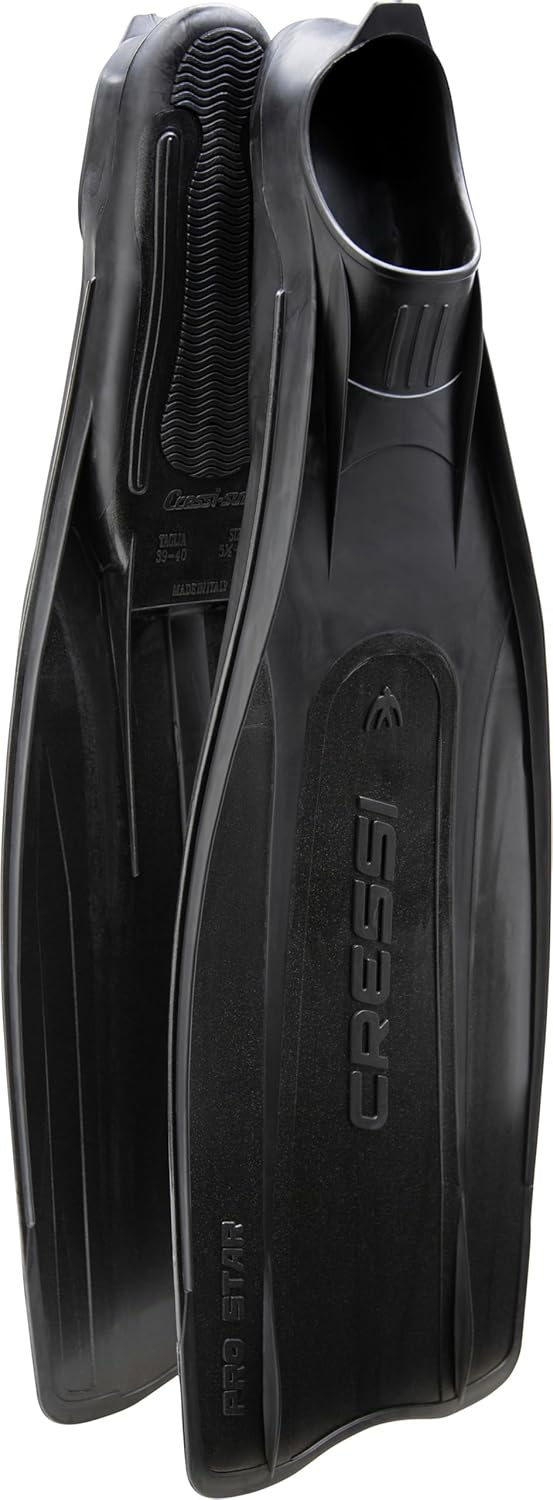
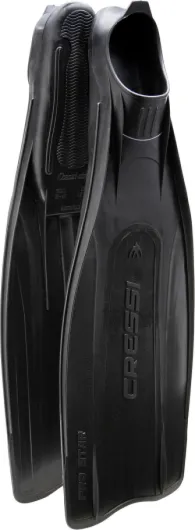
Design-wise, the Pro Star sits halfway between a classic snorkel fin and a freediving fin. The blade starts quite high up on the foot pocket, which effectively gives you more usable blade area – Cressi claims about 20% more, and visually that seems believable. In practice, that means more of your leg movement is turned into forward motion, but it also makes the fin feel longer and a bit more demanding if you’re not used to it. If you’re coming from tiny rental fins, the first few kicks feel like you put your legs in second gear.
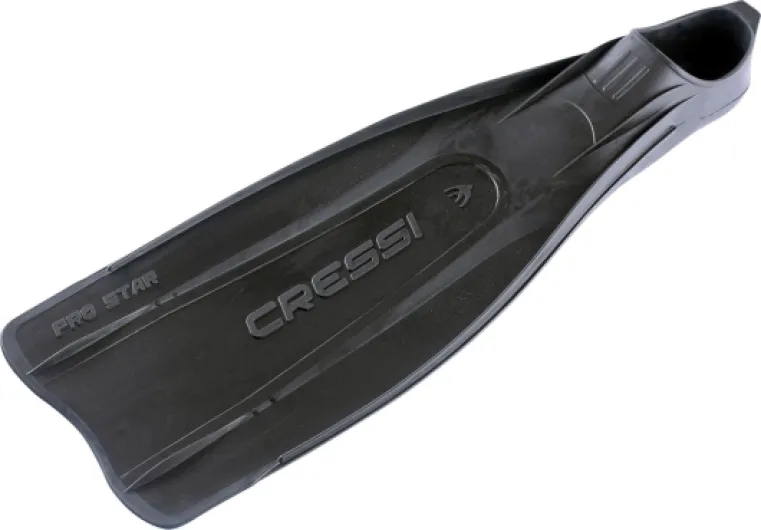
The profile of the blade is pretty straight, with slight channels along the sides created by the rubber rails. These rails help keep the water from spilling off the sides when you kick, so your effort goes forward instead of sideways. There’s no split or fancy hinge system here, just a solid piece of polypropylene. I actually like that: fewer moving parts, fewer things to crack or break. The tip of the blade is slightly rounded but still broad, which again helps with thrust but also makes it a bit more awkward if you’re trying to be super precise in tight spaces.
The foot pocket is relatively low-volume for a 45/46, and shaped quite anatomically. There’s a defined arch area and the sides hold the foot in place quite well. That’s good for power transfer, but also means the shape either suits your foot or it doesn’t. If you have very wide feet or high insteps, you might get pressure points, especially on long sessions. There are small drainage holes under the toes, so water and air don’t get trapped, but it’s nothing fancy. I didn’t have any big issues with trapped air or weird squeaks, just a normal full-foot feel.
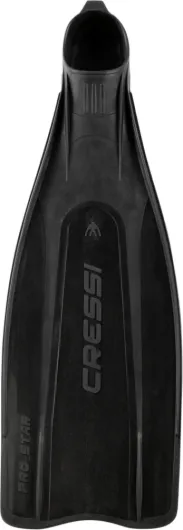
Visually, it’s a no-nonsense design. All black, a bit of texture on the foot pocket, and the Cressi logo on the blade. No flashy graphics, no colour-coded stiffness scheme, no adjustable bits. If you like gear that just looks like gear and not a toy, you’ll be fine with it. If you want something eye-catching for Instagram photos, this is on the boring side. Personally, I’ll take boring and functional over flashy and flimsy any day.
Comfort: good when sized right, but bare feet can suffer
Comfort is where these fins are a bit more picky. I’m a solid EU 45, sometimes 44.5, and this 45/46 size fits me barefoot with a bit of room. They don’t feel like they’re going to fall off, but they’re not vacuum tight either. With thin 2–3 mm neoprene socks, the fit is almost perfect for me: snug, no big movement, and the rubber pocket wraps the foot nicely. If you’re a smaller 45 or have a narrow foot, you might find them slightly loose barefoot. One Amazon reviewer (size 10.5 UK) said the 10/11 was a bit big for them, which matches my feeling: if you’re on the lower end of a size range and plan to go barefoot, consider going down one size.
On the downside, barefoot use over time can cause chafing. After my third snorkelling session (around 45 minutes each), I noticed irritation on the back of the heel and the top of the foot where the pocket presses. Nothing dramatic, but enough to be annoying if you’re doing long sessions every day on holiday. Once I switched to socks, the problem disappeared. The trade-off is that socks make the fins warmer and slightly tighter, but for me it was worth it. If you have sensitive skin or you know you’ll be in the water for hours, I’d call socks pretty much mandatory with these.
Another comfort point is walking. Like most full-foot fins with a longer, stiffer blade, walking forward on land is awkward. The tip catches the ground easily, and you end up either kicking the floor or bending your ankle weirdly. Walking backwards is honestly easier and safer, and that’s what I ended up doing most of the time from the boat ladder or beach entry. This isn’t a unique problem to these fins, but it’s something to keep in mind: don’t plan on long walks in them, especially on uneven rocks.
Once in the water and properly fitted, comfort during swimming is decent. The fin spreads the load across the whole foot, so you don’t get that feeling of all the pressure on your toes. After about an hour of mixed surface and shallow diving, my legs were tired but not destroyed. If you’re untrained, you’ll feel it; these are not ultra-soft beginner fins. In short: comfortable enough when sized right and used with socks, but not the softest or most forgiving fins out there, especially for barefoot, all-day holiday use.
Materials and build: stiff blade, softer pocket, decent quality for the price
The fins use polypropylene for the blade and a softer thermo-rubber for the foot pocket and side rails. In real use, that combo makes sense. The blade feels stiff enough to give good push, but it’s not a plank; it has some flex and spring. Underwater, you feel that snap at the end of the kick, which is what actually moves you forward. Compared to cheaper all-rubber rental fins, these feel more lively. Compared to high-end freediving fins with composite blades, they’re clearly less responsive, but the price isn’t in the same league either.
The rubber used for the foot pocket is on the firmer side, not super squishy. That’s good for power transfer because your foot doesn’t roll around inside, but it can cause rubbing if you go barefoot for long sessions. After about 30–40 minutes of snorkelling barefoot, I started to feel hotspots around the heel and the top of the foot. Switching to 2–3 mm neoprene socks fixed that completely. So I’d say the material choice is fine, but if your skin is sensitive, plan on wearing socks. That matches what some other users mention about chafing after a few outings.
Build quality on my pair looks clean: the junction between the hard blade and the soft pocket is neat, no obvious gaps, no glue mess. I flexed the joint quite aggressively by hand and didn’t see any stress marks. One of the Amazon reviewers mentioned seeing other fins crack at that junction on different brands, but also said their Pro Stars held up over hundreds of dives with proper storage. That lines up with what I see: if you don’t leave them baking in the sun bent in half, they should be fine.
Overall, the materials feel pretty solid for a mid-range fin. You’re not getting fancy composites or ultra-light tech, but you’re also not dealing with cheap, floppy plastic. For snorkelling, skin-diving and recreational scuba in warm water, the material choice is appropriate. Just treat them like real gear: rinse with fresh water, don’t leave them twisted in a hot car, and avoid walking on rocks with the bare rubber pocket, and they should last.
Durability: looks solid, but treat the blade–foot joint with respect
I haven’t had these fins for years, so I can’t pretend I’ve put 300 dives on them like one of the Amazon reviewers. But after several sessions in pool chlorine and salt water, plus being tossed around in a car and on a boat, they still look basically new. No cracks, no whitening at the bends, and the rubber foot pocket hasn’t deformed. The polypropylene blade seems to handle flexing well, and the bond between the hard and soft materials looks clean. I bent the fins by hand quite aggressively to test that junction, and I didn’t see any stress marks or hear any ominous creaks.
The main risk area on fins like this is always where the stiff blade meets the softer pocket. If that joint is badly designed or if the materials don’t play well together, you start getting cracks or delamination over time. The long-term review from the user who did over 300 dives with the same pair is reassuring: they specifically mention other brands cracking in that spot while these held up as long as they were stored properly. That’s a key point: storage and care matter. If you leave any plastic fin jammed under heavy gear in a hot car or bent over the side of a box, you’re asking for trouble.
I did notice that the black colour hides small scuffs well. I bumped them on ladders and concrete edges a few times, and any marks were minor and mostly cosmetic. The rubber pocket also seems dense enough not to tear easily. Obviously, if you insist on walking on sharp rocks with them or scraping them along the bottom, they’ll wear out faster. But for normal snorkelling and recreational diving use, they feel like they’ll handle a few seasons without falling apart.
Overall, durability looks good for this price range, as long as you’re not careless. Rinse them in fresh water, dry them out of direct sun, store them flat or with a light curve, and don’t twist them into weird shapes in a bag. If you want something completely bombproof for years of abuse, heavy all-rubber fins might still be tougher, but they’re also heavier and less efficient. For a mixed plastic/rubber fin, I’m pretty comfortable with how these are holding up so far.
Performance: strong push and efficient, but they’ll work your legs
Performance is where the Cressi Pro Star actually makes sense. In the water, they give a lot more thrust than basic short snorkel fins. On the surface, doing a relaxed flutter kick, I could cruise at a decent pace without feeling like I was thrashing around. When I picked up the tempo or switched to a stronger, longer kick, they responded well and I could cover distance quickly. Against mild current, they handled it without drama; I didn’t feel like I was kicking my lungs out just to stay in place, which is the whole point of having a longer, stiffer blade.
For short apnea dives (5–10 m, nothing crazy), the fins do a good job of converting a few strong kicks into depth. They’re not as long or as specialized as proper freediving fins, but they’re clearly more effective than typical travel fins. The blade’s stiffness and spring make it easy to get moving from a stop, and the longer blade that starts higher on the foot pocket helps transfer leg power efficiently. If you enjoy skin-diving or spending time a bit below the surface, these fins feel like a good compromise between power and size.
For scuba, I used them in warm water with a thin wetsuit and no heavy gear except a single tank. They handled standard kicks and minor manoeuvres just fine. They’re not as agile in tight spaces as shorter fins, but for open water and gentle finning behind a guide, they’re absolutely fine. If you’re into heavy technical diving with multiple tanks and strong currents, you’ll likely want something more specialized and maybe open-heel with boots. But for recreational warm-water dives, they get the job done without fuss.
The flip side of that performance is leg fatigue. If you’re unfit or haven’t used longer fins before, your calves and ankles will feel it after a while. These fins reward a slow, controlled kick more than frantic flailing. When I kept my kicks small and steady, I could stay out much longer without cramping. Once I started sprinting or doing big kicks for too long, my legs complained. So they perform well, but they expect you to meet them halfway with halfway decent technique and some leg strength.
What you actually get when you buy these fins
When you pull the Cressi Pro Star out of the box, there’s not a lot of ceremony. No fancy bag, no accessories, just the pair of fins with a bit of simple protection on the blades. They’re clearly meant to be a functional piece of kit, not a fashion object. The size 45/46 looks long and fairly narrow, with a full-foot pocket that runs quite far up the top of the foot. That design is what gives you more blade surface, but it also means more contact with your skin, so fit really matters here.
In terms of specs, each fin weighs a bit under 800 g according to the listing, and that feels about right in hand. They’re not heavy like some old-school rubber fins, but you feel there’s some material there. The blade is made of polypropylene, which is a fairly stiff, reactive plastic, and the foot pocket and side rails are a softer rubber. The idea is that the soft parts keep things comfortable and guide the water, while the hard blade does the pushing. On the table, you can flex the blade with your hands and it springs back nicely, so you can already guess they’ll give decent propulsion.
There are no fancy colour options here in this version: black only. Honestly, I don’t mind. Black fins are easy to match with any gear, and they also hide scratches and UV wear better than bright colours. The branding is visible but not shouting at you. If you like loud colours to be spotted easily at the surface, this exact black model isn’t that; you’d have to look for another colourway in the same line. For basic snorkelling and diving, plain black is fine.
From a pure presentation perspective, it’s pretty standard: you’re paying for function, not packaging. If you expect a carry bag, instructions on finning technique, or any kind of premium unboxing, you’ll be disappointed. If you just want to open the box, rinse them and jump in the water, it does the job. Personally, I prefer they keep costs down rather than waste money on packaging that ends up in the bin.
Pros
- Strong thrust and efficient kick for snorkelling, skin-diving and light scuba
- Sturdy polypropylene blade and decent build quality for the price
- Simple, full-foot design with good power transfer and low drag
Cons
- Can cause chafing when used barefoot for long sessions; socks are recommended
- Full-foot design limits use mostly to warm water and pool conditions
- Fit can be tricky if you are between sizes or have wide/high-volume feet
Conclusion
Editor's rating
Overall, the Cressi Pro Star full foot fins in size 45/46 are solid, no-nonsense fins that give you good power for a mid-range price. The stiff polypropylene blade and long profile deliver real thrust, whether you’re snorkelling on the surface, doing short apnea dives, or doing warm-water scuba with light gear. They’re clearly a step up from basic travel fins, and user feedback backs that up, with people reporting years of use and hundreds of dives when stored properly.
The trade-offs are mostly around comfort and versatility. Barefoot, they can rub after longer sessions, so thin neoprene socks are basically recommended if you’re in the water a lot. The full-foot design makes them great for warm water and pool use, but not ideal if you dive in cold water with thick boots. Fit is also a bit unforgiving: if you’re between sizes or have very wide feet, you might have to play with sizing or look elsewhere. Walking in them on land is awkward, but that’s just the nature of longer, stiffer full-foot fins.
I’d recommend these fins to snorkellers, skin-divers and recreational warm-water divers who want more performance than cheap rental fins without going into expensive specialist gear. If you’re fairly active in the water and don’t mind using socks, they’re a good, practical choice. On the other hand, if you mostly do cold-water dives with boots, have very sensitive feet, or want ultra-soft beginner fins that never tire your legs, you should probably skip these and look at softer or open-heel options.