
Summary
Editor's rating
Value for money: where it stands vs pricier brands
Design: functional, a bit basic, but it works
Comfort and real-world use on the water
Materials: decent aluminium and a tough-feeling fabric
Durability so far and what worries me long term
Performance: wind, rain, and day-to-day handling
What you actually get in the box
Pros
- Good shade coverage with 4-bow, 240 cm long frame and 130 cm height
- Thick 600D fabric that feels tough, is waterproof, and blocks sun well
- Includes rear support poles and storage boot, so no need for extra accessories
Cons
- Nylon deck hinges and average hardware that may not hold up to heavy, long-term use
- Folding and storing process is a bit fiddly compared to higher-end systems

Specifications
View full product page →| Brand | MiDMarine |
A budget bimini that actually feels pretty solid
I put this MiDMarine 4-bow bimini (230–250 cm, light grey) on my small motor boat at the start of the season because I was tired of frying in the cockpit and messing around with cheap umbrellas. I wasn’t expecting miracles from a no-name brand made in China, but I wanted something that would at least survive a summer without tearing or bending at the first gust of wind.
After a few weekends and a couple of windy afternoons, I’ve got a decent idea of what this thing is worth. It’s not perfect, the finish is clearly not on the same level as the big marine brands, but it does the main job: it gives good shade, feels stable enough, and doesn’t flap like crazy all the time. For the price range it sits in, that was my main concern.
I mounted the 230–250 cm version on a boat that’s roughly 2.35 m wide, so right in the middle of its range. That’s important because if you’re at the extreme ends of the width range, you’ll notice tension and alignment more. In my case, the fit is pretty clean, and I didn’t have to drill extra holes or improvise brackets, which is always a relief when you’re doing this on a Saturday morning before a planned trip.
To be clear: this isn’t some high-end, leave-it-up-all-year bimini. It’s a practical, mid-range setup that suits casual boaters who go out on weekends and holidays. If you’re expecting super premium hardware and perfect stitching, you’ll be disappointed. If you just want shade and basic protection without wrecking your budget, it starts to make sense.
Value for money: where it stands vs pricier brands
In terms of value, I’d say this MiDMarine bimini sits in that sweet spot between cheap junk and premium gear. It’s clearly more solid than the very low-end biminis you see online that sag after one season, but it doesn’t reach the build quality of big-name marine brands that cost two or three times more. For a boat that’s used on weekends and holidays, I find the compromise pretty reasonable.
What you’re paying for here is mainly: a 4-bow aluminium frame, a 600D fabric that’s actually waterproof, rear support poles, and a matching boot, all included in one kit. If you try to piece that together with premium parts, you’ll quickly blow the budget. So for someone who doesn’t want to sink a ton of money into a sunshade but still wants something that feels stable and not like a toy, it’s a decent deal.
Where you feel the lower price is in the details: plastic hinges instead of metal, basic screws, average straps, and stitching that’s functional but not pretty. If you’re handy and willing to upgrade a couple of weak points over time (like swapping hinges or screws for better stainless hardware), you can stretch the lifespan without spending a fortune up front. If you want something you never have to think about or tweak, you’ll probably be happier throwing more money at a higher-end brand.
So, compared to competitors, I’d put it clearly above the bargain-basement stuff and a notch below the premium options. For most casual boat owners who just want shade and basic protection without getting too technical, the value is good. For heavy users or people who are picky about finish and hardware, it’s more of a temporary or mid-term solution than a long-term investment.
Design: functional, a bit basic, but it works
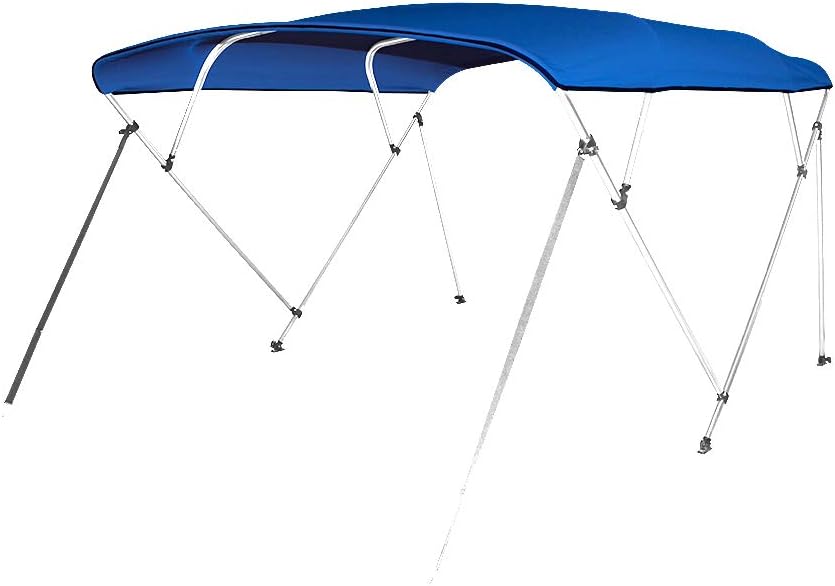
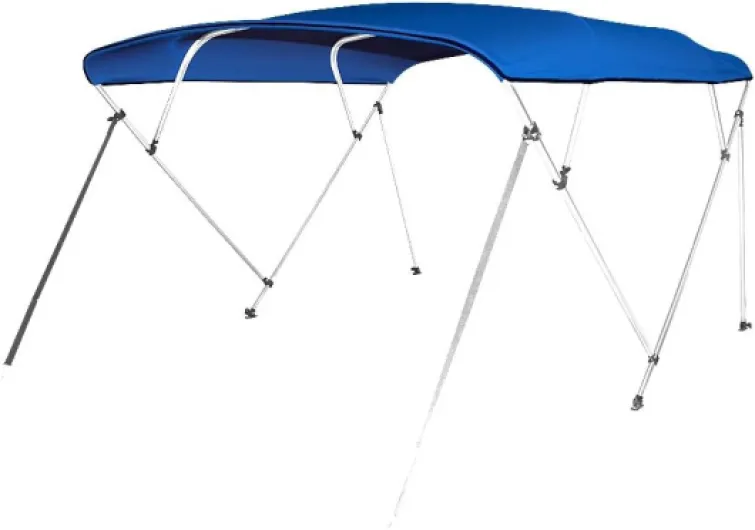
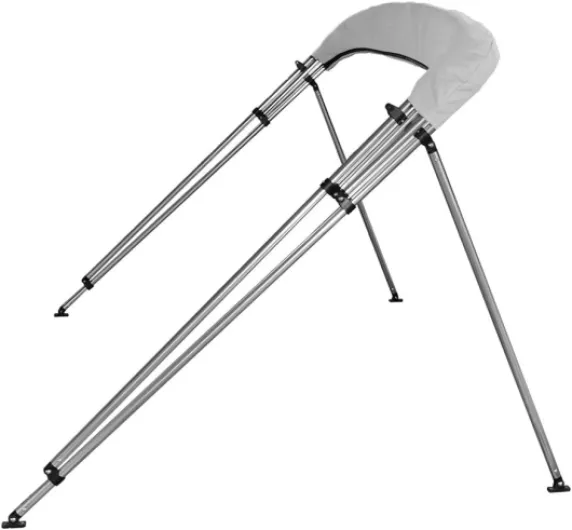
Design-wise, it’s clearly made to be practical rather than pretty. The 4-bow layout gives a nice long roof line and feels more stable than the 3-bow setups I’ve used before. The frame is 25 mm anodised aluminium, so not huge tubing but enough for a small to mid-sized boat. The rear support poles are a big plus: they hold the bimini upright when it’s folded back, which avoids having it lying on the seats or tied with random ropes.
The light grey colour is actually more of a beige/greige, as they mention. On the boat, it looks okay and has one clear advantage: it doesn’t get as hot as black in the sun and doesn’t show dirt as fast as pure white. If you’re picky about matching your boat’s upholstery, this shade is neutral enough that it doesn’t clash. Just don’t expect showroom-level colour uniformity; the fabric and the boot cover match, but the nylon fittings are a different tone of grey/black.
One thing I noticed is that the bows don’t lock into any fancy quick-release systems; it’s all done with simple screws and straps. That’s fine from a reliability point of view but less convenient if you plan to fold and unfold it every single outing. It’s not hard, just not as slick as some higher-end designs where everything clicks into place in seconds.
In terms of footprint on the boat, once folded into the rear position with the support poles, it doesn’t take up a crazy amount of space, but you do end up with about a 240 cm long bundle sitting over the aft area. If you fish a lot at the back of the boat, you’ll have to work around it. For cruising and family use, it’s acceptable. Overall, the design is simple, functional, and clearly thought for universal fit, not for perfectly matching each hull shape.
Comfort and real-world use on the water
In practice, once mounted, comfort is where this bimini actually shines for the price. The 240 cm length covers the helm and rear bench on my boat, so we can sit four people in the shade without playing musical chairs every time the sun moves. The 130 cm height is enough that you don’t constantly hit your head, as long as you set the mounting points sensibly. I mounted it slightly higher than recommended and that made a big difference in day-to-day use.
On a hot, cloudless day, the light grey fabric does a good job of blocking the sun. You can feel the temperature difference when you step out from under it. It doesn’t create a dark cave either; light still passes around the sides, so you don’t feel boxed in. There’s no side or front curtains included, so wind and spray still come in, but that’s normal for a basic bimini. For shade and UV protection, it’s clearly a step up from trying to survive with hats and sunscreen only.
When underway at moderate speed (around 15–18 knots in my case), the bimini stays fairly stable. There is some flapping at the front edge in gusts, but nothing dramatic. I did have to re-tension the straps after the first run; once they settled and I tightened them properly, it behaved better. I wouldn’t run flat out in heavy chop with it up, but for normal cruising it’s fine. The rear support poles keep it from wobbling too much when folded back, so people can move around the cockpit without being constantly hit by a loose frame.
From a daily use comfort point of view, the main downside is that folding and putting it in the boot is a bit of a faff: you have to deal with the fabric, straps, and poles in a specific order or it ends up messy. It’s not hard, just not super quick. If you’re planning to raise and lower it several times during the same trip, you’ll probably get a bit annoyed. If you mostly leave it up or only fold it for trailering, it’s perfectly manageable.
Materials: decent aluminium and a tough-feeling fabric
The frame is 25 mm anodised aluminium, which is pretty standard at this price. It’s not the thickest I’ve seen, but it doesn’t feel flimsy either. I’ve had cheaper biminis with thinner, softer tubing that bent just from someone grabbing them to steady themselves. This one survived a couple of clumsy friends using it as a handhold without warping, so that’s already a good sign. The anodising seems clean, no obvious rough spots or peeling after a few weeks.
The fabric is sold as 600 denier marine polyester, waterproof and UV-resistant. In the hand, it feels quite thick and a bit stiff at first. After a few outings, it softened slightly but still feels robust. I left it under a couple of heavy showers and it didn’t let water through; it beads up and runs off as you’d expect. I haven’t had it long enough to judge long-term UV fade, but so far the colour hasn’t noticeably changed after several full days in strong sun.
The hardware is where you feel the cost-cutting a bit more. The deck hinges are black nylon, not metal. They do the job, but if you’re hard on your gear or your boat bangs around in chop a lot, I’d keep an eye on them. The thumb screws are handy for tightening by hand, but I gave them all a final tweak with a screwdriver because they tended to loosen slightly after the first outing. The straps have stainless-steel parts, which is good, but the webbing itself feels more “OK” than “bulletproof”.
Overall, the materials are better than the cheap no-name biminis you see on marketplaces, but you can tell where they saved money compared to big brands: more plastic, slightly rougher stitching, and not all hardware in stainless. For a casual boater, it’s fine. If you’re keeping your boat in a harsh salt environment all season, I’d probably upgrade some fittings to stainless over time.
Durability so far and what worries me long term
Durability is always the big question with this kind of mid-priced gear. After several weeks of use, nothing has broken or seriously degraded. The frame is still straight, the fabric hasn’t torn, and the stitching looks intact. I leave the boat in the water and the bimini up most of the time, except in really bad weather. So it’s been through sun, a few heavy showers, and some decent gusts already.
The parts I’m keeping an eye on are the nylon deck hinges and the stitching around the corners of the fabric. Nylon in marine conditions tends to go brittle over time, especially with UV. For now they’re fine, but if I keep this setup for several seasons, I wouldn’t be surprised if I end up replacing at least a couple of fittings with stainless metal versions. The fabric seems tough enough that I’m more confident it will last a few summers, as long as I don’t leave it permanently flogging in strong wind.
The storage boot is a nice touch for durability: when trailering or during winter, you can fold the whole thing and zip it inside. That should help protect the fabric from unnecessary UV when not in use. The zipper itself feels average; not junk, but not heavy-duty either. I’ll be gentle with it because that’s often the first thing to fail on this kind of accessory.
Overall, I’d rate durability as good for casual, seasonal use, but I wouldn’t expect it to behave like a high-end custom stainless-and-acrylic setup. If you baby your gear a bit, rinse the salt off, and don’t abuse it in storms, it should last a few seasons without major drama. If you’re rough with your boat and leave everything up all year in a marina, you’ll probably hit its limits faster.
Performance: wind, rain, and day-to-day handling
On the performance side, I tested it in three typical situations: calm sunny days, windy afternoons with gusts around 20 knots, and a couple of showers. In calm weather, nothing to say: it just does its job, no noise, no drama. In wind, you start to notice the limits of the 25 mm tubing and nylon fittings. The frame flexes a bit, especially if the wind hits from the side, but it never felt like it was about to snap. I did slow down when the gusts picked up, more out of caution than because the bimini was freaking out.
Under rain, the waterproof claim holds up. The fabric doesn’t soak immediately and doesn’t drip through the middle. The only spots where water comes in are the usual suspects: at the edges and where the bows create natural low points. If you don’t tension it enough, water can pool slightly between the bows, so it’s worth taking a minute to adjust it properly. I didn’t see any leaks through the seams yet, but long term that’s usually where cheaper biminis start to fail.
One thing to note is that, despite being sold as a “universal fit”, how well it behaves depends a lot on how and where you mount it. If you put the deck hinges too close together or at a weird angle, you’ll get more movement and noise. I had to reposition one hinge by about 3 cm after the first trial because the frame wasn’t sitting square. Once corrected, the overall stability improved a lot. So the performance is decent, but it’s sensitive to installation quality.
In terms of speed, I personally kept it to around 18–20 knots with the bimini up. The structure could probably take a bit more, but with mid-range hardware and nylon hinges, I don’t see the point of pushing it. For normal cruising, fishing, and family outings, it’s perfectly fine. For hardcore offshore runs at high speed, I’d look at something beefier or plan to fold it down.
What you actually get in the box
Out of the box, you get the fabric canopy, the 4-bow aluminium frame in pieces, rear support poles, a matching storage boot, and the hardware: 4 black nylon deck hinges with thumb screws plus 2 adjustable straps with stainless bits. Everything came in one long box, just under 2 meters, and weighed around the 9.5 kg they list. Nothing fancy, but it was packed well enough that nothing was scratched or bent.
Assembly is pretty straightforward if you’ve ever put together any kind of tubular frame. The bows are labelled, the holes line up, and the screws bite properly. I spent about 1.5–2 hours from opening the box to having it fully mounted on the boat, taking my time to measure the mounting points. Someone more experienced could probably do it in under an hour. The instructions are basic but usable: a couple of diagrams, not a full novel, but I didn’t get stuck anywhere.
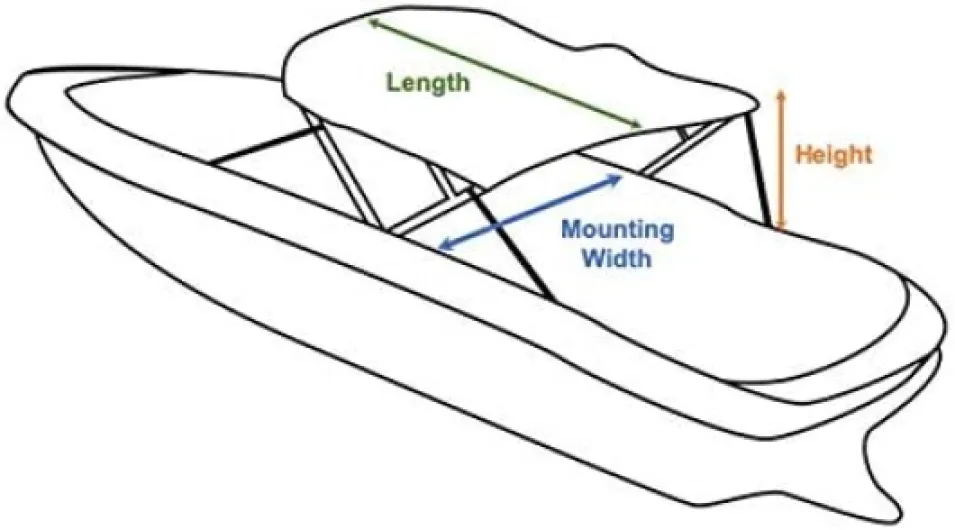
The size I took is the MD1266: 240 cm length, 230–250 cm mounting width, 130 cm height. On the boat, that 240 cm length gives decent coverage over the helm and the seating area behind it. If you expect it to shade the bow as well, forget it; you’d need a different setup. The 130 cm height feels about right: I can stand under it (I’m 1.78 m) as long as I don’t mount it too low on the gunwale.
Overall, in terms of what’s included, it’s pretty complete for the price: you don’t need to buy extra support poles or a cover, it’s all there. The only thing I added myself were stainless bolts and backing plates for the deck hinges, because the supplied screws are fine for light use but I don’t fully trust them in rougher seas.
Pros
- Good shade coverage with 4-bow, 240 cm long frame and 130 cm height
- Thick 600D fabric that feels tough, is waterproof, and blocks sun well
- Includes rear support poles and storage boot, so no need for extra accessories
Cons
- Nylon deck hinges and average hardware that may not hold up to heavy, long-term use
- Folding and storing process is a bit fiddly compared to higher-end systems
Conclusion
Editor's rating
Overall, this MiDMarine 4-bow bimini in the 230–250 cm light grey version is a pretty solid choice if you want shade and basic protection without spending a fortune. The frame is stable enough for normal cruising, the 600D fabric feels tough and keeps both sun and rain off your head, and the included rear support poles and storage boot make it more practical than the very basic kits. It’s not luxury gear, but it does the job for weekend and holiday use.
The weak spots are mostly in the details: nylon deck hinges instead of metal, average straps and stitching, and a folding process that’s not as quick and tidy as on higher-end systems. If you’re the type who leaves the bimini up all season in harsh conditions or runs fast in rough seas, you might want to either upgrade some hardware or look at a more expensive, heavy-duty setup. But if your use is more relaxed—coastal cruising, lakes, fishing trips with the family—this one offers good value and enough durability as long as you don’t abuse it.
So, I’d recommend it to casual boaters with small to mid-sized boats (around 2.1–2.5 m wide) who want a functional, budget-friendly canopy and are okay with a few compromises on hardware and finish. If you’re very picky about premium materials, or if your boat lives in a tough salt environment year-round, you’ll probably be happier stepping up to a more expensive brand.