
Summary
Editor's rating
Value: solid jacket, but you do pay for the badge
Design: built for the boat, not the café
Comfort: warm, protective, but a bit bulky
Materials: tough shell with a greener twist
Durability and build: feels like it’ll last several seasons
Performance on the water: keeps you dry and blocks the wind
What you actually get when you buy this thing
Pros
- Very good waterproofing and wind protection, especially the high collar and face guard
- Robust materials and clean build quality that feel ready for several seasons of use
- Practical details like hand-warmer pockets with fleece, good hood with stiffened peak, and fully taped seams
Cons
- Bulky and on the warm side, can feel heavy and sweaty during more active use or in mild weather
- Price is on the higher side for casual users who don’t really need full offshore-level protection

Specifications
View full product page →| Brand | Gill |
A serious jacket for people who actually get wet
I took this Gill Mens OS2 Offshore Sailing Jacket (XL, Gold Fusion/Navy) out for a few winter trips on the water and some very wet days on the dock. I’m not a pro racer, just someone who spends a fair bit of time on boats in cold, wet conditions and is tired of being damp and freezing. I’ve used cheaper coastal jackets before (Helly Hansen and some random chandlery brands), so I had something to compare it to right away.
First impression: it’s a proper offshore jacket, not a casual raincoat you also wear to the office. It’s quite bulky, clearly built for bad weather and long hours outside. When you pick it up, the 1.2 kg weight is noticeable, but not crazy for this category. It gives that “gear, not fashion” vibe, which for me is what you want when waves are coming over the bow.
During testing I got it in heavy rain, 20–25 knots of wind, and a few hours of constant spray. I also wore it a couple of times just walking the dog in horrible sideways rain to see how it felt in more normal use. The short version: it keeps you dry and blocks wind very well, but you do feel the bulk and heat if you’re moving a lot.
Overall, I’d say this jacket is clearly aimed at people doing proper offshore or at least serious coastal sailing. If you just want something to wear in town when it rains, it’s overkill and too expensive. For regular boat use though, it’s a pretty solid piece of kit with some details that are well thought out, and a few that are a bit annoying for the price.
Value: solid jacket, but you do pay for the badge
On the value side, this Gill OS2 Offshore Jacket sits in that mid- to high-price bracket for sailing gear. It’s not the most expensive offshore jacket out there, but it’s definitely not budget territory either. For what you pay, you’re getting a proper offshore-level shell: fully waterproof, windproof, with a decent level of breathability, and a build that feels like it will last. The Amazon rating around 4.6/5 lines up with my experience: people generally like it, with only minor complaints.
If you compare it to cheaper coastal jackets, you’re paying extra for things like the higher collar, better hood, more robust fabric, and some design tweaks that matter when you’re out for hours in bad conditions. If you only sail occasionally in mild weather, it’s probably overkill and not the best value for you. A lighter, cheaper coastal jacket would cover your needs at a lower price and be more comfortable on warmer days.
Compared to more premium brands, the OS2 is kind of in the middle. You can find higher-end Gore-Tex or similar 3-layer gear that’s lighter and breathes better, but you’ll pay noticeably more. In that context, the OS2 feels like a “pretty solid for the money” option: not top of the line, but definitely a step up from entry-level stuff. You’re also getting the environmental angle (recycled materials, PFAS-free DWR), which some people will see as a plus.
For someone who sails regularly in rougher conditions – offshore trips, cold shoulder seasons, night sails – and wants something reliable without going to the very top price range, the value is decent. For casual sailors or people who mostly use it as a raincoat in town, the price will feel steep and the jacket will feel like too much. So the value really depends on how often you’re actually out there getting battered by wind and spray. If that’s your reality, the cost makes more sense.
Design: built for the boat, not the café
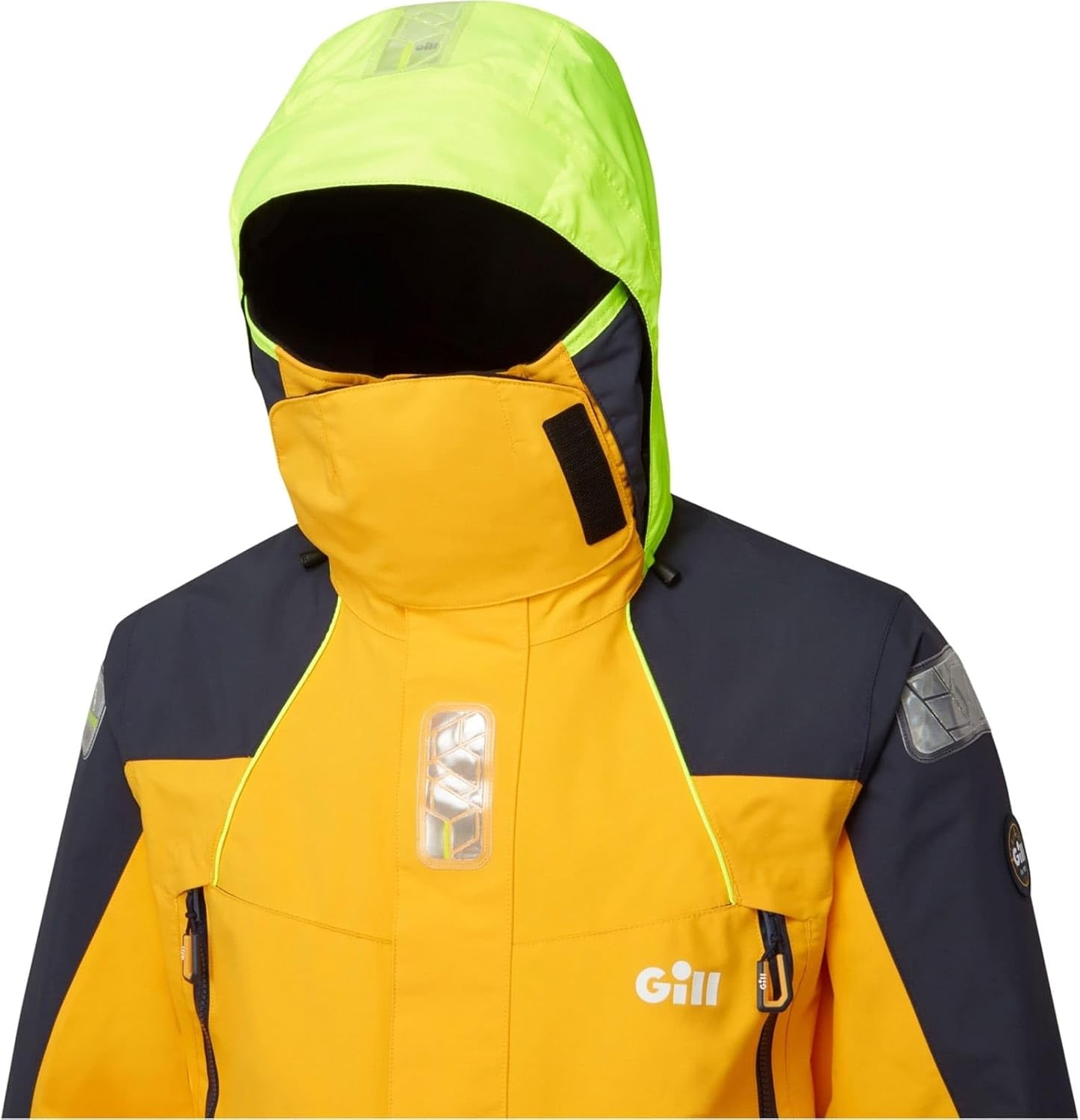
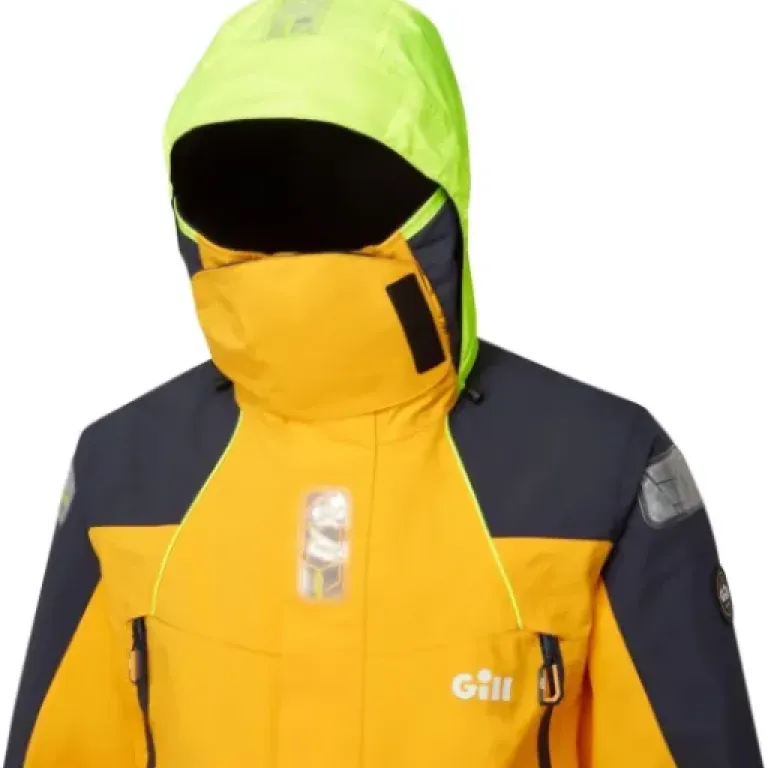
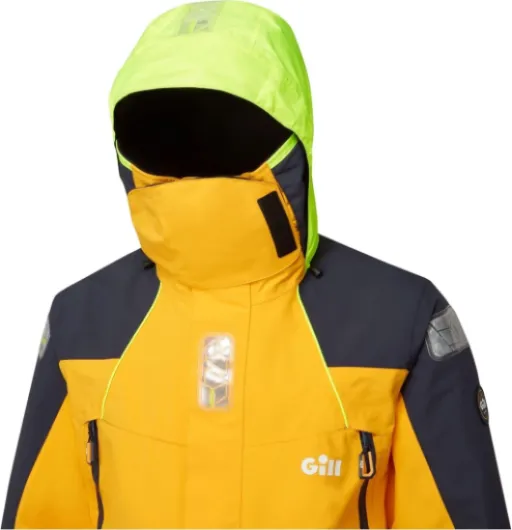
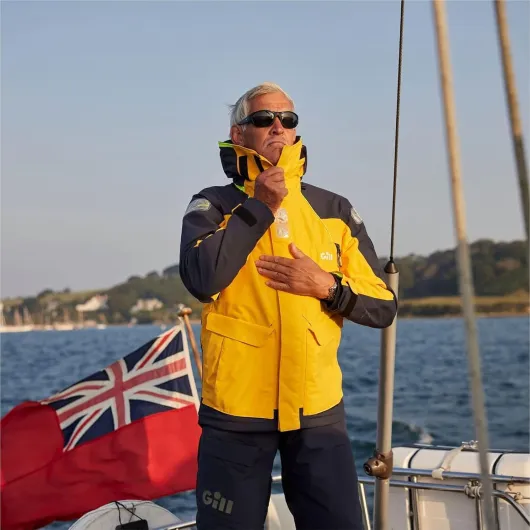
Design-wise, Gill clearly focused on function first. The silhouette is an anorak-style offshore coat: fairly boxy, long enough to cover your lower back, big hood, big collar. It’s not something you throw over a t-shirt to look cool in town. But on deck, the choices make sense. The high collar is one of the main features. When fully zipped, it covers your neck and part of your face nicely, and the added face guard that rolls away actually works. In rough wind and spray, that extra height is a big plus.
The hood design is decent. It has an improved adjustment system and a stiffened peak. In practice, the peak does a good job of keeping water from streaming straight into your eyes. Once you dial in the adjustments, the hood turns reasonably well with your head, which is important when you’re looking around for lines and traffic. It’s not the most compact hood when rolled away, and you do feel it behind your neck, but that’s pretty common on offshore jackets.
Placement of pockets and adjustments is mostly good. The hand-warmer pockets are at a comfortable height, and the reversible fleece lining is a nice touch when your fingers are frozen. There are drainage details so water doesn’t pool inside, which is something cheaper jackets often miss. The hem has an adjustable shock cord, easy to grab even with gloves. Cuffs are long and seal well, though I would have liked a slightly cleaner inner cuff construction – it works, but it’s not the neatest I’ve seen.
Visually, the Gold Fusion/Navy combo is practical. The bright areas make you visible, while the navy zones hide grime and wear a bit better. Reflective details are present but not overdone. If I nitpick, the jacket does look a bit chunky compared to some newer, slimmer-cut sailing shells. If you care about looking sharp on shore, this isn’t your piece. But if your main priority is staying dry and visible on a bouncing deck, the design choices are mostly on point.
Comfort: warm, protective, but a bit bulky
Comfort-wise, I’d sum it up like this: very good protection, decent breathability, and noticeable bulk. On cold, wet days, I was glad to have it. Standing at the helm for hours in 5–8°C with wind and spray, I stayed dry and reasonably warm with just a base layer and a mid-layer under it. The high collar and face guard are the stars here – they really cut the wind on your neck and lower face, which is usually where you start to freeze first.
Breathability is okay, not outstanding. It’s a 2-layer fabric with fleece and mesh inside, so it’s never going to feel as airy as a thin 3-layer shell. When I was actively grinding winches or moving around a lot, I did start to feel a bit warm and sweaty. The jacket vents moisture, but not instantly. If you run hot or do a lot of physical work on board, you’ll want to manage your layers under it and open the front zip when you can. There are no pit zips, which I missed a bit during more active moments.
Mobility is decent for a relaxed fit. I could reach above my head, lean forward, and twist around without the jacket pulling too much. The longer back is good when you sit or crouch, and the sleeves are long enough that your wrists stay covered even when reaching up. That said, you always feel that you’re wearing a substantial piece of gear. It’s not restrictive, but you’re aware of the bulk, especially compared to lighter coastal jackets.
On land, walking the dog or doing normal stuff, I found it almost too warm unless it was really miserable outside. This is clearly tuned for time on the water in bad conditions, not for casual city wear. If you mostly sail in mild climates or only in summer, this might be overkill and you might end up sweating more than you’d like. For cold, windy, wet shoulder-season or winter sailing though, the comfort level is pretty good, as long as you accept the trade-off between warmth and bulk.
Materials: tough shell with a greener twist
The jacket uses Gill’s XPLORE 2-layer waterproof and breathable fabric, with a 100% nylon face and a recycled PU membrane. On the inside you’ve got 100% recycled polyester fleece and mesh. So it’s not some ultra-light, three-layer mountaineering fabric, but more of a robust, medium-weight shell with a comfort lining. The weight is around 1.22 kg, which you feel in the hand, but once it’s on and you’re on deck, it’s fine.
The outer nylon feels tough enough to handle regular boat abuse: winches, ropes, sitting on non-slip decks, brushing against hardware. I didn’t baby it, and after a few trips there were no obvious snags or scuffs. The PFAS-free DWR is a nice touch if you care about that. In real use, water beads and rolls off well when the jacket is new. After a couple of long, wet sessions, it still beaded decently, but like any DWR, you’ll probably need to refresh it after a season or so.
The inner fleece and mesh are fully synthetic and recycled, which is good from an environmental angle, but also just practical: they dry faster than cotton and don’t hold as much smell. After long, sweaty hours, the inside didn’t feel clammy or soaked. The mesh drainage panels help move moisture away, especially if you’re wearing a wicking base layer. The lining isn’t super soft luxury fleece; it’s more functional, medium-weight stuff that adds a bit of warmth without turning the jacket into a sauna.
All seams are fully taped, and the taping looks clean and consistent inside. Zippers feel solid, storm flaps are thick enough, and the general impression is that this can take repeated soaking and rough handling. It doesn’t feel like a fragile, technical piece you’re scared to damage. The trade-off is that it’s not light or compact. If you’re looking for something you can stuff in a tiny daypack, this isn’t it. But if you want materials that can deal with salt, abrasion, and constant use, it’s pretty solid for the category.
Durability and build: feels like it’ll last several seasons
Durability is always hard to judge in a short test, but based on build quality and early signs, this feels like a jacket that can do several seasons of regular use without falling apart. The outer nylon face is fairly thick and has a tough feel, not that thin, papery texture you get on some lightweight shells. I brushed against winches, metal fittings, and rough deck surfaces, and didn’t see any obvious marks or pulls.
The stitching looks clean and consistent. No loose threads out of the bag, no seams starting to lift after a few uses. The fully taped seams inside are neatly applied. Zippers run smoothly and feel robust, with decent-sized pulls that are easy to grab with cold hands or light gloves. The storm flaps are wide and sit flat enough that they don’t catch on everything, which helps prevent snagging and wear.
Where I’d expect wear over time is mainly the cuffs, the collar/hood area, and the front zip zone – the usual high-friction points on any sailing jacket. On this OS2, those areas seem reinforced enough. The inner fleece and mesh also held up fine to repeated on/off cycles with velcro gloves and harnesses brushing by. No pilling or tearing so far. Because a lot of the inner materials are recycled polyester, they should handle moisture and repeated drying cycles better than cotton blends.
The PFAS-free DWR will need maintenance like any water repellent finish. If you actually sail a lot, plan on reproofing after a season or so to keep water beading nicely. That’s normal and not a flaw. Overall, I’d put the durability at a solid level for the price range. It’s not bombproof industrial gear, but it definitely doesn’t feel cheap or fragile. If you take basic care of it (rinse salt, dry properly, reproof occasionally), I’d expect it to last multiple years of weekend and holiday sailing without major issues.
Performance on the water: keeps you dry and blocks the wind
In actual use on the water, the jacket does what it’s supposed to do: keep you dry and shielded from wind. I had it in several hours of steady rain plus spray, and I didn’t get any leaks through the shoulders, seams, or zippers. The fully taped seams and double storm flap over the front zip do their job. Water tends to run off the fabric rather than soak in, at least while the DWR is still fresh. Even when the outside looked soaked, the inside stayed dry.
Wind protection is strong. In 20–25 knots, facing straight into the breeze at the helm, I never felt wind cutting through the fabric. The high collar and face guard are the key here; zip it all the way up and you basically create a little sheltered zone around your neck and lower face. The hood’s stiffened peak also helps a lot in rain and spray – it keeps water from streaming down your face, so you’re not wiping your eyes every few seconds.
In terms of breathability, as mentioned earlier, it’s fine but not outstanding. During more static tasks (helming, sitting, trimming occasionally), I was comfortable. During continuous grinding or when moving around the deck a lot, I started to feel heat build up. The jacket moves moisture out, but if you’re working hard, you’ll probably get a bit sweaty inside. This is pretty normal for a medium-weight offshore jacket, but if you’re coming from a super high-end, super-breathable 3-layer shell, you’ll notice the difference.
One thing I appreciated is the hand-warmer pockets with fleece. In cold wind, being able to shove your hands in there between tasks is a big plus. They warm up quickly and stay reasonably dry thanks to the design and drainage. Overall, in terms of pure performance for offshore or rough coastal sailing – staying dry, blocking wind, keeping you functional on deck – the jacket is pretty solid. Not magical, not some miracle tech, but it gets the job done reliably.
What you actually get when you buy this thing
Out of the box, the Gill OS2 Offshore feels like a mid- to high-end technical jacket. No fancy packaging, just a plastic bag and the usual hang tags explaining the XPLORE fabric, waterproof rating, and the whole PFAS-free DWR story. Nothing premium or special in the unboxing, but honestly that’s fine for a sailing jacket. I’d rather they put the cost into the fabric and stitching than into a pretty box.
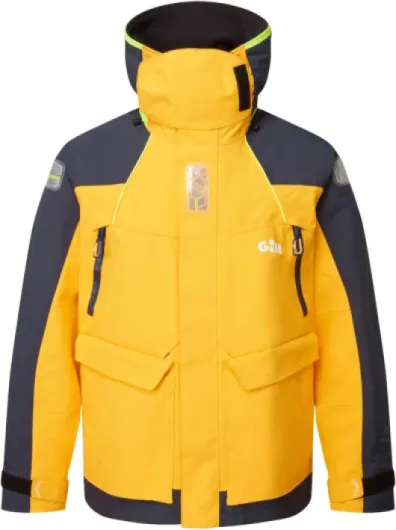
The model I tried is XL, Gold Fusion/Navy. The color is basically a bright yellow-gold with navy panels. It’s not subtle, but that’s kind of the point offshore: you want to be visible. Compared to the usual red/navy combo from other brands, this feels a bit more modern without being silly. If you’re shy about bright colors, you might find it loud, but on a grey, choppy day I was glad it stood out.
The cut is described as “relaxed fit”, and that’s accurate. I’m about 1.83 m and 90 kg, and XL gave me enough room for a base layer plus a thick mid-layer fleece without feeling squeezed. At the same time, it didn’t feel like I was swimming in fabric. The back is slightly longer, which helps when you’re bending over winches or sitting on wet benches. The sleeves are proper long, so when you reach up for halyards, your wrists stay covered.
On the outside, you’ve got the usual offshore details: high collar with a fold-away hood, double storm flap over the main zipper, hand-warmer pockets, and some reflective bits. It looks like a standard offshore jacket from a distance, but when you start using it you notice some small touches that are nice (like the reversible fleece in the pockets) and a couple that feel a bit dated compared to newer, lighter tech shells from other brands.
Pros
- Very good waterproofing and wind protection, especially the high collar and face guard
- Robust materials and clean build quality that feel ready for several seasons of use
- Practical details like hand-warmer pockets with fleece, good hood with stiffened peak, and fully taped seams
Cons
- Bulky and on the warm side, can feel heavy and sweaty during more active use or in mild weather
- Price is on the higher side for casual users who don’t really need full offshore-level protection
Conclusion
Editor's rating
After using the Gill Mens OS2 Offshore Sailing Jacket in a mix of heavy rain, strong wind, and regular dock work, my take is pretty simple: it’s a solid, no-nonsense offshore jacket that does its main job well – keeping you dry and protected – but it’s not light, and it’s not cheap. The waterproofing and wind protection are strong, the high collar and hood setup are genuinely useful in rough conditions, and the overall build feels like it can handle several seasons of real use. It’s clearly designed for people who actually spend time on boats, not for someone who just wants a stylish raincoat.
On the downside, it’s a bit bulky and warm if you’re very active or in milder weather, and the breathability is decent rather than impressive. If you’re mostly doing summer coastal trips or wearing it around town, you’re probably overbuying with this model. There are lighter and cheaper options that will feel more comfortable for that kind of use. But if you’re out in cold, wet, windy conditions and you want something reliable without jumping to the very top-tier price range, this jacket hits a good middle ground.
So, who is it for? Regular sailors, offshore or serious coastal, who want a tough, functional jacket with proper weather protection and aren’t obsessed with shaving every gram. Who should skip it? Casual weekend sailors in mild climates, or anyone mainly looking for a daily rain jacket – for those people, this will feel like too much jacket for too much money.