
Summary
Editor's rating
Is it worth the money compared to other options?
Chunky but practical: design and noise in real use
Battery demands and UPS behaviour: where reality hits
Build quality and reliability over time
Real-world performance: what it actually powers and how it behaves
What you actually get and what it’s meant to do
Pros
- Clean pure sine wave output that works well with sensitive electronics (laptops, monitors, routers)
- Realistic 2000W continuous / 4000W surge performance with solid protection features
- Useful UPS / grid priority function and remote control for daily convenience
Cons
- Fans are clearly audible under moderate to high load, not ideal right next to a sleeping area
- Requires a strong 12V battery bank and thick cables; will expose weak setups quickly

Specifications
View full product page →| Brand | Renogy |
A 2000W inverter that actually feels usable day to day
I’ve been running this Renogy 2000W pure sine wave inverter (12V to 230V, UK sockets) for a while now in a small off-grid setup and occasionally in the back of the van. I’m not an engineer, just someone who needs 230V without dragging a noisy generator around. The short version: it does what it says, and most of the time I forget it’s even there, which is what you want from this kind of kit.
In my case it’s hooked up to a 12V battery bank (about 200Ah) that’s charged by solar most days. I’ve used it to power a laptop, monitor, a small fridge, a few power tools, and the usual phone chargers and lights. I also tested the UPS function with a mains feed in the house just to see if it could keep a PC and router running during cuts. No lab gear, just real-world use and a plug-in watt meter.
What stood out pretty quickly is that the pure sine wave output is clean enough for sensitive stuff. My work laptop and a fussy Dell monitor behaved exactly like they do on grid power. No coil whine, no weird buzzing from chargers, and the router didn’t drop once during the switch-over tests. That’s already better than the cheap modified sine wave inverters I’ve used before, which made some gear whine like crazy.
It’s not perfect though. The fan noise is noticeable in a quiet van, the UPS switchover is fast but not totally seamless for every device, and you need to be realistic about what 2000W continuous actually means on a 12V system. Overall I’d call it a pretty solid workhorse rather than a miracle gadget, but if you size your batteries and cables properly, it gets the job done without drama.
Is it worth the money compared to other options?
Price-wise, the Renogy 2000W sits in the middle-to-upper range for 12V pure sine wave inverters with a UPS/transfer function. You can definitely find cheaper 2000W units, but most of those are modified sine wave or no-name brands with shaky reviews and limited protection features. On the other side, you’ve got premium units that cost a fair bit more but add fancier displays, higher-end chargers, or hybrid inverter features. So this Renogy lands in a kind of sweet spot for people who want something reliable without going full high-end.
For what you pay, you get: pure sine wave output, realistic 2000W continuous power, 4000W peak for start-up surges, a usable UPS/grid priority mode, decent build quality, and a remote switch. That’s a pretty solid feature set. The main compromises are the fan noise, the basic display, and the fact that it’s 12V only. If you’re planning a bigger system, a 24V or 48V inverter might make more sense long term, but those are usually pricier and need different batteries.
Compared to a cheaper inverter I tried before (which saved me maybe a third of the price), the Renogy is clearly better: fewer quirks, cleaner output, and less random tripping under load. Compared to top-tier brands, you save money but you don’t get the same integration or smart features. For most vanlifers, DIY off-grid cabins, or people who want a straightforward backup for a few circuits at home, this feels like good value for money. It’s not a bargain basement unit, but you’re paying for stability and a known brand rather than fancy marketing.
If you’re on a tight budget and only need to run basic, non-sensitive tools occasionally, you could probably get away with something cheaper. But if you care about your electronics and want a unit that behaves predictably, this Renogy makes sense. Just remember the total cost includes proper cables, fuses, and a decent battery bank. The inverter is only one part of the bill. Taken in that context, I’d say the price is fair for what you get.
Chunky but practical: design and noise in real use
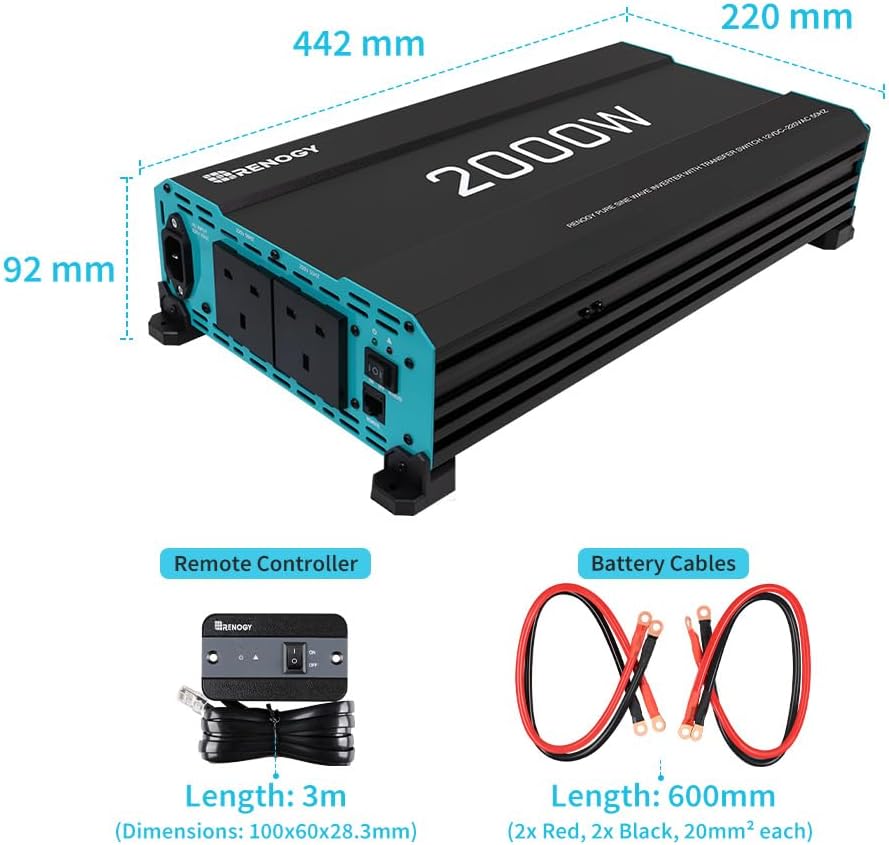
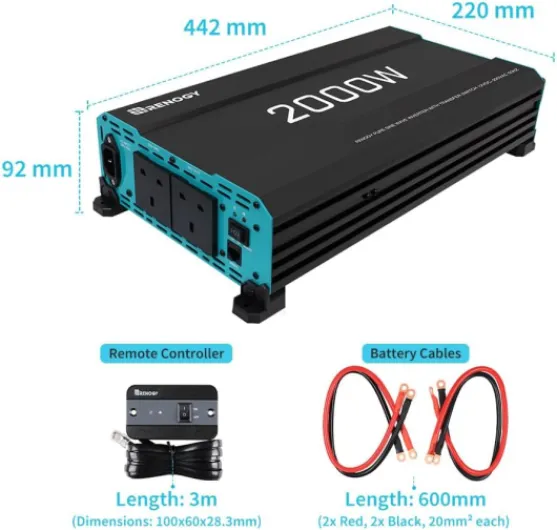
Physically, the Renogy 2000W is a long, metal box: about 44 cm long, 22 cm wide, and just under 10 cm high. At around 4.8 kg, it’s not light but it’s manageable. I can move it around one-handed, but you’re not going to casually toss it in a backpack. The casing is metal, mostly black with some blue accents, and it feels more like industrial gear than a flashy gadget, which I prefer. It looks like something meant to be bolted down and forgotten.
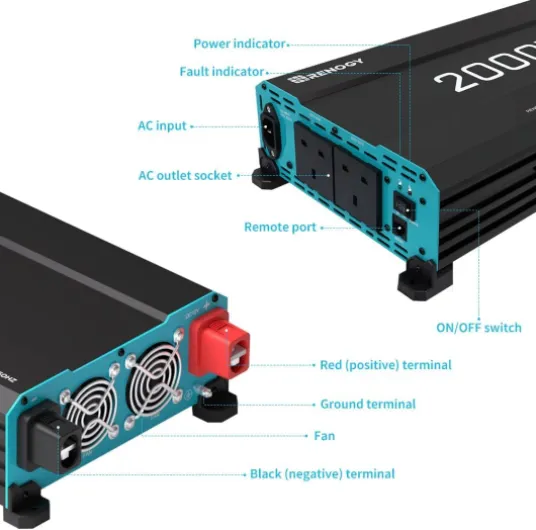
The layout is fairly straightforward. On the front you get two UK sockets, an on/off button, a simple display for voltage and some status LEDs, and the RJ-type port for the remote. On the back you’ve got the 12V DC terminals, the AC input terminals for the UPS function, and the cooling vents. The terminals are decent-sized, and I had no trouble fitting proper lugs with thick cable. Just be ready to crimp or buy the right cables; this thing will happily melt thin wires if you cheap out.
One thing that stands out in daily use is the fan behaviour. It has high-speed fans that kick in under load or when it gets warm. They do their job, but in a quiet van or cabin you will hear them. It’s not jet-engine loud, but it’s a constant whoosh once you pull a few hundred watts for a while. I’d say if you’re planning to sleep right next to it, mount it under a seat or in a cupboard and add some sound insulation (without blocking airflow). Compared to a cheap inverter I had before, the Renogy’s fans are a bit quieter and ramp more sensibly, but they’re still noticeable.
In terms of everyday usability, the remote switch is actually handy. I mounted the inverter under a bench and ran the remote to an easy-to-reach spot. Being able to kill the inverter without crawling around is a small thing, but it means I actually turn it off when not in use, which saves some idle draw. The only thing I’d have liked is more detailed info on the display (like actual wattage), but at this price point I can live with using a separate plug-in meter. Overall, the design is practical, a bit bulky, not pretty, but clearly built for being installed permanently rather than moved around every day.
Battery demands and UPS behaviour: where reality hits
This inverter is pretty clear about one thing: if your battery setup is weak, it will show it. It’s rated around 2000W continuous, which on a 12V system means huge currents at full tilt. You’re easily looking at 170–200A DC draw near max load once you factor in losses. I ran it mostly on a 200Ah AGM battery bank, and at 800–1000W loads you can literally watch the voltage drop if the batteries aren’t fully charged. That’s not a flaw of the inverter itself, but something to keep in mind before you blame the hardware.
With more modest loads – say 200–400W for my usual work setup (laptop, monitor, router, lights) – the battery usage is a lot more sensible. On a sunny day with solar coming in, the system happily ticks along. Overnight, pulling 200–300W for several hours is realistic with 200Ah, but if you start adding a fridge cycling on and off, you really want a bigger bank or lithium batteries. The inverter doesn’t hide any of this; it just draws what it needs, and if the battery can’t cope, the low-voltage protection kicks in.
The UPS function is where battery and mains meet. I wired it so that it could take mains in and keep a PC and network gear alive during short outages. The switchover time (Renogy says about 50ms) matched my experience. My desktop and router stayed on, but an older monitor occasionally blinked. For most home use – keeping internet and a few lights on – it’s fine. If you’re planning to protect very sensitive equipment or servers, I’d still go with a dedicated online UPS, but for basic backup this Renogy is good enough.
One thing to be aware of: when used as a UPS, the battery is more of a backup reservoir than something you want to drain daily at high loads. If you keep it on grid most of the time, you’ll barely notice the battery unless there’s a cut. In a pure off-grid setup, you need to size your battery properly and accept that you can’t run everything like you’re on the national grid. So in short, the inverter itself is fine on the battery side, but it’s demanding, and it will quickly expose undersized or tired batteries.
Build quality and reliability over time
In terms of build quality, the Renogy feels more like pro gear than a random no-name inverter from eBay. The metal casing is rigid, there’s no rattling when you shake it, and the terminals and sockets don’t feel flimsy. I’ve had it bolted in the van and also temporarily on a plywood board in the shed, and it’s survived a few bumps and dusty days without any sign of trouble. Nothing has come loose, and the fans still spin smoothly.
I’ve run it for several sessions of a few hours at a time, often at a few hundred watts, sometimes with short spikes closer to its rating. It gets warm but not scorching, and the fans seem to keep things under control. I haven’t noticed any reduction in performance or weird behaviour over time. No random shutdowns, no unexplained error beeps. That’s already better than a cheaper inverter I killed in under six months, which started cutting out under modest loads for no reason.
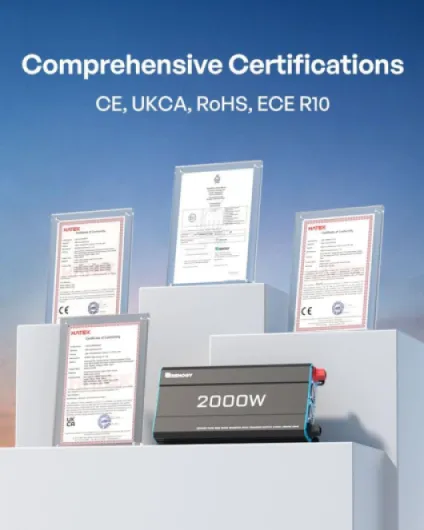
On paper, there’s a warranty (1–2 years depending on where you look) and CE/ETL-type certifications. I haven’t had to use the warranty, so I can’t comment on how helpful Renogy is when things go wrong, but the brand is at least known in the solar/off-grid space, which is more reassuring than some anonymous manufacturer. The Amazon rating around 4.4/5 also lines up with my experience: mostly positive with a few people hitting issues, usually around installation or expectations.
My feeling is that if you install it properly – decent cables, proper fusing, good ventilation, and you don’t run it at 90–100% load all day – it should last several years without drama. It’s not bulletproof, and I wouldn’t mount it somewhere it can get soaked or packed with dust, but for a van, shed, or small cabin it feels robust enough. I’d call the durability good but not indestructible: treat it like a serious electrical device, not a throwaway gadget, and it should hold up fine.
Real-world performance: what it actually powers and how it behaves
Performance-wise, this inverter is pretty solid once you respect its limits. I ran a mix of loads on it: a 120W laptop and monitor setup, a 60–80W router/network combo, a 90W fridge (with a higher startup surge), some LED lights, and occasionally a 700–800W power tool. It handled all of that without any complaint. The pure sine wave output seems clean – no strange noises from transformers, no flicker on the monitor, and no random resets on electronics.
I did push it closer to its rated power a few times. With a kettle drawing close to 1800–1900W according to my plug-in meter, the inverter held the load but the fans went full blast and the battery voltage dipped hard. That’s not the inverter’s fault; that’s just what happens when you try to pull that kind of power from 12V. Still, it shows the 2000W continuous rating is realistic for short bursts if your wiring and battery bank are up to it. I wouldn’t sit at 1800W for an hour straight, but for short high-power uses it’s fine.
The efficiency seems in line with the >90% claim. I didn’t do lab-grade tests, but comparing DC draw from the battery to AC load, the numbers were close to what I’d expect. The idle consumption is there though. If you leave it on with almost no load, it still eats a bit of power. That’s where the remote switch is useful – you actually turn it off between uses instead of leaving it humming all day. For a small solar setup, that makes a difference over a week.
On the protection side, I did hit the low-voltage cutoff once when I abused a small battery with a high load. The inverter beeped, shut down, and came back fine once the battery recovered. No drama, no smoke. I also tested a short overload by starting a tool with a fridge already running; it handled the surge and then settled. So the protection circuits seem to do their job. Overall, in real life, the performance is “strong and predictable” rather than flashy. It gives you stable AC, handles realistic surges, and doesn’t behave weirdly, which is what I want from a power box.
What you actually get and what it’s meant to do
Out of the box, you get the inverter itself, a basic remote control with a cable, some chunky DC cables, and a manual that’s actually readable. No fancy extras, but everything you need to get started if you already have a battery and fuses. The unit is rated 2000W continuous and 4000W peak, 12V DC in, 230–240V AC out, pure sine wave, with two UK sockets on the front and terminals for hardwiring if you want to go that route.
Renogy pushes the idea that it’s good for off-grid cabins, RVs, trucks, boats, and home backup. From using it, I’d say that’s fair as long as you understand the limits of a 12V, 2000W inverter. It’s happy running things like laptops, TVs, routers, LED lighting, a small fridge, and even some power tools, but it’s not a magic box that will run electric heaters or kettles all day from a small battery. I tried a 2kW kettle on it: it worked, but the battery voltage dropped fast, and I wouldn’t do that often unless you have a serious battery bank.
The UPS / grid priority function is the interesting part. You can feed it mains and a battery, and it will prefer grid when available, then switch to battery when power cuts. Renogy says the switchover is around 50ms. In practice, that’s quick enough that my desktop PC and router stayed on, but an older monitor flickered once or twice during tests. So it’s usable as a basic backup, but I wouldn’t compare it to a dedicated high-end UPS for servers.
Overall, the product is positioned as a multi-purpose inverter that can live in a van or cabin and also double as a backup at home. I’d say that’s accurate, but it’s on you to wire it correctly, use proper fusing, and not overload your battery. If you expect plug-and-play like a small power station, you’ll be a bit disappointed. If you’re used to 12V systems, the feature set actually makes sense and feels complete for the price bracket.
Pros
- Clean pure sine wave output that works well with sensitive electronics (laptops, monitors, routers)
- Realistic 2000W continuous / 4000W surge performance with solid protection features
- Useful UPS / grid priority function and remote control for daily convenience
Cons
- Fans are clearly audible under moderate to high load, not ideal right next to a sleeping area
- Requires a strong 12V battery bank and thick cables; will expose weak setups quickly
Conclusion
Editor's rating
Overall, the Renogy 2000W pure sine wave inverter is a solid, practical choice if you need reliable 230V power from a 12V source and you’re not expecting miracles. It delivers clean power, handles realistic surges, and the UPS/grid priority function works well enough for home backup of basic gear like PCs and routers. The build feels robust, and day-to-day use is mostly uneventful – which is exactly what you want from something sitting between your batteries and your appliances.
It’s not perfect. The fans are audible, the display is basic, and if your battery bank and wiring aren’t up to the job, you’ll quickly hit the limits of what 2000W on 12V can do. It also isn’t the cheapest option out there. But compared to random cheap inverters, you’re getting a cleaner sine wave, more reliable protection, and a brand that at least has a track record in the solar/off-grid world. I’d recommend it to people with vans, small off-grid setups, or anyone wanting a straightforward backup solution for a few key devices at home. If you need silent operation, ultra-fast UPS performance for critical servers, or a big house-wide backup, you should probably look at more specialised (and more expensive) gear.