
Summary
Editor's rating
Is it worth the money compared to other options?
Compact screen, metal camera head, and a cable that’s more practical than pretty
Battery life: one of the strong points
Build quality and how it handles real fishing abuse
Image quality, IR, and what you actually see underwater
What you actually get and how it works in real life
Pros
- Very simple plug-and-play use with clear buttons and no apps
- Good battery life (around 6–8 hours real-world) with USB-C charging
- Sturdy IP68 aluminum camera head and included weights help keep it stable underwater
Cons
- Small 4.3" screen and non-HD (1000TVL) image, more functional than pretty
- Cable spool is a bit fiddly and takes time to rewind properly
- Plastic screen unit feels basic and not especially premium

Specifications
View full product page →| Brand | FishPro |
A small underwater camera that finally shows what’s going on under the ice
I’ve been curious about underwater fishing cameras for a while, but I always found them either too bulky, too expensive, or just full of gimmicks. I picked up this FishPro 4.3'' KA-4315 DVR mainly for ice fishing and a bit of dock fishing, just to see if it actually helps or if it’s another toy that ends up in the garage. I’ve used it for a few outings in cold water, including one full day on the ice and a couple of hours off a small pier.
My use is pretty basic: I wanted to see if there’s fish where I’m drilling, how they react to my jig, and if I’m wasting my time in a dead hole. I’m not trying to film National Geographic, just know what’s going on down there. So I didn’t care much about fancy menus, I just wanted something that turns on fast and lets me see clearly.
Overall, this camera feels like a practical tool more than a toy. The screen is small but usable, the camera itself is compact and heavy enough to stay in place, and the 50 ft cable is plenty for most of my spots. It’s not perfect, there are a few annoying bits, but it actually helped me move to better holes and adjust my presentation. For me, that’s already a win.
If you’re expecting pro-level video quality or a giant display, this isn’t that. But if you want a simple, plug-and-play underwater view to back up your flasher or sonar, this thing gets the job done without being a pain to set up. I’ll break down what worked for me and what’s a bit meh.
Is it worth the money compared to other options?
In terms of value for money, this FishPro sits in what I’d call the mid-budget zone. It’s not the cheapest underwater camera on the market, but it’s also far from the high-end stuff. For the price, you’re getting: a metal IP68 camera head, 50 ft of cable, DVR with a 32 GB card included, a 4.3" IPS screen, a 5,000 mAh battery, and a carrying case. That’s a pretty complete package, and you don’t have to buy extra accessories to make it usable.
Compared to the really cheap no-name cams, the main differences I noticed are: more stable and clearer image, better IR control (3 levels with a button), and much better battery life. The cheaper ones often cut corners on battery and durability. On the other side, compared to more expensive brands with bigger screens and HD resolution, this one is obviously simpler. The small screen and non-HD image are the main compromises. If you want a big 7" screen and full HD, you’ll pay noticeably more.
For my use (ice fishing, checking structure, watching fish behavior), the price-to-utility ratio feels pretty solid. It helped me save time by moving when I saw nothing down there, and it confirmed that some spots actually had fish even when they were finicky. That, for me, justifies the cost. I’m not paying for fancy menus or Wi-Fi streaming to my phone, just a basic tool that works.
So, is there better out there? Yes, if you’re ready to spend more. Is there cheaper? Yes, but usually with worse battery, flimsier build, or no DVR. This model sits in a nice middle ground: good value if you want reliability and simple use, and you’re okay with a smaller screen and non-HD footage. If your budget is tight, it’s still a reasonable buy that actually gets used instead of staying in a drawer.

Compact screen, metal camera head, and a cable that’s more practical than pretty
Design-wise, it’s pretty no-nonsense. The camera head is full aluminum, which gives it a solid, slightly heavy feel. That weight is actually useful underwater because it helps keep the camera from drifting all over the place. With the extra 10 lb weights they include, you can really lock it down in mild current or when you’re jigging aggressively. The IP68 rating just means I don’t baby it; I dropped it on the ice a couple of times and dunked it in slushy holes, no issues so far.
The 4.3" screen unit is plastic, nothing fancy, but light and easy to hold or set on a bucket. Buttons are simple and clearly labeled, which I like. You get dedicated buttons for power, IR, and recording, so you’re not digging through menus. The built-in sun visor is just a little hood, but on a bright, snowy day it really helps. The plastic doesn’t feel premium, but it didn’t creak or flex in my hands, and it survived a couple of bumps in the sled.
The cable is 50 ft and comes on a small spool. It’s not the neatest system, but it beats having a loose tangle of wire in your bag. After a few uses, you do have to be a bit patient rewinding it if you don’t want knots. The cable thickness feels okay: not crazy thick, but not flimsy. I dragged it along the ice edge a few times and didn’t see any damage or cuts. Time will tell, but early impression is that it should handle normal use.
One detail that’s actually handy is the magnetic adsorption and the 1/4'' screw hole. If you have their 360° positioner (I don’t), you can mount it more cleanly. I just used the fin and sometimes clipped the cable to my homemade holder. Not flashy, but the overall design is focused on being used with cold hands and basic gear, and in that sense, it’s pretty solid. No design "wow" factor, but it’s practical and not fragile.
Battery life: one of the strong points
The built-in 5,000 mAh battery is honestly one of the key reasons I don’t mind bringing this thing along. FishPro claims up to 9 hours, and in real use, I’d say that’s not far off if you’re reasonable with the IR. On my first big test, I ran it for about 6 hours total over a long day on the ice, with IR on low or off most of the time, and the battery indicator still showed juice left. I didn’t have to baby it or turn it off constantly to save power.
When I deliberately pushed it on another outing, I left it on almost non-stop for around 7 hours, with more frequent use of IR and some recording. By the end, it was getting low but still alive. So I’d say 6–8 hours real-world is fair, which is enough for a normal day trip without carrying extra power. That’s better than a lot of cheaper units that start dying after 3–4 hours, especially in the cold.
Charging is via USB-C, which is a relief. No weird proprietary plug. I just used the same power bank I use for my phone to top it up in the car. A full charge from low took a few hours (I didn’t time it exactly, but it was roughly an afternoon), which is fine since I usually charge it the night before anyway. The indicator isn’t ultra-precise, but you get a decent idea of how much battery you have left.
In cold conditions, battery life always drops a bit, but this one held up better than I expected. I kept it in the case or on top of a bucket when not in use, and it never suddenly died. For someone who hates dealing with extra batteries and cables, this single, long-lasting battery is a real plus. Not perfect monitoring, but in practice, it’s reliable enough that I don’t stress about it during a session.

Build quality and how it handles real fishing abuse
Durability is always the big question with these underwater cameras, especially with cables and connectors. So far, after several trips, the IP68 aluminum camera head feels trustworthy. I’ve banged it against the ice edge pulling it up, dropped it in the slush, and let it bump around in the sled. No leaks, no fogging inside the lens, and no visible dents. It’s not bulletproof, but it clearly isn’t fragile.
The cable is usually the weak point on this kind of gear. Here, the cable feels decent: flexible enough to coil, but with a bit of thickness. I haven’t noticed any kinks or cracks yet. I’m careful not to step on it with crampons, but I’ve definitely pinched it between ice and my boot once or twice. So far, no issues. The spool helps keep it from becoming a tangled mess, but you do need to take 1–2 minutes to wind it properly if you want it to last.
The screen unit is plastic, and while it doesn’t feel premium, it doesn’t feel like a toy either. I had it fall off a bucket onto the ice once (maybe 40–50 cm drop), and it kept working fine. Buttons still click properly, and the USB-C port hasn’t loosened yet. The included hard-ish case is basic but useful; it protects against most knocks in transport. I wouldn’t throw it loose in a truck bed, but in a sled or backpack, it’s okay.
Long-term, the main things I’d keep an eye on are:
- the cable near the camera and near the screen (common stress points)
- the flap or seal around the USB-C port
- the hinges of the sun visor
Image quality, IR, and what you actually see underwater
The camera is rated at 1000TVL, which basically means analog SD-level detail, not HD. So don’t expect razor-sharp video like a GoPro. In clear water, you can clearly see fish shapes, fins, and your lure, and you can usually tell species and size without too much guessing. In murky water, it’s more about silhouettes and movement, but that’s normal for this type of camera. Compared to cheaper no-name cams I’ve seen, this one is a bit sharper and less grainy, but it’s still in the “good enough” category, not “wow”.
The 3-level IR is actually one of the better points. You can switch IR brightness with a dedicated button instead of plugging/unplugging anything, which is nice when you’re on the ice. On low IR, you get a gentle boost in darker water without turning the image into a white fog. On high IR, you’ll see more in very dark conditions, but particles in the water become more visible and the image gets a bit noisy. Still, it’s usable, and the IR being invisible to fish (no bright white LEDs) seems to help keep them calm around the camera.
Latency is low enough that you see your jig movements almost in real time. I used it mainly to check how perch and walleye were reacting. You really notice when they follow but don’t commit, which helped me adjust lure size and movement. For that alone, the performance is worth it. The fixed focus is set for typical fishing distances, so if the fish is right up against the lens, it’ll be a bit blurry, but at normal distance (a couple of feet or more), it’s fine.
The DVR records in AVI. The files aren’t huge, and the 32 GB card is more than enough for a few long sessions. Playback quality on a computer looks about the same as on the screen, just a bit more compressed. For sharing clips with buddies or reviewing spots later, it does the job. If your main goal is scouting structure, weed lines, and fish behavior rather than making fancy YouTube edits, the performance is solid for the price range.
What you actually get and how it works in real life
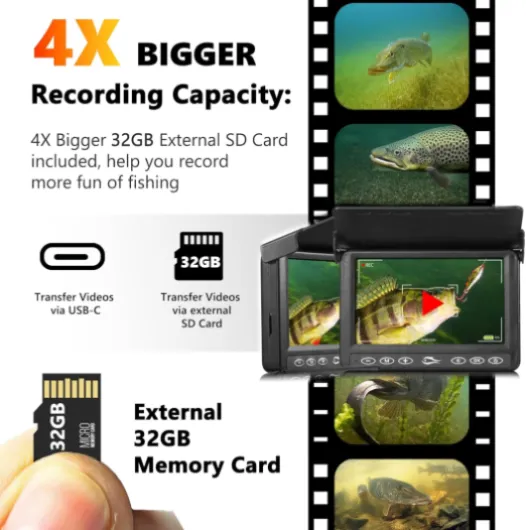
Out of the box, you get the 4.3" screen unit with built-in battery, the camera on a 50 ft cable, a spool to wrap the cable, two extra 10 lb weights, a couple of fins for angle (45° and 90°), a USB-C charger, a 32 GB card already included, and a small carrying case. So you don’t need to buy anything extra to start using it. The DVR is built into the screen unit and records to the TF card in AVI format, which my old laptop opened without any issue.
In practice, setup is pretty straightforward: unwind as much cable as you need, clip on the fin to set the angle, drop the camera in, and turn on the screen. No pairing, no app, no Wi-Fi, nothing. The menu is very basic. You can start/stop recording, adjust IR levels, and that’s about it. Honestly, I like that. Less stuff to fiddle with when your hands are cold and you just want to fish.
The screen is 4.3" IPS, so it’s not huge, but it’s clear enough to see fish, structure, and your lure. I used it with gloves and was still able to press the buttons without much trouble. The built-in sun visor is more useful than I expected; on bright days on the ice, it cuts just enough glare to keep the image readable. Don’t expect tablet-level comfort, but for a quick check under the ice, it works fine.
One thing I appreciated is the plug-and-play feel: there’s no weird driver, no special cable for the DVR. When I got home, I just pulled the TF card, stuck it in a cheap USB card reader, and copied the files. For someone who just wants to watch back how fish reacted during the day, it’s simple and it works. Not high-tech, but functional.
Pros
- Very simple plug-and-play use with clear buttons and no apps
- Good battery life (around 6–8 hours real-world) with USB-C charging
- Sturdy IP68 aluminum camera head and included weights help keep it stable underwater
Cons
- Small 4.3" screen and non-HD (1000TVL) image, more functional than pretty
- Cable spool is a bit fiddly and takes time to rewind properly
- Plastic screen unit feels basic and not especially premium
Conclusion
Editor's rating
After a few real sessions with the FishPro 4.3'' KA-4315 DVR, my feeling is pretty clear: it’s a practical, no-nonsense underwater camera that does what it says without turning into a hassle. The image is not HD, but it’s clean enough to see fish, your lure, and structure. The IR system with three levels is simple to use and genuinely useful in darker water. The aluminum camera head and IP68 rating give some confidence that it can handle rough fishing conditions, and the 5,000 mAh battery is honestly one of its biggest strengths for full-day trips.
It’s not perfect. The 4.3" screen is on the small side, the cable management could be smoother, and the overall feel is more "tool" than "gadget you show off". If you’re expecting crisp, cinematic underwater footage or a giant display, you’ll be disappointed. But if you just want to know what’s going on under the ice or around your dock, and you don’t want to fight with apps and complicated menus, it’s a solid, plug-and-play option.
I’d recommend it to anglers who: fish ice or vertical spots regularly, like to understand fish behavior, and want a simple device that turns on and works. If you already have a top-tier underwater camera or you’re obsessed with HD quality, this will feel basic. But for most weekend anglers looking for a reliable, reasonably priced tool, it’s a good compromise between cost, performance, and ease of use.