
Summary
Editor's rating
Value for money: where it makes sense and where it doesn’t
Design: compact and practical, but clearly budget
Power draw and battery impact
Materials and build: decent housing, mixed hardware
Durability after a few outings (and what I expect long term)
Performance on the water: does it actually pull its weight?
What you actually get in the box
Pros
- Enough pulling power and speed for a 15–25 lb anchor on small boats
- Remote control and free-fall drop make anchoring much easier and quicker
- Good price compared to big-name electric anchor winches with similar specs
Cons
- Generic brand with basic instructions and mixed-quality mounting hardware
- Not ideal for heavy boats, frequent saltwater use, or very demanding conditions

Specifications
View full product page →| Brand | Generic |
Electric anchor winch for lazy boaters like me
I bought this generic marine anchor winch mainly because I was tired of hauling a 20 lb anchor by hand at the end of every fishing session. My boat is a 17 ft aluminum fishing boat with a bow casting deck, and I run a 20 lb river anchor plus chain. So I’m pretty much the target use case they describe. I’ve used it on six outings so far, in light chop and a couple of windy days, so I’ve had time to see how it behaves in real conditions, not just in the driveway.
Right away, this is clearly a budget option: unknown brand, very basic branding, and the instructions feel like they were translated in a hurry. But the core idea is simple: push a button, anchor goes down; push another, anchor comes back up. I wasn’t expecting miracles, just something that saves my back and works reliably enough that I’m not constantly worried about the anchor slipping or the rope jamming every five minutes.
In use, it’s a mix of good and "okay but be careful". The motor has enough strength for a 20 lb anchor plus chain and mud, but you do feel it slow down when you’re in heavier weeds or if the anchor dug in deep. The free-fall drop is fast, so if you’re not ready on the switch you can overshoot your depth. It’s not plug-and-play like the premium brands, but with a bit of learning, it gets the job done.
If you’re expecting a polished premium windlass, this isn’t it. If you want an electric anchor solution that’s relatively cheap, works on a small boat, and you’re willing to tinker a bit with installation and rope management, then it’s a decent option. I’ll go into the details, because this thing has some good points but also a couple of annoyances you should know before drilling holes in your bow.
Value for money: where it makes sense and where it doesn’t
Given that this is a generic, no-name unit, the main reason to consider it is price. It usually comes in quite a bit cheaper than big-brand electric anchor winches with similar specs. For that lower cost, you get the main functions: electric up/down, free-fall drop, remote control, and enough pulling power for a 15–25 lb anchor on a small boat. From that angle, it’s pretty solid value if your expectations are realistic and you’re comfortable doing a bit of your own installation tweaking.
Where the lower price shows is in the details: basic instructions, mixed-quality hardware, and a general feeling that it’s built to be "good enough" rather than overbuilt. If you’re the kind of boater who wants gear that looks and feels premium, and you’re out on the water three times a week in all conditions, I’d say spend more and get a known brand. The peace of mind and better long-term durability will likely be worth the extra money for you.
If, like me, you’re more of a weekend angler who trailers the boat, fishes lakes and rivers, and just wants to stop hauling the anchor by hand, then this hits a nice spot. It saves your back, it doesn’t murder your battery, and once you understand its quirks (fast drop, watch for snags, check the rope), it performs reliably enough. I don’t feel like I overpaid, and I’d buy something in this range again if it lasts a couple of seasons.
In short, compared to the big names, you’re trading brand reputation and polish for a lower entry price. If budget is tight and your use is moderate, it’s a reasonable compromise. If your boat and trips are more serious, I’d see this as a stopgap rather than a long-term solution.
Design: compact and practical, but clearly budget
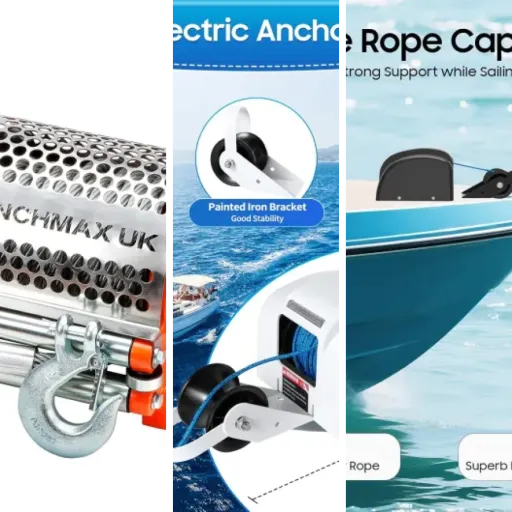
The design is pretty straightforward: a compact white housing that sits on the deck, with the rope feeding out toward the bow roller. Size-wise, it’s about 17×8.5×7 inches and roughly 16 lbs, which is manageable to move around and test fit before drilling. On my 17 ft boat, it doesn’t dominate the bow, but you do need to plan where it sits so you can still walk around it and not stub your toes every time you cast.
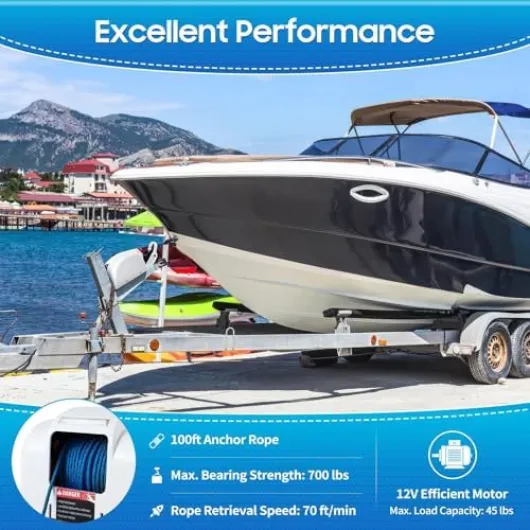
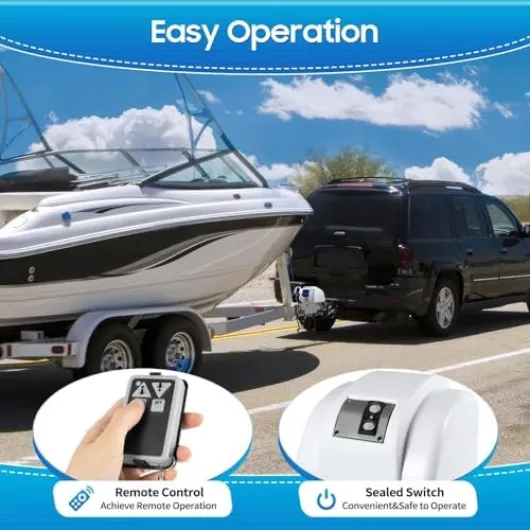
The layout of the controls is simple: there’s a main switch panel on the unit, and then the wireless remote that you can keep near the helm or up front. The remote range is advertised at 10–15 meters, and in practice it worked fine from both the bow and the driver’s seat, even with other gear around. No fancy screen or anything, just up/down buttons. It’s basic, but you don’t really need more than that for an anchor.
What I liked in the design is the free-fall function for dropping the anchor. You hit the down button and the rope runs out quickly until you stop it. This is handy when you’re trying to hit a specific depth without slowly winching down. But there’s a flip side: if you’re not ready, the anchor dumps fast, and on the first outing I overshot and had to reel back up a good 20–30 ft. It’s not a deal-breaker, just something you learn to manage by tapping the button instead of holding it.
Visually, it looks like a typical generic marine accessory: white plastic body, simple lines, nothing fancy. It doesn’t look cheap from a distance, but up close you can tell it’s not from a big-name manufacturer. No rubberized edges, no extra sealing gaskets visible, just a basic housing with a lid. For a small freshwater or light inshore boat, that’s fine. For heavy offshore use, I’d probably look for something beefier and better sealed.
Power draw and battery impact
This winch runs on 12V DC, so it hooks straight up to your boat’s standard battery system. There’s no built-in battery; you wire it to your existing one with the included cable and circuit breaker. I’ve got a single starting battery plus a separate trolling motor battery on my boat. I wired the winch to the starting battery through the supplied breaker, and after a few trips I can say it doesn’t drain things in any noticeable way for normal use.
Each anchor cycle – dropping and raising from around 20–25 ft – only runs the motor for maybe 1–2 minutes total. Even on a fishing day where I moved spots 8–10 times, the battery voltage barely budged compared to what my fishfinder and bilge pump use. You can hear the motor draw when it starts, especially under load, but it’s not the kind of thing that will kill a healthy marine battery in one outing.
The included automatic reset circuit breaker is a good safety net. I pushed it a bit on purpose by trying to pull the anchor when it was snagged, and I could feel the motor struggle. I didn’t manage to trip the breaker, but it’s reassuring to know it’s there if something really binds up. For wiring, I’d suggest using decent gauge marine cable and keeping the run as short as practical, especially if your battery is far from the bow. The kit cable is okay, but if you have a longer boat, you might want thicker wire to avoid voltage drop.
In short, battery impact is minor for normal recreational use. As long as your boat’s electrical system isn’t already on the edge, you shouldn’t have issues. I still wouldn’t sit there and hold the up button for 5 minutes straight on a stuck anchor, but for realistic scenarios, it’s power-hungry for short bursts only, which is fine.
Materials and build: decent housing, mixed hardware
According to the specs, the winch uses ABS plastic for the housing, some 45 steel parts inside, PP, and 316 stainless steel for the exposed metal bits. In practice, the housing feels reasonably solid when you knock on it. It doesn’t flex much when you tighten it down, and it didn’t rattle when I hit waves at moderate speed. The lid closes properly and doesn’t feel like it will snap off at the first bump.
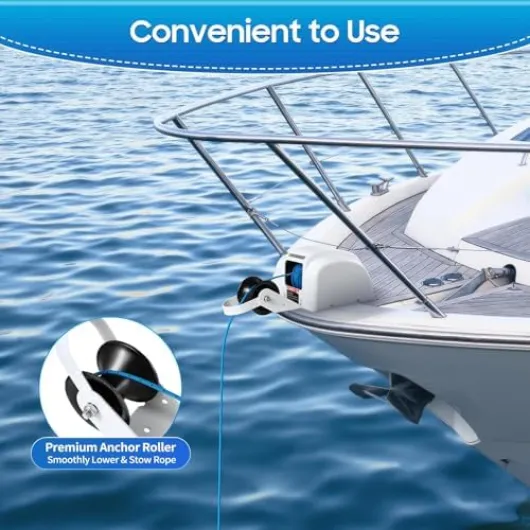
The anchor roller that comes with it is actually better than I expected. The metal looks like real stainless, and the roller runs smoothly with the rope and my chain. After a few trips on freshwater, no obvious rust spots yet. The internal drum that holds the rope is not visible without opening the unit, but from the sound and feel, it’s metal, and it grips the rope well enough that I never had it slip under normal load.
Where you feel the budget side is in the small hardware. The bolts and nuts for mounting and some of the external screws don’t look like top-grade marine stainless. They’ll probably last a while in freshwater, but if you use this in saltwater all season, I’d expect some corrosion unless you rinse and maybe replace them. Same for the remote: it’s light plastic, and while it works, it doesn’t feel rugged. I keep it in a small dry box when not in use, because I don’t trust it to survive repeated dunking or being stepped on.
Overall, I’d say the materials are pretty solid for occasional use but not something I’d rely on for heavy commercial or daily offshore use. For weekend fishing and casual boating, it’s fine, especially if you’re willing to swap a few bolts for better ones and take basic care like rinsing it after salty trips. It’s clearly built to a price, but not so flimsy that you feel it will fall apart right away.
Durability after a few outings (and what I expect long term)
I’ve used this winch for about six trips so far, in mostly freshwater with one light brackish outing. In that short time, nothing has broken, and the unit still runs like on day one. No weird noises, no cracks in the housing, and the rope hasn’t frayed. The anti-reverse clutch works: when you stop the motor, the drum holds the rope and the anchor stays put. I haven’t had any surprise drops or slipping, which is key for peace of mind.
That said, you can tell this isn’t built like a high-end windlass. The housing seams don’t have big obvious gaskets, and some screws look like they’ll be the first point of rust if you don’t rinse them after saltwater. I’d rate it as fine for weekend use but I’d be cautious if you leave your boat in a harsh marine environment year-round. For my use – trailered boat, mostly freshwater – I’m not too worried. I do pop the lid occasionally to check for moisture or corrosion, and so far it’s clean and dry inside.
The rope they include seems okay. It’s not the softest, but it runs well through the roller and drum, and the stated ~700 lb strength is plenty for anchoring a small boat. Just keep an eye on the first few feet near the anchor, because that’s where abrasion will show up first. If you’re anchoring on rocky bottoms a lot, you might eventually want to replace the rope with something you trust more and maybe tweak the length to your usual depths.
Long term, I don’t expect this thing to last forever, but for the price, if I get a few seasons of regular use with basic care (rinsing, checking hardware, storing the remote safely), I’ll be satisfied. If you’re rough on gear or leave your boat in saltwater all year, you might want to budget for more frequent maintenance or step up to a more heavy-duty brand.
Performance on the water: does it actually pull its weight?
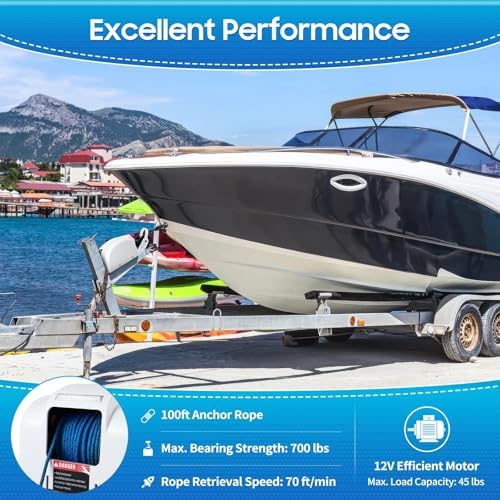
Performance-wise, with a 12V motor and a rated pull for up to a 35 lb anchor (they also mention 45 lbs in the description, which I’d take with a grain of salt), it handled my 20 lb anchor plus a short chain without drama. The retrieval speed is listed at about 70 ft per minute, and that matches what I saw: roughly a minute and a half to pull up my usual 80–90 ft of line in 20–25 ft of water. It’s not blazing fast, but it’s a lot nicer than yanking it by hand, especially at the end of the day.
In light wind and mild current, it brings the anchor up smoothly. When the anchor is really dug into mud or snagged on some weeds, you can hear the motor slow and strain a bit, but it still manages to pull free as long as you don’t overload it. I got into a heavier weed bed once and had to bump the boat forward a touch to relieve the load; after that, the winch finished the job. So it’s not magic – you still have to use your head – but it has enough power for normal small-boat situations.
The free-fall drop is handy when you’re trying to anchor fast over a spot. Rope runs out quickly, and you stop it with the button once you hit your target depth. You just need to be ready, because the first time I used it, the anchor hit bottom and kept going a bit before I reacted. After a couple of outings, I started feathering the button instead of holding it down, and it was much easier to be precise. No major backlash or snarls so far, but I do take a second to straighten the rope on the drum when I’m done for the day.
Overall, it gets the job done for small boats in typical conditions. If you’re trying to anchor a heavier boat in strong current or deep water all the time, I’d look for a stronger, branded windlass. For lakes, rivers, and light coastal use on a 14–20 ft boat with a 15–25 lb anchor, this unit is good enough, as long as you’re not expecting commercial-level performance.
What you actually get in the box
Out of the box, you get the winch unit, an anchor roller, about 100 ft of rope already spooled, a basic remote, wiring, a circuit breaker, and some mounting hardware. No anchor included, which is fine, but you need to already own something in the 15–35 lb range to match what this winch can handle. The product listing mentions up to 45 lbs in some places, but the specs say 35 lbs max anchor capacity. I treated it as a 35 lb system and I think that’s more realistic. With my 20 lb anchor and a short chain, it feels about right.
The instructions are usable but not great. There are diagrams, but they’re small and you need to read them twice to be sure which way the rope is supposed to feed. If you’ve never installed an electric winch before, plan to watch a couple of YouTube videos of similar models. The manual doesn’t really explain best practices, like where to place the circuit breaker or how to route the rope to avoid chafing. It just tells you what wire goes where.
One thing I did like is that most of the key parts you actually touch or see are already assembled: rope is spooled, remote is pre-paired, and the internal clutch is set from the factory. You’re not rebuilding a machine here, you’re just mounting and wiring it. The supplied bolts and nuts are okay for a test fit, but for a permanent install on a boat that hits waves, I’d personally replace them with better stainless hardware from a marine store. The included stuff looks like it will rust faster than the rest of the unit.
Overall, the presentation screams "generic but functional". No fancy branding, no nice storage case, just the core parts in bubble wrap. If you’re the kind of person who wants everything labeled and color-coded, you’ll be a bit disappointed. If you’re fine with a simple kit where you do a bit of your own thinking during install, it’s acceptable for the price range.
Pros
- Enough pulling power and speed for a 15–25 lb anchor on small boats
- Remote control and free-fall drop make anchoring much easier and quicker
- Good price compared to big-name electric anchor winches with similar specs
Cons
- Generic brand with basic instructions and mixed-quality mounting hardware
- Not ideal for heavy boats, frequent saltwater use, or very demanding conditions
Conclusion
Editor's rating
For a small to mid-size boat running a 15–25 lb anchor, this generic electric winch does what most people actually need: it raises and lowers the anchor at the push of a button and saves you from hauling wet rope by hand. The motor strength is adequate, the free-fall drop is convenient once you get used to it, and the remote control works reliably within normal boat distances. It’s clearly a budget product, but in normal freshwater or light coastal use, it holds up fine so far.
On the downside, you feel the lower price in the instructions, the hardware quality, and the general finish. This isn’t the kind of windlass I’d choose for a heavy boat anchored in strong current every day, or for a boat that lives permanently in saltwater. You need to be a bit handy for the install and willing to keep an eye on the hardware and rope over time. If you accept those trade-offs, the value is good: it gets the job done without costing as much as the big brands.
I’d recommend it to weekend anglers and casual boaters with 14–20 ft boats who want an electric anchor solution and don’t mind a more basic, generic product. If you’re running a larger, heavier vessel, anchoring in tough conditions, or you just want gear that feels top-tier and you never think about it, I’d skip this and pay more for a known, heavy-duty system.