Summary
Analysis score
Average of the criteria rated below
Value for money compared with other 40–50 L travel fridges
Design and ergonomics: built to live in a boot, not on a countertop
Power management and battery protection for vehicle use
Build quality, reliability and warranty coverage
Cooling performance, noise and app control
What the Subcold Roam45DZ offers on paper
Pros
- Dual-zone compressor cooling allows simultaneous fridge and freezer use in one 45 L unit
- Runs on 12V/24V DC and 240V AC with 3-level battery protection to help protect vehicle starter batteries
- Smartphone app control for temperature, Eco/Max modes and monitoring without touching the unit
Cons
- Only 1-year warranty and limited long-term user feedback so far
- 16.3 kg weight and functional design make it less convenient to move around frequently

Specifications
View full product page →| Brand | Subcold |
A 45L car fridge-freezer aimed at hassle-free road trips
The Subcold Roam45DZ sits in that category of gear that can completely change how you handle food and drinks on the move. On paper, it’s a 45-litre portable compressor fridge-freezer that runs on 12V/24V in vehicles and 240V at home or on mains hook-up. It’s clearly aimed at people who want to stop relying on ice and cool boxes: campers, van owners, 4x4 users and anyone doing long road trips. With a published noise level of 44 dB and a dual-zone layout, it tries to cover both chilled food and frozen items in one unit.
What stands out straight away is the mix of features that you usually see on more expensive models: dual-zone cooling, smartphone app control, and a 3-level battery protection system to avoid flattening the starter battery of your car or van. The capacity is announced at 45 litres, which is a decent size for a couple on a week-long trip or a small family for weekends. At 16.3 kg, it’s not a featherweight, but that’s typical for a compressor model of this volume.
The published customer feedback is very positive so far, with a 5.0/5 rating from a small number of Amazon reviews. That’s encouraging, but the low review count means you have to keep a bit of distance: there isn’t a huge sample of long-term use stories yet. Still, verified buyers sound satisfied with cooling performance and practicality, which matches what the spec sheet suggests for this kind of compressor fridge.
In my opinion, the Roam45DZ looks like a straight-to-the-point, feature-rich travel fridge-freezer aimed at users who care about reliable cooling, dual temperature zones and car battery safety more than fancy design. It’s not pretending to be decor for a kitchen; it’s gear for the boot of a car or the back of a van. The key question is whether those specs and early reviews justify picking it over other 40–50 L portable fridges in the same segment.
Value for money compared with other 40–50 L travel fridges
In terms of value, the Roam45DZ combines several features that usually push prices up: dual zones, compressor cooling, app control and 3-level battery protection. Many competitors in the 40–50 L bracket either skip the dual-zone layout or don’t offer any smart control at all. Here you get both, which makes the package attractive for people who want a bit more control and flexibility without stepping into the price range of premium expedition brands.
The exact selling price is not listed here, but the Amazon Best Sellers Rank (around 535 in Large Appliances and 107 in Mini Fridges) suggests it’s moving reasonably well for a relatively new product. The 5.0/5 average rating from a small number of verified buyers indicates strong satisfaction so far. That said, with so few reviews, you have to be cautious: it’s easier to stay at 5/5 when only a handful of people have commented. Over time, ratings usually stabilise a bit lower as more varied experiences come in.
From a pure spec perspective, you’re paying for: 45 L capacity, dual-zone flexibility, 12/24/240 V compatibility, battery protection, automatic defrost, and noise rated at 44 dB. In my opinion, that’s a well-rounded set for someone who camps regularly, travels in a van, or wants reliable cooling for off-grid use with a power station. If the street price stays in the mid-range of portable compressor fridges, the value looks good. If it creeps close to the top-tier brands, then the one-year warranty and limited track record become weaker points.
Overall, I’d place the Roam45DZ as good value for users who actually need dual zones and app control. If you only want a simple single-zone fridge for the occasional weekend, you can probably save money with a more basic model. But if you like the idea of keeping ice cream frozen while drinks stay just cold, watching everything from your phone and protecting your car battery at the same time, this model offers a lot for what is likely a competitive price in its category.
Design and ergonomics: built to live in a boot, not on a countertop
The Roam45DZ uses a solid, matte black finish with a simple, boxy form factor. It’s clearly a functional, portable unit rather than something meant to blend into a kitchen. The configuration is listed as “Freestanding Freezerless”, which basically means it’s not designed as a built-in appliance and has no traditional freezer compartment like a domestic fridge; instead, both internal zones are flexible cooling/freezing spaces. The door orientation is right-hinged, and there is one main door rather than two separate lids, which may affect how often you expose both zones to warm air when accessing one compartment.
At 16.3 kg, this is not something you casually carry long distances, especially once loaded with food and drinks. That’s typical for compressor coolers with 40–50 L capacity, though. The listing mentions one plastic shelf inside, which suggests some basic organisation but not a highly modular layout with baskets everywhere. For a travel fridge, that’s acceptable: most users end up using containers or bags to structure their food anyway. The form factor is portable, which usually implies integrated handles and a footprint designed to fit in most car boots; the strange dimension values in metres (4.41D x 7.53W x 4.47H m) are obviously a listing error and shouldn’t be taken literally.
The control interface is a key element of the design. While the listing doesn’t go into detail on button layout, it does highlight adjustable temperature control and direct switching between Eco and Max modes, plus app connectivity. In my opinion, the design logic is clear: give direct, simple hardware controls on the unit for everyday use, and offer the app for those who want more convenience or remote monitoring from inside a tent or the driver’s seat.
According to the few published reviews, buyers seem satisfied with the overall practicality and don’t complain about awkward shape or layout. There is no flood of comments about flimsy lids or annoying hinges, which is usually a red flag with portable coolers. So while the design isn’t trying to win style awards, it looks functional, straightforward and aimed at real travel use. If you want something that looks like a piece of furniture, this is not it. If you want something that sits in the back of a car and just does its job, the design approach makes sense.
Power management and battery protection for vehicle use
Power handling is one of the most important points for any car fridge, and the Roam45DZ takes this seriously with its multi-voltage support and 3-level battery protection. It can run on 12V or 24V DC, which covers standard cars, vans and trucks, plus 240V AC for home or campsite mains. That flexibility means you can cool it at home before leaving, keep it running from the cigarette lighter or a dedicated socket while driving, then plug into shore power or a power station at your destination.
The 3-level battery protection (High / Medium / Low) is designed to protect your vehicle’s starter battery by cutting power when the voltage drops below a threshold. On paper, this avoids the classic scenario where you wake up at a campsite and the car won’t start because the fridge has run all night. For users who don’t have a separate leisure battery, this is crucial. You can choose how conservative you want the cut-off to be: High for maximum safety, Low if you accept more risk to squeeze extra runtime. This kind of setting is common on better compressor fridges, and it’s good to see it clearly advertised here.
The annual energy consumption of 117 kWh gives a rough idea of its efficiency for home use, but for travel the real concern is how much it draws in Eco vs Max mode and how that interacts with your battery size. There are no detailed wattage figures in the listing, so you have to infer from similar units: compressor fridges of this size typically draw more power during initial cool-down in Max mode, then settle to lower, intermittent consumption in Eco mode. In my opinion, if you pair this with a decent car alternator and drive a bit each day, or use a dedicated leisure battery or power station, the power management features should be enough for worry-free use.
Among the early Amazon reviews, there are no horror stories of dead car batteries or unstable power behaviour. Users seem to appreciate the battery protection and the overall stability of the unit when plugged into 12V or 240V. The presence of automatic defrost also helps avoid efficiency loss over time due to ice build-up. Overall, on paper the Roam45DZ looks well thought out for real-world power scenarios: you get protection for your vehicle, flexible voltage options, and control modes that let you balance cooling speed and energy use according to your setup.

Build quality, reliability and warranty coverage
Durability is always a question mark with portable compressor fridges because they get bounced around in vehicles, exposed to heat and used for long stretches. The Roam45DZ is manufactured in China, like most products in this category, and carries a CE certification plus a 1-year warranty from Subcold. A one-year warranty is standard for this price range but not especially generous; some higher-end brands offer two or more years, especially on the compressor. So if you want long formal coverage, this is something to keep in mind.
The materials mentioned include a matte finish exterior and plastic shelving inside. That’s pretty typical: plastic is lighter and less prone to corrosion than metal racks in a damp camping environment. There’s no detailed breakdown of the casing material, but portable fridges in this category usually use robust plastic shells with reinforced corners rather than thin sheet metal. Given the 16.3 kg weight, it’s clearly housing a full compressor system and insulation, not a flimsy thermoelectric setup. The automatic defrost feature should also help long-term efficiency by preventing extreme ice build-up in the compartments.
As for real-world reliability, there are only a handful of Amazon reviews, all giving 5/5. Buyers mainly highlight that the fridge does what it’s supposed to do and that they are satisfied with the purchase. There are no reports of early compressor failure, cracked housings or broken lids in the current comments. That’s a good sign, but the sample size is small and doesn’t replace long-term data from dozens or hundreds of users. In my opinion, it’s fair to say that nothing alarming shows up yet, but it’s too early to declare it bulletproof.
Practically, if you plan to use this fridge in a 4x4 or van over rough tracks, it would be sensible to treat it as mid-range gear: solid enough for regular use, but not something to throw around without care. Using tie-down straps, avoiding constant harsh impacts and not overloading the lid are basic habits that will help any compressor fridge last longer. With a one-year warranty and positive early feedback, the Roam45DZ looks reasonable on durability, but not in the heavy-duty, expedition-grade category.
Cooling performance, noise and app control
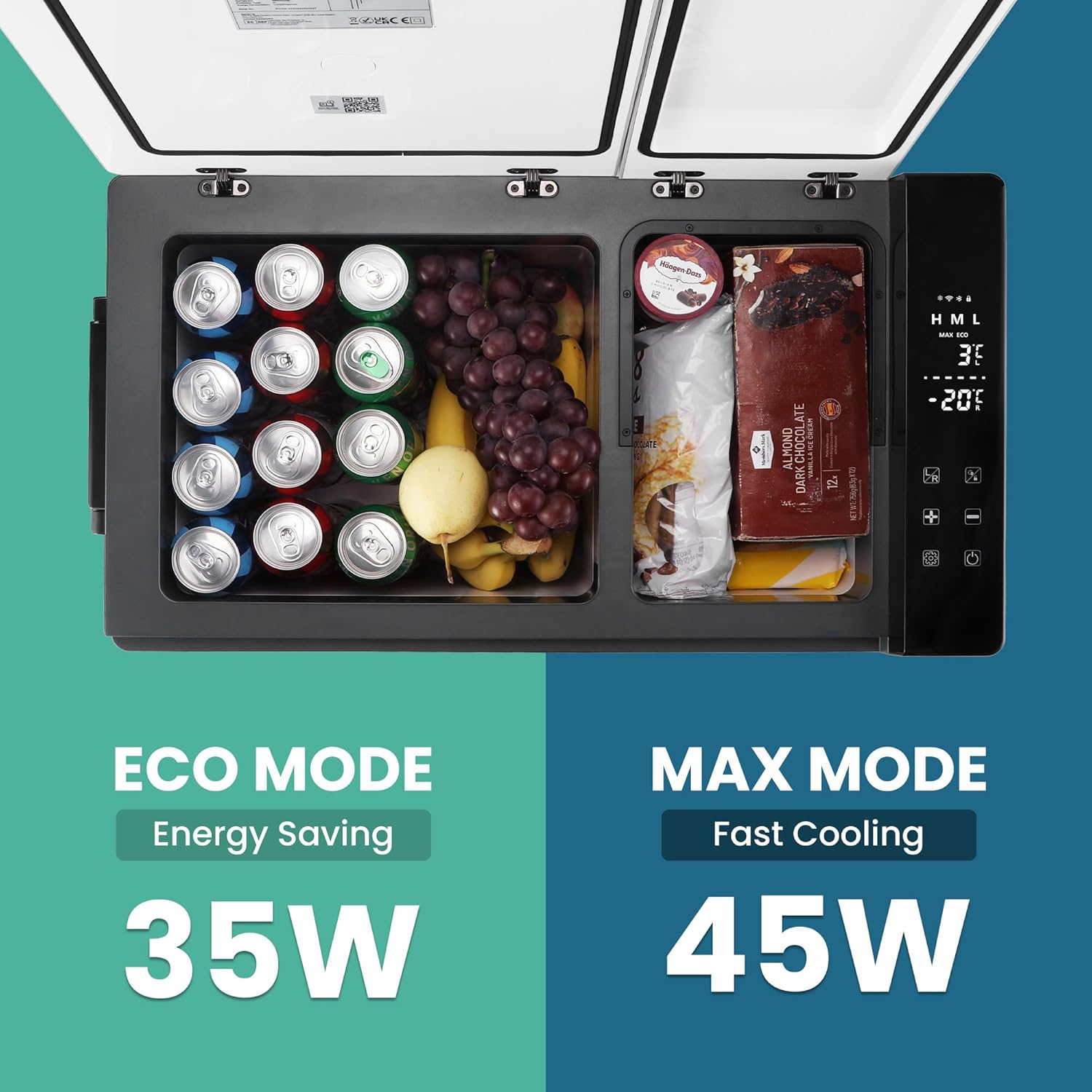
The Roam45DZ uses a compressor-based cooling system, which is the same technology as household fridges and generally far more effective than thermoelectric coolers, especially in hot weather. The product description highlights “powerful compressor cooling – fast & reliable performance” and the presence of Eco and Max modes. On paper, Max mode should allow faster temperature pull-down when you first load warm items, while Eco mode should reduce power draw once everything is cold. That combination is standard on serious camping fridges and usually more efficient than running a single fixed power setting.
The dual-zone capability is the big functional advantage. Being able to refrigerate and freeze at the same time with independent temperature zones means you can, for example, keep drinks and fresh food at around +3 to +5 °C while running the other zone below 0 °C to keep meat or ice frozen. For road trips longer than a day or two, that’s a big step up from a simple cooler that only keeps things “less warm”. There are no detailed temperature graphs in the listing, but compressor fridges in this class typically handle a range from around -20 °C up to normal fridge temperatures.
The published noise level of 44 dB puts it in the range of a quiet domestic fridge. In a tent or small camper, you would probably still hear the compressor cycle on and off, but on paper it’s moderate for a compressor system. Among the few Amazon reviews, there are no complaints about the sound being unbearable, which suggests it stays within a level most users accept for camping and van life. As always, sensitivity to noise is personal, but nothing in the feedback points to a major issue here.
The app control is more than a gimmick for this kind of product. Being able to adjust temperature, switch between Eco/Max and monitor performance from a smartphone means you don’t need to lean into the boot or open the tent every time. For people who sleep near the fridge, tweaking Eco mode or temperature without getting out of bed is a real convenience boost. In my opinion, the performance package looks solid: compressor cooling, dual zones, reasonable noise spec and app control tick the main boxes for serious travel use. The only unknown is long-term reliability under high heat or constant cycling, and with so few reviews, there isn’t enough public data yet to judge that point confidently.

What the Subcold Roam45DZ offers on paper
On paper, the Subcold Roam45DZ is a 45 L dual-zone portable compressor fridge-freezer designed to run on multiple power sources. It accepts 12V or 24V DC from a car, van, truck or leisure battery, and also 240V AC with a standard UK Type G plug. That means it can move from vehicle to campsite power hook-up or home use without adapters. The listed “Fresh Food Capacity” of 40 L vs 45 L total suggests part of the space is taken by the freezer or internal structures, but overall you’re in the typical 40–45 L travel fridge bracket.
The big feature is the dual-zone layout: two independent temperature zones that can cool and freeze at the same time. In practice, this usually means one compartment works as a fridge (for drinks, dairy, fresh food) while the other can be used as a freezer for meat, ice cream or ice packs. Temperature control is adjustable and can be managed from the onboard panel or via a smartphone app, which is fairly advanced for this price segment. You can switch between Eco Mode for lower consumption and Max Mode for faster pull-down of temperature.
Another strong point on the spec sheet is the 3-level battery protection system (High / Medium / Low). This cuts power to the compressor when the input voltage drops below a defined level, to help ensure the vehicle battery still has enough charge to start the engine. For anyone running it off a starter battery instead of a dedicated leisure battery, that’s a crucial layer of safety. The unit is also CE certified, has automatic defrost, and is sold with a 1-year warranty from Subcold, which is standard but not generous.
The manufacturer lists an annual energy consumption of 117 kWh, which is reasonable for a compressor unit of this size. Noise is announced at 44 dB, which is closer to a quiet household fridge than a loud camping cooler. In my opinion, the Roam45DZ positions itself as a fully featured, mid-sized travel fridge-freezer with a focus on practical features rather than premium finishing: dual-zone, multi-voltage, app control and battery protection are its core selling points. The spec sheet looks coherent with that goal, even if some details like the oddly formatted dimensions (in metres) clearly come from sloppy listing rather than an actual issue with the product.
Pros
- Dual-zone compressor cooling allows simultaneous fridge and freezer use in one 45 L unit
- Runs on 12V/24V DC and 240V AC with 3-level battery protection to help protect vehicle starter batteries
- Smartphone app control for temperature, Eco/Max modes and monitoring without touching the unit
Cons
- Only 1-year warranty and limited long-term user feedback so far
- 16.3 kg weight and functional design make it less convenient to move around frequently
Conclusion
Analysis score
The Subcold Roam45DZ comes across as a practical, feature-rich 45 L portable compressor fridge-freezer aimed at real-world travel rather than showroom style. On paper, its biggest strengths are clear: dual-zone cooling, multi-voltage support (12/24/240 V), a 3-level battery protection system and smartphone app control. Add in a moderate noise rating of 44 dB and automatic defrost, and you get a fridge that should handle most camping, road trip and light off-grid scenarios without constant babysitting.
The weak points are not dramatic but worth noting. The 1-year warranty is just average, and there isn’t a long history of user feedback yet: a handful of 5-star reviews look good, but they don’t tell the full long-term story. The design is functional rather than stylish, and at 16.3 kg, it’s not the kind of unit you’ll want to carry far once loaded. In my opinion, it sits in the mid-range: more capable and flexible than basic coolers, but not trying to compete with the most rugged, expedition-focused brands.
If you’re a camper, van owner or frequent road-tripper who wants proper refrigeration and freezing in one box, with app control and decent battery safety, the Roam45DZ looks like a solid candidate. If you only need a simple drinks cooler for the odd picnic, it’s probably overkill. Overall, the spec sheet and early reviews suggest good value for money for users who plan to actually use the dual-zone and power management features on a regular basis.