
Summary
Editor's rating
Is it worth the money compared to just Googling everything?
Layout, illustrations, and how usable it is in real life
Physical durability: can it survive life on an actual boat?
How it holds up as your main maintenance reference over time
What you actually get inside those 896 pages
Does it actually help you fix stuff, or just explain theory?
Pros
- Very broad coverage of most sailboat systems in one volume
- Clear explanations and diagrams that help you actually understand problems, not just follow steps
- Helps plan and prioritize maintenance and spot issues before they get expensive
Cons
- Some topics (like winch servicing and modern electronics) are not covered in much depth
- Content is a bit dated for newer technologies and advanced gear

The boat DIY book that actually earns its shelf space
I bought Don Casey's Complete Illustrated Sailboat Maintenance Manual after a winter haul-out where I spent more time on YouTube than actually fixing things. I wanted one reference I could keep on the boat and in the workshop instead of jumping between random forums and half-baked videos. This book popped up everywhere people talked about doing their own work, so I gave it a shot.
First impression: it’s big and heavy, almost 900 pages. This isn’t a quick read you smash in a weekend; it’s the kind of thing you grab when something breaks and you’re trying to figure out if you can fix it yourself or if you’re about to make it worse. I started by using it for a couple of specific jobs: checking some old deck fittings for leaks, understanding my 12V system better, and planning a bit of cosmetic work inside the cabin.
In practice, the book feels like a mix between a course and a manual. Don Casey doesn’t just say "do this, do that"; he explains why things are built a certain way and what typically goes wrong. That helped a lot when I was troubleshooting wiring and trying to understand if my alternator was the problem or my batteries were just tired. I’m not an engineer, and I could still follow along without feeling lost.
It’s not perfect though. There are a few areas where I wished it went deeper, like winch servicing and some very specific gear that’s more modern. Also, because it’s from 2006, a few details feel a bit dated compared to what you see in newer boats. But overall, after using it on real jobs, it’s become the book I pull out first when something looks sketchy on the boat. It’s useful, not just something that looks smart on the shelf.
Is it worth the money compared to just Googling everything?
Price-wise, this book isn’t cheap, but it’s not outrageous either, especially considering the size and the amount of information. The way I look at it: if it helps you avoid one yard bill or one bad mistake, it’s paid for itself. In my case, using it to deal with deck leaks and electrical gremlins definitely saved me a couple of professional call-outs. Even if I still double-check some things online, having a structured explanation in one place is worth a fair bit.
Compared to buying multiple smaller books (one on electrics, one on hull repair, one on engines, etc.), this all-in-one approach is decent value. It won’t go as deep as a specialized book on every single subject, but for most owners of older fiberglass sailboats, it hits a good balance between breadth and depth. I only felt the need to supplement it with brand-specific manuals and a few detailed online guides for very particular jobs, like my specific diesel model and my self-tailing winches.
If you’re a new owner or thinking about buying a used boat, the value goes up even more. There’s a lot of guidance here on what to look for in a survey, how to spot hidden problems, and how to judge what’s a cosmetic issue versus a structural or safety problem. I used it that way before making an offer on a boat, and it gave me a more realistic idea of the work (and costs) I was signing up for.
On the flip side, if you’re mostly a charter sailor, or your plan is to pay professionals for almost everything, the value is lower. You’ll probably find the book interesting, but it won’t save you much money or effort. Same if your boat is very modern with lots of cutting-edge tech; you’ll quickly hit its limits on newer systems. But for the average hands-on cruiser or budget-conscious owner doing their own maintenance, I’d call it good value for money and one of the few books that actually earns its price over time.
Layout, illustrations, and how usable it is in real life
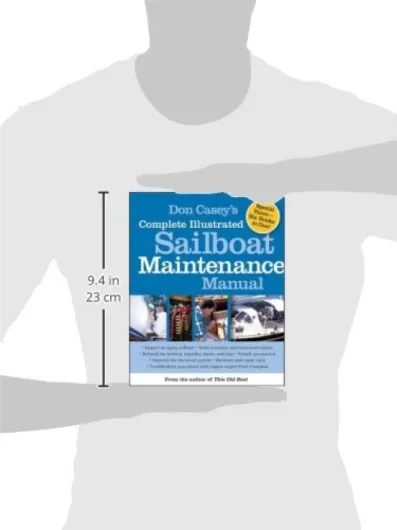
Physically, this thing is a brick: 1.9 kg and almost 900 pages. On the plus side, that makes it feel like a serious reference. On the downside, it’s not the book you casually flip through in bed; it’s more of a "spread it out on the saloon table with a coffee and a notepad" situation. The dimensions (roughly 19 x 24 cm) are nice though: big enough that diagrams are readable, small enough that it still fits on a standard bookshelf on the boat.
The layout is old-school but practical. Text is dense, but broken up with a lot of black-and-white drawings. No glossy color photos, no fancy design, just functional diagrams. When I was trying to understand how my masthead rigging was arranged, the simple line drawings actually helped more than some cluttered color photos you often see online. It’s very clear what’s what, and key parts are usually labelled properly.
Navigation-wise, the table of contents is solid and the index is decent. When I needed info on rebedding chainplates, I went through the index and found the section without too much hunting. Same with alternators, batteries, and osmosis. It’s not perfect—sometimes the exact term you’re thinking of isn’t the one used in the index—but nine times out of ten I eventually found what I needed. I’ve used worse technical books where the index is basically useless; this one is workable.
If you’re used to modern manuals with color step-by-step photos, you might find this a bit dry. Personally, I got used to it after a couple of sessions. For reading in the cabin or workshop, it’s fine. For use on deck in the wind, not so much—you don’t really want a 1.9 kg book flying around. I usually read the relevant chapter, take a few notes or photos of the key pages with my phone, and then go outside. So, design-wise: nothing fancy, but it’s clear and practical enough to actually use, which is what matters.
Physical durability: can it survive life on an actual boat?
This is a paper book living in a damp, salty environment, so durability actually matters. Mine has spent most of its time either on a shelf in the saloon or on a workbench in the garage during haul-out. After a season and a half of use, the binding is still holding together, which is already better than some cheaper manuals I’ve owned that started shedding pages after a few months of being flattened open.
The cover is just standard softcover, nothing fancy. It’s thick enough that it doesn’t curl instantly, but this is not a waterproof or ruggedized manual. A couple of times I’ve had it open near the companionway while working, and you can see some light wrinkling on a few pages from humidity and the odd greasy fingerprint. If you’re the type who likes pristine books, you’ll have to be careful. I treat this more like a tool: it’s okay if it gets a bit dirty as long as it stays readable.
One thing I’ve noticed: because it’s heavy, if you leave it open flat on a table, the spine gets a bit stressed. I started using small clamps or a weight to keep the right page open instead of forcing the spine all the way back. That seems to help. I also sometimes take photos of the relevant pages on my phone and bring the phone into the cockpit instead of the whole book, which keeps the book out of the worst of the elements.
So in practice, durability is acceptable as long as you’re not reckless with it. It’s not made to be tossed around in the cockpit or used in the rain, but as a workshop/cabin reference that occasionally gets dragged closer to the action, it holds up fine. If you want something you can literally hose off, this isn’t it. But for a normal sailboat environment with a bit of care, it should last several years without falling apart.
How it holds up as your main maintenance reference over time
I’ve been using this book across one full season and one haul-out, and its long-term performance as a reference is pretty clear: it’s the one I reach for first when something looks off. The big value is that it covers almost every area of the boat at a decent level. One weekend I was reading about blister repair and gelcoat, the next it was about chainplate inspection, and later about basic engine checks. Not many books can jump between all those topics without feeling random.
Compared to just using the internet, the book is slower but more reliable. Online, you get ten different opinions, half of them conflicting. Here, you get one clear explanation and a methodical way of thinking. For example, when I was planning to add a small solar panel and upgrade my battery bank, the sizing and wiring explanations here gave me a solid base. Then I went online for more up-to-date product choices. So I’d say the book performs best as the "foundation" layer: it gives you the logic and principles so you can judge whether some random advice on a forum actually makes sense.
Where it shows its age is with newer tech and certain modern fittings. There’s very little on things like lithium batteries, smart chargers, or networked electronics. If your boat is loaded with the latest gear, you’ll find gaps. On my older, fairly simple cruiser, it’s less of a problem, because most of my systems are still basic fiberglass, 12V, and mechanical stuff. But if you’re planning a full modern refit, you’ll definitely need extra, more recent sources.
In daily use, the "performance" of the book is basically: can I find what I need fast, and does it help me avoid stupid mistakes? For me, the answer has mostly been yes. It helped me spot issues early (like minor leaks turning into core problems), plan maintenance in a logical order, and understand what work I should leave to a pro. It doesn’t replace specialized manuals, but as a central hub of boat knowledge, it does a pretty solid job over time.
What you actually get inside those 896 pages
The main thing to know: this is a general sailboat maintenance encyclopedia, not a niche book on one system. It covers a lot: hull and deck, rigging, electrics, plumbing, engines, canvas, sails, interiors, and basic surveys. If you’ve just bought an older fiberglass sailboat and you’re trying to figure out what’s urgent and what can wait, this book gives you a good roadmap. I used it exactly like that when I bought a 30+ year old boat and needed to sort the scary stuff from the cosmetic stuff.
The structure is fairly logical. Each section starts with how the system works, then typical problems, then how to inspect and fix. For example, in the electrical section, it walks through the basics of 12V systems, battery types, charging, and then gets into troubleshooting. I used that chapter to track down why my cabin lights were randomly dimming. The explanation of voltage drop and bad connections matched what I was seeing, and the step-by-step checks were clear enough that I could narrow it down without guessing.
There are lots of drawings and diagrams, which helps. They’re not fancy, but they’re clear. When I was looking at deck core rot and rebedding hardware, the cross-section drawings of cored decks made it much easier to understand what was happening under the gelcoat. Same thing with through-hulls and seacocks: having a simple sketch next to the text made it much easier to visualize what I was about to mess with.
On the downside, because it tries to cover so much, some topics are more of an overview than a full deep dive. That reviewer who mentioned winch servicing is right: there’s not as much detail there as I’d like. Same for some more specialized modern electronics; you’re not going to get detailed chartplotter or NMEA2000 guidance here. But as a broad "how boats are put together and how to keep them alive" guide, it’s pretty solid. I treat it as a first stop: get the basics and the logic from this book, then look up brand-specific details online if needed.
Does it actually help you fix stuff, or just explain theory?
In terms of real-world usefulness, this book has paid for itself several times over for me. First concrete example: I had some suspicious brown stains around a couple of stanchion bases and was worried about deck core rot. Using the sections on deck inspection and cored construction, I figured out how to test the area properly, drill inspection holes, and rebed the hardware. That saved me from blindly paying a yard for exploratory work. The steps were clear enough that I felt confident doing it myself, even if I took it slow.
Second example: my cabin lights and instruments were acting weird when the engine was off. I used the electrical chapter to systematically check connections, fuses, and battery state. The book doesn’t turn you into an electrician, but it gives a decent troubleshooting process instead of just "wiggle wires and hope". I traced the issue to a corroded negative bus connection. The explanation of voltage drop and bad grounds matched what I was seeing on the multimeter.
That said, it’s not a magic fix-all. There are times where the book gives you just enough info to understand the problem, but not quite enough detail to feel totally comfortable doing the repair on your own the first time. Winch servicing is a good example: it explains the general idea, but when I actually stripped my self-tailing winches, I still ended up pulling up a brand-specific video to be sure I wasn’t going to launch springs across the cockpit. Same with diesel engine work: basic maintenance is covered, but for deeper engine jobs I’d still want the specific engine manual next to this book.
Overall, I’d say its effectiveness is highest for:
- Understanding how systems work and what usually fails
- Planning maintenance and upgrade projects
- Doing medium-level DIY jobs on hull, deck, rig, and electrics
Pros
- Very broad coverage of most sailboat systems in one volume
- Clear explanations and diagrams that help you actually understand problems, not just follow steps
- Helps plan and prioritize maintenance and spot issues before they get expensive
Cons
- Some topics (like winch servicing and modern electronics) are not covered in much depth
- Content is a bit dated for newer technologies and advanced gear
Conclusion
Editor's rating
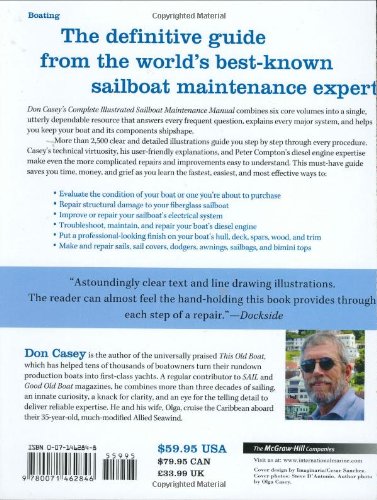
After using Don Casey's Complete Illustrated Sailboat Maintenance Manual through one full season, I see it as a solid, no-nonsense reference for people who actually work on their own boats. It’s big, a bit old-school, and not perfect, but it covers hull, deck, rig, electrics, engines, and interiors well enough that you can understand what’s going on and tackle a lot of jobs yourself. It won’t turn you into a professional boatbuilder, but it does give you the confidence to stop guessing and start working methodically.
This book is best for owners of older fiberglass sailboats who want to save money by doing their own maintenance, or at least understand what the yard is doing and why. It’s also very useful if you’re thinking of buying a used boat and want a realistic idea of what you’re getting into. If your boat is packed with the latest electronics or lithium setups, you’ll need more current sources to fill the gaps. And if you hate reading or prefer watching someone do everything on video, this might feel heavy.
Overall, I’d say it’s a pretty solid investment if you’re serious about hands-on ownership. Not magic, not perfect, but it gets the job done and has earned a permanent spot on my boat’s bookshelf.