Summary
Editor's rating
Value for money: where it sits vs bigger brands
Design: functional, not fancy
Materials and build: light but reassuring
Durability and long-term feel (so far)
Performance on the water: grip, release, and real use
What this double clutch actually offers
Pros
- Good holding power on 10–12 mm lines with minimal creep in normal cruising conditions
- Releases under load with reasonable effort and allows controlled easing with handle locked
- Decent build quality (anodised aluminium cams, plastic body, stainless hardware) at a mid-range price
Cons
- Looks and finish are basic compared to premium brands
- Can show slight creep with thinner lines near the lower end of its range (around 8 mm)

Specifications
View full product page →| Brand | Barton Marine |
A no-nonsense rope clutch for normal sailors
I’ve been using the Barton Marine DO 550 double clutch on a 32-foot cruising boat for a few weeks now, mainly for halyards and a reefing line. I’m not a pro racer, just someone who sails regularly and wants hardware that works without fuss. I swapped this in to replace an older, stiff clutch that was starting to slip and chew the cover off my jib halyard. So I went into this test looking for three things: grip, ease of release under load, and general reliability.
In day-to-day use, this clutch feels like a pretty straightforward bit of kit. Nothing fancy, no over-engineering, just a standard double clutch layout with two levers, meant for lines up to 12 mm and a safe working load of 550 kg. That spec matches what I actually saw on the boat: it handled 10–12 mm halyards without drama, and I never felt like I was pushing it to its limits during normal cruising. I didn’t take it to the breaking point, obviously, but it never gave warning signs like creaking or visible flexing.
What stood out early on is that the mechanism really is a true clutch, not just a cam cleat with a lid. I could ease the halyard with the lever down and locked, and the line fed through in a controlled way with only a bit of slippage. That’s the kind of detail you only notice once you actually try to fine-tune sail shape in some breeze, and it’s where cheap clutches usually show their limits. With this one, I could make small adjustments without fully opening the handle, which felt safer and more controlled.
It’s not perfect, and it’s definitely not the top of the range compared to big names like Spinlock, but it feels like a solid mid-range option. If you’re expecting miracle performance, you’ll be disappointed. If you just want something that works, grips decently and doesn’t destroy your lines, this one sits in that category. My impression so far: decent, reliable, and fairly honest for what it is.
Value for money: where it sits vs bigger brands
On the value side, the Barton DO 550 sits in a middle ground. It’s not the cheapest clutch you can buy, but it’s usually noticeably cheaper than top brands like Spinlock or Lewmar for equivalent double units. For that lower price, you don’t get the same polished look or maybe the absolute peak performance, but you do get a clutch that holds properly, releases without drama, and doesn’t shred your lines. For a lot of cruising sailors, that’s enough.
Compared to my old generic clutch (no-name unit that came with the boat), the Barton is clearly a step up. The handle feel is better, the grip is more consistent, and the ability to adjust with the handle down is more controlled. If you’re upgrading from older or cheaper hardware, you’ll probably notice the difference right away. If you’re coming from high-end race clutches, you’ll feel that this is a more basic tool, but also that you’re paying less for it.
Where I think it offers good value is for people who want reliable hardware without going into premium pricing. For a typical 30–35 foot cruiser that does weekend sailing, holidays, and maybe a club race or two, this clutch is more than enough. It should last several seasons if you look after it, and replacing a worn clutch with this will likely improve both line handling and safety. The SWL of 550 kg is fine for most halyard applications in this size range, as long as you’re not doing extreme high-load setups.
If you’re very budget-focused, you can probably find cheaper clutches, but you’ll likely sacrifice either smoothness or durability. If you’re chasing top performance and racing hard, you might prefer a more expensive brand. For the rest of us, the DO 550 lands in that "decent but nothing more" category: not flashy, but fairly priced for what it delivers.
Design: functional, not fancy
Design-wise, the Barton DO 550 sits firmly in the "functional" category. It’s fairly low-profile, with rounded edges so it doesn’t snag lines too easily when you’re moving around the coachroof. The handles are long enough to give good leverage when releasing under load, but not so long that they’re constantly in the way. I mounted it just aft of the mast base, and I can still walk over that area without worrying about catching my shoes. That’s a small thing, but on a busy deck you notice it quickly.
The handle action is quite precise. There’s a clear detent when you lock it down, and a positive feel when you open it. After a few days of use, I was opening and closing it without looking, just by feel. The locking mechanism doesn’t feel sloppy or loose, which I’ve had on older clutches where the handle starts to rattle after a season. Here, after multiple hoists and reefs, the handles still feel tight. The internal cam engages quickly when you drop the handle, so there’s not much free travel where the line can slip before it bites.
One design detail I liked is that releasing under load doesn’t require a massive yank. I tested it with the main halyard loaded up in about 15–18 knots of wind. With one hand on the halyard to control the easing and the other on the handle, I could crack it open smoothly without the usual heart-stopping jerk. There’s still a bit of a jump as the load transfers, but it’s manageable. If you’re used to wrestling older clutches that feel like they’re welded shut, this is an improvement.
It’s not perfect though. The top surface is a bit slippery when wet, and there are no real anti-slip textures where you might brace your hand. Also, the overall look is quite basic; if you care about matching a super clean, modern deck aesthetic, this won’t impress you. But for me, the design focuses on function over looks, and on that front it does the job: easy to operate, clear feedback, and compact enough not to clutter the deck.
Materials and build: light but reassuring
The body of the DO 550 is made from high-grade plastic, with cams and base in marine-grade aluminium that’s "Spectro" anodised, plus stainless steel where it matters (fastening points and internal bits). In the hand, it feels lighter than some chunky all-metal clutches, but not flimsy. When I first unboxed it, I’ll be honest, I was a bit skeptical about the amount of plastic. Once mounted and under load, that doubt went away pretty fast: no flex, no scary noises, and it felt solid when cranked down on the halyard.
During testing, I used it in salty, damp conditions for about three weeks, including one weekend where it rained on and off the whole time. The anodised aluminium cams didn’t show any immediate corrosion or staining, and the plastic housing didn’t show any stress marks around the mounting bolts after tightening them properly. I did use backing plates underneath, which is important if you don’t want to crush the deck or the clutch body. If you just crank down bolts into a thin deck without backing, that’s on you, not the clutch.
The stainless parts are decent. The pivot points for the handles feel solid and didn’t show play after repeated operations. I opened and closed each lever at least a few dozen times while hoisting, reefing, and playing with trim. No squeaks, no grinding, just a consistent feel. I didn’t disassemble it fully, but based on the feel, the internal hardware doesn’t seem cheap. It behaves like mid-range marine gear rather than bargain-bin stuff.
Overall, the materials feel appropriate for cruising and club racing use. If you’re planning hardcore offshore racing with constant punishment, I’d probably look at heavier-duty clutches from the top brands. But for coastal cruising, weekend regattas, and general use, the mix of plastic, anodised aluminium, and stainless steel seems like a sensible compromise between weight, cost, and durability. It doesn’t scream luxury, but it also doesn’t feel like something that’s going to fall apart after one season.
Durability and long-term feel (so far)
I obviously haven’t had this clutch for years, so I can’t pretend to give a full long-term verdict, but I can talk about what I’ve seen in a few weeks of fairly active use. In that time, we did multiple hoists, drops, and reefing cycles, plus a couple of bumpy days with the rig loaded up. The handles still feel tight, with no extra play or wobble developing. That’s usually one of the first signs of cheap internals, and I didn’t see it here.
The plastic housing hasn’t shown any cracks, whitening, or stress marks around the bolt holes. I torqued the mounting bolts sensibly (not gorilla-tight), and I used backing plates, which I’d strongly recommend. After sailing in rain and spray, I gave it a freshwater rinse; the anodised aluminium parts still look clean, with no visible pitting. Obviously, real corrosion tests come after months or years, but the first impression is positive. It behaves like typical mid-range deck hardware, not like something that’s going to crumble after one season.
One thing I watched closely was wear on the lines. Some clutches are rough on halyard covers, especially cheaper ones. After several hoist/lock/release cycles, my 10 mm halyard didn’t show any unusual fuzzing or flattening where it passes through the clutch. There was normal light wear, but nothing that made me worry. If anything, it seemed gentler than my old clutch, which had sharper cams. As always, if you use very old or already damaged lines, they’ll wear faster, but that’s not specific to this model.
If I had to guess based on the build and the way it feels, I’d say this clutch should hold up fine for typical coastal cruising and weekend racing for several seasons, as long as you rinse it occasionally and don’t abuse it. For full-on offshore or heavy racing programs, I’d probably step up to a heavier-duty line, but that’s more about use case than a flaw. So far, durability feels decent and in line with the price and materials.
Performance on the water: grip, release, and real use
In terms of pure performance, the DO 550 is pretty solid. I ran my 10 mm main halyard and an 8 mm reefing line through it. Both were polyester lines with decent covers, nothing exotic. Under full hoist in 15–20 knots, the clutch held the 10 mm halyard without noticeable creep. After about an hour sailing upwind, I checked the mark I’d made on the halyard at the clutch, and it hadn’t moved in any way I could see. With the thinner 8 mm reefing line, there was a slight tendency to creep if I really loaded it up, but that’s also pushing the lower end of the recommended diameter. For 10–12 mm, it feels in its comfort zone.
The ability to adjust the line while the clutch is closed is probably the nicest part. With the handle down and locked, I could ease the halyard a few centimetres at a time by easing the tail. There is a bit of controlled slippage, but it’s predictable. That’s much safer than having to fully open the clutch and risk a sudden dump of the sail. When you’re tweaking luff tension or reefing in a gust, that control matters. It’s not as smooth as some top-tier race clutches I’ve tried, but for this price bracket it’s decent.
Releasing under load is also pretty friendly. I tried it with the boat heeled over and the main sheeted in hard. With one hand on the handle and one on the halyard, I could crack it open without excessive force. There’s still a small jolt as the cam lets go, but nowhere near the "all or nothing" feeling of older clutches. The handle doesn’t snap back aggressively either, which is nice when your hands are cold or wet. I used it several times with gloves and a couple of times bare-handed in cold water; the grip on the handle is okay, though a bit more texture wouldn’t hurt.
Overall, performance is in line with what the spec suggests: suitable for cruising and club racing, solid holding power on correctly sized lines, and decent control when easing. It’s not magic, and if you try to clamp down on undersized or very worn lines, you’ll get some slip. But used properly, it does what you expect from a modern rope clutch, without nasty surprises.
What this double clutch actually offers
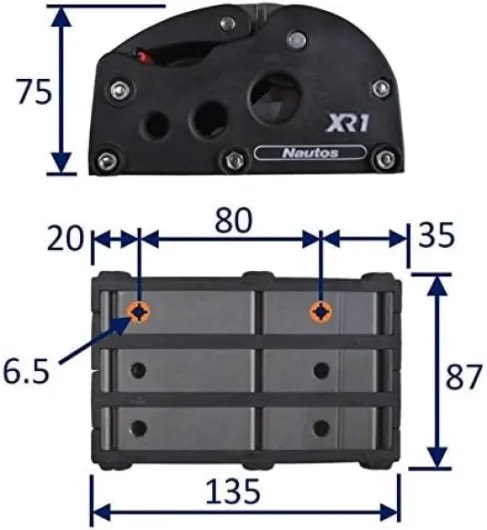
The Barton Marine DO 550 is a double rope clutch designed for lines up to 12 mm, with a stated SWL (safe working load) of 550 kg per line. On paper, that puts it squarely in the cruising and light racing bracket for boats around 28–36 feet, which is exactly where I used it. You get two independent levers, each controlling its own cam mechanism, so you can lock or release each line separately. The footprint is fairly compact: about 140 mm long and 70 mm wide, so it fit nicely on the existing mounting pad on my coachroof without needing to drill new holes.
The mounting is done with four 6 mm bolts (not included), which is standard. I reused my existing stainless bolts with backing plates, and alignment was fine. If you’re replacing another brand, you’ll probably have to redrill unless you’re lucky, but that’s normal when changing clutches. The body itself is made from high-grade plastic with aluminium cams and base, all anodised. So visually, it looks like typical mid-range marine hardware: not fancy, not ugly, just functional and a bit industrial.
One detail I actually found useful is the removable insert on top of the handle. Barton claims you can swap it for coloured or printed inserts to label each line. I didn’t get fancy with printed stuff, but I did pop the insert off and stick a bit of coloured tape underneath to mark main halyard vs reef. It sounds like a gimmick, but in practice it’s handy when you’re tired or sailing at night and trying to grab the right lever quickly.
Overall, the product is presented as a practical cruising/racing clutch rather than some high-end race-only part. And that’s how it feels: a straightforward, mid-level bit of deck hardware. No built-in fairleads, no extra bells and whistles. If you want a clean, simple double clutch and you know the spec you need (line diameter and loads), this one ticks the basic boxes without pretending to be something else.
Pros
- Good holding power on 10–12 mm lines with minimal creep in normal cruising conditions
- Releases under load with reasonable effort and allows controlled easing with handle locked
- Decent build quality (anodised aluminium cams, plastic body, stainless hardware) at a mid-range price
Cons
- Looks and finish are basic compared to premium brands
- Can show slight creep with thinner lines near the lower end of its range (around 8 mm)
Conclusion
Editor's rating
After using the Barton Marine DO 550 double clutch on a 32-foot cruiser for a few weeks, my take is simple: it’s a solid, no-nonsense clutch that does what it says on the tin. It holds properly on correctly sized lines, lets you ease under control with the handle down, and releases under load without needing a heroic pull. The build feels decent, the materials make sense for coastal use, and it hasn’t chewed up my halyards so far.
It’s not aiming at the high-end racing crowd, and it doesn’t have the refined feel or looks of the most expensive brands. The design is fairly plain, and if you’re very picky about aesthetics or pushing your boat hard offshore, you might want to spend more on a premium model. But for most cruising sailors and casual racers who just want reliable deck gear at a sensible price, this clutch is a good fit. It sits firmly in the “works well, reasonably priced” category.
If you have a 28–36 foot boat, use 10–12 mm halyards, and you’re upgrading from older or unknown clutches, you’ll likely be happy with this. If you’re on a tight budget or rarely sail in strong wind, you might consider cheaper options. If you’re a performance-obsessed racer, look higher up the range. For the average sailor who wants hardware that simply gets the job done, the Barton DO 550 is a pretty solid choice.