
Summary
Editor's rating
Value for money: where it sits versus bigger brands
Design: basic helm, functional layout, nothing fancy
Materials and build: solid where it counts, budget where it doesn’t
Early durability signs and what I expect long term
Performance on the water: steering effort and precision
Installation and setup: doable DIY, but measure carefully
What you actually get in the box
Pros
- Complete kit with helm, 10 ft cable, hardware, and wheel included
- Steering effort and play noticeably better than a worn-out cable system
- Materials seem decent where it counts, with stainless on exposed parts
Cons
- Instructions are basic; beginners may need extra guidance
- Finish and overall refinement are clearly budget-level compared to big brands

Specifications
View full product page →| Brand | Acclcors |
Swapping out an old steering system on a budget
I put this Acclcors mechanical rotary steering kit on a small 15 ft aluminum fishing boat with a 40 HP outboard, so right in the middle of the "up to 60 HP" range they mention. My old push-pull cable was stiff, had dead play, and honestly made docking a bit stressful. I wanted something cheap that I could install myself in an afternoon without having to redo half the console. That’s how I ended up trying this no-name (or almost no-name) steering kit.
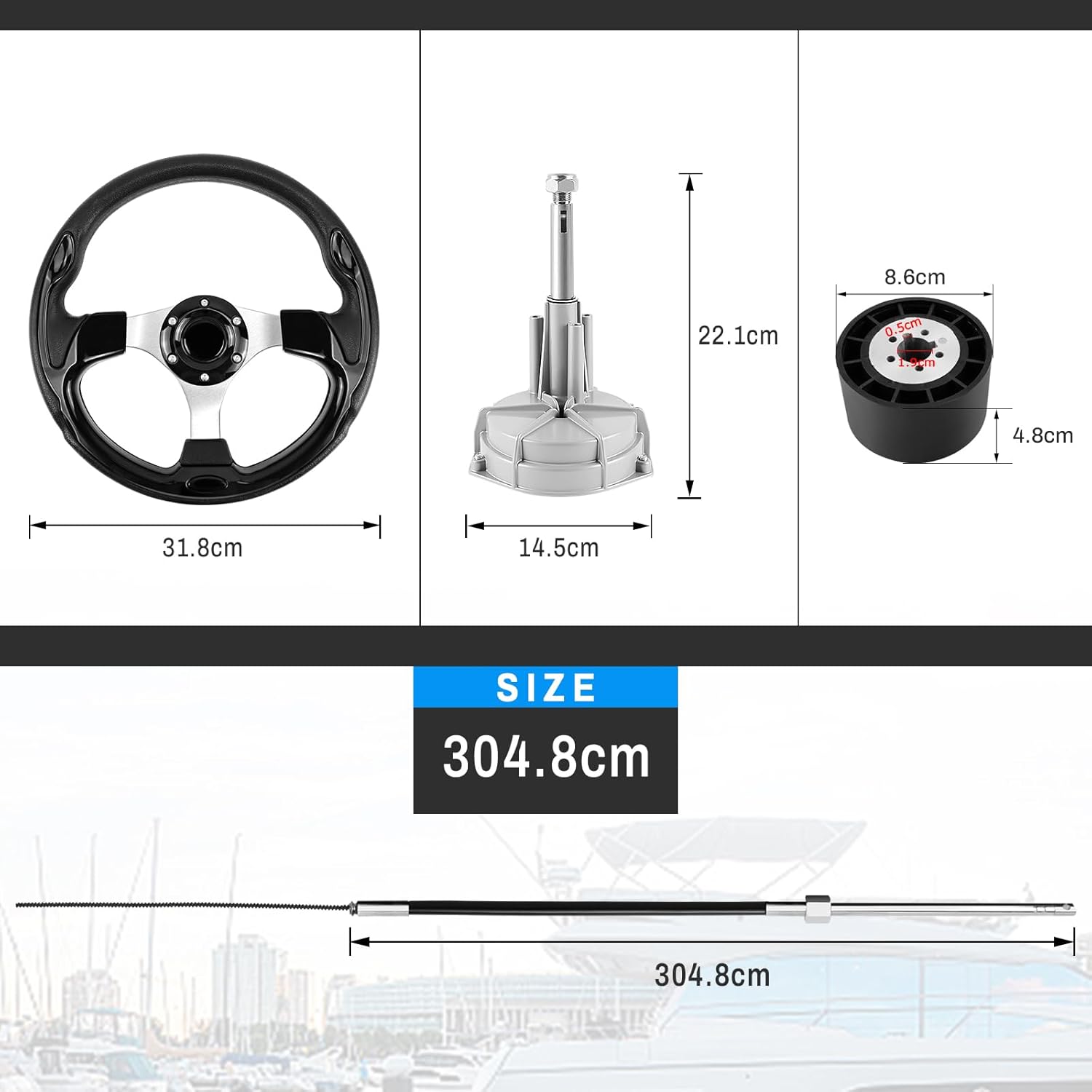
First thing to know: this is a basic mechanical rotary system, not hydraulic, not fancy. If you’re expecting luxury yacht steering, this isn’t it. But if your current steering is sloppy or borderline unsafe, this type of kit is a realistic upgrade. I went for the 10 ft / 304.8 cm cable version, which is just enough for a small center console layout where the run is not too crazy.
In use, the difference versus my worn-out cable was obvious: less effort, more predictable turns, and a lot less play at the wheel. It’s not feather-light, but it’s consistent and, most importantly, it feels safe. I’ve had it out in choppy conditions, slow trolling, and some tighter maneuvers around docks and ramps, and it behaved the same every time.
It’s not perfect. The instructions are a bit generic, the finish is clearly "functional" rather than pretty, and you need to be careful measuring cable length. But for a budget steering system from a lesser-known brand, it actually gets the job done better than I expected. If you’re handy with tools and not afraid to drill a few holes, it’s a realistic DIY project for a weekend.
Value for money: where it sits versus bigger brands
Price-wise, this Acclcors kit undercuts the big-name steering brands. You get a complete mechanical rotary system with wheel included for about what some other brands charge just for the helm and cable. That’s the main selling point here: for an older small boat that’s not worth dumping a ton of money into, this lets you refresh the steering without blowing the budget.
In terms of feel and build, it’s clearly a step below the top brands, but not by a huge margin. The steering effort and smoothness are very close to what I’ve felt on basic OEM setups from better-known manufacturers. Where they save money is on finish, packaging, instructions, and brand support. If those things matter a lot to you, you’ll probably lean toward a more expensive kit. If you just want the wheel to turn the engine reliably, this one hits that mark.
For me, the value is good because I was replacing a completely shot cable on an inexpensive boat. Spending a lot on a fancy system didn’t make sense. This kit gave me safer, more predictable steering for a relatively low cost and one afternoon of work. If I ever upgrade to a bigger boat or more horsepower, I’ll probably go hydraulic and spend more, but for this setup it would have been overkill.
So overall, I’d call the value pretty solid for small boats under 60 HP. It’s not a steal, but it’s fairly priced for what you get. If you expect premium details and long-term brand warranty support, you might be disappointed. If you’re realistic about it being a budget mechanical kit and you maintain it, it’s a sensible purchase.
Design: basic helm, functional layout, nothing fancy
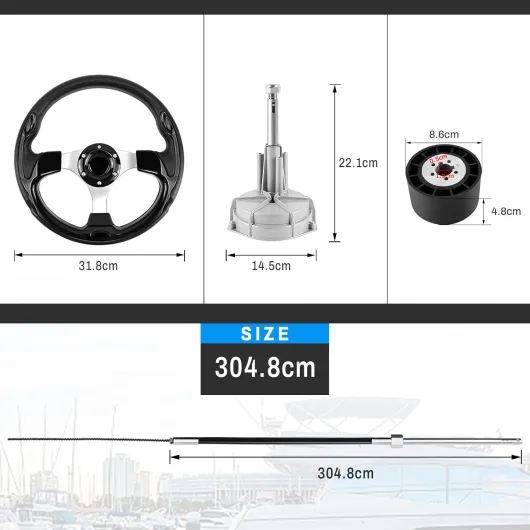
The design is straightforward: rotary helm box + fixed-length cable + standard tapered shaft. The helm is a compact square-ish unit that doesn’t take up too much space behind the console, which helped a lot on my small boat where access is tight. The 90-degree bezel kit lets you mount it on a slightly angled console and still have the steering wheel sit reasonably straight.
There’s no fancy tilt function, no adjustable ratio, and no built-in feedback reduction like you might find on more expensive systems. Steering ratio feels pretty standard for mechanical rotary: a few full turns from lock to lock, with enough precision for low-speed maneuvering without feeling twitchy at higher speeds. For a 40 HP on a light hull, it’s perfectly adequate. I never felt like I had to over-correct constantly.
One thing I noticed is that the helm casing is a bit more "industrial" looking than big-name brands. The edges aren’t as refined, and the casting marks are visible. That said, all the key contact areas (shaft, mounting holes, cable attachment) are aligned properly and didn’t give me any trouble. Once it’s bolted behind the dash, you don’t see any of that anyway. The visible part is just the bezel and the wheel, which look standard.
Compared to more expensive systems I’ve used on rental boats or friends’ rigs, this one feels more like an OEM replacement for a small runabout or fishing boat rather than something meant for a high-end center console. The design choice is clearly: keep it simple, keep it compact, and keep the cost down. And honestly, for a small boat that’s used on weekends for fishing and cruising, that’s enough. You’re not buying design flair here, you’re buying functional steering.
Materials and build: solid where it counts, budget where it doesn’t
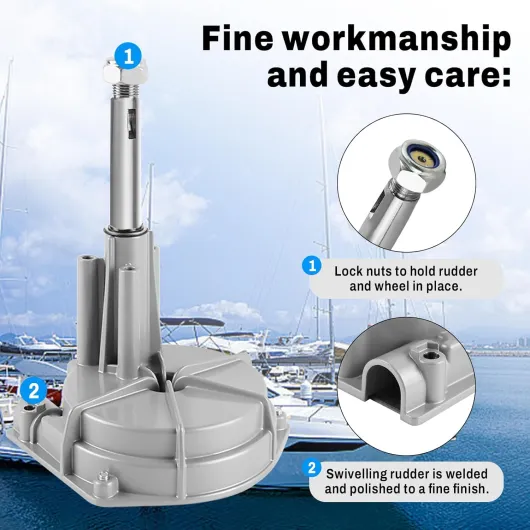
The brand advertises cast steel and 304 stainless steel seamless tubes, plus corrosion-resistant materials. In practice, the parts that actually touch the water or sit in the splash zone (cable end, hardware, swivel) do look like stainless or at least decent plated metal. I’ve had it mounted for a bit now, including some brackish water use, and there’s no rust showing yet on the exposed fittings.
The helm housing itself is more of a painted or coated metal with some plastic portions. It’s clearly built to live behind a console, not out in the open. The finish isn’t pretty, but the important bits (gear, shaft, and cable connection) feel tight and have no obvious play or wobble. When you spin the wheel with the engine disconnected, the internal movement feels smooth and consistent, no grinding noises or weird spots.
The steering cable sheath is fairly stiff and has a solid feel when you try to bend it. It’s not as flexible as some premium cables I’ve seen, but on a 10 ft run that’s not a big deal. The inner movement is smooth enough; you don’t feel any roughness through the wheel. The included hardware (nuts, bolts, washers) is standard marine-grade stuff. I swapped a couple of washers for my own stainless ones because I’m picky, but you could absolutely use what’s in the bag.
Overall, the materials are exactly what I’d expect at this price point: good where performance and safety matter, cheaper where it’s just cosmetic. If you baby your boat and rinse it after every saltwater run, this should hold up fine. If you leave it uncovered in harsh salt conditions year-round, you’ll probably want to keep an eye on the exposed metal over a couple of seasons, but that’s true for any budget mechanical steering system.
Early durability signs and what I expect long term
I haven’t had this system installed for years obviously, so I can’t pretend to know its long-term fate, but I can share what I’ve seen so far and compare it to other budget steering setups I’ve used. After several outings, including a couple of rougher days and some trailering, there’s been no noticeable increase in play, no stiffness developing, and the cable end hardware still looks clean with no rust spots or seized nuts.
I do rinse the engine and the exposed steering parts with fresh water after each salt or brackish use, which helps a lot. The 304 stainless description seems accurate for the external tube and fittings; they behave like other stainless hardware on my boat. The helm is hidden behind the console, so it’s mostly protected from direct spray. I haven’t seen any paint flaking or weird corrosion on the housing yet.
Realistically, budget mechanical steering systems like this usually last several seasons if you don’t abuse them and keep an eye on the cable routing so it doesn’t rub on sharp edges. If you store the boat outside uncovered and never rinse it, any mechanical system will suffer. Here, I expect this kit to be "good enough" for casual use. The moving parts feel tight and decently machined, which is a good sign.
There is a manufacturer warranty mentioned, but as with many lesser-known brands, I wouldn’t rely on that as my main safety net. I’m treating this as a reasonably priced wear item: if I get a few good years out of it with safe, reliable steering, I’ll consider it money well spent. So far, the durability looks on track for that, but if you want something to survive harsh commercial use, I’d still look at bigger brands with a long track record.
Performance on the water: steering effort and precision
On the water, the biggest change for me versus the old worn-out cable was the consistent steering effort. Before, the wheel would be light in one direction and heavy in the other, and there was a good quarter-turn of slop. With this kit, the wheel has a steady resistance in both directions. It’s not super light like hydraulic, but for a 40 HP outboard it’s absolutely manageable, even after a couple of hours of trolling and slow maneuvering.
In terms of precision, I’d say it’s "good enough" for a small fishing boat. There’s a tiny bit of play in the system, which is normal for mechanical steering, but nothing excessive. At idle around the dock, I could make small adjustments and the boat responded predictably. At higher speeds (20–25 knots range), it tracked straight without constant correction, and I never felt any scary feedback through the wheel, even in light chop.
One thing I noticed is that when turning hard at speed, you do feel the load on the wheel, but it’s linear. There are no sudden jumps or sticky spots. That’s important when you’re doing quick turns to avoid floating debris or other boats. I did a few full lock-to-lock turns just to see how it behaved, and the helm stayed smooth, no grinding or binding, even with the engine trimmed slightly up.
If you’re coming from hydraulic steering, you’ll probably find this system a bit basic. But if you’re replacing an old mechanical cable system, the performance improvement is very clear. Steering feels safer, more predictable, and less tiring. For boats up to the stated 60 HP, I think the performance is perfectly acceptable. I wouldn’t put it on a high-speed bass boat or anything too powerful, but for normal small-boat use, it does what it’s supposed to do without drama.
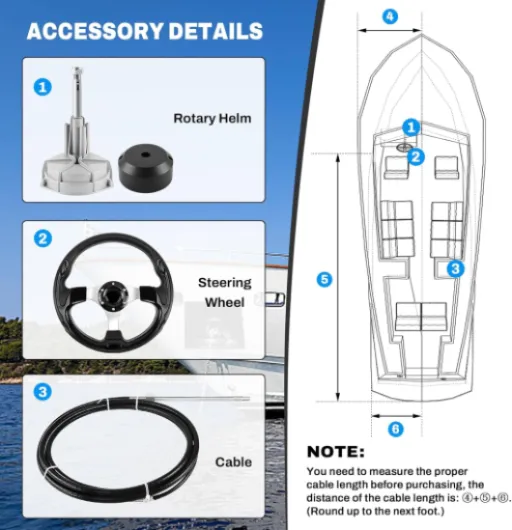
Installation and setup: doable DIY, but measure carefully
Installation was fairly straightforward, but only because I’ve messed with boat steering before. The kit uses snap-in cable connections and standard mounting hardware, so if your boat already had a mechanical rotary system, it’s mostly a swap. Removing the old cable was actually the most annoying part, especially snaking it out of cramped spaces. Running the new 10 ft cable was easier because the sheath is stiffer and doesn’t kink as easily.
The most important part is getting the cable length right before you buy. They warn you about this in the description, and they’re not wrong. A cable that’s too short simply won’t reach, and one that’s too long will force you into silly loops that can cause binding or premature wear. My 10 ft run was just enough for a small center console with a simple route. If you’re unsure, take the time to measure properly following a standard steering cable measuring guide.
Mounting the helm to the console using the 90-degree bezel was simple: four bolts through the dash, tighten them, slide on the bezel, and then the wheel. The only slightly tricky part is aligning everything so the wheel sits straight when the engine is centered. I loosely mounted everything, centered the outboard, then adjusted the wheel position before final tightening. The cable connection at the engine side was also pretty standard: attach the swivel to the engine steering arm, adjust the nuts so there’s no side play, and lock everything down.
The instructions are serviceable but not detailed. I ended up cross-checking with a couple of generic rotary steering install videos on YouTube just to confirm I wasn’t missing anything. For someone comfortable with basic tools (drill, wrenches, screwdriver), this is a 2–4 hour job depending on how tight your boat is. If you’ve never done anything like this, you might want a friend who’s a bit more experienced, or at least set aside a full afternoon and be patient.
What you actually get in the box
Out of the box, you get the rotary helm unit, the 10 ft steering cable already attached, a small hardware bag (bolts, nuts, washers), a 90-degree bezel / flapper kit for mounting the helm on the console, and a basic steering wheel. It’s basically a complete mechanical steering setup for a small boat, assuming you already have a console or dash where you can mount the wheel.
The steering wheel itself is pretty plain: black, plastic, three-spoke style. It’s not ugly, but it’s clearly built to keep costs down, not to impress anyone at the marina. The helm has the standard 3/4'' tapered shaft, so if you already own a nicer wheel, you can reuse it. I tested it both with the supplied wheel and my old one; both fit fine and tightened down securely.
The cable is pre-crimped and permanently attached to the helm, which simplifies installation but also means you can’t swap just the cable later without changing the helm. For a cheap system, that’s acceptable, but something to keep in mind. The kit also includes a swivel rudder connection and adjustable nuts to secure the cable to the engine bracket. Everything you need for a typical outboard up to 60 HP is there, you don’t have to hunt for extra brackets unless your engine setup is unusual.
The documentation is the weak point. You get a short generic manual with some diagrams, but it’s not tailored to every boat layout. If you’ve never touched a steering system before, you’ll probably need to watch a couple of YouTube videos to feel confident. For someone who’s reasonably handy and has seen a cable steering system before, the parts are pretty self-explanatory once you lay them out and dry-fit everything.
Pros
- Complete kit with helm, 10 ft cable, hardware, and wheel included
- Steering effort and play noticeably better than a worn-out cable system
- Materials seem decent where it counts, with stainless on exposed parts
Cons
- Instructions are basic; beginners may need extra guidance
- Finish and overall refinement are clearly budget-level compared to big brands
Conclusion
Editor's rating
If you’ve got a small fishing boat, dinghy, or runabout with tired, sloppy steering and you don’t want to throw a lot of money at it, this Acclcors mechanical rotary kit is a practical option. It’s not fancy, but it does the basics well: steering is consistent, effort is reasonable, and the parts that matter feel solid. The included wheel and hardware mean you don’t have to chase extra components, and if you’re handy enough, you can install it yourself in a weekend.
Where it falls short is mostly in the "polish" department: the manual is basic, the finish is clearly budget, and long-term durability is more of an educated guess than a sure thing, simply because the brand isn’t as well-known. I’d be comfortable using it on boats up to the stated 60 HP, especially for casual weekend use. For heavier, faster boats or anyone who wants premium feel and strong brand backing, I’d still look at hydraulic or higher-end mechanical systems.
So, who is this for? Owners of older or modest boats who want safer, smoother steering without overspending. Who should skip it? People running higher horsepower rigs, serious offshore users, or anyone who values top-tier finish and brand reputation above saving money. For my small 40 HP setup, it hits a good balance between cost and performance.